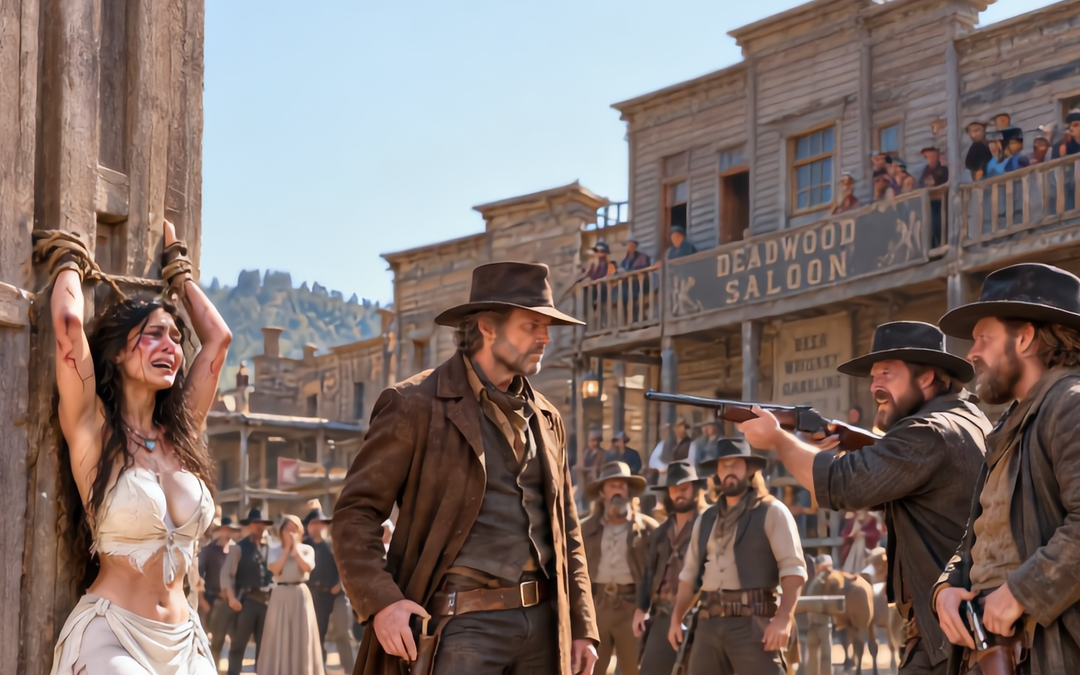
They Tied an Apache Woman to a Post and Dared Anyone to Help—Then a Cowboy Saw the Badge on Her Captor’s Coat
Part 2
That night, Odet brought Dalton an old letter written by a ranger who had witnessed Vain’s disappearance—and what Dalton read proved that everything he had blamed himself for during the last four years was a lie, but the truth also revealed why Silas Vain had become exactly the kind of man Dalton might have to kill.
The letter had been written by Ezra Coulter.
A ranger stationed forty yards from Vain during the disastrous scouting mission.
Dalton read it twice.
Then a third time.
Vain had not been cut off because Dalton abandoned him.
Vain had broken formation.
He had heard rumors of silver hidden in an abandoned mission and left the assigned route against orders.
Two men followed him.
Neither returned.
Vain was captured because of his own decision.
Dalton stared at the paper.
“Four years.”
Odet said nothing.
“I spent four years believing I left him behind.”
“He may believe it too,” she said. “People can repeat a lie until memory starts obeying it.”
The revelation freed something inside Dalton.
It also frightened him.
A man who had built his entire life around blaming someone else could become very dangerous when the truth threatened that foundation.
The following morning, Wallace—the mercantile owner—arrived carrying old transaction records.
“Every ranch Vain scares empty gets bought within months.”
“By whom?” Thorne asked.
Wallace pointed to the underlying bank drafts.
“Ashford Cattle Company.”
Cornelius Ashford.
One of the wealthiest men in the territory.
Church benefactor.
Road builder.
Respectable businessman.
Kaya went still.
“Three years ago, a man came to my grandfather offering to buy our valley.”
“Did you see him?” Dalton asked.
“No.”
She swallowed.
“But I remember his voice.”
They rode to Ashford’s ranch.
The moment Cornelius Ashford spoke, Kaya knew.
“That was him.”
Ashford did not confess.
Men like him rarely did.
He smiled.
Called forced land sales “opportunity.”
Called development “progress.”
Dalton called it murder with clean hands.
When they rode away, Ashford’s smile was gone.
Then everything worsened.
Thorne learned someone had warned Vain before their earlier attempt to raid Black Rock Canyon.
The traitor was Franklin Doyle, the telegraph operator.
But Doyle broke down immediately.
“They took my wife.”
Margaret had been held for three weeks.
Vain promised she would remain alive only if Doyle passed information.
Instead of arresting him immediately, Dalton asked one question.
“Where is she?”
“I don’t know.”
Then an old relay-station keeper remembered a guarded wagon carrying a woman toward an abandoned homestead near Miller’s Draw.
Dalton, Kaya and Thorne rode through the night.
They found Margaret alive in a root cellar.
When they brought her home, Doyle collapsed into her arms.
For one brief moment, Solace Creek felt victorious.
Then a rider came tearing into town.
“Ashford’s coming!”
Everyone turned.
“More than a dozen men.”
Another rider arrived moments later.
“And Vain’s gang is riding from Black Rock.”
Thorne went pale.
“Both?”
Dalton looked down opposite ends of the same street.
Then something clicked.
Ashford no longer trusted Vain.
Vain knew it.
Their partnership was collapsing.
“We don’t fight two armies,” Dalton said.
Kaya understood first.
“We let them meet.”
An hour later, riders appeared from both directions.
Ashford entered from the south.
Vain from the north.
They stopped when they saw each other.
Ashford’s voice carried through the darkness.
“Your usefulness ended the moment you became a liability.”
Vain’s face changed.
“You sent men to kill me?”
“I sent men to clean up what you failed to finish.”
Dalton stepped into the moonlit street between them.
“Looks like both of you finally found out what your loyalty was worth.”
Vain’s hand moved toward his gun.
Ashford’s men raised their rifles.
And the entire street erupted.
The first shot came from Ashford’s side.
Nobody ever agreed afterward who fired it.
That was how gunfights became legends.
People remembered the meaning and forgot the sequence.
Within seconds, Solace Creek disappeared beneath smoke.
Ashford’s hired riders had expected Vain’s men to be allies.
Vain’s gang had expected Ashford’s riders to reinforce them.
Instead, both sides suddenly realized the same thing.
Each had come to eliminate the other.
Dalton had counted on suspicion.
He had underestimated hatred.
Vain wheeled his horse and fired toward Ashford’s men.
“Traitor!”
Ashford shouted something Dalton never heard.
Sheriff Thorne opened fire from the saloon side.
Wallace fired from the mercantile roof.
Doyle, who had spent most of his life sending messages instead of bullets, crouched behind a water trough and fired with shaking hands.
Not far away, Margaret helped Odet drag an injured townsman behind cover.
Kaya moved differently from everyone else.
She did not waste motion.
She stayed low, watching angles rather than noise.
When an Ashford gunman attempted to circle behind Wallace’s position, Kaya spotted him first.
“Roof! Left alley!”
Wallace turned in time.
The gunman’s shot buried itself in wood instead of Wallace.
The shopkeeper fired back.
Then sat against the chimney afterward, breathing like he had run ten miles.
His hands were not shaking anymore.
Something had changed in Solace Creek.
A week earlier, everyone had watched Kaya tortured because terror had trained them to remain still.
Now the same people were defending one another.
Fear had not disappeared.
They had simply stopped obeying it.
Ashford discovered that difference too late.
One by one, his riders surrendered or fled.
Those who had worked for him because the money was good suddenly discovered the money was not good enough to die for.
Vain’s men lasted longer.
They had been trained by a crueler teacher.
But even they began to break once they realized their employer’s empire had become a trap.
Dalton saw Cornelius Ashford trying to reach an overturned wagon.
He followed.
Ashford spun with a pistol.
“Stop.”
Ashford froze.
His hand shook.
That surprised Dalton.
The man who had ordered villages burned and families driven from their homes had spent years making others face violence he personally avoided.
“You don’t understand what I built,” Ashford said.
“I understand perfectly.”
“Roads. Wells. Jobs. Trade.”
“And graves.”
Ashford’s face tightened.
“This territory needed development.”
“Kaya’s people needed their homes.”
“Progress always costs someone.”
Dalton stepped closer.
“That’s a convenient philosophy when you’re never the one paying.”
Ashford’s mask finally broke.
“It was land!”
Dalton stared at him.
“No.”
His voice turned cold.
“It was people standing on land you wanted.”
Ashford raised the gun.
Dalton did not flinch.
“You can face a judge,” Dalton said, “or you can make one more bad decision.”
For several seconds, Ashford appeared to consider it.
Then his shoulders collapsed.
His revolver fell into the dirt.
“Wise choice,” Dalton said.
Thorne took him into custody.
But Vain remained.
Dalton found him at the far end of town.
Creed, his longest-serving gunman, lay dead nearby.
Vain stood over him, pistol still in hand.
“He turned on me,” Vain said.
Dalton approached slowly.
“Creed?”
“For Ashford.”
His laugh held no humor.
“Four years beside me. One offer from a richer man and suddenly loyalty had a price.”
“You built loyalty with money and fear.”
Vain looked up.
“You don’t get to lecture me about loyalty.”
There it was.
The ridge.
The wound underneath everything.
“You left me.”
“No.”
Vain’s pistol lifted slightly.
Dalton did not draw.
“You abandoned me.”
“You broke formation.”
Something changed in Vain’s eyes.
“Don’t.”
“You heard there was silver in an abandoned chapel.”
“Stop.”
“Ezra Coulter saw you leave the scouting line.”
Vain went pale.
Dalton continued.
“You took two men with you.”
“That’s a lie.”
“They died because they followed you.”
“Shut up!”
Vain’s pistol came level with Dalton’s chest.
Several people behind Dalton raised their weapons.
He lifted one hand.
Nobody fired.
Vain’s breathing grew ragged.
“Ezra wrote it down,” Dalton said. “He tried to report it.”
Silence.
“The company buried the truth because ‘presumed dead in action’ looked cleaner than ‘disobeyed orders chasing silver.’”
Vain stared at him.
The pistol began trembling.
Dalton reached inside his coat.
Slowly.
He removed the old letter.
Held it out.
Vain did not take it.
“Four years,” he whispered.
Dalton knew the feeling.
“I spent them blaming myself too.”
“You should have come for me.”
“I did.”
Vain’s eyes snapped up.
“We searched three days.”
“No.”
“Yes.”
“I waited.”
“We searched.”
Vain looked suddenly less like the notorious outlaw who had ruled Solace Creek through terror and more like the young ranger Dalton remembered.
Lost.
Furious.
Terrified.
“When they had me…”
His voice cracked.
“I needed somebody to blame.”
Dalton said nothing.
“The captivity…”
Vain looked away.
“I kept telling myself you chose to leave me. Every day. Every night.”
“Because blaming me was easier than admitting how you got there.”
Vain closed his eyes.
“Yes.”
The word barely existed.
Behind them, the street had gone strangely quiet.
No one wanted to interrupt.
Then Vain said:
“If that story was false… what was any of the rest for?”
Dalton’s answer hurt more than anger would have.
“Nothing.”
Vain looked at him.
“The people Kaya lost weren’t responsible for what happened to you.”
No answer.
“The families you drove from their land weren’t responsible.”
Silence.
“Slade wasn’t responsible.”
Vain looked toward where his former gunman had died days earlier.
“Neither was Ashford.”
A bitter laugh escaped him.
“He just discovered I was useful.”
“Yes.”
Vain’s face tightened.
“I thought if I kept moving forward, eventually what happened on that ridge would make sense.”
“It doesn’t.”
“No.”
“Pain doesn’t become meaningful because you give it to someone else.”
Vain’s shoulders dropped.
For a moment, Dalton thought he might fire anyway.
Not from rage.
From despair.
Instead, the gun slipped from his fingers.
It landed in the dirt.
Vain looked toward Kaya.
She stood several yards away.
His eyes lowered.
“Tell her…”
“No.”
Vain looked back at Dalton.
“You tell her yourself.”
Kaya approached.
Vain could barely meet her eyes.
“I’m sorry.”
She gave him no comfort.
Good.
He did not deserve comfort yet.
“You killed my grandfather,” she said.
Vain’s face tightened.
“Yes.”
“You ordered our homes burned.”
“Yes.”
“My family?”
A long silence.
“Yes.”
Kaya swallowed.
“You hunted me for three years.”
“Yes.”
“Because Ashford wanted water.”
“And because I wanted him to keep paying me.”
No excuse.
That mattered.
Not enough.
But it mattered.
Vain continued.
“I believed I had been betrayed once.”
His voice roughened.
“So I spent years betraying people who had never done anything to me.”
Kaya’s eyes shone, but she did not cry.
“I believe you regret it.”
Vain looked surprised.
“That does not mean I forgive you.”
“I know.”
“Your regret belongs to you.”
She stepped closer.
“My forgiveness belongs to me.”
Vain nodded.
“That’s fair.”
“It’s more fairness than you gave my people.”
He closed his eyes.
“Yes.”
Sheriff Thorne placed irons around his wrists.
Vain did not resist.
Two days later, federal marshals arrived.
They came because the violence around Solace Creek had finally become impossible for territorial officials to ignore.
Thorne gave them everything.
His two-year notebook.
Wallace’s transaction ledgers.
Ashford’s shell-company records.
Doyle’s testimony.
Margaret’s captivity.
Kaya’s account of her people’s land.
And Vain himself.
Once Vain began talking, Ashford’s empire unraveled frighteningly fast.
Years of hidden transactions became visible.
Families had been terrorized.
Ranches burned.
Owners frightened into selling for fractions of their value.
Then Ashford’s companies bought the property.
Vain provided violence.
Ashford provided money.
One looked like a criminal.
The other looked respectable.
That had been the entire design.
When Ashford was taken away, Solace Creek did not cheer.
People simply watched.
Wallace stood in front of his mercantile.
Odet leaned against her saloon door.
Doyle held Margaret’s hand.
Sometimes justice did not feel like triumph.
Sometimes it simply felt like finally being able to breathe.
Vain asked for five minutes with Dalton before the marshals left.
They stood near the jail wagon.
For a moment, neither spoke.
Then Vain smiled weakly.
“Remember that camp south of the river?”
Dalton nodded.
“Coffee tasted like horse piss.”
“It was worse.”
“You drank two cups.”
“I was young.”
Vain almost laughed.
Then the smile vanished.
“I was happy then.”
“So was I.”
“I keep trying to understand where that man went.”
Dalton looked at him.
“You buried him under excuses.”
Vain accepted that.
“What happens now?”
“You answer for what you did.”
“And after?”
“That depends on whether there’s an after.”
Vain glanced toward Kaya.
“I don’t expect forgiveness.”
“Good.”
“Still…”
He looked back at Dalton.
“I’m glad you weren’t the one who left me.”
Dalton felt four years loosen in his chest.
Not disappear.
Some things did not disappear.
But loosen.
“I’m sorry you believed I did.”
Vain nodded.
Then the marshal closed the wagon door.
Dalton watched it roll away.
He had imagined that moment many ways during the previous week.
Victory.
Relief.
Hatred.
Instead, he felt grief.
Not for the man Vain had become.
For the man he had once been.
Some endings deserved grief even when they were necessary.
Solace Creek began rebuilding almost immediately.
The mercantile removed its boarded windows.
Children returned to the street.
People began leaving doors open during daylight.
Someone hung a length of iron pipe in the church tower to replace the bell sold years earlier.
It sounded terrible.
Everyone loved it.
Whitfield recovered from the canyon ambush with a scar and an increasingly ridiculous version of the story.
By his fifth telling, he had apparently fought twelve gunmen by himself.
“You were unconscious for half of it,” Odet reminded him.
“Minor detail.”
Doyle closed the telegraph office early most evenings.
He and Margaret sat together outside their house.
Sometimes neither spoke.
After three weeks of being separated, silence felt different when chosen.
Kaya stayed.
Ashford’s paperwork had tangled the rights to her people’s valley through several false companies.
She intended to undo every page.
“There are other survivors,” she told Dalton one evening.
“People scattered after what happened.”
“You’ll find them?”
“I’ll try.”
“And then?”
“Bring them home if they want to return.”
Dalton looked toward the horizon.
“You always know what comes next?”
“No.”
Kaya smiled.
“I just know the next right thing.”
They sat on the saloon porch beneath a sky crowded with stars.
A week earlier she had sat there with bloody wrists, unsure whether she would survive until morning.
Now she was planning years.
That was what freedom looked like sometimes.
Not a celebration.
A future tense.
Sheriff Thorne found Dalton the following night.
He placed a small tin star on the desk.
Dalton stared at it.
“No.”
Thorne raised an eyebrow.
“You haven’t heard the offer.”
“I know the shape of it.”
“Deputy.”
Dalton looked away.
“I already buried one badge.”
“I know.”
“Badges have never been particularly good to me.”
“Maybe because you kept wearing them for other people.”
Thorne pushed the star closer.
“Try wearing this one for the people standing outside.”
Dalton said nothing.
“It belonged to Caleb.”
Thorne’s younger brother.
The man Vain had killed three years earlier.
Dalton looked sharply at him.
“I can’t take that.”
“Yes, you can.”
“Why me?”
“Because you stopped.”
Dalton frowned.
Thorne continued.
“Every other stranger who saw what this town had become kept riding.”
He nodded toward the street.
“You stopped.”
Dalton touched the badge.
“Could still bring trouble.”
“Trouble already knows the address.”
Despite himself, Dalton smiled.
Thorne sat back.
“Stay a month.”
“That how you recruit everyone?”
“No. Usually I threaten them with paperwork.”
Dalton looked out the window.
Wallace was closing the mercantile.
Whitfield was arguing with somebody outside the saloon.
Doyle was walking home.
Kaya stood across the street speaking with Odet.
Ordinary life.
Dalton had spent years avoiding anything ordinary because ordinary things could be lost.
He understood now that avoiding them had never protected him.
It had simply guaranteed he never had them.
“I’ll stay.”
Thorne nodded.
“For a month.”
“Of course.”
“Maybe two.”
“Dangerous.”
Dalton picked up the star.
Later, Kaya noticed it pinned inside his coat rather than outside.
“You hiding it?”
“Getting accustomed.”
“You’re staying.”
“That seems to be the rumor.”
“Good.”
One word.
But it meant more than Dalton expected.
He looked at her.
“You?”
“I told you.”
“I know.”
She smiled.
“You were hoping I’d say it again.”
“Maybe.”
“I’m staying.”
This time Dalton smiled too.
A month later, families began returning to the valley.
Not everyone.
Too much had happened.
Some survivors had built lives elsewhere.
Others could not bear to return to land containing so many ghosts.
Kaya never judged them.
She simply made sure they had the choice.
Water rights were restored.
Fraudulent transfers overturned.
Ashford’s property was seized pending trial.
Vain eventually testified to the full arrangement.
His cooperation reduced nothing of what had happened, but it ensured the structure behind those crimes could not survive him.
One evening, Kaya took Dalton to the valley.
She showed him the spring her grandfather had protected.
Clear water emerged between stones, disappearing underground before resurfacing farther south.
“He told me this would still be running after all of us were gone.”
Dalton crouched and touched the water.
“Was he right often?”
“Annoyingly.”
Dalton laughed.
Kaya sat beside him.
“You know what I thought when you rode into town?”
“What?”
“That you were another fool who would get himself killed trying to look brave.”
“Reasonable.”
“And then you cut the ropes.”
Dalton looked toward her wrists.
The wounds had closed.
Scars remained.
“I thought you were afraid of the knife.”
“I was.”
“Didn’t look like it.”
“I was terrified.”
Kaya smiled faintly.
“Courage and fear aren’t opposites, Dalton.”
He thought about Wallace crossing a street with one cup of water.
Doyle confessing.
Thorne opening his notebook.
Margaret refusing to hide.
Odet preserving a letter for years.
Kaya standing in front of the man who destroyed her family and refusing to give him either easy hatred or easy forgiveness.
“No,” Dalton said.
“I suppose they aren’t.”
The sun lowered behind the ridge.
Water continued moving beneath them.
Quiet.
Patient.
Unconcerned with who claimed to own it.
Dalton had entered Solace Creek believing he was only passing through.
He had stopped because a woman was tied to a post and everyone else had been too frightened to move.
But stopping had forced an entire town to remember something fear had almost erased.
One person could move.
Then another.
Then another.
Until courage became as contagious as fear had once been.
Dalton did not save Solace Creek alone.
Kaya survived when Vain expected her to break.
Thorne kept records when silence would have been safer.
Wallace followed money nobody else noticed.
Odet preserved a truth everyone had buried.
Doyle found courage after fear had already made him fail.
Margaret survived long enough to come home.
Even Vain, at the final possible moment, chose surrender over one more lie.
That did not erase the dead.
It did not return three stolen years to Kaya.
It did not rebuild every burned house.
Justice rarely restores everything.
Sometimes its first job is simply to stop the taking.
Months later, someone asked Dalton why he had drawn his gun that first afternoon.
Two men against one stranger.
An entire town too frightened to help.
No reason to believe he would survive what followed.
Dalton thought about it.
Then shrugged.
“Because she was tied to a post.”
The man waited.
“That’s all?”
Dalton looked across the street.
Kaya was speaking with three families who had come to discuss returning to the valley.
Her scars were visible.
So was her smile.
“That should’ve been enough.”
And in Solace Creek, after everything that happened, people finally understood exactly what he meant. ❤️
Disclaimer: This story is entirely fictional and created for entertainment purposes only. It does not represent any organization or individual, nor does it encourage inappropriate behavior. The content was generated with AI assistance.








