He Spent His Last Coins Saving a Dying Stranger — Then an Apache Woman Appeared With His Pendant
—
## **Part 2**
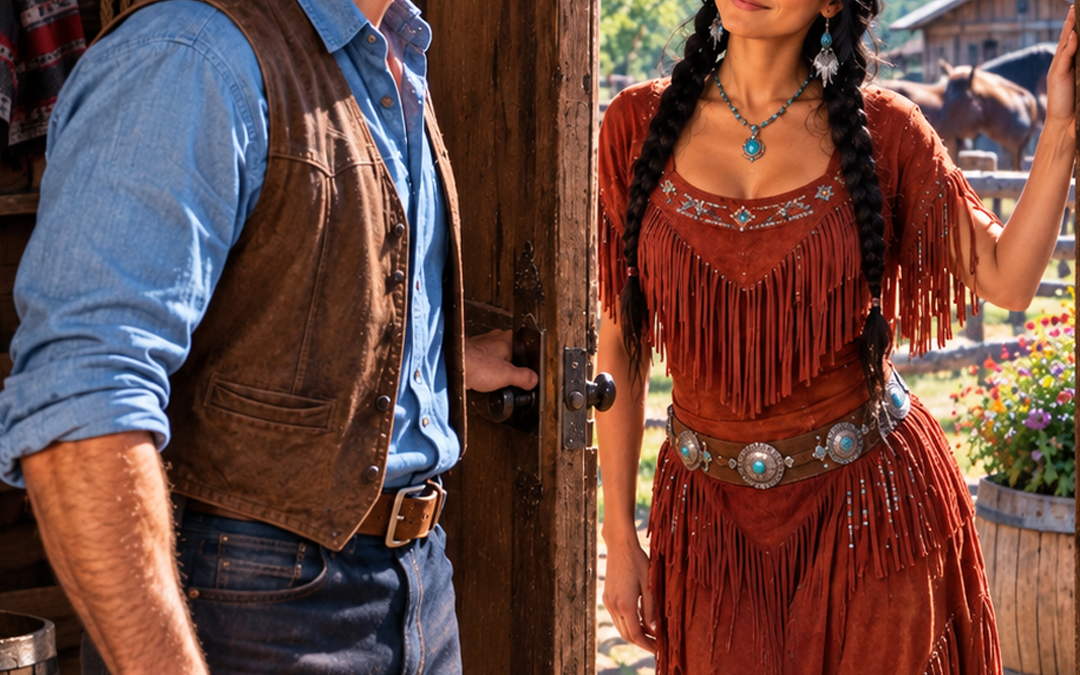
**“Because Mateo told me what you gave to save him…and now my family intends to repay that debt.”**
Elias stared at Naali.
“I don’t want repayment.”
“I expected you to say that.”
“Then you rode all this way for nothing.”
“No.”
Naali wrapped the coins again.
“You spent your savings on his medicine.”
“How did you know?”
“Mateo told us.”
Elias froze.
“You’ve seen him?”
Naali nodded.
“He reached people he trusted. He’s alive.”
The tension left Elias’s shoulders.
For three days he’d wondered whether the stranger had collapsed somewhere after disappearing.
“Why did he leave?”
“He believed staying here would put you in danger.”
Elias remembered Mateo’s warning.
*They’re looking for me.*
Naali explained that thieves had attacked Mateo while he traveled between settlements. They stole his horse, supplies, and belongings before abandoning him beneath the cottonwoods.
“He thought they might follow him,” Naali said.
Elias looked toward the empty trail.
“So he left to protect me.”
“Yes.”
Naali offered him the coins.
Again Elias refused.
“I won’t take payment for keeping somebody alive.”
Naali studied him for several seconds.
Then smiled faintly.
“My uncle said you’d say that too.”
Elias almost laughed.
“He seems to know me pretty well for a man who barely spoke.”
“Then we’ll repay you differently.”
“I don’t need—”
Naali walked past him.
Straight toward his fields.
Elias followed.
“You have no water,” she said.
“Not enough.”
Naali pointed toward the broken irrigation channel.
“When did that fail?”
“Months ago.”
“Why haven’t you repaired it?”
Elias laughed bitterly.
“With what money?”
Naali crouched beside the dry channel.
She studied the stones, soil, and remnants of the damaged wooden structure.
Then stood.
“This can be repaired.”
“Not by me.”
“I didn’t say by you.”
Elias stared at her.
—
The next morning, he awoke to hoofbeats.
Many of them.
Elias rushed outside.
Naali had returned.
But she wasn’t alone.
Several members of her community had come carrying tools, timber, rope, and supplies.
Elias walked toward her.
“No.”
Naali raised an eyebrow.
“No?”
“I can’t accept all this.”
“You accepted nothing.”
“Look around!”
“You saved Mateo.”
“That’s different.”
“Why?”
Elias couldn’t answer.
Naali stepped closer.
“You believed he deserved help when he had nothing to give you. Why do you believe you deserve less?”
The words struck harder than Elias expected.
For two years, pride had been the only thing he’d had left.
Now accepting help somehow felt like surrendering it.
Then Naali said:
“Accepting kindness doesn’t make you weak, Elias.”
She looked toward his dead fields.
“Sometimes it gives you enough strength to stand again.”
Work began.

Stones were cleared.
Wooden sections were rebuilt.
The channel was reshaped.
Hour after hour, Elias watched something he thought was beyond saving slowly return to life.
Then someone shouted.
Water appeared at the far end of the channel.
A thin stream at first.
Then stronger.
It moved toward Elias’s fields.
Elias stared.
Naali stood beside him.
“You helped one dying man,” she whispered. “Perhaps it’s time someone helped something of yours live.”
Elias looked at the water reaching his soil.
But before he could answer—
A rider appeared on the distant trail.
Naali suddenly went still.
Elias shaded his eyes.
The rider moved slowly.
Painfully.
Supported by a wooden cane strapped along the saddle.
Naali whispered one word.
“Mateo.”
Elias’s heart jumped.
But as Mateo approached, Elias saw his face.
There was no relief in it.
Only urgency.
Mateo stopped his horse and looked directly at Elias.
“They found the trail.”
Elias frowned.
“Who?”
Mateo turned toward the ridge behind him.
Then came the distant sound of more horses.
**And this time, Mateo wasn’t smiling.**
Elias immediately reached for his rifle.
Naali moved toward her uncle.
“How many?”
Mateo dismounted slowly.
“Not close.”
Elias looked toward the ridge.
“Are these the men who attacked you?”
Mateo nodded.
Naali’s expression hardened.
“Then we should leave.”
“No,” Elias said.
Everyone turned toward him.
“If they’re following Mateo’s trail, running only gives them another trail.”
Naali looked around at the workers, the open ground, and the half-repaired irrigation channel.
“Elias, this isn’t your fight.”
He almost laughed.
“That’s what I thought when I found him.”
Mateo looked at Elias.
Something passed silently between them.
Recognition.
Two men who had met when one of them was dying now stood on the same ground because neither had chosen the easiest path.
Mateo walked closer.
“I left your cabin because I feared this.”
“You could’ve told me.”
“You had already given too much.”
“That wasn’t your decision.”
Mateo lowered his eyes.
“No.”
Then he smiled faintly.
“Perhaps we are both stubborn.”
Elias smiled despite himself.
“So I’ve been told.”
—
They waited.
But no riders appeared.
Minutes became an hour.
Finally Mateo explained that he’d spotted men examining tracks near the trail. He couldn’t be certain they had followed him all the way to Elias’s property.
The danger was real.
But immediate violence never came.
By sunset, the workers had finished enough of the channel to send water farther into Elias’s fields.
Elias stood watching the earth darken as it absorbed moisture.
For years, he’d believed salvation would arrive as money.
A good harvest.
More customers.
Enough cattle.
Instead, it had arrived carrying tools.
And asking for nothing.
—
That evening Mateo sat beside Elias’s cabin.
His wound still troubled him, and he leaned heavily on the cane.
Elias handed him coffee.
“You disappeared without saying goodbye.”
Mateo looked guilty.
“I did.”
“You left the pendant.”
Mateo smiled.
“That wasn’t an accident.”
Elias glanced toward Naali.
“She found me because of it.”
“That was the hope.”
“You planned this?”
“Part of it.”
Mateo reached into his coat.
He produced a folded letter.
“I was carrying money when I was attacked.”
“For what?”
“A debt.”
Mateo explained that the silver had been intended for a struggling family elsewhere in the territory.
He had carried obligations of his own.
But after Elias used nearly everything he had to save a complete stranger, Mateo made another decision.
“You gave when giving hurt you,” he said.
Elias looked uncomfortable.
“I did what anybody should’ve done.”
Mateo shook his head.
“No.”
His voice was gentle.
“You did what everybody *should* do. That is different from what everybody *does*.”
Elias fell silent.
Mateo placed the folded letter beside him.
“I wanted to repay what you spent.”
“I told Naali I don’t want it.”
“I know.”
“Then stop trying.”
Mateo chuckled.
“I also told her you’d say that.”
Elias groaned.
“Does anybody in your family listen?”
Naali called from nearby.
“Not when you’re wrong.”
For the first time in what felt like years, Elias laughed loudly.
It surprised him.
The sound seemed unfamiliar coming from his own chest.
Naali heard it too.
And smiled.
—
The following weeks changed the ranch.
Water continued flowing through the repaired channel.
At first, nothing happened.
Elias walked the fields every morning searching for some sign that all the work had mattered.
Then one morning he stopped.
Green.
Barely visible.
A tiny shoot pushing through soil that had seemed dead.
Elias crouched.
He touched it carefully.
Another appeared several feet away.
Then another.
“Naali!”
She came running.
“What happened?”
He pointed.
Naali stared at the tiny green shoots.
Then looked at Elias.
“You shouted like the cabin was burning.”
“Look!”
“I see them.”
Elias laughed.
For anyone else, they were just plants.
For Elias, they were proof.
Proof that land could recover.
Perhaps people could too.
—
More repair work began coming his way.
A farmer needed a wagon wheel rebuilt.
Another rancher needed fencing repaired.
Someone else had heard that Elias could restore damaged equipment instead of forcing families to purchase replacements they couldn’t afford.
His small income grew.
He bought food without counting every coin first.
His horse gained weight.
He repaired the cabin roof.
He replaced part of the fence.
But the greatest change couldn’t be measured in dollars.
The cabin stopped being silent.
Naali visited frequently.
At first, Elias told himself it was because of Mateo.
Then Mateo recovered.
Naali kept coming.
Sometimes she brought supplies.
Sometimes she helped with the irrigation channel.
Sometimes she brought nothing.
One evening Elias finally asked:
“Why are you here?”
Naali looked confused.
“I’m sitting.”
“I can see that.”
“Then why ask?”
“You don’t need to check on Mateo anymore.”
“I know.”
“And the channel works.”
“Yes.”
“So…”
Naali looked at him.
Then smiled.
“Perhaps I like being here.”
Elias suddenly found the horizon fascinating.
Naali laughed.
“You’re uncomfortable.”
“No.”
“You are.”
“I’ve negotiated prices with men twice your size.”
“Were they women?”
“No.”
“Then perhaps you’ve discovered your weakness.”
Elias shook his head.
“Apparently.”
Their friendship didn’t erase his grief.
Naali never asked it to.
That mattered more than Elias could explain.
His wife had been part of his life.
Losing her had broken something inside him.
Naali didn’t behave as though healing required pretending that loss had never happened.
She simply helped him understand that grief and hope could occupy the same heart.
—
Months passed.
Mateo regained his strength.
One afternoon he returned to Elias’s ranch on foot, carrying his cane more than leaning on it.
Elias saw him approaching.
“You look less dead than the last time I found you.”
Mateo grinned.
“You look less miserable.”
“That was unnecessary.”
“But accurate.”
The men embraced.
No grand speech.
No dramatic declaration.
Just two people who understood what the other had changed.
Mateo looked toward the flourishing land.
“You saved me beneath those trees.”
Elias shook his head.
“You survived.”
“You gave me the opportunity.”
Then Mateo gestured toward the fields.
“And perhaps I returned part of it.”
Elias looked across the green shoots.
“More than part.”
—
Eventually Elias began changing the purpose of the ranch itself.
Travelers passing through could stop for water.
Nobody was charged.
If someone arrived injured, Elias helped.
If a wagon broke, he repaired what he could.
People from different communities sometimes found themselves resting beneath the same shade.
Not everyone was comfortable with that.
Prejudice hadn’t vanished.
Fear hadn’t vanished.
Hardship hadn’t vanished.
But Elias refused to build his life around those things anymore.
One afternoon a traveler questioned him.
“You just let anybody stop here?”
Elias looked at him.
“Anybody thirsty.”
“You don’t know who they are.”
“No.”
“That doesn’t bother you?”
Elias thought about the dying man beneath the cottonwoods.
“It used to.”
“And now?”
Elias looked toward the irrigation channel.
“Now I know sometimes you find out who someone is only after deciding they’re worth helping.”
—
Years later, the pendant still hung inside Elias’s cabin.
Not because it was valuable.
It wasn’t.
Its value came from everything attached to it.
One wounded stranger.
One nearly empty pantry.
One decision beneath the cottonwoods.
One woman arriving unexpectedly at his door.
One irrigation channel.
One piece of land returning to life.
And one lonely man discovering that accepting kindness required its own kind of courage.
On a quiet evening, Elias and Naali sat outside watching the Arizona sunset.
The desert glowed gold.
“You know,” Elias said, “I nearly kept riding.”
Naali turned toward him.
“When you found Mateo?”
“Yes.”
“Why didn’t you?”
“My father.”
Naali waited.
“He used to say a person’s worth wasn’t measured by what they could give you.”
Elias looked toward the horizon.
“But by what you were willing to give when they had nothing.”
Naali smiled.
“He sounds wise.”
“He was irritating.”
Naali laughed.
“That too.”
Elias became quiet.
“If I’d kept riding…”
“Don’t.”
He looked at her.
“You didn’t.”
“But everything that happened afterward—”
“Wasn’t why you stopped.”
Elias frowned slightly.
Naali continued.
“You didn’t help Mateo because you knew I would come.”
“No.”
“You didn’t know about the silver.”
“No.”
“You didn’t know anyone would repair your water.”
“No.”
“You believed you’d never see him again.”
Elias nodded.
Naali’s voice softened.
“That’s why it mattered.”
The words settled between them.
That was the truth Elias had needed years to understand.
Kindness wasn’t an investment.
It wasn’t valuable because it might return with interest.
It was valuable precisely because, in the moment it was given, there was no promise of return.
Elias had fed Mateo believing that food was gone forever.
He had spent his coins believing the money was gone forever.
He had given time, medicine, shelter, and safety to someone who might never even remember his name.
And somehow that act had traveled beyond him.
Mateo carried it to Naali.
Naali carried it back to Elias.
Others carried it farther.
The ranch became a place of water.
Shelter.
Conversation.
Help.
One action had become many.
—
Near sunset, Mateo arrived for supper.
He was older now, but strong.
He noticed Elias looking at the pendant.
“You still have that?”
“Of course.”
“I could give you something prettier.”
Elias shook his head.
“Wouldn’t mean as much.”
Mateo sat beside him.
For a while, all three watched the sun sink.
Elias thought again of the cottonwoods.
A dying stranger.
An empty canteen.
A wounded side.
A frightened man with barely enough food for himself.
At the time, Elias believed he had almost nothing.
Now he understood that wasn’t true.
He still possessed the ability to choose what kind of man hardship would make him.
Loss had taken his wife.
Drought had taken his crops.
Winter had taken his cattle.
Poverty had taken his security.
But none of those things had taken his compassion.
Only Elias could surrender that.
And he hadn’t.
That choice changed everything that followed.
Naali eventually broke the silence.
“What are you thinking about?”
Elias smiled.
“How expensive that bowl of beans became.”
Mateo laughed.
Naali shook her head.
“After everything, that’s your lesson?”
“No.”
Elias looked toward the fields.
Water reflected the final orange light of the sunset.
“My lesson is that I thought I was saving a stranger.”
He looked at Mateo.
“Maybe I was.”
Then at Naali.
“But I didn’t know that stopping beneath those trees would eventually save something in me too.”
Nobody answered.
They didn’t need to.
Wind moved gently through the grass that once hadn’t existed.
Elias leaned back.
For the first time in years, the future didn’t feel like something he merely had to survive.
It felt like something he was allowed to live.
And whenever a traveler later asked why Elias Mercer offered water to strangers without first asking who they were or what they could pay, Elias never told the entire story.
He simply smiled and said:
**“Because sometimes the person who has nothing to give you today may leave you with something money could never buy.”**
And somewhere beyond the ranch, cottonwood leaves moved softly in the desert wind.
The same kind of trees beneath which Elias had once found a dying stranger and made a choice nobody was watching.
A choice made without reward.
Without certainty.
Without knowing what would happen next.
And that was precisely why it mattered.
Because sometimes kindness doesn’t return as money.
Sometimes it returns as water to dying land.
As friendship to a lonely home.
As hope to someone who thought his best years were behind him.
And sometimes the hand you extend to a stranger becomes the hand that reaches back for you when you finally need help yourself.
**One small act did not erase Elias’s losses.**
**It gave him a reason to believe loss did not have to write the rest of his life.**
—
*Important Note: This story is completely fictional and created for entertainment purposes only. It does not represent any real organization or individual and does not encourage inappropriate behavior. The content was created with the assistance of artificial intelligence.*








