He Was Hired to Keep the Apaches Away—Then the Chief’s Daughter Stepped in Front of His Rifle
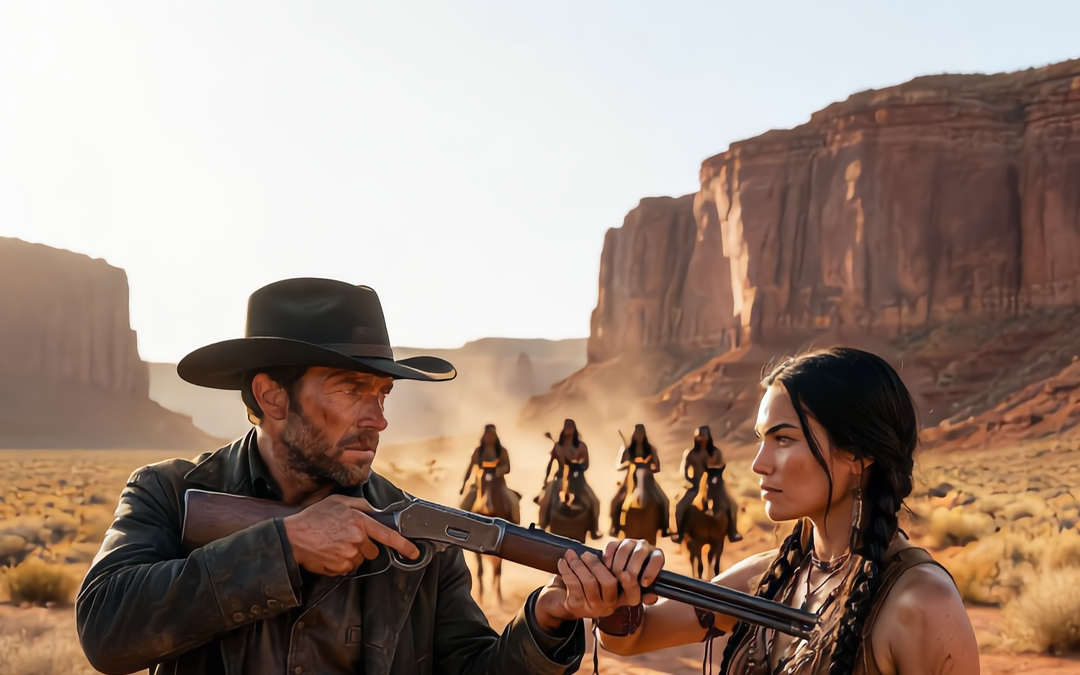
## **Part 2**
**“The attack you were hired to stop was never coming from us—it was coming from someone standing beside you every day.”**
Ethan stared at White Hawk.
“Who?”
The chief shook his head.
“We do not know his name.”
Ayanna stepped closer.
“Our scouts followed the thieves three nights ago. One man met them beyond the southern ridge.”
“A ranch hand?”
“He wore Briggs’s coat.”
Ethan immediately thought of every man in the bunkhouse.
Lucas Trent.
Cal Morrison.
Henry Pike.
A dozen others.
Any one of them could be feeding information to the outlaws.
“What happens tonight?”
White Hawk answered.
“The thieves enter from the western arroyo after moonrise. Someone inside opens the lower cattle gate.”
Ethan mounted immediately.
Ayanna moved toward her own horse.
“You’re coming?”
“My people will warn the others.”
White Hawk rose.
“So will I.”
Ethan looked surprised.
The chief’s expression remained calm.
“You asked for trust. Trust must travel in both directions.”
By sunset, Ethan was back at Briggs’s ranch.
He told Samuel everything.
Briggs laughed.
“You expect me to believe White Hawk?”
“I expect you to believe cattle thieves prefer open gates.”
That stopped him.
Ethan ordered every ranch hand to remain in the main yard.
No one was told why.
Then he secretly placed several men near the western arroyo.
White Hawk’s warriors waited farther into the hills.
The arrangement was fragile enough to collapse with one nervous gunshot.
Ayanna remained beside Ethan near the cattle pens.
“You are worried,” she said.
“I’ve been in battles with simpler plans.”
“You still believe this can work?”
“I believe it has to.”
Hours passed.
Nothing happened.
Then, near midnight, the lower cattle gate creaked open.
Ethan’s hand moved toward his revolver.
A shadow slipped from the bunkhouse.
Someone crossed the yard.
Lucas Trent.
Ethan’s stomach sank.
Lucas reached the gate and raised a lantern three times.
A signal.
Then horses thundered from the darkness.
At least twenty riders.
Outlaws.
They rushed toward the herd.
“Now!” Ethan shouted.
Apache scouts appeared along the ridge.
Briggs’s ranch hands emerged from the corrals.
The outlaws suddenly found themselves trapped between both groups.
Gunfire erupted.
Cattle scattered.
Horses screamed.
Ethan tackled Lucas before he could escape.
“You sold us out!”
Lucas struck him across the face.
“You fool! Briggs pays pennies while those men pay gold!”
Another gunshot cracked.
Ayanna suddenly shouted.
“Ethan!”
He turned.
One outlaw had broken through the line.
The man was galloping directly toward Samuel Briggs with his rifle raised.
White Hawk stood farther away.
Too far to reach him.
Ethan reached for his revolver.
But Ayanna was already moving.
She ran straight into the open.
The outlaw swung his rifle toward her.
Ethan’s face drained of color.
“Ayanna, DOWN!”
The outlaw pulled the trigger—
The rifle exploded.
Ayanna dropped.
For one unbearable second, Ethan heard nothing.
Not the cattle.
Not the gunfire.
Not the shouting.
Nothing.
Then Ayanna rolled behind a water trough.
The bullet had missed her by inches.
Ethan raised his revolver.
Before he could fire, another shot cracked from the ridge.
The outlaw’s rifle flew from his hand.
White Hawk had fired—not at the man, but at his weapon.
The outlaw stared in shock.
Samuel Briggs tackled him from the side.
Both men disappeared into the dust.
“Hold your fire!” Ethan shouted.
Nobody listened at first.
Fear had already taken command.
Apache warriors were shooting over the heads of frightened cattle.
Ranch hands fired from behind fences.
Outlaws raced between them, deliberately trying to turn the battle into chaos.
Ethan understood their strategy immediately.
If a ranch hand accidentally killed an Apache warrior—or an Apache shot a settler—the alliance could collapse before sunrise.
The thieves would escape while both sides blamed each other.
Ethan climbed onto a fence rail.
“STOP SHOOTING!”
A bullet struck the post beside him.
He did not move.
“THE OUTLAWS WANT YOU FIRING AT EACH OTHER!”
Ayanna rose behind the trough.
She shouted something in Apache.
White Hawk repeated the command.
Slowly, his warriors redirected their fire.
Only horses carrying known outlaws were targeted.
Briggs understood next.
“Ranch men! Hold the ridge! Don’t fire on White Hawk’s people!”
The battle changed.
For the first time, the thieves were no longer fighting two suspicious groups.
They were fighting one coordinated defense.
Apache scouts drove several outlaws away from the cattle.
Ranch hands closed the western gate.
Three thieves surrendered.
Others fled toward the mountains.
Lucas Trent tried to crawl beneath the fence.
Ethan caught his coat.
Lucas turned with a knife.
“Get away from me!”
He swung.
Ethan trapped his wrist.
Lucas struck him in the ribs.
They fell into the dirt.
“You ruined everything!” Lucas snarled.
“You were making money starting a war.”
“War was coming anyway!”
“No.”
Ethan forced the knife away.
“Men like you just needed everyone to believe that.”
Lucas spat blood.
“You think they’ll ever trust you?”
Ethan looked toward Ayanna.
She was helping one of Briggs’s wounded ranch hands tie a bandage around his arm.
“Maybe not today.”
He twisted the knife from Lucas’s grip.
“But today’s a start.”
By sunrise, seven outlaws were prisoners.
The remaining thieves had fled deep into the territory.
Not one Apache warrior had been killed.
Not one ranch hand had died.
Most importantly, the cattle remained on Briggs’s land.
Samuel Briggs stood beside the corral watching White Hawk’s people gather their horses.
He seemed unsure what to say.
White Hawk approached him.
For several seconds, the two men simply looked at one another.
Briggs finally spoke.
“You saved my cattle.”
White Hawk nodded.
“You allowed my people water.”
“Ethan allowed it.”
The chief looked toward Ethan.
“No. Ethan opened the conversation. You allowed the gate to remain open.”
Briggs glanced at the spring.
The words seemed difficult for him.
“My men spent years believing your people were responsible for every stolen steer.”
White Hawk’s expression remained calm.
“And my people spent years expecting every settler to reach for a rifle before speaking.”
Neither man apologized.
Perhaps neither knew how.
But Briggs extended his hand.
White Hawk looked at it.
Then took it.
Ethan watched from several yards away.
Ayanna stood beside him.
“You seem disappointed,” she said.
“I was hoping there would be a speech.”
Ayanna almost laughed.
“My father does not enjoy speeches.”
“Neither does Briggs.”
“Then perhaps peace has a chance.”
Ethan turned toward her.
“You ran in front of a rifle last night.”
“You did the same for me.”
“That doesn’t make it a good idea.”
Ayanna’s expression softened.
“I saw the outlaw aiming at Briggs.”
“You could have been killed.”
“Yes.”
“That doesn’t bother you?”
“It bothers me greatly.”
Ethan stared at her.
“Then why do it?”
Ayanna looked toward the ranch.
“Because if Briggs died while my people were present, every frightened settler for fifty miles would say Apache warriors killed him.”
Ethan understood.
“You weren’t only protecting Briggs.”
“I was protecting what we had started.”
He had no answer to that.
In the weeks that followed, the change came slowly.
No miracle erased years of anger.
No handshake instantly removed suspicion.
But the hidden spring became a meeting place rather than a boundary.
White Hawk’s people came for water during the dry season.
At first, Briggs’s ranch hands watched them closely.
Apache warriors watched the ranch hands just as carefully.
Children were different.
They were always different.
They cared less about old grudges.
Apache children began appearing beside the creek.
Ranch children came too.
Within days, they were throwing sticks into the water and racing along the bank as if no one had ever taught them they were supposed to fear each other.
Women from White Hawk’s camp traded woven blankets, leatherwork, herbs, and dried meat.
The ranch exchanged flour, metal tools, coffee, salt, and medicine.
Ethan often stood at a distance and watched.
Something about it felt impossible.
Months earlier, Briggs had hired him because he expected war.
Now the ranch looked more peaceful when Apache families were present.
One afternoon, Samuel found Ethan repairing a fence.
“You knew?”
Ethan looked up.
“Knew what?”
“That they weren’t coming to attack us.”
“No.”
“But you suspected.”
“I suspected we didn’t know enough.”
Briggs leaned against the fence.
“I spent years hearing stories.”
“So did I.”
“My father told me Apache raiders killed one of his cousins.”
Ethan stopped working.
“Maybe they did.”
Briggs looked surprised.
Ethan continued.
“One terrible thing can be true without every other story becoming true with it.”
Briggs was silent.
“That’s difficult for people.”
“Yes.”
“Easier to have one enemy.”
“Much easier.”
Briggs looked toward several Apache families near the water.
“And usually more expensive.”
Ethan smiled faintly.
“That too.”
The outlaw problem did not disappear.
Several months later, scouts discovered the remaining gang operating farther south.
This time, nobody automatically blamed White Hawk’s people.
That mattered.
When cattle disappeared, ranchers asked questions before loading rifles.
When Apache hunters noticed unfamiliar riders, they warned nearby settlements.
Travel became safer.
Not perfectly safe.
But safer.
And every small success made the next act of trust slightly easier.
Ethan continued working at Briggs’s ranch through winter.
His original contract eventually ended.
Briggs offered him more money to stay.
“You’ve earned it.”
Ethan folded the paper containing the new wage offer.
“You still need someone protecting the ranch?”
Briggs smiled.
“Yes.”
“From Apaches?”
“No.”
That single word meant more than Ethan expected.
“From thieves, drunks, wandering cattle, and whatever else Arizona decides to throw at me.”
Ethan accepted.
But his reasons had changed.
So had his relationship with Ayanna.
They saw each other often.
Sometimes she came to trade medicine.
Sometimes Ethan rode toward White Hawk’s camp with supplies.
They spoke for hours.
Not only about conflict.
About ordinary things.
Ayanna loved sunrise but disliked cold mornings.
Ethan hated repairing saddles but somehow always volunteered.
She mocked the way he brewed coffee.
He insisted no one had ever complained.
“You drink it alone,” she reminded him.
“Exactly. No complaints.”
Ayanna laughed.
Ethan realized he had begun waiting for that sound.
One evening, they sat above the spring.
The desert sky turned orange, then purple.
Ayanna asked, “Why did you come west?”
“Work.”
“That is not what I asked.”
Ethan looked toward the horizon.
He understood.
“The war ended,” he said.
“And?”
“I didn’t know what to do afterward.”
Ayanna waited.
Ethan continued.
“During the war, everything seemed simple because someone told you where the enemy was.”
“That does not sound simple.”
“It was simpler than peace.”
She studied him.
“How?”
“In war, you are told who stands across from you.”
Ethan picked up a stone and tossed it into the creek.
“In peace, you have to decide for yourself what kind of man you are.”
Ayanna considered this.
“And have you decided?”
“I’m working on it.”
“I think you decided the night you stood between me and those rifles.”
Ethan looked at her.
“I was afraid.”
“That does not mean you lacked courage.”
“No?”
“No.”
She met his eyes.
“Courage is rarely needed when no one is afraid.”
He remembered those words for years.
Spring came.
Grass returned.
The drought eased.
But the agreement between the ranch and White Hawk’s people remained.
It no longer existed merely because water was scarce.
It existed because both communities had discovered something worth preserving.
At a gathering beside the creek, Briggs surprised everyone.
He stood with White Hawk before ranchers, Apache families, traders, and travelers.
Briggs cleared his throat.
“I am not good at speeches.”
Ethan whispered to Ayanna, “I knew it.”
She elbowed him.
Briggs continued.
“This land has seen enough graves.”
The crowd became quiet.
“I spent too much time believing every story that made fear convenient.”
He looked at White Hawk.
“I cannot change those years.”
Then he looked at the children beside the water.
“But we can decide what happens next.”
White Hawk stepped forward.
“My people remember their dead.”
“So do mine,” Briggs said.
“Remembering them does not require creating more.”
Briggs nodded.
“No.”
White Hawk turned toward the crowd.
“Then let the spring remain open.”
There was no cheering.
No dramatic celebration.
Just people quietly accepting something that once would have seemed impossible.
Ethan preferred it that way.
Real peace rarely arrived with trumpets.
Most of the time, it arrived through repeated decisions.
A gate left open.
A rifle lowered.
A conversation allowed to continue.
Years passed.
White Hawk grew older.
Ayanna gradually took on more responsibility among her people.
She became known not because she abandoned her traditions, but because she understood how to defend them while speaking to a changing world.
She mediated disputes.
Organized trade.
Protected water access.
Warned ranchers when outlaws entered the region.
And challenged settlers when agreements were broken.
Ethan remained near the ranch.
He never became a wealthy man.
He never became famous.
But travelers began hearing the story.
They were told about a cowboy hired to protect a ranch from the Apaches.
They expected the story to end with a gunfight.
Instead, they heard about a woman carrying water.
A chief willing to listen.
A rancher willing—eventually—to reconsider.
And one man who decided that his Winchester did not have to answer every question.
Years later, Ethan stood beside the same creek where everything had changed.
Children played nearby.
Some were Apache.
Some were settlers.
Their laughter crossed the water without caring which side anyone belonged to.
Ayanna approached.
Her hair now carried a few silver strands.
“You are staring again,” she said.
“I’m thinking.”
“That is always dangerous.”
Ethan smiled.
“Do you remember the first night I found you?”
“Yes.”
“You had a knife.”
“You had a rifle.”
“I lowered mine.”
“I did not lower the knife.”
“I noticed.”
She smiled.
Ethan looked toward the children.
“Did you believe any of this would happen?”
“No.”
“Neither did I.”
Ayanna became serious.
“My father once told me peace is not something people find.”
Ethan looked at her.
“What is it?”
“Something people keep building.”
She pointed toward the creek.
“Like a channel for water. Stop caring for it, and eventually it fills with dirt.”
Ethan nodded.
“That sounds like White Hawk.”
“It was.”
The chief had died peacefully years earlier.
Both Apache families and ranchers had attended the burial from a respectful distance.
Samuel Briggs had stood there too.
So had Ethan.
The old frontier continued changing.
New roads came.
Telegraph lines stretched across territory that once seemed endless.
Towns grew.
Some agreements failed.
Other conflicts followed.
Nothing Ethan and Ayanna accomplished solved every problem.
But along that small part of Arizona, something enduring remained.
People remembered a time when fear nearly turned thirsty families into enemies.
They remembered the night ranchers and Apache warriors defended the same herd.
They remembered White Hawk shaking Samuel Briggs’s hand.
And they remembered Ayanna, the chief’s daughter who walked into danger carrying water instead of a weapon.
Most of all, they remembered Ethan Carter.
The cowboy hired to keep the Apaches away.
His greatest victory did not come from killing the people he had been taught to fear.
It came from refusing to fire before understanding why they were there.
He discovered that courage was not always charging toward an enemy.
Sometimes courage meant stepping between two frightened groups and saying:
**Enough.**
Sometimes strength meant lowering a rifle.
Sometimes protecting a ranch meant opening its gate.
And sometimes the person you were told to fear most was simply standing in the desert asking for water.
That was why, long after Ethan’s name disappeared from newspapers and payroll books, people still repeated the lesson of his story:
**The strongest man on the frontier was not always the one who won the fight. Sometimes, it was the one brave enough to stop the fight before it began.** 🕊️
*Disclaimer: This story is entirely fictional and created for entertainment purposes only. It does not represent any organization or individual, nor does it encourage inappropriate behavior. The content was generated with AI assistance.*








