**SHE ASKED A LONELY COWBOY FOR ONE NIGHT’S SHELTER—BY DAWN, HIS RANCH WAS SURROUNDED**
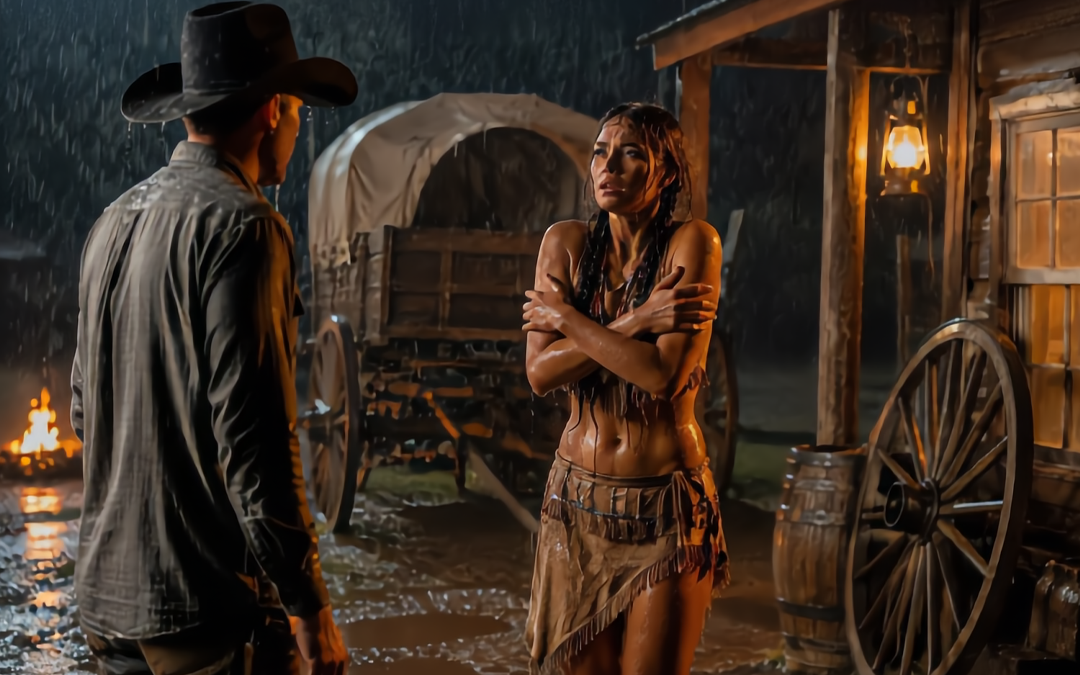
# **Part 2**
**“They found me,” Ayana whispered—find Part 2 in the comments or leave the word SHELTER and I’ll send it to you privately.**
Cole gently removed her hand from his sleeve.
“Then they made a mistake.”
Ayana stared at him.
“What mistake?”
“Coming to my house.”
Before dawn, nearly a dozen armed riders had surrounded Cole Harper’s ranch.
Their leader called from beyond the fence.
“Send the girl out!”
Cole stepped onto the porch.
Rifle lowered.
Not because he trusted them.
Because whoever fired first would decide whether sunrise arrived peacefully or stained red.
The gang leader rode forward.
“Don’t make this your fight, Harper.”
Cole’s expression remained calm.
“She knocked on my door.”
“So?”
“I let her inside.”
The outlaw laughed.
“That makes her yours?”
“No.”
Cole’s voice hardened.
“It makes her my guest.”
The laughter disappeared.
“And nobody takes a guest from my house at gunpoint.”
Inside, Ayana listened.
Something tightened inside her chest.
For two days, she had believed she was completely alone.
Now a man who had known her less than a night was risking everything because he believed a promise of shelter actually meant something.
The outlaw leader slowly raised his pistol.
“Last chance.”
Cole did not move.
Behind him, Ayana suddenly noticed the back window.
Beyond the ranch stood a rocky ridge.
High enough to be seen for miles.
An idea struck her.
She slipped through the rear door.
Cole heard it open but did not turn.
Somehow, he understood.
He kept the outlaws focused on him.
“You boys steal enough horses lately?” he called.
The leader glared.
“Careful.”
“I am careful. That’s why I recognize thieves.”
While angry voices rose below, Ayana crawled between rocks and sagebrush.
Her legs screamed from exhaustion.
She climbed.
Higher.
Higher.
At last she reached the ridge.
Her hands shook as she collected dry brush hidden beneath an overhang.
From around her neck, she pulled the flint she had carried since childhood.
One spark.
Nothing.
Another.
Nothing.
Below, Cole heard the outlaw leader begin counting.
“Ten…”
Ayana struck the flint again.
“Nine…”
A spark caught.
“Eight…”
Smoke curled upward.
Ayana fed the tiny flame.
“Seven…”
The fire grew.
“Six…”
Thick gray smoke rose into the morning sky.
One outlaw noticed.
“What the hell is that?”
Cole looked toward the ridge.
And smiled.
The leader spun toward the smoke.
Then came a sound from the distant hills.
A cry.
Then another.
The gang fell silent.
Figures appeared along the cliffs.
Mounted warriors.
Dozens of them.
Ayana stood beside her signal fire while Apache riders emerged from the rocks above the valley.
The outlaws suddenly found themselves trapped between Cole’s ranch and the high ground.
Their leader’s confidence vanished.
“Ride!”
The gang turned.
But just as they prepared to flee, another line of riders appeared across the southern trail.
The escape route was closed.
And at the front of those riders sat an older Apache warrior staring directly toward Ayana.
She stopped breathing.
“Father…”
The chief had found his daughter.
But before Ayana could run toward him, one desperate outlaw suddenly raised his rifle—not at Cole…
**but directly at her.**
The rifle rose.
Cole saw it.
Ayana’s father saw it.
Ayana did not.
She was still staring at the riders below, overwhelmed by the impossible sight of her family alive.
The outlaw’s finger tightened around the trigger.
“AYANA!”
Cole shouted.
She turned.
**BANG!**
The shot shattered the morning air.
Ayana dropped.
Her father let out a cry that echoed across the valley.
Cole fired almost simultaneously.
His bullet struck the outlaw’s rifle, knocking it sideways.
The man screamed and fell from his horse.
For one terrible second, nobody moved.
Then Ayana lifted her head.
The outlaw’s bullet had struck the rock beside her.
Stone fragments had cut her cheek, but she was alive.
Her father charged forward.
Several Apache warriors followed.
The horse thieves realized the fight was finished.
Some dropped their weapons.
Others tried to flee.
But escape routes had disappeared.
Within minutes, the gang that had terrorized ranches and camps across the territory stood disarmed beneath the rising sun.
Cole remained near his porch.
His rifle was still in his hands.
But he did not fire again.
The older Apache man dismounted.
His eyes searched the ridge.
“Ayana!”
She ran down the path.
“Father!”
Whatever dignity had kept her standing through two days of fear disappeared.
She threw herself into his arms.
The chief held his daughter tightly.
For a long moment, neither spoke.
Cole looked away.
Some reunions deserved privacy.
Other riders dismounted.
Among them were people Ayana recognized.
An uncle.
Two cousins.
Friends from her camp.
Some were bruised.
One had his arm wrapped in cloth.
But they were alive.
Ayana cried openly now.
“I thought…”
Her father touched her face.
“We searched every canyon.”
“The thieves—”
“We survived.”
He looked toward the captured gang.
“Not everyone.”
Pain passed between father and daughter.
Their reunion contained joy.
But also names that would never answer again.
After several minutes, the chief turned toward Cole.
The rancher suddenly became aware of dozens of eyes studying him.
Cole lowered his rifle and placed it on the porch.
A simple gesture.
No threat.
No challenge.
Ayana spoke quickly to her father in Apache.
Cole did not understand every word.
But he understood his name.
And the way she repeatedly pointed toward the cabin.
The chief listened without interruption.
Ayana described arriving alone.
Cole feeding her.
Giving her blankets.
Refusing to surrender her.
Standing on the porch while armed men surrounded him.
When she finished, the chief walked toward Cole.
He was older than Cole had first realized.
Gray threaded his hair.
His weathered face belonged to a man who had known both war and responsibility.
Cole waited.
The chief stopped before him.
“You knew who she was?”
“She told me her name.”
“I mean that she was Apache.”
Cole almost smiled.
“That was difficult to miss.”
Several warriors exchanged looks.
The chief’s mouth moved slightly.
Perhaps the beginning of amusement.
“You knew sheltering her could bring danger.”
“Yes.”
“Yet you opened your door.”
Cole glanced toward Ayana.
“She was hungry.”
The chief studied him.
“That is your answer?”
“She needed help.”
“You risked your life because someone needed help?”
Cole shrugged.
“Seemed reason enough.”
Ayana’s father looked at him for a long moment.
Then he placed one hand over his heart.
Cole’s expression changed.
No speech was necessary.
Still, the chief gave him one.
“You protected my daughter when you had nothing to gain.”
His voice was calm.
“You chose her life over your comfort.”
He looked around the ranch.
“You stood alone because you had given your word.”
Cole shook his head.
“Wasn’t completely alone.”
His gaze went toward the ridge where smoke still climbed into the sky.
“Your daughter handled herself pretty well.”
Ayana smiled through her tears.
Her father looked toward her.
“She always has.”
That was the first moment the tension truly broke.
The warriors began gathering the abandoned horses.
Several inspected Cole’s fences.
One noticed damage caused when an outlaw horse crashed through a section during the confusion.
Without asking, he began repairing it.
Another joined him.
Then another.
Cole watched them.
“You don’t have to do that.”
Ayana translated.
The men continued working.
Her father answered, “Neither did you.”
Cole had no response.
So he let them repair the fence.
—
By midmorning, the ranch looked unlike anything Cole had seen in years.
People filled the yard.
Horses crowded the corral.
Smoke rose from outdoor cooking fires.
Children who had accompanied the search party laughed near the stable.
Someone produced dried meat.
Cole contributed coffee and flour.
Ayana helped prepare food.
The lonely ranch had become almost festive.
Cole stood near the porch watching everything.
Ayana approached carrying two tin cups.
“Coffee.”
“You remembered.”
“You drink enough of it to poison three men.”
Cole accepted the cup.
“I’ve built tolerance.”
She stood beside him.
For several seconds, they watched the others.
Then Ayana said, “I thought my father was dead.”
Cole nodded.
“I know.”
“And when I reached your cabin…”
She stopped.
“What?”
“I had begun believing I might die too.”
Cole turned toward her.
“But I was more afraid of knocking on your door than sleeping outside.”
“Why?”
“Because people can be more dangerous than cold.”
Cole had no easy answer.
He understood too well.
Ayana continued.
“I did not know whether you would see a tired woman…”
Her eyes moved toward him.
“…or only an Apache.”
Cole looked down at his coffee.
“What did you think when you saw me?”
He considered lying.
Then chose honesty.
“I thought you might bring trouble.”
Ayana gave him an unimpressed look.
Cole added, “I was right.”
She laughed.
A real laugh.
He smiled.
“But I also thought you looked like someone who had run out of places to go.”
Her laughter softened.
“So you gave me one.”
“One night.”
Ayana looked around the ranch.
“One night can be a long time.”
Cole knew what she meant.
Yesterday, his cabin had felt comfortably empty.
Today, he noticed the silence waiting inside it.
—
Later, Ayana’s father approached.
“We will take the thieves to the territorial authorities.”
Cole nodded.
“Probably better than burying them.”
The chief studied him.
“Some among my people wanted revenge.”
“I imagine some still do.”
“They do.”
Cole understood.
The gang had attacked families.
Stolen horses.
Taken lives.
Forgiveness was not a simple thing.
The chief continued.
“But killing surrendered men would not return those we lost.”
Cole looked toward the prisoners.
“That doesn’t make mercy easy.”
“No.”
The chief’s eyes hardened.
“It makes it difficult.”
Cole respected the answer.
Sometimes civilization was measured not by what someone deserved, but by what those with power chose not to become.
The chief gestured toward Cole’s land.
“You live here alone?”
“Yes.”
“Always?”
Cole hesitated.
“Probably.”
“Why?”
Ayana, standing nearby, suddenly looked interested.
Cole sighed.
“You two ask too many questions.”
The chief smiled faintly.
Ayana answered, “Then perhaps lonely men give too few answers.”
Cole shook his head.
He liked her far too easily.
That worried him.
—
Before the group prepared to leave, Ayana walked inside the cabin one last time.
The blanket she had slept beneath remained folded beside the fireplace.
She touched it.
Less than twelve hours earlier, this room had been the safest place in the world.
Cole appeared in the doorway.
“You forgot something?”
Ayana turned.
“No.”
She looked around.
“I wanted to remember it.”
“The cabin?”
“The feeling.”
Cole leaned against the doorway.
“What feeling?”
“Being safe before I knew I was safe.”
He understood.
Sometimes safety arrived before the mind believed it.
Ayana picked up the blanket.
She handed it to him.
“Thank you.”
“You already thanked me.”
“I may do it again.”
“That sounds excessive.”
“Get used to it.”
Cole smiled.
Then her expression became more serious.
“My father invited you to our village.”
“I heard.”
“You should come.”
Cole glanced toward the horses outside.
“I have work.”
“There is always work.”
“My fences—”
“Our people just fixed your fences.”
“My horses—”
“Your horses survived one night without conversation.”
Cole stared.
Ayana folded her arms.
“You really do talk to them.”
“Occasionally.”
“I knew it.”
Cole laughed.
Ayana smiled.
Then she reached beneath her clothing and removed a small woven cord.
A bead decorated its center.
She held it out.
“What’s this?”
“Something my mother made.”
Cole’s smile faded.
“I can’t take that.”
“She made many.”
“You sure?”
“Yes.”
He accepted it carefully.
“What does it mean?”
Ayana thought.
“Safe return.”
Cole looked at the bead.
“For travelers?”
“For anyone worth hoping comes back.”
Their eyes met.
Neither spoke.
Outside, someone called Ayana’s name.
She stepped toward the door.
Then stopped.
“Cole.”
“Yeah?”
“When I knocked last night, you said I could stay because I needed shelter.”
“That’s right.”
“What if someday I come back when I do not need shelter?”
Cole looked at her.
For a man accustomed to silence, he suddenly had difficulty finding words.
Finally he said, “Door will still open.”
Ayana smiled.
“Good.”
—
The riders gathered.
Ayana mounted beside her father.
Before leaving, the chief approached Cole once more.
“Your home is welcome to our people.”
Cole nodded.
“And ours is open to you.”
Then the chief extended his hand.
Cole took it.
Two men from worlds too often taught to fear one another stood beneath the Arizona sun and sealed something far stronger than a bargain.
Respect.
The riders began moving.
Ayana remained behind for several seconds.
Cole stood beside the fence.
“You should catch up.”
“I know.”
“Your father’s waiting.”
“I know.”
“Then why are you still here?”
She smiled.
“I wanted you to understand something.”
“What?”
“You did not save me because you defeated those men.”
Cole frowned.
“You saved me when you opened the door.”
Then she turned her horse.
“Ayana.”
She looked back.
Cole touched the small woven cord now tied around his wrist.
“I’ll visit.”
Her expression brightened.
“I know.”
“How?”
“You gave your word.”
Then she rode away.
Cole watched until the riders became shadows against the hills.
Until Ayana disappeared with them.
Until the ranch fell silent again.
But the silence no longer felt the same.
—
Three weeks passed.
Cole repaired fences.
Fed horses.
Worked cattle.
Every morning looked almost identical to the one before.
Yet each evening, his eyes drifted toward the western trail.
He told himself he was checking the weather.
The horses seemed unconvinced.
“You keep that opinion to yourself,” he told his bay gelding.
The horse snorted.
Cole frowned.
“Traitor.”
Then, one afternoon, riders appeared.
Not dozens.
Three.
Cole stepped outside.
Ayana rode in front.
She wore cleaner clothes now, and the exhaustion had vanished from her face.
Behind her rode her brother and an older woman carrying woven baskets.
Ayana stopped before the porch.
Cole tried not to smile too quickly.
“You lost again?”
“No.”
“Fire die?”
“No.”
“Horse thieves?”
“No.”
Cole folded his arms.
“Then I suppose I’m out of reasons to let you stay.”
Ayana dismounted.
She came closer.
“You said the door would open even if I did not need shelter.”
Cole nodded.
“I did.”
“So…”
She looked toward the cabin.
“Does your promise still stand?”
Cole opened the door.
Warm light spilled onto the porch.
“Always.”
Ayana smiled.
And that was how something that began with one frightened traveler seeking refuge became a friendship between families.
Cole visited her community.
Her people traded horses and supplies with neighboring ranchers.
Men who once viewed one another across a distance slowly learned names instead of rumors.
Distrust did not vanish overnight.
History did not suddenly become simple.
But change rarely begins with entire nations.
Sometimes it begins with two people.
A woman brave enough to knock.
And a man decent enough to open the door.
Years later, Cole still remembered that first night whenever storms rolled across the desert.
He remembered the hesitant knock.
The exhausted woman beneath the moon.
The bowl of stew.
The approaching hoofbeats.
And the moment he understood something that life on the frontier had nearly made him forget:
Survival could teach a person to close every door.
Fear could teach entire communities to distrust anyone who looked different.
Loss could convince a lonely man that isolation was safer than caring.
But safety without connection was only another kind of emptiness.
Cole had thought he was giving Ayana one night beside a warm fire.
Instead, she brought warmth back into a house that had been cold long before her arrival.
And Ayana had believed she was asking a stranger for nothing more than shelter.
Instead, she discovered that compassion could appear in unexpected places—and that one act of courage could create a bridge where generations of fear had built walls.
Their lives changed because neither of them allowed fear to make the final decision.
That became the story people remembered.
Not the gunfight that never truly happened.
Not the thieves.
Not even the riders surrounding the ranch.
They remembered one simple sentence spoken beneath a desert moon:
**“My fire died. May I stay tonight?”**
And the answer that changed everything:
**“You can stay.”** 🤠🔥
**Disclaimer:** This story is entirely fictional and created for entertainment purposes only. It does not represent any organization or individual, nor does it encourage inappropriate behavior. The content was generated with AI assistance.








