The Apache Woman He Saved From Freezing Returned With Her Tribe to Claim Him
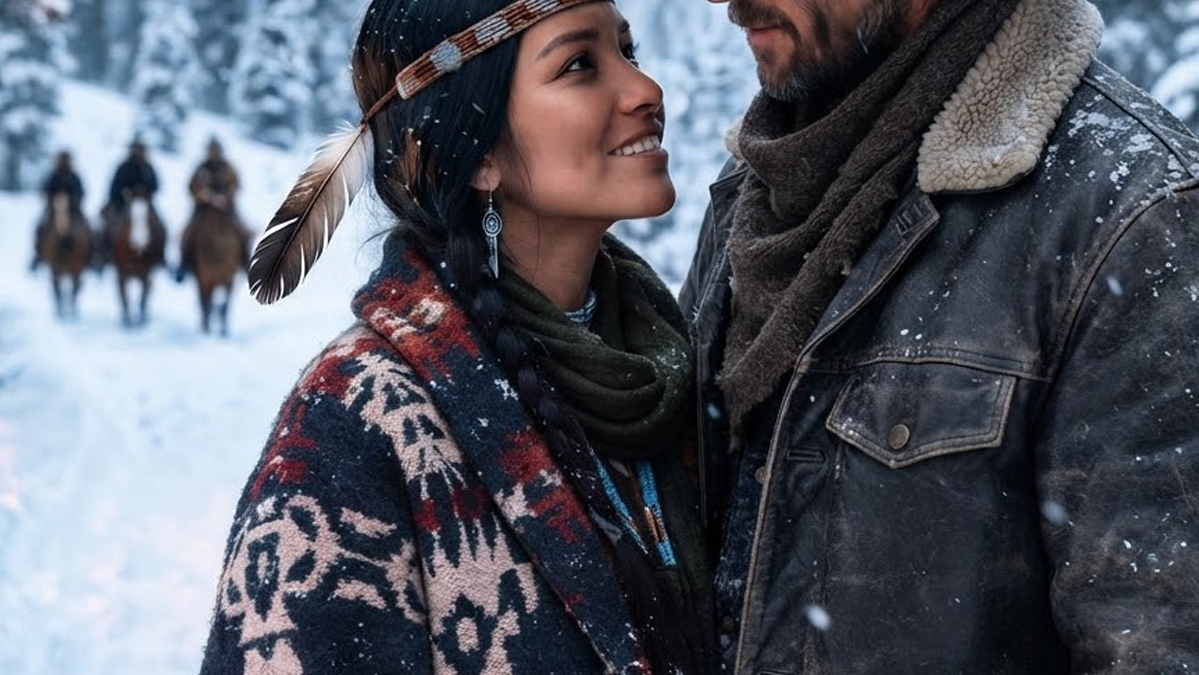
—
## Part 3
The next shot never came.
Not because Virgil Kaine lowered his rifle.
Not because Nate backed away.
And not because the men surrounding them suddenly discovered mercy.
It was because Tala moved first.
She dropped to one knee.
Her hand struck the snow.
Then she shouted a single word.
Every Apache warrior disappeared into the trees.
Nate understood what was happening only a second later.
“Down!”
He threw himself sideways.
Gunfire exploded across the ridge.
The canyon erupted with smoke and shouting.
Virgil’s men fired blindly toward the trees.
But the Apache warriors were no longer where the bullets landed.
They had vanished into the timber as if the mountains themselves had swallowed them.
Nate rolled behind a fallen pine.
Tala landed beside him.
“You all right?”
She nodded.
“Stay here.”
“No.”
“Tala—”
“I’m not staying behind you.”
For one absurd second, despite the rifles cracking around them, Nate almost smiled.
That was Tala.
She had never waited for anyone to rescue her.
Not beneath the ponderosa.
Not during the storm.
Not now.
She pointed toward the ridge.
“Virgil is moving.”
Nate looked.
He was.
The trail boss had grabbed Toma by the collar and was dragging him toward the horses.
Two men covered him.
The other two were firing into the trees.
Nate looked at Tala.
She looked back.
No words were needed.
They moved together.
Nate circled left.
Tala disappeared right.
Snow muffled their footsteps.
A gunman turned.
Too late.
Nate struck the man’s rifle aside and drove him into the snow.
Another man raised his weapon.
An arrow appeared before he could fire.
He collapsed.
Nate looked toward the trees.
Kota stood there.
His expression was calm.
Controlled.
He nodded once.
Nate understood.
Keep moving.
Nate chased Virgil.
“Toma!”
The young Apache looked over.
His face was bloodied.
But he was still standing.
Virgil pulled him closer.
“Another step and he dies.”
Nate stopped.
Virgil’s rifle pressed against Toma’s chest.
“You always were a fool, Rollins.”
Nate kept his revolver lowered.
“You don’t have to do this.”
Virgil laughed.
“You don’t know what I’m doing.”
“I know you’re holding a wounded boy at gunpoint.”
Virgil’s expression hardened.
“I’m doing what men like us have always done. Taking what this territory gives us.”
“No.”
Nate’s voice was quiet.
“Men like you take what they want.”
Virgil’s eyes narrowed.
“And men like you?”
Nate looked toward Tala.
“I learned the difference.”
Virgil suddenly shoved Toma aside and fired.
Nate dove.
The bullet tore through his coat.
Tala came from nowhere.
She struck Virgil’s rifle with her knife.
The weapon flew into the snow.
Virgil swung at her.
Nate tackled him.
They hit the ground hard.
For several seconds, the two men fought without weapons.
Virgil was bigger.
Stronger.
Meaner.
He drove his fist into Nate’s ribs.
Nate gasped.
Virgil grabbed his collar.
“You threw away your whole life for an Apache woman.”
Nate looked toward Tala.
She was kneeling beside Toma.
Kota was helping the wounded boy.
Then Nate looked back at Virgil.
“No.”
He drove his forehead into Virgil’s face.
“I finally found it.”
Virgil staggered.
Nate stood.
Virgil reached for the rifle.
Nate kicked it away.
For a moment, neither man moved.
Then Virgil looked past Nate.
At Tala.
At the Apache warriors.
At the young man he had tried to use as bait.
Something changed in his expression.
Fear.
For the first time, Virgil Kaine looked afraid.
Kota stepped forward.
He could have killed him.
Everyone knew it.
Instead, he looked at Nate.
Tala translated.
“He asks what you want done.”
Nate stared at Virgil.
The old Nate might have answered immediately.
The lonely drifter who had spent years letting life happen around him might have chosen revenge.
But that man was gone.
Nate looked at Tala.
Then at Toma.
Then at the blanket tied behind his saddle.
“My mother taught me something,” he said.
Tala listened.
“She said a man can spend his whole life becoming hard because the world keeps hurting him.”
He paused.
“But being hard isn’t the same as being strong.”
Tala translated.
Kota listened.
Nate continued.
“Take their horses.”
Tala looked surprised.
“And their weapons.”
Another pause.
“But let them go.”
Kota studied him.
Then he nodded.
Virgil stared at Nate.
“You’ve gone soft.”
Nate shook his head.
“No.”
He stepped closer.
“I just don’t need to become you.”
Virgil and the surviving men were stripped of their weapons and horses.
Then they were sent down the canyon.
Alive.
Humiliated.
And carrying a lesson they would likely never admit they had learned.
The camp returned before dawn.
Toma’s wound was cleaned.
He would live.
Tala sat beside him until his breathing became steady.
Only then did she leave the shelter.
Nate was outside beside the fire.
He was holding his ribs.
“You should rest,” Tala said.
“I’ve been told worse things.”
She smiled.
Then her expression became serious.
“Nate.”
He looked at her.
“I need to tell you something.”
He waited.
“That day beneath the pine… I didn’t accept the blanket because I wanted to trap you.”
“I know.”
“You don’t.”
She sat beside him.
“I knew what the blanket meant. But I didn’t know what you would mean to me.”
Nate remained quiet.
“I had seen white men before,” she continued. “Some were cruel. Some were frightened. Some were kind only when kindness benefited them.”
She looked at his hands.
“You were different.”
Nate smiled faintly.
“Because I gave you a blanket?”
“No.”
She shook her head.
“Because you held it out.”
He remembered.
He had almost forgotten that small detail.
He hadn’t wrapped it around her immediately.
He had let her choose.
Tala continued.
“When you held it out, you gave me warmth without taking away my choice.”
She looked at him.
“I knew then that if I accepted it, I would be making a choice too.”
Nate swallowed.
“And when you tried to return it?”
“I wanted to know if you understood what you had given.”
“I didn’t.”
“I know.”
A quiet laugh escaped her.
“You told me to keep it because it was cold.”
Nate smiled.
“I was thinking about the weather.”
“I know.”
She leaned closer.
“But I was thinking about you.”
The fire cracked between them.
For a while, neither spoke.
Then Nate reached behind his neck.
His fingers touched the small buckskin amulet Tala had given him.
The hawk.
The symbol meant to help a person find the road home.
“You gave me this before I understood where I was going.”
Tala looked at it.
“You were always going here.”
“How could you know?”
She smiled.
“I didn’t.”
Then she touched the amulet.
“I hoped.”
Spring came slowly.
The snow disappeared from the lower country first.
Then the trails opened.
Then the creek ran freely again.
Nate could have gone back to Sholo.
He could have found work.
He could have returned to the life he’d known.
Instead, he stayed.
He learned.
He worked.
He listened.
He made mistakes.
Tala corrected him.
Often.
Sometimes patiently.
Sometimes not.
He learned Apache words for water, fire, horse, snow, medicine, family.
He learned that knowing a language wasn’t merely knowing vocabulary.
It was learning how another people saw the world.
Tala learned English too.
She became good enough to argue with Nate.
She discovered card games.
That was a mistake.
Within months, she was beating him regularly.
“You cheated.”
She stared at him.
“I learned.”
“You counted the cards.”
“Is that cheating?”
“Yes.”
“Then you should learn faster.”
She gathered the beans she had won.
Nate laughed.
The life they built did not fit neatly into either world.
And perhaps that was the point.
They built something of their own.
By February, Kota began asking Nate questions about the settlements.
About cattle.
About the territorial government.
About what white men said when they believed no Apache was listening.
Nate answered honestly.
Even when the answers were ugly.
Kota respected that.
A man who only tells easy truths is of little use.
By spring, Nate and Tala moved with the band.
Later, they built a small adobe house in the foothills near the edge of the summer country.
Nate planted a kitchen garden.
Tala kept herbs and medicines.
Their door was rarely locked.
Years passed.
Children came.
They grew up knowing two languages.
Two traditions.
Two histories.
They knew the open horizon Nate had loved.
And the canyon walls Tala had always called home.
Some towns still refused to accept them.
Men who had once greeted Nate at the table suddenly found reasons not to speak.
Nate stopped caring.
He had spent too many years trying to belong in places that had never wanted him.
Now he had a home.
And home was not a town.
It was Tala.
It was the children.
It was the fire.
It was the sound of someone waiting for him when he returned from the trail.
And through all those years, Tala kept the blanket.
Martha Rollins’s blanket.
The indigo and cream squares faded.
The wool became thin.
The eight-pointed stars remained.
Twenty years after that blizzard, the blanket was too worn to serve as bedding anymore.
Tala refused to throw it away.
Instead, she carefully cut the remaining good sections into squares.
Then she stitched them together again.
Into a vest.
For Nate.
When she finished, she held it out.
Nate ran his fingers over the faded stars.
“My mother made these.”
“I know.”
“You remembered every one?”
Tala smiled.
“You remembered every one.”
He put the vest on.
It fit.
He wore it for the rest of his life.
By then, the indigo had faded almost to gray.
The edges had been repaired many times.
But the stars remained exactly where Martha had stitched them.
And Nate finally understood something he had missed for years.
His mother had told him to keep the blanket close.
He had always believed she meant it because it would keep him warm.
Maybe she did.
But perhaps there had been another meaning.
Perhaps keeping something close did not always mean holding onto it.
Sometimes it meant knowing when to give it away.
Nate had given the blanket to Tala because she was freezing.
He had not known her customs.
He had not known what the gesture meant.
He had simply seen another human being in danger and chosen not to ride past.
That choice brought him to a hidden Apache camp.
It brought him face-to-face with Virgil Kaine.
It nearly cost him his life.
But it also brought him to the woman who would become his wife.
The woman who taught him another way to see the land.
Another way to understand strength.
Another way to understand home.
Years later, Nate would sometimes tell the story of the blizzard to his children.
They would ask him whether he had known what the blanket meant.
He always gave the same answer.
“No.”
Then they would ask why he gave it to Tala.
Nate would look across the room at the woman who had once been a stranger beneath a ponderosa pine.
And he would say:
“Because she was cold.”
Tala would hear him.
She would smile.
And sometimes, when the children weren’t watching, she would correct him.
“You always leave out the important part.”
Nate would laugh.
“What part?”
“The part where you held it out.”
He would look at her.
And she would say:
“You let me choose.”
That was the part neither of them ever forgot.
Because the promise had never truly been created by the blanket.
It had begun with a choice.
Her choice to accept.
His choice to offer.
And later, both of them choosing to stay.
That was why their marriage endured.
Not because a tradition had forced them together.
Not because one man had rescued one woman.
But because two people from completely different worlds had discovered that love could begin with something much simpler.
Respect.
Nate had not saved Tala so she would owe him her life.
He saved her because she was dying.
Tala had not stayed with Nate because she owed him a debt.
She stayed because she wanted to.
And Nate stayed because, for the first time in years, he had found somewhere he wanted to belong.
The blanket had started as his mother’s final gift.
It became Tala’s warmth.
Then it became a promise.
And finally, it became part of the life they built together.
A life neither of them could have imagined beneath that storm-darkened ponderosa.
A life that began when a lonely cowboy stopped his horse in the middle of a blizzard and decided that another person’s life mattered more than his own comfort.
Sometimes the biggest moments in a person’s life do not announce themselves.
They arrive quietly.
A hand reaching for a knife.
A blanket opening in the snow.
A stranger being given a choice.
A name spoken for the first time.
And somewhere between those small moments, a life changes forever.
Nate Rollins entered the mountains carrying the last warmth his mother had left him.
He came out carrying something far more valuable.
A family.
A home.
And a love that had begun beneath a winter sky when neither he nor Tala knew what the future would demand of them.
The frontier was still harsh.
People were still divided by fear.
The world did not suddenly become kind.
But Nate no longer faced it alone.
Neither did Tala.
And perhaps that was the real promise hidden inside that old indigo blanket.
Not that two people would never suffer.
Not that the road would always be easy.
But that when the cold came…
neither would have to face it alone.
**Disclaimer:** This is a completely fictional western romance story created for entertainment purposes. The characters, events, dialogue, cultural details, and dramatic situations are fictionalized and should not be treated as a factual historical account. The story was created with the assistance of artificial intelligence.








