THE TRAIL CREW COULDN’T STAND ONE MORE BURNT MEAL—THEN A WIDOW WITH A BABY TOOK OVER THEIR WAGON AND CHANGED EVERYTHING
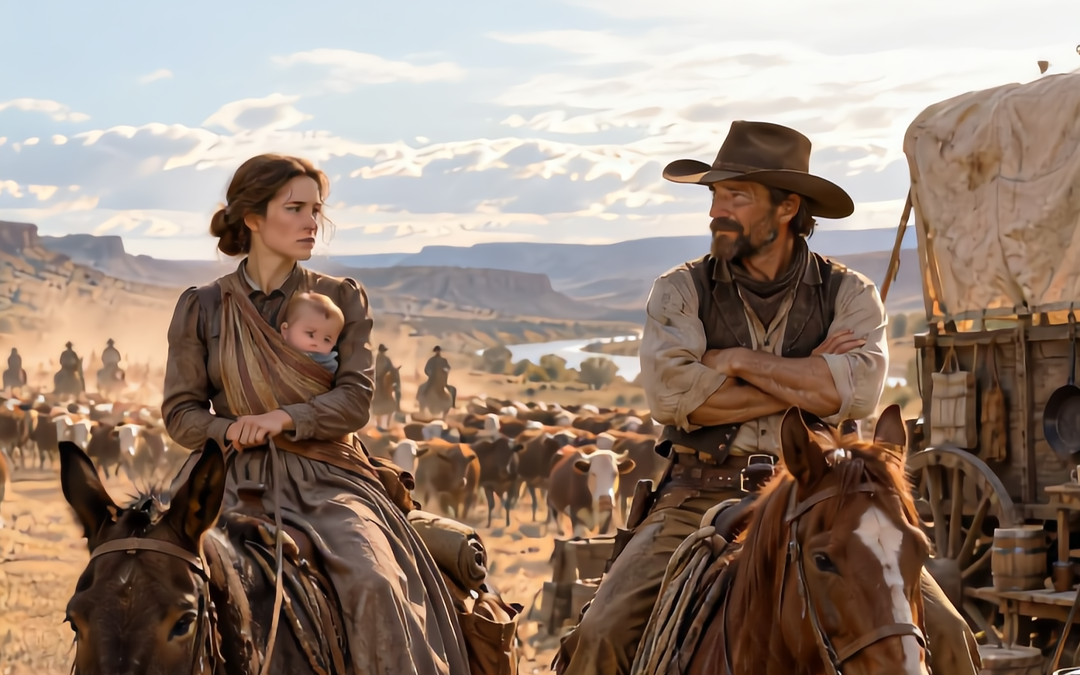
—
## **Part 2**
**“I’m not asking you to work for me, Joe—I’m asking whether you and Sam might make that ranch a home with me.”**
Joe stared at Walker.
Around them, Ellsworth roared with the sounds of stockyards, wagons and cowboys celebrating their pay.
But beside the chuck wagon, everything seemed strangely still.
Sam slept against her shoulder.
Walker waited.
Joe looked at the man who had spent weeks making decisions for twelve cowboys without hesitation.
Now he couldn’t seem to decide what to do with his hands.
“Just the three of us?” she asked.
“And the horses.”
Joe almost smiled.
“And the wagon.”
“You’d have a proper kitchen.”
“I didn’t ask whether I’d have a kitchen.”
“No.”
Walker glanced at the wagon.
“You want to keep it.”
“I do.”
“Then we keep it.”
Something inside her shifted.
Amos had been dead more than a year.
For months afterward, everyone had told Joe what she ought to do.
Stay with family.
Raise Sam quietly.
Be grateful.
Be sensible.
Walker hadn’t told her any of that.
Even when she rode into his camp uninvited, he’d given her a condition rather than charity.
Earn your place.
And she had.
But this was different.
“This isn’t because of the river?” she asked.
Walker frowned.
“No.”
“Or because you feel responsible for Sam?”
“No.”
“Or because you think a widow needs rescuing?”
Walker looked almost offended.
“Joe, I’ve watched you command twelve cattlemen with a biscuit pan. I don’t believe you’ve needed rescuing one day in your life.”
She laughed despite herself.
Then her expression softened.
“Amos loved me.”
“I know.”
“I loved him.”
“I know that too.”
“I still do sometimes.”
Walker took a moment before answering.
“I’d be worried about you if you didn’t.”
That nearly undid her.
Because he wasn’t asking her to erase Amos.
He wasn’t demanding the empty part of her life be scrubbed clean before he entered it.
He was simply asking whether there might be room beside what remained.
Then Sam woke.
He blinked sleepily at Walker.
Walker extended one finger.
Sam grabbed it.
Hard.
Walker winced.
Joe laughed.
“There goes another button.”
“He hasn’t learned mercy.”
“He comes by that honestly.”
Their eyes met.
And this time neither looked away.
Joe touched the side of the wagon.
“I’ll keep this.”
“Fine.”
“My own money stays mine.”
“Wouldn’t touch it.”
“I decide how Sam is raised.”
Walker considered that.
“We decide anything that concerns all three of us. But I’m never going to pretend I’m his father unless someday you want me to be.”
Joe’s breath caught.
Walker continued quietly.
“And Amos doesn’t disappear because I’m there.”
There it was.
The sentence she hadn’t known she needed.
Joe looked toward the trail behind them.
Months earlier she had left Caldwell on a mule because she refused to spend another year being somebody’s burden.
Now she was being offered something entirely different.
Not charity.
A place.
But before she could answer, Dusty came running around the wagon.
“Walker!”
Walker turned.
Something in Dusty’s expression wiped the softness from his face.
“What?”
“Castle’s clerk just came from the stockyard.”
Dusty was breathing hard.
“Grier’s here.”
Joe frowned.
“The buyer from Abilene?”
Dusty nodded.
“And he says Walker stole cattle from his contracted herd.”
Walker went absolutely still.
“That’s a lie.”
“He’s brought a marshal.”
Joe’s stomach dropped.
Dusty looked toward the stockyards.
“They’re coming now.”
Walker stepped around the wagon.
At the far end of the street, three mounted men appeared.
Grier rode in the center.
Beside him was a lawman.
And behind them, two stockyard clerks carried papers.
The crew began gathering.
Castle came from his office.
Grier dismounted and smiled.
“You should’ve taken my offer, Boon.”
Walker didn’t answer.
The marshal unfolded a document.
“Walker Boon, there’s a claim that the herd you sold this morning was already under purchase agreement in Abilene.”
“That’s false.”
“Then you can explain it.”
Grier’s smile widened.
“If the claim stands, Castle’s payment is frozen. Your crew may have to return their wages.”
The celebration died instantly.
Joe looked at the men.
Eight more days on the trail.
Everything they’d risked.
Everything they’d earned.
And suddenly she understood.
Grier wasn’t punishing Walker for rejecting half price.
He intended to ruin him for it.
The marshal turned toward the chuck wagon.
“I’ll need to inspect the drive records.”
Walker looked at Joe.
Then at the wagon.
And Joe remembered something.
Something she’d put away weeks earlier without understanding why Amos had once told her never to throw such things out.
Her hand slowly moved toward the wooden box beneath the wagon seat.
Inside was an old trail ledger.
And folded inside that ledger was a document bearing a name none of them expected to see.
Joe pulled it free.
She read the signature.
Her face changed.
“Walker…”
He turned.
Joe held up the paper.
“I think my dead husband just gave us the one thing Grier never expected me to have.”
**And when Grier saw the signature at the bottom of that page, the smile vanished from his face.**
Joe held the old paper in both hands.
For a moment, nobody spoke.
Walker looked from her to Grier.
“What is it?”
Joe swallowed.
“A receipt.”
Grier recovered quickly.
“For what?”
Joe ignored him.
She looked at Walker.
“Amos kept records of nearly everything when he rode trail. Feed. Supplies. Buyers. Advances.”
Her fingers trembled slightly.
“I brought his old ledger because I thought there might be names in it that could help me find work.”
She unfolded the paper.
“This is from Grier.”
The marshal stepped forward.
“May I?”
Joe handed it to him.
The lawman read silently.
Then read it again.
Grier’s face tightened.
“That paper concerns an entirely different drive.”
“Yes,” Joe said.
“It has nothing to do with Boon’s cattle.”
“Maybe not.”
She looked directly at Grier.
“But it tells us how you do business.”
Walker watched her.
Joe’s grief had vanished from her expression.
This was the woman who had ridden alone into a camp of twelve strangers and informed them their cooking was terrible.
“What does it say?” Castle asked.
The marshal answered.
“It records an advance payment against cattle delivered by Cassidy’s outfit two seasons ago.”
Grier shrugged.
“Perfectly ordinary.”
Joe nodded.
“Read the line underneath.”
The marshal did.
His eyebrows lifted.
Walker stepped closer.
“What line?”
The marshal looked at Grier.
“It says final purchase price to be determined after inspection at destination. No exclusive sale obligation prior to final inspection.”
Grier’s jaw hardened.
“So?”
Joe answered.
“So you used the same argument against Amos’s outfit.”
Grier stared at her.
“My husband told me about it after that drive. You tried to claim Cassidy had already committed his cattle to you before inspection. Cassidy refused your price and sold elsewhere.”
“That proves nothing about Boon.”
“No.”
Joe turned toward Walker.
“But Amos told me why Cassidy started making every buyer write the terms plainly afterward.”
Walker suddenly understood.
His head snapped toward the tally box.
“Dusty.”
Dusty was already moving.
He climbed into the wagon and emerged carrying Walker’s trail papers.
Walker searched through them.
One sheet.
Another.
Then another.
Finally he found the document Grier had signed in Abilene when Walker first presented the herd.
Castle read over his shoulder.
There it was.
An inspection offer.
Not a purchase agreement.
Half price.
Valid only if accepted.
Walker had never accepted it.
There had been no sale.
No contracted herd.
Nothing for Grier to own.
The marshal looked at Grier.
“Do you have another document?”
Grier’s face darkened.
“I have witnesses.”
“To an offer?”
“To negotiations.”
Castle laughed without humor.
“Negotiations aren’t ownership.”
The crew began murmuring.
Grier looked around and realized the balance had shifted.
He pointed toward Joe.
“This is exactly what I was talking about. Boon brings women into trail business and now she’s standing here interfering in a cattle transaction.”
Walker moved.
Joe caught his arm before he could take another step.
“No.”
Walker looked at her.
She shook her head.
She didn’t need him to fight this battle.
Then Joe turned toward Grier.
“You offered half price because there was a woman and baby on the drive.”
“I offered what I considered the cattle worth.”
Castle spoke from behind them.
“I paid full market.”
Grier glared at him.
Castle shrugged.
“And I’d pay it again.”
Dusty stepped forward.
“So would any buyer who actually looked at the herd.”
Pertie joined him.
Then Ellis.
One by one, the trail crew closed around Walker and Joe.
Not threateningly.
Simply standing there.
Twelve men.
The same twelve who had once voted to keep Joe because they were desperate for edible biscuits.
Now they stood beside her for another reason.
She was one of them.
The marshal folded Grier’s paper.
“There’s no basis here to seize Castle’s payment.”
Grier’s face flushed.
“You’re taking their word over mine?”
“I’m taking signatures over tempers.”
That ended it.
Grier climbed back onto his horse.
Before leaving, he looked at Walker.
“You’ll regret making an enemy over a cook.”
Walker glanced at Joe.
Then at Sam.
“No,” he said quietly. “I don’t believe I will.”
Grier rode away.
Nobody spoke until he disappeared around the stockyard.
Then Dusty removed his hat.
“Now.”
Everyone looked at him.
“I believe we were discussing Miss Vance’s biscuits before we were interrupted.”
The laughter that followed broke whatever tension remained.
Even Joe laughed.
But she still held Amos’s ledger.
Walker noticed.
“You all right?”
She looked down at it.
“Yes.”
Then, after a moment:
“No.”
Walker waited.
Joe ran one finger across Amos’s handwriting.
“I spent a year thinking everything connected to him belonged behind me.”
Walker said nothing.
“I left Caldwell because everybody treated me like Amos’s widow before they treated me like Josephine.”
Her eyes filled.
“And now something he kept helped us.”
Walker leaned against the wagon beside her.
“Maybe carrying something forward isn’t the same as living backward.”
Joe looked at him.
He shrugged.
“I’m not particularly wise. Mostly tired.”
She laughed through the tears.
Then Sam began fussing.
Joe wiped her eyes.
“Your timing is terrible, young man.”
Walker held out his arms.
“Give him here.”
Joe hesitated.
Not because she didn’t trust Walker.
Because suddenly the ordinary nature of the gesture struck her.
Give him here.
Not dramatic.
Not heroic.
No flooded river.
Just a tired man reaching for a tired baby so a tired mother could have both hands free.
Joe passed Sam over.
The baby settled against Walker as if he’d done it a hundred times.
Perhaps, Joe thought, this was what a future actually looked like.
Not replacing what had been lost.
Not some grand rescue.
Just someone willing to carry part of the weight when asked.
That evening, the trail crew gathered for one last supper.
Their drive was finished.
Tomorrow, they would scatter.
Some would drink away half their wages.
Some would send money home.
Ellis planned to buy boots and had been warned by six different men not to let anyone in town sell him anything after his second whiskey.
Joe cooked beef stew.
Biscuits.
Coffee.
Nothing fancy.
When she put the biscuits down, Dusty stared at them solemnly.
“Gentlemen, remember where we started.”
Pertie nodded.
“Burnt beans.”
“Raw biscuits.”
“Coffee that could strip paint.”
Ellis looked offended.
“I improved.”
“You stopped cooking,” Dusty said. “That’s how you improved.”
The camp exploded in laughter.
Walker sat slightly apart as always.
Except this time Joe noticed something.
His plate was already full.
She had filled it before serving anyone else.
Walker noticed too.
Their eyes met.
Neither commented.
Later, when the men drifted toward town, Joe remained beside the wagon.
Walker came back from settling accounts with Castle.
“Crew’s paid.”
“Everybody?”
“Everybody.”
“Even Ellis?”
“Especially Ellis. Before somebody convinces him he’s rich.”
Joe smiled.
Walker looked at the wagon.
Then at her.
“We never finished our conversation.”
“No.”
“I suppose Grier interrupted at a convenient moment.”
“For you.”
“For me?”
“You were terrified.”
Walker considered denying it.
Then apparently thought better of it.
“Yes.”
Joe folded a blanket.
Walker waited.
Finally he asked, “Do you want to come?”
She looked toward Sam, asleep in his crate.
Then toward the open country beyond Ellsworth.
“What exactly are you offering?”
Walker took his hat off.
It was a gesture Joe had begun recognizing.
He removed it whenever he wanted to say something he couldn’t hide behind.
“A ranch.”
“I heard that part.”
“Small house. Barn needs work. Roof leaks over the back room if the rain comes from the west.”
“Very romantic.”
“I’ve got seventeen cattle, six horses, two hens that refuse to lay, and a milk cow with a personal hatred of me.”
Joe fought a smile.
“Anything else?”
“One chair in the kitchen has a short leg.”
“Walker.”
“All right.”
His humor disappeared.
He stepped closer.
“I’m offering a place if you want it. Not employment. Not charity.”
He looked at Sam.
“And I’m not asking you to forget Amos.”
Then back to her.
“I couldn’t compete with a dead man even if I wanted to, and I don’t.”
Joe became very still.
“I liked the woman who rode into my camp and insulted my cooking before she’d been there fifteen minutes.”
“It deserved insulting.”
“I liked the woman who kept twelve men fed in rain that drowned half our firewood.”
He moved closer.
“I liked watching you tell Dusty how much salt belonged in beans as if you were disciplining a child.”
“He needed discipline.”
“I liked watching you with Sam.”
His voice softened.
“And somewhere along the trail, I started thinking about reaching Ellsworth and realized I didn’t want reaching Ellsworth to mean you were gone.”
Joe’s eyes burned.
Walker continued.
“I don’t know what name that deserves yet. Maybe I do and I’m too old to say it quickly.”
“You’re not that old.”
“Feels different after a cattle drive.”
She smiled.
Then Walker said the part that mattered.
“If you say no, I’ll put you and Sam wherever you want to go. Caldwell, Kansas City, back down the trail. No debt. No argument.”
Joe studied him.
“You mean that?”
“Yes.”
“Even after the river?”
“That doesn’t buy me anything.”
“Even after feeding me and Sam?”
“You fed me considerably more.”
Despite herself, she laughed.
Walker smiled.
Then Joe looked down.
“I loved Amos.”
“I know.”
“I may always love him.”
“I expect you will.”
“And Sam will know who his father was.”
“He should.”
“If we come to your ranch, I’m not becoming your cook.”
“Good. I can hire one.”
Joe raised an eyebrow.
“You’re going to pay somebody to cook while I’m standing there?”
“If that’s what keeps me alive.”
She laughed again.
Then became serious.
“And the wagon stays mine.”
Walker looked at the battered chuck wagon.
One wheel had been repaired twice.
The canvas was stained.
The seat carried scratches from Sam’s crate.
It had hauled food through storms, crossed a flooded river, and carried a widow from dependence into a life she’d chosen herself.
Walker nodded.
“The wagon stays yours.”
Joe extended her hand.
Walker stared at it.
“What’s this?”
“A deal.”
His expression fell so noticeably that Joe nearly laughed.
“A deal?”
“Three months.”
“Three?”
“I come to the ranch. Sam comes. Wagon comes.”
“All right.”
“If it doesn’t suit us, we decide what happens next.”
“Together?”
Joe held his gaze.
“Together.”
Walker took her hand.
“Three months.”
It became considerably longer.
The ranch was exactly as Walker described.
Small.
Honest.
In need of work.
The roof leaked.
The kitchen chair rocked.
The cow truly did hate him.
Joe discovered this on her second morning when the animal kicked over a milk pail and nearly pinned Walker against the stall.
She laughed until she had to sit down.
Walker threatened to sell the cow.
Joe forbade it.
“That animal and I understand each other.”
“She tried to kill me.”
“So have I, twice.”
“When?”
“I’m still deciding.”
Sam learned to crawl on Walker’s kitchen floor.
Then to stand by gripping that uneven chair.
Walker fixed the chair only after Sam fell over with it and Joe informed him, in language the trail crew would have admired, exactly where she intended to put the broken leg if he didn’t repair it.
The wagon remained beside the barn.
Joe refused to sell it.
Spring came.
Then summer.
There was no dramatic moment when Joe realized she was home.
That was what surprised her.
It happened quietly.
One morning she found Walker asleep in the chair with Sam on his chest.
Another evening Walker came in from the pasture and automatically washed his hands before taking the baby.
There were arguments.
Real ones.
Joe didn’t want a life built from gratitude, and Walker didn’t want one built from fear of loss.
So they learned.
Walker learned not to turn protection into decisions made on her behalf.
Joe learned that accepting help wasn’t the same thing as surrendering independence.
And both learned that grief did not vanish simply because happiness returned.
On the anniversary of Amos’s death, Joe saddled the mule before sunrise.
Walker found her in the yard.
“Going somewhere?”
“There’s a rise about three miles east.”
He nodded.
“Want company?”
Joe thought about it.
“No.”
“All right.”
That was all.
No wounded expression.
No questions.
No demand to be included.
When she returned near noon, Walker was repairing fence.
Sam sat safely in the grass nearby banging a wooden spoon against an overturned pan.
Walker looked up.
“Coffee’s warm.”
Joe dismounted.
She walked to him.
And kissed him.
Not because he’d rescued Sam.
Not because he’d given her a ranch.
Because he’d finally understood that sometimes loving someone meant letting them ride away alone—and trusting them to return.
They married the following autumn.
Dusty came.
Pertie came.
Ellis arrived wearing expensive boots that proved nobody had successfully protected him from Ellsworth merchants.
Castle sent a side of beef.
Even Bidwell, walking with a permanent slight limp from the broken leg that had started the entire thing, came and complained that if he hadn’t been thrown from that horse, none of them would have eaten properly for months.
The chuck wagon stood beside the barn during the ceremony.
Someone tied flowers to it.
Joe pretended not to notice Dusty wiping his eyes.
Years later, when Sam was old enough to ask about the faded wagon, Joe told him everything.
About Amos.
About Caldwell.
About the mule.
About twelve starving men.
About burnt beans.
About the river.
And about Walker Boon.
“Did Walker save me?” Sam asked.
Joe looked across the yard.
Walker was older now, repairing a gate that had been perfectly functional until he decided otherwise.
“Yes,” she said. “He did.”
Sam considered this.
“So that’s why you married him?”
Joe smiled.
“No.”
The boy frowned.
“Why, then?”
Joe looked toward Walker.
Because saving someone once wasn’t enough to build a life.
Because gratitude wasn’t love.
Because loneliness wasn’t love either.
And because the greatest thing Walker had eventually offered her was not rescue, money, protection, or even his ranch.
It was room.
Room for Amos to remain part of her story.
Room for Joe to make her own choices.
Room for Sam to know both the father he’d lost and the man who helped raise him.
Room for grief and happiness to exist at the same table without one needing to defeat the other.
“I married him,” Joe finally said, “because he learned when to hold on and when to let me choose.”
Across the yard, Walker looked up.
“What are you two talking about?”
“Your cooking,” Joe called.
Walker pointed a hammer at her.
“My coffee has improved.”
Sam laughed.
Joe laughed with him.
Beside the barn stood the old wagon.
Its wheels had not turned in years.
The canvas had been replaced twice, but Joe never let Walker take the wagon apart.
Because it reminded her of the woman who had once ridden into a cattle camp with a six-month-old baby and almost nothing else.
That woman had believed she was searching for work.
She wasn’t.
She was searching for somewhere she could contribute without being pitied.
Somewhere her past didn’t make her a burden.
Somewhere she could become Josephine Vance again instead of merely Amos Vance’s widow.
She found it among twelve hungry cowboys who couldn’t cook.
And Walker?
He had spent eleven years believing keeping people at a distance would protect him from grief.
Then a widow arrived on a mule, took possession of his chuck wagon, survived storms and rivers, argued with him in front of his own crew—and taught him that avoiding loss wasn’t the same thing as living.
Neither rescued the other from the past.
They simply stopped facing it alone.
And every once in a while, when Dusty visited the ranch, he still demanded Joe’s biscuits.
He would take the first bite, close his eyes dramatically and say:
“Best decision Walker Boon ever lost a vote on.”
Walker always answered the same way.
“Wasn’t a democracy.”
And Joe, standing in the kitchen with flour on her hands while Sam laughed nearby, would smile.
“No,” she’d say.
“But we stayed anyway.” ❤️
**Important Note:** This story is completely fictional and created for entertainment purposes only. It does not represent any real organization or individual and does not encourage inappropriate behavior. The content was created with the assistance of artificial intelligence.








