A Widower Asked for a Housekeeper—His Eight-Year-Old Son Secretly Added Six Words That Changed Everything
Part 3
“What other reasons?” Harmon asked.
Louisa did not answer at once. She smoothed the piece of mending in her lap,
considering him with the same steady attention she had given the house when she first arrived.
“I stayed because I like Thomas,” she said. “He tells the chickens why they ought to come in before dark.
He notices when the stove needs another log. When he asks me something, he listens to the answer.”
Harmon smiled despite the tightness in his throat. “He learned the chicken talks from you.”
“He had plenty to say to them already. I only made it clear I wouldn’t laugh.”
Louisa set the mending on the table. “And I stayed because I like talking with you.
You ask whether there’s enough flour before winter. You remember how Thomas takes his bread.
You notice when I’ve had a hard day, even when I don’t mention it.”
“I haven’t said much.”
“You have never needed to say much for me to know you’re paying attention.”
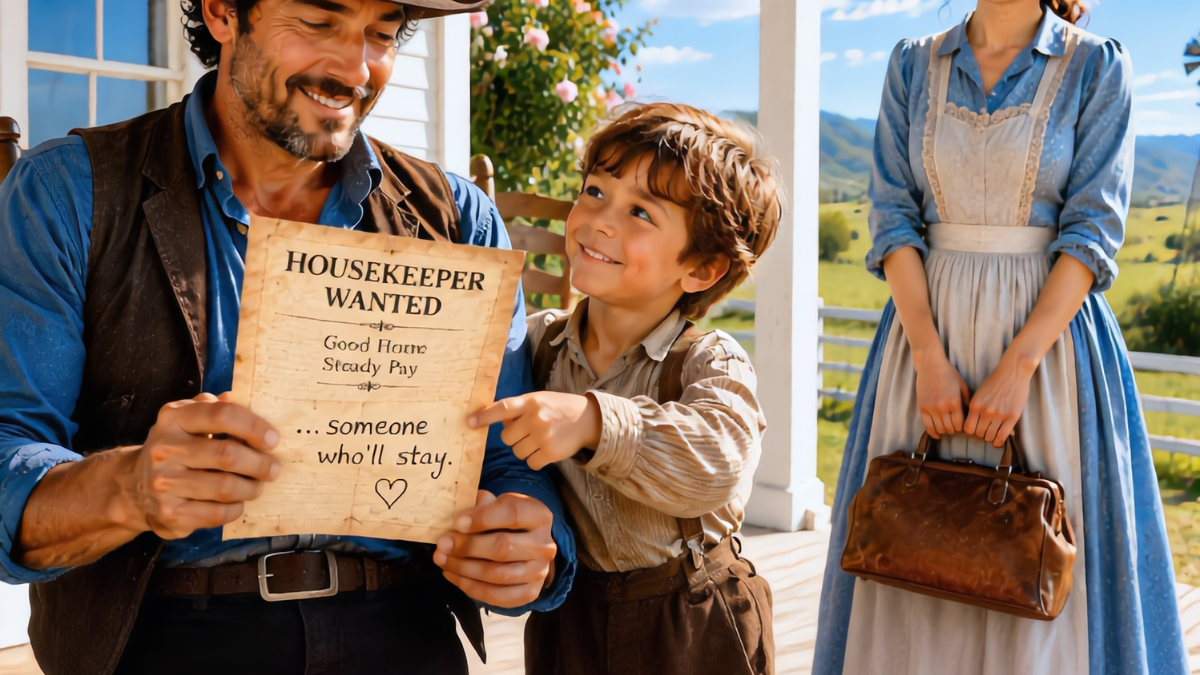
Harmon looked down at the advertisement. At the bottom,
Thomas’s letters sloped slightly upward, as though he had been trying to fit his hope into the little space left on the page.
For months Harmon had told himself that hiring help would set the household right.
The work did need doing. But Thomas had seen something beneath the neglected stove and uneven meals,
something Harmon had been afraid to name. He missed Eleanor.
He also missed sharing a home with someone who wanted to be there.
“This house has had love in it all along,” Louisa said.
“You and Thomas have kept it that way through a hard two years.
I think you’ve both been waiting for it to feel like a home again.”
Harmon leaned back in his chair.
He had watched Louisa take care of daily things without making a show of them: a dry place for Thomas’s boots, a meal held warm when barn work ran late, a question asked when she truly wanted his opinion.
He had come to look for her at the table after supper.
Even on quiet evenings, he found reasons to stay in the kitchen a little longer.
“I haven’t made this easy for you,” he said. “I know I can be exacting.”
“You can. I’ve had two months to learn it.”
He let out a short laugh. “And you’re still sitting here?”
“I am.”
He grew serious again. “I don’t want you to feel you must stay because Thomas asked you to. Or because I hired you.”
“I wouldn’t,” Louisa said. “Thomas’s words brought me here. I’ve made my own choice each day since.”
Harmon reached toward the advertisement, then stopped. There was something he wanted to say that no notice could ask on his behalf.
“Louisa, I would like to know whether we might make a life together. I want to ask you properly, beyond the arrangement we made about the house. You can take whatever time you need.”
“I know what you’re asking.”
He held her gaze. “Will you stay with us?”
“Yes,” she said. “I’ve wanted to for some time. I was waiting until you asked.”
Harmon felt the relief of it before he could find another word. Louisa’s hand rested on the table. He offered his, and she put hers in it.
“I want Thomas to hear it from both of us,” he said.
“He will. He has been watching the two of us rather closely.”
“He has?”
“He told me this morning that his papa might ask me something important tonight.” Her smile widened. “He hoped I would say yes.”
Harmon shook his head, smiling now too. “He could have warned me.”
“He may have thought you needed to work it out yourself.”
They sat together awhile, making no promises on Thomas’s behalf and no plans they had not discussed.
Outside, the October wind eased. Inside, the stove settled with a soft tick.
Harmon thought of Eleanor. Her cup was still in the cupboard where she had kept it.
She had loved this kitchen and the house her father had built. For a long time,
Harmon had feared that letting anyone else close would mean putting her memory away.
Louisa followed his glance toward the cupboard.
“Tell me about her sometime,” she said.
He turned back to her. “I’d like that.”
He spoke a little that night. Eleanor had laughed when a foal sneezed.
She could tell by the sound of the wind when rain would reach the back pasture.
Thomas had her eyes, and, when he decided something mattered, her determination.
Louisa listened. She asked what Eleanor had called the old brown mare in the barn.
Harmon told her, and the story led to another.
When they rose at last to bank the stove, he felt glad he had said his wife’s name aloud.
On Sunday morning, Thomas came down to find Louisa at the stove and his father already seated at the table. Both looked up.
He took his place and ate his eggs and bread.
He was trying to wait patiently; Harmon could tell by how carefully he cut each bite.
When breakfast was finished, Harmon said, “Miss Crane and I talked last night.”
Thomas set down his cup.
“I asked whether she’d like to stay and make a life here with us,” Harmon said. “She said yes.”
Thomas looked at Louisa. “You chose to?”
“I did.”
“For how long?”
Louisa came to sit near him. “I’m planning for winters after this one, if you and your father still want me here.”
“I do,” Thomas said at once.
“I do too,” Harmon said.
Thomas got out of his chair and came around the table.
He put one hand on his father’s arm and rested the other on Louisa’s. The three of them stayed like that for a moment.
Then Thomas looked at Harmon. “I wrote on your letter without asking.”
“You did. Next time, tell me what you need before you borrow my pen.”
“I can do that.”
Harmon covered his son’s hand with his own. “You can tell me without a letter, too.”
Thomas nodded. He had spoken plainly once, on paper, and someone had heard him.
Harmon wanted him to know there would be people at the table to hear him next time.
After breakfast, Thomas fetched his coat and went out to feed the chickens.
Through the window, Louisa and Harmon watched him explain something to the birds as he scattered grain.
“He says they come sooner if he tells them why it’s breakfast time,” Louisa said.
“He might be right.”
Louisa poured coffee into two cups and took the chair across from Harmon.
Soon Thomas would come in with cold hands and news from the chicken yard.
Louisa might ask him to carry in wood. Harmon would have work in the barn before noon.
The day felt full of familiar things they wanted to do together.
Outside, Thomas turned toward the window and waved. Louisa raised a hand to him.
Harmon waved too, and his son went back to his chickens.
(Disclaimer: This story is entirely fictional and created solely for entertainment purposes. It does not represent any real organization or individual, nor does it encourage inappropriate behavior. Content created with the assistance of artificial intelligence.)








