“Give Her Ten Seconds,” the Foreman Mocked—Then the Unrideable Mare Dropped to Her Knees
Part 2
Orson still refused to cancel the sale.
Thursday morning, buyer Holt arrived from Billings.
Elo brought Sable into the corral.
She worked slowly.
Saddle pad.
Saddle.
Cinch tightened in stages.
Every time Sable stiffened, Elo waited.
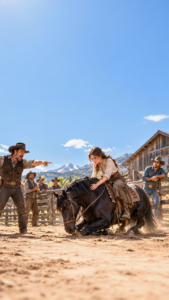
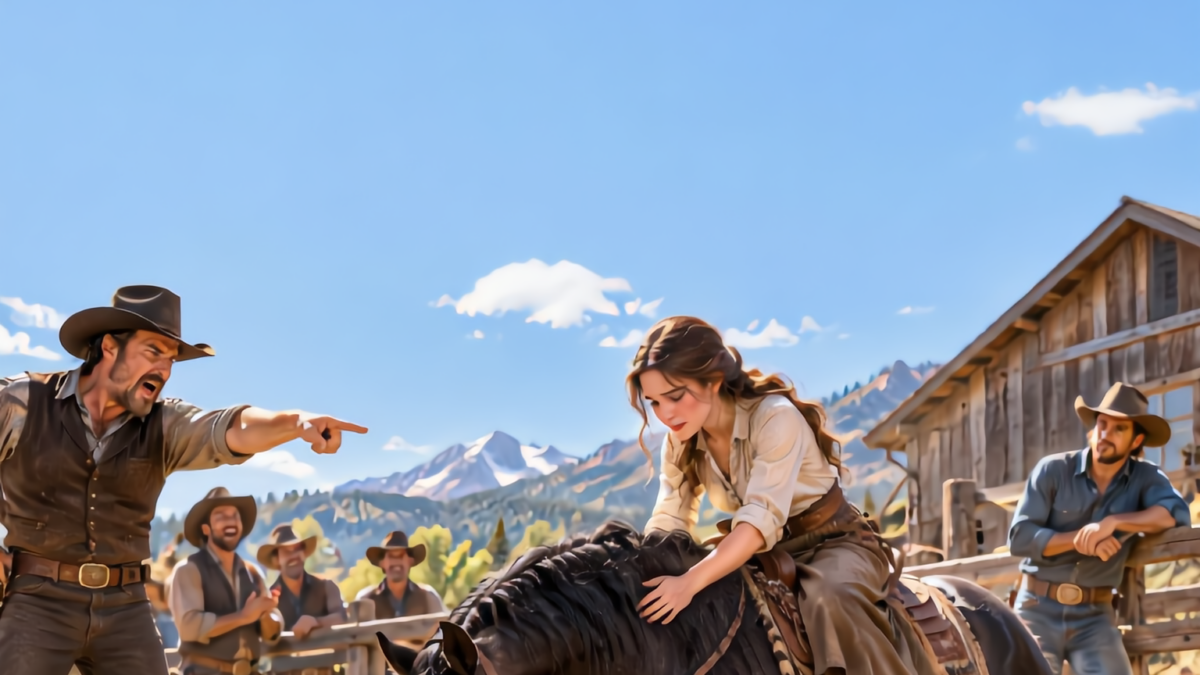
Then she mounted.
Ten seconds passed.
Twenty.
Thirty.
At forty seconds, Sable lifted her head.
Her ears moved forward.
Elo asked for one careful circuit.
The mare walked.
Unevenly.
Slowly.
But she walked.
When Elo dismounted, Sable pressed her muzzle against her chest.
Nobody spoke.
Holt finally looked at Orson.
“You sold me an unbreakable kill horse.”
He nodded toward Sable.
“That isn’t what I’m seeing.”
“She’s damaged.”
“She’s healing.”
Holt picked up his hat.
“I didn’t come for a sound horse.”
Then he left.
Sable was safe.
For now.
Days later, Elo overheard Orson behind the barn.
Holt’s name.
A lower price.
Paperwork dated before the demonstration.
Condition won’t matter.
Elo went cold.
Orson planned to make the sale appear legally completed before she could stop him.
She found Wade.
“He’s moving the paperwork.”
Wade’s expression hardened.
“If the owner isn’t paying attention, Orson could force it through.”
Elo stared.
Then pieces began clicking together.
This barn is my concern.
The unexplained authority.
The questions about ranch operations.
The grandfather who had left Wade something unexpected.
“The owner isn’t in Helena, is he?”
Wade looked directly at her.
“No.”
“You own Copper Ridge.”
“My grandfather died in January.”
He exhaled.
“I inherited the ranch in February.”
Elo stared.
“You came here pretending to be a hired hand?”
“I needed to know what kind of ranch I actually inherited before I walked in and started giving orders.”
“You let me believe you were a cowboy with nothing to do with any of this.”
“Yes.”
“Why tell me now?”
“Because now it concerns you.”
His voice softened.
“And because stopping Orson with authority you didn’t know I had would make me another man deciding what you should understand.”
The next morning, Wade voided Sable’s sale.
But Copper Ridge barely had time to absorb the revelation.
Weeks later—
thunder exploded over the ranch.
Five hundred cattle panicked.
The herd began stampeding toward the weak north fence.
Beyond it—
a ravine.
Men scrambled for saddles.
There was no time.
Elo ran to Sable.
Opened the gate.
Wade shouted through the rain:
“Elo, don’t!”
She grabbed Sable’s mane.
Swung onto her bare back.
The mare went rigid.
Elo pressed one palm against the old scar.
“Trust me.”
Sable breathed once.
Twice.
Then launched toward the stampeding herd.
Part 3
Sable ran as if she remembered what she had been before fences.
Before saddles.
Before pain.
Before men decided fear meant rebellion.
Rain struck Elo’s face so hard she could barely see.
Ahead, hundreds of cattle thundered toward the damaged northern fence.
Beyond that fence waited the ravine.
Wade raced along the opposite flank on a bay horse.
“Take the left!”
Elo understood.
They could not stop five hundred terrified animals.
They had to turn the leaders.
Sable reached the herd.
A steer broke sideways.
The mare stumbled—
caught herself—
and kept running.
Elo buried one hand in Sable’s mane.
“Come on!”
The fence rushed closer.
Fifty yards.
Forty.
Thirty.
Elo pushed Sable toward the lead cattle.
Wade came from the right.
Together they compressed the herd’s direction.
One degree.
Then another.
The leaders fought the turn.
Sable drove harder.
Twenty yards from the fence—
the first steer broke right.
Another followed.
Then ten more.
Suddenly the entire herd began bending east.
Like water finding a new channel.
The mass swept past the damaged fence.
Past the ravine.
Into the open meadow.
Elo finally pulled Sable down.
The mare stood beneath her trembling, sides heaving.
But alive.
The cattle were alive.
Elo laughed once from sheer disbelief.
Then she heard a horse fall.
Her blood froze.
“Wade?”
No answer.
She turned Sable.
Lightning lit the field.
The bay stood riderless.
Thirty feet away—
Wade lay in the mud.
Elo slid from Sable before the mare fully stopped.
She dropped beside him.
“Talk to me.”
His eyes opened.
“I’m…”
He winced.
“Still here.”
“Where does it hurt?”
“Everywhere.”
“Useful.”
He tried to sit.
Elo pressed one hand against his chest.
“Stay down.”
“The herd?”
“East meadow.”
“We turned them.”
His face loosened.
“You turned them.”
“We.”
Elo looked toward Sable.
Rain ran down the black mare’s body.
She stood quietly in the storm.
No wall behind her.
Nothing holding her.
No rope.
She had stayed anyway.
Wade looked too.
“She went bareback.”
“The saddle would’ve taken too long.”
“You could have been killed.”
“So could five hundred cattle.”
Wade stared at her.
Then laughed weakly.
“You are impossible.”
“You hired me.”
“Technically Orson did.”
“Then blame him.”
That made Wade laugh harder, which hurt his shoulder, which made him immediately regret it.
Elo helped him stand.
For one moment, they ended up close.
Her hand in his.
Rain pouring over both of them.
Neither let go immediately.
The morning after the storm, Copper Ridge looked battered.
Fence posts leaned.
Water channels overflowed.
Part of the barn roof needed repair.
But the herd was intact.
And Sable was sound.
Elo ran her hands along the mare’s left side.
No swelling.
No new injury.
The scar remained.
It always would.
But the scar was not the whole horse.
Wade arrived with his arm in a makeshift sling.
“You went to a doctor?”
“The kitchen.”
“That is not a doctor.”
“It had cloth.”
“You own a ranch and somehow have the medical judgment of a fence post.”
Wade smiled.
Then his expression became serious.
“I need to tell you something else.”
Elo crossed her arms.
“At this point I’m afraid to ask.”
“The ranch is in trouble.”
That wiped away the humor.
Wade explained.
His grandfather had borrowed heavily against Copper Ridge.
Debt had compounded.
The cattle operation was solid—
but not enough.
“I need another source of revenue before spring.”
Elo waited.
“I want to use the north pasture barn.”
“For what?”
“Horses like Sable.”
Elo went still.
“Damaged horses other ranches have given up on.”
“Bring them here.”
“Rehabilitate them.”
“Sell them back into appropriate work.”
Wade looked at her.
“You know how to do something this ranch does not.”
“And there are horses all across this territory losing value because people are treating fear like stubbornness.”
“It is not charity.”
“It has to pay for itself.”
“But I think it can.”
Elo studied him.
“And you want me to run it?”
“Yes.”
“Not Orson?”
“You.”
“Full authority over the horsework?”
“Yes.”
“I decide when an animal is ready?”
“Yes.”
“I’m allowed to tell the owner of Copper Ridge when he’s wrong?”
Wade almost smiled.
“I imagine preventing you from doing that would be impossible.”
Elo looked toward Sable.
Weeks earlier, she had arrived with eleven cents.
Now someone was asking her to build something.
Not giving her a place out of pity.
Trusting her with responsibility because she had earned it.
“I’ll do it.”
Wade held out his hand.
They shook.
A business agreement.
Nothing more.
Except neither released immediately.
Orson surprised her.
The morning after the storm, he stood beside the north fence watching the repair crew.
Then he said:
“The mare held.”
Elo looked over.
“She ran in a stampede with a rider on her back.”
“Bareback.”
“Yes.”
Orson stared toward the south corral.
“I’ve been here sixteen years.”
He paused.
“I wouldn’t have given her that chance.”
Elo said nothing.
“I was wrong about the horse.”
Another pause.
“I may have been wrong about some other things.”
Then he walked away before she could answer.
Martinez appeared beside her.
“Did Orson Pike just apologize?”
“Something close.”
Martinez watched the foreman disappear.
“Huh.”
It was not redemption.
Orson had not magically become gentle.
But something had cracked.
Sometimes change began there.
The north pasture barn became Elo’s project.
She cleaned two years of abandoned tack from the stalls.
Designed a separate feeding area.
Planned a round pen.
Wade appeared every evening with coffee.
He rarely offered advice unless asked.
One evening, Elo showed him her sketch.
“This is more than what I described,” he said.
“Is it more than you can build?”
“No.”
He pointed toward the round pen.
“This makes the program permanent.”
Elo met his eyes.
“I don’t build temporary things.”
Wade studied her.
Then nodded.
“Neither do I.”
The first rehabilitation horse was a four-year-old gelding named Copper.
He had fallen badly during a roundup.
Three trainers tried working him afterward.
All failed.
For eight months, he stood in a paddock avoiding people.
Elo rode Sable eight miles to assess him.
The owner watched skeptically as Elo entered Copper’s paddock—
and sat on the ground.
Forty minutes passed.
Copper took three steps closer.
After more than an hour, he stood within six feet.
Eventually his breath touched Elo’s shoulder.
“You’re not bad,” she whispered.
“You’re hurt.”
Copper lowered his head.
Elo bought him.
When she returned to Copper Ridge, leading Copper beside Sable, Wade was standing at the main gate.
Coincidence would have been possible.
Elo did not believe in that much coincidence.
“You bought him.”
“You said you’d front the purchase.”
“I did.”
Wade walked slowly around Copper.
“How long?”
“Three or four months.”
“That long?”
“If you want quick, sell him for meat.”
Wade immediately shook his head.
“Three or four months.”
That answer told Elo everything she needed.
Later that evening, Wade led her behind the north barn.
Four post holes had already been dug for the round pen.
She looked at him.
“You said the crew starts next week.”
“I said they start next week.”
He pointed toward himself.
“I started today.”
“Your shoulder.”
“Fine.”
“It is not fine.”
“Manageable.”
Elo stared at him.
“Go eat.”
Wade actually obeyed.
That worried her more than if he had argued.
The months that followed changed Copper Ridge.
Copper improved.
Another horse arrived.
Then another.
A young mare believed to have a rope problem turned out to have impaired vision in her left eye.
Once the problem was understood, most of the “bad behavior” vanished.
Even Orson began sending difficult ranch horses to Elo.
One morning, he stood outside the round pen watching Copper move.
“He’ll make a good cutting horse.”
Elo glanced at him.
“That’s what I think.”
Orson hesitated.
“I’ve got a gelding in the east barn that flinches when approached from the left.”
“Bring him tomorrow.”
No speech.
No apology.
But he brought the horse.
That was enough.
By late summer, Wade came to Elo at the north barn with his hat in both hands.
That immediately made her suspicious.
“What?”
“I need to tell you something.”
“You already told me you secretly owned the ranch.”
“Yes.”
“And nearly went bankrupt.”
“Correct.”
“What could possibly remain?”
His mouth moved slightly.
“This.”
Elo waited.
Wade looked directly at her.
“This stopped being only about Sable.”
Silence.
“And the rehabilitation barn.”
More silence.
“For me.”
He took a breath.
“I know you work here.”
“I know I own Copper Ridge.”
“I don’t want those facts used to pressure you.”
“So I’ve been trying to decide whether saying nothing was more honorable.”
“And?”
“It isn’t.”
He looked almost uncomfortable.
“I think about you when you aren’t there.”
“The storm.”
“The ridge.”
“The mornings.”
“The way you look at a horse everyone else has stopped seeing.”
His voice softened.
“I needed you to know.”
Elo stared at him.
Three feet separated them.
Exactly enough space for choice.
She thought about the second coffee cup.
The lamp Wade had hung on the barn door so she would not cross the dark yard alone.
The mounting block he built without announcing it.
The post holes dug one-handed.
The way he listened.
The way he had never once told her everything would be fine when he could not know that.
“I know,” she finally said.
Wade’s face changed.
“It stopped being only about the ranch for me too.”
He exhaled like a man who had been holding his breath for months.
“Okay.”
“Okay.”
Neither moved closer.
Not yet.
Some things deserved time.
Copper sold in October.
The price covered the amount Wade had calculated.
Barely.
But enough.
Wade showed Elo the check.
She read it.
Looked up.
“The next one.”
“The next one,” he agreed.
By spring, the North Barn had a waiting list.
Thirteen horses.
Elo rejected two because their problems fell outside what she could safely treat.
It cost the ranch money.
Wade supported the decision.
Word spread that Copper Ridge did not promise miracles.
It promised attention.
Honest assessment.
Patience.
For frightened horses, that turned out to be rarer than grand promises.
A year after Elo first arrived with eleven cents, Wade asked her to ride with him to the ridge above Copper Ridge.
Sable carried Elo.
Loose reins.
Relaxed gait.
The old scar remained beneath her coat.
But it no longer dictated every movement.
At sunset, Wade dismounted.
He took Elo’s hand.
No audience.
No dramatic speech.
Just the directness she had come to trust.
“You changed this ranch.”
Elo shook her head.
“We changed it.”
“Yes.”
Wade smiled.
“You changed me too.”
“That sounds dangerous.”
“Probably.”
Then:
“Marry me.”
Elo did not answer immediately.
She looked toward Sable.
The mare stood untethered several yards away.
No wall.
No locked stall.
No rope.
Free to leave.
Instead, Sable walked toward Wade.
Pressed her muzzle against his shoulder.
And stayed.
Elo laughed.
Her eyes filled.
“That is unfair.”
“What?”
“She’s voting.”
“I didn’t train her to do that.”
“You couldn’t.”
Elo took Wade’s face between her hands.
“Yes.”
They married beneath the cottonwoods beside the creek.
Martinez served as witness.
Orson attended quietly from the back.
He wisely gave no speech.
Sable was never sold.
Never bred simply because her bloodline could make money.
She spent her life moving between the south corral, north pasture, and open trails.
Some days she carried Elo.
Some days she did absolutely nothing.
Both were acceptable.
The North Barn expanded the following year.
Then again.
Elo trained an apprentice.
The ranch survived.
Not easily.
There were difficult accounts.
Horses they could not save.
Arguments between Elo and Wade.
Winters that cost too much.
Summers with too little water.
Real life did not transform into perfection because one mare learned to trust again.
But it became something Elo had nearly stopped believing she could have.
A place where her work mattered.
A man who listened.
A horse who stayed because she wanted to.
Ground beneath her feet that felt earned rather than borrowed.
Years later, ranchers still told the story of the impossible black mare.
They usually started with Orson Pike’s challenge.
Ten seconds.
They talked about the moment Sable dropped to her knees at nine.
Some called Elo a miracle worker.
She always corrected them.
“There was no miracle.”
Sable had told everyone what was wrong from the beginning.
In the only language she possessed.
She froze.
She panicked.
She threw riders when pressure hit the scar.
Men called it defiance because defiance was easier to punish than pain was to investigate.
Elo simply stopped long enough to notice.
That was all.
And perhaps—
that was everything.
Because Sable was not the only one who had spent years bracing for the next bad thing.
Elo had too.
She had lost her father’s farm.
Lost security.
Learned to walk six miles rather than expect someone to wait.
Learned not to build her life around people because people could disappear.
Then Copper Ridge taught her something Sable already knew.
Trust did not mean believing nothing painful would ever happen again.
The scar remained.
Storms still came.
People still failed.
Trust meant discovering that after something hurt—
the next hand might be different.
That pressure might release.
That the gate might stay open.
That you could leave—
and still choose to remain.
On their anniversary, Elo and Wade rode to the ridge.
Always Sable beneath her.
Always loose reins.
Sometimes the black mare stopped before Elo asked.
Elo let her.
Sometimes she chose another path.
Elo followed.
The old scar was still there.
But it was no longer the whole story.
And whenever someone asked Elo Hartley Merrick what Sable had taught her, she gave the same answer:
Fear is not failure.
Frightened is not broken.
And sometimes the thing everyone has given up on does not need another person strong enough to force it.
It needs someone patient enough to sit down—
be still—
and wait long enough to be trusted.
🐎❤️🌄
(Disclaimer: This story is entirely fictional and created solely for entertainment purposes. It does not represent any real organization or individual, nor does it encourage inappropriate behavior. Content created with the assistance of artificial intelligence.)








