“I Wasn’t Lost. I Needed Them to Believe I Was.” The Missing Reporter Hiding in a Mountain Cabin With a 12-Week-Old Puppy
Part 2
She told it in the order she’d verified it, which I learned was the only order she trusted.
Three years earlier, the Ledger had sent her to interview a retired K9 handler for a weekend feature.
The dog slept under the kitchen table and stole toast.
Clare wrote the story she was assigned, then another, and her series, After the Vest,
became a record of what happens to working dogs when the job ends.
She’d never trained one. She just knew exactly where her knowledge stopped. I told her that was rarer than she thought.
The trouble started with a company called Sentinel Ridge Working Dogs, owned by a man named Graham Voss.
Retired dogs listed as placed somewhere that never received them. A dog turning up in promotional photos under a different name.
Clerical errors, she’d assumed. Then the same errors kept repeating.
Once, after she’d called a sheriff’s office about a single dog, that dog’s records changed within hours.
In blue ink, she’d boxed one sentence: Someone is warning them. After that she stopped calling local law enforcement.
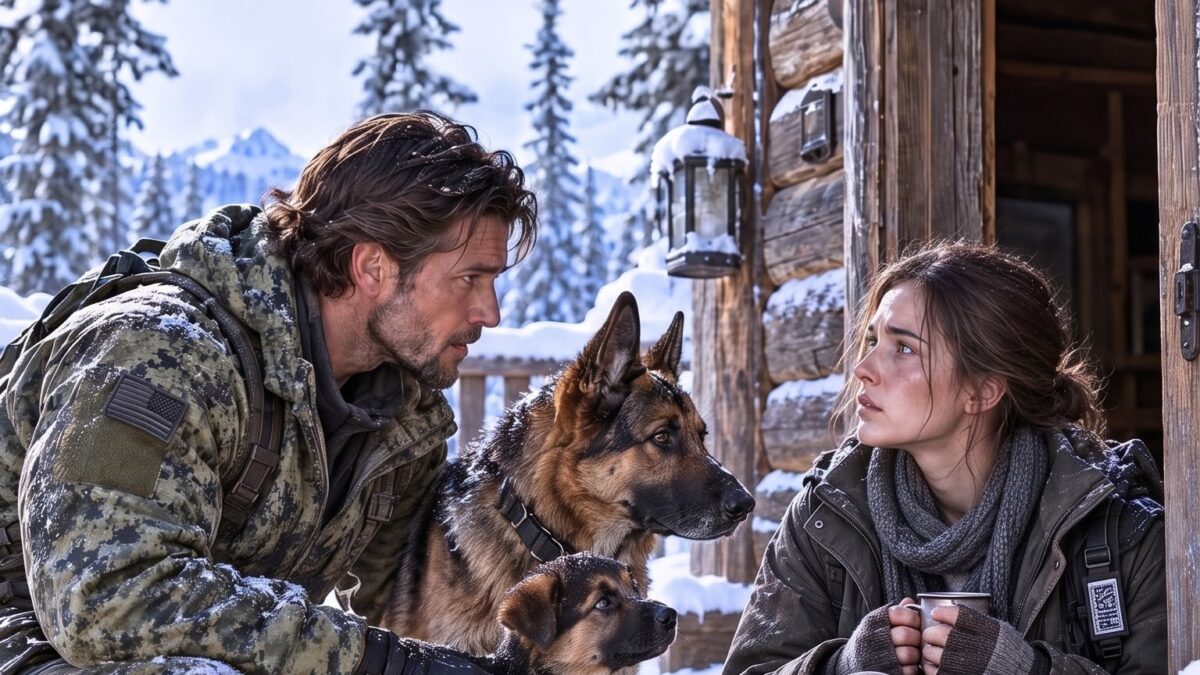
Then her SUV left the road. She didn’t say how, and I didn’t push. She walked to Walter’s cabin with Milo.
Search teams found the vehicle. The county mourned.
And the men she’d been watching relaxed. While they believed she was gone, they moved dogs like nobody was looking.
She had spent a month writing it all down.
“There’s a backup,” she said. A weatherproof case in Walter’s old training shed, miles off. “If the road opens, I need it.”
We got it the next morning.
On the drive back, I noticed fresh tire turnarounds at two dead-end spurs,
and pink survey ribbon on saplings where Walter only ever used orange.
It could be utility crews. It could be nothing. I told Clare exactly that. She looked back toward the cabin she’d controlled for a month, and went quiet.
“Staying here had a reason yesterday,” I said. “Today it has less of one.”
She didn’t answer right away. Then she asked how far my place was from Sentinel Ridge.
I didn’t know yet that the name appearing page after page in her files wasn’t a dog’s.
Part 3
Clare stayed at my house outside Harmon. Two days turned into weeks, and nobody mentioned the arithmetic. She slept almost ten hours the first night. Milo spent that week trying to move into Rook’s bed. Rook relocated three times, then surrendered.
Her case needed people who remembered the dogs before the paperwork changed, and that was my side of the work. I called handlers and trainers with ordinary questions. What did he look like in good light? Did she sit a little crooked? How did he act around vehicles? Some answers gave Clare nothing, and that mattered too. Within a week, her list of twenty-odd questionable dogs shrank to nine solid ones.
I made mistakes. After a hard call, Clare went quiet, and I started laying out three next steps. She let me finish two. “Not everything needs a plan right away.” I stopped. The next morning I still made breakfast. I just quit arranging her day while I did.
One case wouldn’t settle. Ekko, a yellow Lab, had been transferred without his county’s approval. But he’d spent a year working with a volunteer search team whose handler had done nothing wrong. “The truth can’t change because the outcome is inconvenient,” Clare said. “No,” I said, “but correcting a lie doesn’t always mean reversing every mile that came after it.” Neither of us won. She moved his folder into its own stack, not cleared, not resolved.
Then a name kept surfacing. Deputy Evan Pike’s signature appeared on five transfers. She sent documents, not conclusions, through the Ledger’s attorney to investigators outside the county. We also drove out to meet Tom Callahan, a retired deputy whose dog Bishop had gone to “temporary placement” during Tom’s surgery and never came back. Tom kept Bishop’s worn leash by his mudroom door and used it, he said, with no ceremony. Clare promised only to check.
The expo was twelve days off, at a working dog center in Elkins, with Sentinel Ridge on the vendor list. Clare didn’t plan to confront anyone. She planned to watch. “Paperwork can be dismissed as error,” she said. “A handler recognizing a dog changes the conversation.”
At the expo, Voss saw her come through registration. His sentence stopped for a second, then he finished it.
She went to the dogs first. One retired handler recognized a scar on a shepherd’s rear leg. Then Ben Keller, a former deputy, stood in an aisle where a Sentinel Ridge card read Ranger, seven years old, no previous service. Ben gave a quiet cue. The dog turned, walked to the end of his lead, sat at Ben’s left side, and pressed his muzzle into Ben’s palm. Atlas. Nobody applauded. The room just changed.
Voss came over. “Ms. Mercer. I’m glad you’re all right. I imagine some of these records look more connected than they really are.”
She didn’t answer the remark about her state of mind. “There are dogs here with histories that don’t match the people who trained them.”
By noon, two investigators had arrived. Sentinel Ridge began “schedule adjustments,” and crates rolled toward vans.
In the quiet room, Milo stood at the gate whining at a large female passing in the corridor. The tag read Nova. Clare pulled up the shelter photo from Milo’s intake, a litter surrendered through a third party. At the edge of the frame, an adult female was being led away. She asked the investigators to hold Nova for verification. The van stayed. Records later confirmed the link. Milo hadn’t solved anything. He’d just made Clare look twice.
Pike was working the event as law enforcement liaison. When investigators asked for archived transfer records, Voss saw him across the hall. Neither man moved. Then Pike took a key card from his belt and opened the archive room. No speech. Just a door that had stayed shut too long.
Around two, I saw Voss cross toward a side lot with a black hard case. I knew the winter road he’d take to his property from a clinic I’d taught there once. I gave the route to an investigator and didn’t follow. Twenty minutes later, they’d stopped him.
Nobody cheered. Clare sat on a folding chair with Milo asleep across her boots and a coffee going cold. I almost reminded her. Then I looked at the room, and let it be.
Voss was charged with fraud and theft. Pike cooperated. Clare learned later that his mother’s medical bills had pushed him into debt. Voss’s first favor was small, a date changed, and each one after became leverage. She didn’t write a forgiveness scene. Understanding a bad decision doesn’t make it harmless.
Ekko stayed with the handler he trusted, and the paperwork was corrected around him. Watching him work weeks later, Clare closed her notebook without a conclusion.
Bishop turned up at a legitimate facility several states away, living under another name. When Tom met him, there were no cameras. Bishop stood at the end of a loosened lead, gray in the muzzle, and looked. Tom said, “Bishop.” One ear shifted, then both. “With me, buddy.” The dog crossed the yard, sat at Tom’s left, and pressed his muzzle into his palm. “Yeah,” Tom said quietly. “That’s where you belong.” I looked away. So did Clare.
Her article ran days later. She put Bishop near the end, where it felt honest. Then she went back to Morgantown and her newsroom desk, and Milo went with her.
At first we saw each other because there was still work. Later, we didn’t need the reason. By late winter, the snow was pulling back from my gravel. Clare arrived with Milo, longer-legged now, his ears finally agreeing on a direction. She stopped when she saw two dog beds beside the stove.
She looked at the smaller one. Then at me. I said nothing. I took down the mug she’d left on her last visit and filled it without asking how long she’d stay.
Milo inspected his own bed for nearly three minutes. Then he walked across the room, turned twice beside Rook, and pressed himself against the older shepherd. Rook stayed where he was.
I still think about Tom’s worn leash by that door. It wasn’t framed or hidden away. It was just there, among coats and boots, and somehow that felt more true than anything grand could have. Loyalty usually lives in small habits like that: a place left open beside a chair, a name said the same way after a long absence, a dog settling into the spot it always knew.
Disclaimer: This story is entirely fictional and created for entertainment purposes only. It does not represent any organization or individual, nor does it encourage inappropriate behavior. The content was generated with AI assistance.








