The Orphan Train Left One Girl Behind — Until a Lonely Cowboy Walked Up and Said, “I Choose Her.”
PART 3
Monday arrived under a gray Kansas sky.
The courthouse in Harmon was full before the doors opened.
People had heard the story.
A cowboy.
A scarred orphan girl.
A powerful agent who claimed he had the law on his side.
Everyone wanted to know what would happen.
Would Miriam be sent away?
Would Emmett lose everything?
Or would the girl nobody wanted finally get the family she deserved?
Miriam sat in the front row.
Her dress was simple.
Her scar visible.
She refused to hide it.
Not anymore.
Across the room, Aldridge sat confidently beside his lawyer.
He believed he had already won.
Men like him were used to winning.
They knew how to make cruelty sound official.
The hearing began.
Aldridge’s lawyer spoke first.
He talked about rules.
Regulations.
Procedures.
He described Emmett as reckless.
A lonely rancher who acted on emotion.
He described Miriam as vulnerable.
A child who could not know what was best for herself.
But every time he spoke about her…
He never looked at her.
Not once.
Then Judge Harlan turned toward Emmett.
“Your response?”
Emmett stood.
He did not bring a fancy lawyer.
He did not bring expensive papers.
He simply brought the truth.
“Your Honor, I came to Harmon Station because I heard a boy needed a home.”
The courtroom became quiet.
“But I saw twelve children standing there.”
He looked at Miriam.
“And eleven people saw a child worth choosing.”
His voice softened.
“But one child was left behind.”
Miriam lowered her eyes.
Emmett continued.
“She was not left behind because she was difficult.”
A pause.
“She was left behind because people decided her pain made her less valuable.”
Nobody spoke.
“She had a scar.”
He looked at the crowd.
“So did I.”
The room became still.
“I lost my wife and daughter in a fire four years ago.”
Miriam looked at him.
She knew his story.
But hearing him tell it aloud felt different.
“I spent years believing grief was something I had to carry alone.”
Emmett looked toward the judge.
“Then I met a girl who survived the same kind of fire.”
His voice cracked slightly.
“And I realized I was not the only person who needed a second chance.”
Aldridge’s lawyer stood.
“Emotional stories do not change the law.”
“No,” Emmett replied.
“But the truth does.”
He reached into his coat.
And removed a letter.
“This was found with Miriam when she arrived.”
Judge Harlan took it.
She read.
The room waited.
The letter was from Miriam’s mother.
It confirmed her true age.
Her identity.
Her family history.
And her wish that whoever cared for her would keep her safe.
Judge Harlan looked at Aldridge.
“Why was this child’s age changed?”
Aldridge shifted.
“I cannot speak to paperwork errors.”
“Errors?”
The judge’s voice hardened.
“You transported a thirteen-year-old child under false records.”
Aldridge’s lawyer opened his mouth.
But Emmett interrupted.
“There is more.”
He placed another document on the table.
“Records from the Topeka Industrial School.”
The room changed.
Because everyone understood.
This was not about guardianship.
It was about money.
The school paid agents for every child delivered.
Healthy children.
Young workers.
Miriam was not a mistake.
She was profit.
The color disappeared from Aldridge’s face.
Judge Harlan turned to him.
“Is this true?”
Silence.
That was the answer.
The sheriff looked away.
The crowd began whispering.
The same people who once ignored Miriam now saw the truth.
She was never damaged.
She was exploited.
Finally, Judge Harlan looked toward Miriam.
“Miss Holt.”
Miriam stood.
Her hands trembled.
But she stayed standing.
“Do you wish to remain with Mr. Ward?”
Everyone waited.
This was the moment.
The choice.
The one she had never been given.
Miriam looked at Emmett.
The man who did not rescue her.
The man who chose her.
“Yes.”
Her voice was clear.
“I choose him.”
Judge Harlan nodded.
“Then I grant guardianship to Mr. Emmett Ward.”
The gavel fell.
And something inside Miriam finally relaxed.
She was no longer waiting to be picked.
She had chosen.
Outside the courthouse, Nathan was waiting.
He ran toward her.
“Miriam!”
She hugged him.
He had grown.
Not much.
But enough.
“I told Mrs. Greer about you,” he said.
“She says you look happy.”
Miriam smiled.
“I am.”
Nathan looked at Emmett.
“Is he your family now?”
Miriam looked at the cowboy.
Then at the ranch road waiting beyond town.
“Yes.”
She paused.
“He is.”
Spring came softly that year.
And with it came a new garden.
Miriam planted flowers beside the house.
She planted vegetables.
She planted things that needed patience.
Things that needed care.
Things that proved something could grow after surviving fire.
She learned to read.
She went to school.
She learned riding.
She learned she was good with animals.
The horses trusted her.
Maybe because they understood what people often forgot.
Fear did not mean weakness.
Pain did not mean broken.
One evening, years later, Miriam sat on the porch beside Emmett.
The prairie stretched golden beneath the sunset.
“You know,” she said, “I used to think home was a place.”
Emmett smiled.
“What do you think now?”
She looked toward the house.
The room facing east.
The table where nobody counted her worth.
The door that always opened.
“Home is where someone sees all of you.”
She touched her scar.
“And stays.”
Emmett looked away for a moment.
His eyes were wet.
“My daughter Lucy would have liked you.”
Miriam smiled.
“I think I would have liked her too.”
“She would have called you brave.”
Miriam laughed softly.
“I’m not brave.”
“Yes, you are.”
“No.”
She shook her head.
“I was just tired of being afraid.”
Emmett smiled.
“That might be the bravest thing there is.”
Years later, people in Harmon remembered the story.
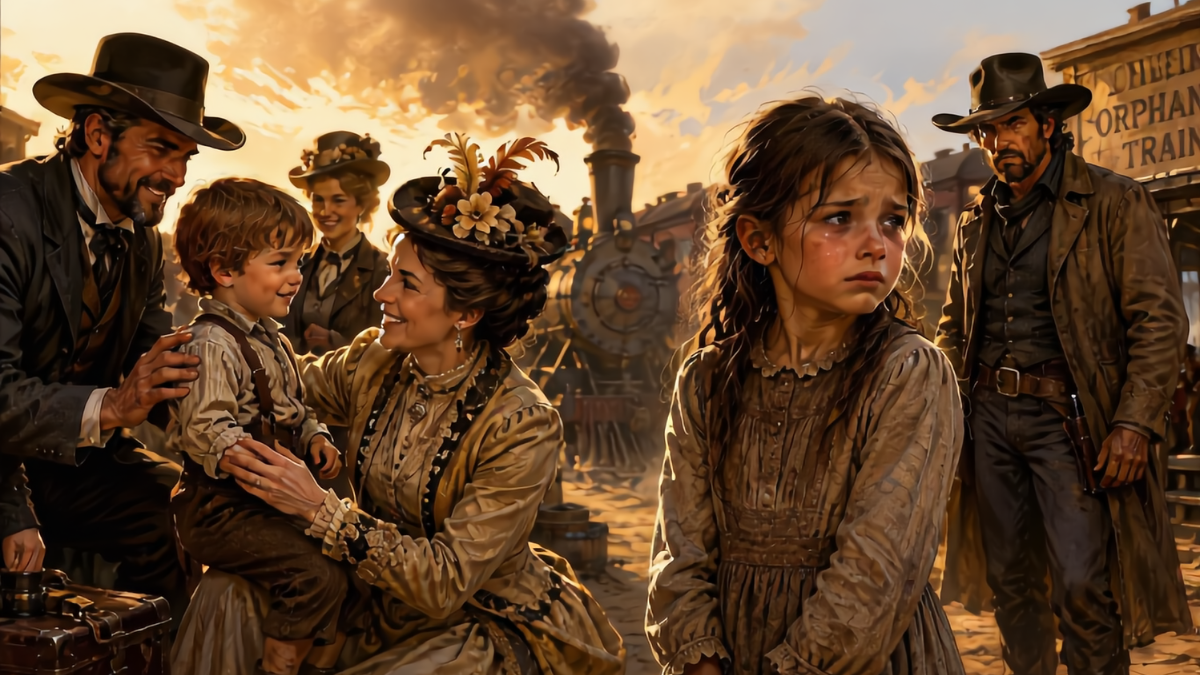
They remembered the orphan train.
The little boy everyone wanted.
The girl nobody chose.
And the cowboy who looked at the end of the line and saw a person instead of a problem.
Miriam never forgot that day.
Not because she was saved.
But because someone finally gave her the thing every child deserves.
A choice.
She later wrote letters to the Children’s Aid Society.
She fought for children who were still standing at the end of the line.
Children with scars.
Children with difficult stories.
Children who believed nobody would choose them.
And every time someone asked her why she cared so much, she gave the same answer:
“Because I know what it feels like to wait for someone to see you.”
The little girl who once stood alone on a train platform became the woman who made sure others were never invisible again.
And the cowboy who chose her learned something too.
Sometimes the person you save…
Is the person who saves you back.
❤️
Disclaimer: This story is entirely fictional and created solely for entertainment purposes. It does not represent any real organization or individual, nor does it encourage inappropriate behavior. Content created with the assistance of artificial intelligence.








