14 graves. No names. One night.
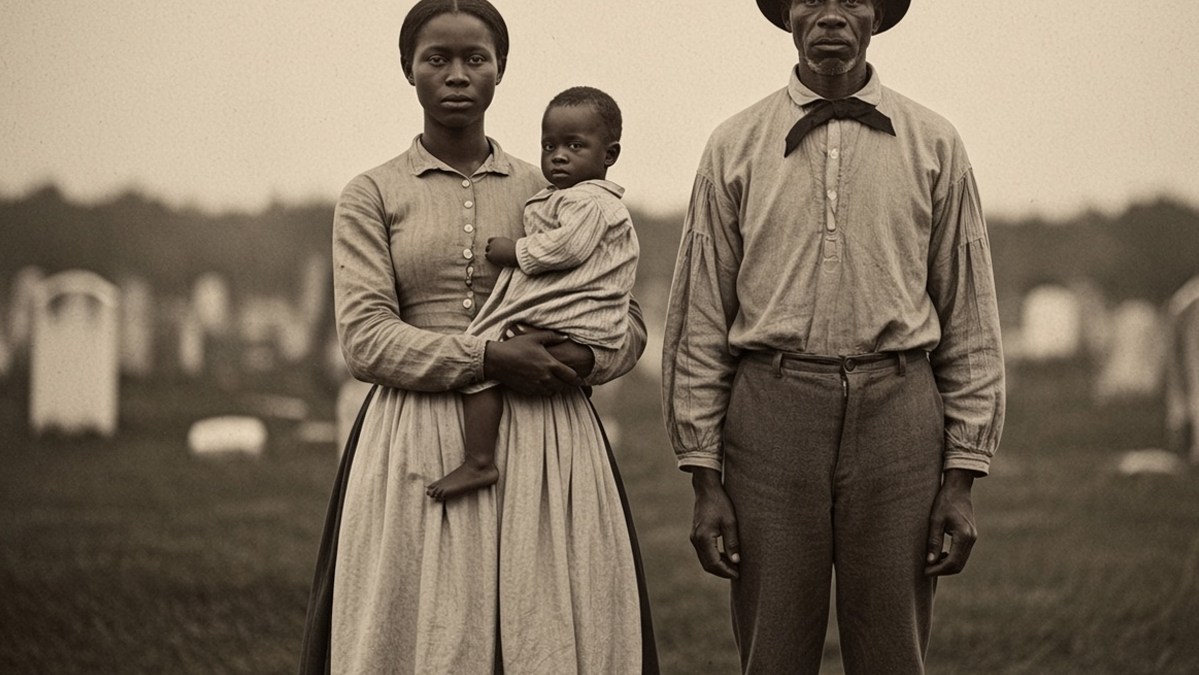
PART 2 Henry came out of the trees after Dunor went back inside.
He had watched from a place the master would not notice.
He checked each body. Some died at once.
Others bled out while he held their hands so they would not die alone.
Then he started digging.
He chose the magnolia grove for shade and distance.
The rest of the community came.
They were hungry, exhausted, and not strong enough for that labor.
They did it anyway. They wrapped the bodies in sheets and spare cloth.
Some wanted markers. Henry said no. Marked graves would draw questions.
Questions would bring more death. Fourteen graves. Two rows of seven.
Facing east, the way their grandparents had taught them.
Henry spoke the names. Everyone repeated them until they were burned in.
The next morning Dunor rang the work bell as if nothing had happened.
There was no one to report it to. The sheriff was Dunor’s friend.
The law treated them as property a master could discipline to death.
Dunor paid Dr. Silas Crawford to write fever.
He paid Reverend John Walsh to enter “colored deceased, natural causes.”
He paid a lawyer to adjust the asset list by the market
price of fourteen people. The official story was an outbreak.
Nobody who mattered asked. The children remained.
Joseph’s sons were raised by an aunt.
Diana’s daughter was later sold to Georgia when Dunor needed money again.
Grace never recovered from losing Thomas.
They kept the secret because the truth would not have brought justice.
It would have brought more graves.
Samuel sat with that knowledge in the dark and told Margaret everything.
She wanted to leave. They had put everything they had into the land.
They sat in the parlor with no good answer.
By dawn Samuel had one decision: mark the graves. Henry warned him.
Make it public and other planters would see Riverside as
the place where people defied a master.
Pressure would fall on the living. They found a compromise.
No formal headstones that could be read from the road.
Fourteen dogwood saplings—white blooms like crosses,
a tree associated with suffering and return.
One bronze plaque: Here rest 14 souls who chose dignity over survival.
Their names are known to those who love them. July 15th, 1850.
Ruth wrote the names and the lives into a private
journal in the plantation books.
In late September Samuel gave the whole community the day off.
Neighbors noticed. He did not care. Henry read the names.
After each one, someone spoke. He could sing across the fields.
She taught my daughter to read. He carved me a rabbit when I was six.
I still have it. Samuel planted the first tree over Joseph.
Margaret and Eleanor planted the second over Diana.
Joseph’s sons, now teenagers, planted their father’s.
Grace planted Thomas’s and whispered something no one else heard.
Ruth said they had made the choice together, faced it together,
and now rested together.
Remember them for who they were while they lived.
Someone started one of Rebecca’s spirituals. The grove filled with it.
Word spread. Neighbor James Whitfield came to the office.
You are making martyrs of people who should have been an example.
Samuel said he had honored people who died on his land.
Whitfield said banks would tighten, buyers would hesitate,
society would close. He was right. Credit got harder.
Invitations dried up. Eleanor’s playmates pulled away.
Samuel still cut hours in extreme heat, required water,
brought a doctor, let people keep gardens. Profits fell.
Margaret asked if the trees had been worth becoming poor and isolated.
He did not have a clean answer. Eleanor grew.
At ten she asked what happened.
Samuel told her the truth as plainly as he could.
She said the law was wrong. She said they could free everyone.
He could not explain why they would not without it sounding like an excuse.
She said remembering without changing anything was just
feeling sad while the same bad things kept happening. Ruth grew frail.
In 1857 they carried her to the grove one last time.
The dogwoods were blooming late. She told the fourteen stories again.
She was not afraid of dying.
She was afraid that after the witnesses were gone,
people would invent prettier stories that asked no hard questions.
Eleanor promised she would not let that happen.
Ruth told Samuel he was better than Dunor and still a man who owned people.
Teach the girl to choose better. She died two days later.
They buried her among the fourteen and planted a fifteenth dogwood.
Samuel wrote that she had carried truth when silence would have been easier.
War came.
Samuel was too old to be conscripted and could not fully support the cause.
In 1863 Henry told him younger people planned to walk toward Union lines.
Grace and her children. Joseph’s boys. Others.
Samuel said he would not stop them. He would not send dogs.
He would not report them. Grace came before she left.
Thank you for the trees. For remembering Thomas.
It doesn’t make up for anything. It meant something.
After Appomattox and the Thirteenth Amendment,
Samuel gathered whoever remained. You are free.
That is the law, not my gift. Stay for wages or go. The choice is yours.
Some left. Some stayed because the land was the only home they had.
Henry stayed because he was too old to start over and
wanted to help build something less dishonest out of the
ruin. Wage labor produced less. Free people could refuse the old pace.
Samuel preferred the honesty of it. Eleanor never married.
She told her father she could not plan a future on that
soil until she knew what she owed the past. Samuel died in 1878.
His last words to her: don’t let them forget.
She inherited a smaller, indebted place and held a memorial.
Then she did more than remember.
She divided forty acres into plots people who worked
there could buy on terms they could meet.
She opened a school in a renovated barn for any child.
She wrote the true history into a locked journal to be
made public when the time was right.
Those acts were radical in 1878 South Carolina.
She used what was left of the family money anyway.
She taught the students that the fourteen had been
forced into a choice that should never have existed.
Your generation has different choices. What will you do with them?
She died in 1899 and was buried in the grove. A sixteenth dogwood.
A former student wrote that she had shown bearing
witness is only the first step.
When Hartwell found the depressions in 1891,
most of the witnesses were already gone. Henry had died in 1875.
Grace had died in Philadelphia in 1880.
The children of the fourteen had scattered.
Eleanor’s journal stayed locked.
The few who still knew decided the story was too costly
to hand to casual curiosity.
The property changed hands, was divided, restored.
The house became a museum. The school grew.
The grove was left alone, later protected.
Every July 15th someone still reads the names. Joseph Hendris.
Diana Wells. Marcus Reed. Thomas Carter. Anna Price. James Foster.
Eliza Hayes. William Grant. Rebecca Shaw. Daniel Brooks.
Sarah Monroe. John Ellis. Catherine Wright. Robert Stone.
They were not a tidy symbol when they walked to that porch.
They were people who had run out of livable options and
chose the only freedom left to them. The official paper said fever.
The ground said otherwise.
The dogwoods still bloom white over the place where
fourteen people decided that survival without
self-respect was not survival at all. And every spring,
someone still comes to say the names out loud,
so the earth is not the only thing that remembers.








