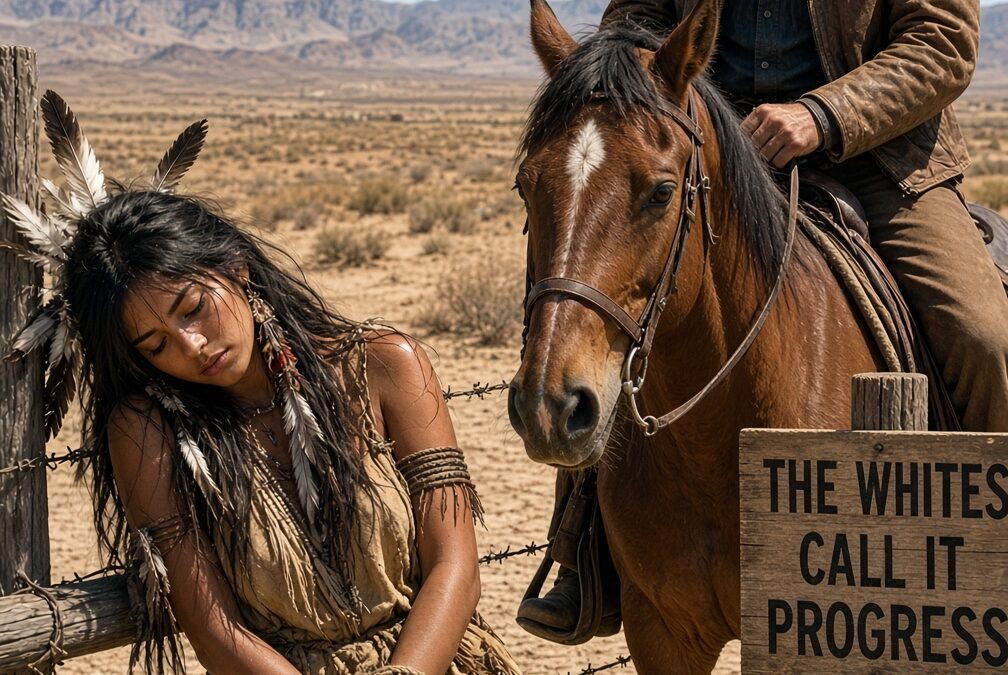
He Found a Young Woman Tied Across Barbed Wire Under the Florida Sun. The Bloody Sign Above Her Said: “The Whites Call It Progress.”
PART 2
Jed took a long time studying that sketch. Longer than he needed to.
Then he looked up at the lieutenant.
“Can’t say I have.”
Graham tilted his head. “You sure?”
Jed let a beat pass. “Only girl been ’round here lately is my mule. She’s got a kick like Judgment Day and a better attitude than most folks I meet.”
That earned him the ghost of a smirk. But the lieutenant didn’t relax.
“Mind if I have a look around?”
“I do mind.”
The silence crackled between them.
“I got no warrant, if that’s what you’re waiting to hear,” Graham admitted.
Jed took half a step forward. “Then I reckon this here’s the end of the conversation.”
For a long second, neither man moved. Then the lieutenant tapped his reins. “If you see anything strange, you know where to find us.”
“Strange don’t tend to announce itself,” Jed said.
The rider vanished into the fog. Jed waited until even the hoofbeats were gone. Then he went inside.
She was still crouched in the corner, eyes wide but dry. Her name, he would come to learn, was Naya.
“You heard all that,” he said quietly.
She nodded.
“I lied for you.” He sat down across from her at the small table. “I’m not asking if it’s true. And I ain’t sending you back. But I need to know. Will more follow?”
She looked down at her bandaged hands. Then, softly, like leaves rustling after a storm:
“They never stop.”
“Didn’t think so.”
Then her voice came again, rough but clear. “Why lie?”
Jed took a moment. “Because no one lies for the ones who need it most.”
That hit her somewhere deep. He could see it.
“They called me a slave harborer,” she whispered. “Like it was a curse.”
Jed’s jaw tightened. “They call a lot of things a curse. Freedom’s always near the top of the list.”
He draped a blanket over her shoulders. She didn’t flinch.
“You stay as long as you need.”
“And if they come again?”
He looked her square in the eye. “Then I’ll stand in front of the door.”
Outside, the fog lifted. A bird called from the pines. Under that small roof sat a girl who had nearly died on barbed wire and a man who had once stood still while someone else suffered. Bound now by something more dangerous than blood.
Hope.
On the third day, the heat pressed down thick and heavy. Naya had been quiet since the lieutenant’s visit, but she’d changed. She no longer flinched when Jed came close. She’d started setting things right around the cabin. A pot on the proper hook. A cup scrubbed and turned over. A bundle of moss drying on the windowsill.
Then Jed came back from cutting firewood and froze in the doorway.
In the dust on the floor, she had drawn something with a stick. A tall cypress tree with flames curling at its roots. And beside it, a water moccasin, mouth open. Not attacking. Leaving. Escaping.
“That your people’s sign?” he asked softly.
“In the swamp,” she began, her voice like gravel and creek water, “the trees bend to survive. They break and bend and break again. But they don’t fall. The roots go deep. Under fire. Under flood.”
She touched the flames. “And this is what they did.”
Then the story came pouring out.
Her father was a runner. Not the kind with shoes, but the kind with maps inside his head. He guided people deep into the backwaters of the Glades. Men, women, children. Black, Seminole, mixed. People nobody else wanted.
“We took them in,” she said. “Built huts on platforms above the gators. Grew rice in flooded ground. They called us rebels. Traitors. Slave thieves.”
She drew a line straight through the tree.
“One night they came. No flag. No warning. Just torches.”
They burned the huts. They shot old men in their hammocks. Her uncle died with a knife in his teeth. Her little cousin tried to run.
Her voice cracked. Jed didn’t touch her. He just laid his hand flat in the dust beside the drawing. It was enough.
“They caught me,” she whispered. “Said I’d talk. But I didn’t.”
So they beat her. Tied her to a pine tree overnight with no water. The next day, they laid her across that fence “like a slaughtered deer.”
“That’s how you found me.”
Jed tasted copper in his mouth.
“You should have let me die,” she said.
“No.”
“You don’t know what they’ll do if they catch me again.”
“They’ll have to catch me first.”
“You’re not like them,” she said slowly.
And then Jed confessed the thing that had haunted him for years.
“I was. Once, I wore the same blue coat. I stood with them when they came for the villagers. Told myself I was just following orders. Then one day, they hung a boy no older than 12. Said he was a scout. He just had a map drawn in charcoal on his skin.”
Naya’s lips parted.
“I left that night. Rode west. Burned the uniform. Never picked a side again.” He paused. “Until now.”
Naya leaned forward and wiped the snake’s mouth out of the dust.
“Why’d you do that?”
“Because it’s not running anymore,” she said. “I’m tired of running.”
Jed held out his hand. She took it without hesitation.
But the peace didn’t last.
One morning before sunrise, the forest went dead silent. No birds. No squirrels. Just fog, thick as poured milk.
Jed loaded his rifle. Naya braided her hair by the hearth, fast and calm, like someone who’d spent a childhood running at dawn and hiding at dusk.
“They’re coming,” she said.
“Three riders. Maybe four. Saw the trail a mile out.”
She grabbed a flint knife from the mantel and tucked it into her sash. “What do we do?”
“We don’t wait.”
They slipped out the back along an old deer path. In a ravine lined with fallen pines, they crouched and listened. Hoofbeats. Then a short, sharp military whistle.
“Union scout,” Jed cursed.
Naya turned to him. “Jedediah, if they catch me…”
“They won’t.”
“But if…”
“I said they won’t.”
She looked at him, face streaked with sweat and sap. “Don’t throw your life away for me.”
Jed took her scarred hands in his.
“I already did.”
They ran. Branches clawed at them. A shot cracked. Then another. Bark exploded just above Naya’s head. She didn’t scream. She just kept running.
By midday they reached the river. Jed shoved his old half-sunken ferry into the current and pulled her aboard, their horse tied behind.
Then figures in blue appeared on the bank, muskets raised.
A bullet splashed into the river. Another tore through the sail rope. “Down!” Jed shouted. They dove behind a crate of flour sacks as a bullet slammed into the wood, spraying splinters. Blood ran down Jed’s arm.
“You’re hit!”
“I’ve had worse.”
Then came a scream. Their horse had been clipped by a bullet. It bucked, tore loose, and crashed into the brush, leaving a trail of blood behind.
“We’re exposed now,” Jed growled.
But Naya wasn’t afraid. She was furious.
“I’m not dying here.” She pointed toward the bank. “There’s a switchgrass tunnel. Leads to an old hideout. My father built it. They’ll never find us there.”
Jed saw the steel in her. He nodded. “Go.”
She jumped into the river. He followed a heartbeat later.
The water was freezing. The gunfire went muffled. When they surfaced inside the reed tunnel, soaked and gasping but alive, Naya did something Jed had never seen her do.
She smiled.
Not wide. Not loud. But real.
And bloody, breathless, and covered in mud, Jed smiled back.
Behind them, the empty ferry drifted downstream.
That night they hid in the ruins of an old trapper’s hut, half buried in ivy deep in the hills. Jed leaned against a tree, pressing a hand to the wound where the bullet had struck close to the bone. Blood soaked his shirt.
Naya tied off his bandage with a knot so tight it bit into flesh. He didn’t flinch.
“You’re bleeding,” she said.
“Hell, darling. I’ve been bleeding since the day I met you.”
He asked if she still had the old coin he’d given her. The one he called lucky and she called cursed. She pulled the tarnished silver from her pocket.
“Been with me ever since,” she said.
“That’s why we’re still breathing.”
“No,” she said, brushing hair from his brow. “That’s because you’re too damn stubborn to die.”
Then he caught her wrist.
“I ain’t got much left in me, Naya. I need you to listen. I need you to go. Alone. They’ll be looking for two, not one. Head south. There’s a man in Laredo, Esquivel. Tell him I sent you. He’ll get you to Mexico.”
“And what about you?”
“I’ll lead them the other way. I’ll buy you time.”
“I won’t let you do this.”
He smiled, soft and crooked. “You already have.”
He stood, slow and unsteady, and strapped his rifle to his back. He pressed the coin into her hand and closed her fingers around it.
“I want you to live,” he said. “Not hide.”
“I want you,” she whispered. “With me.”
“Men like me carry storms in our pockets,” he said. “And you deserve sun.”
“I never asked for the sun. I asked for you.”
She took his hand and pressed it to her heart. “You feel that? That’s yours. It’s always been.”
“Promise me,” she said, gripping his wrist. “If you make it out, you come find me. No more disappearing.”
“Cross my heart.”
“And if you die?”
He smiled. “Then I’ll haunt every man who ever raised a hand to you. I’ll ride the wind and spit in their whiskey.”
She laughed, and it broke into a sob. She pulled him close and buried her face in his neck like she was trying to breathe him into her bones.
“I was never meant for peace,” he whispered, foreheads touching. “But you were meant for more than gunpowder and ghosts.”
“Jed?”
“Yeah?”
“I hate you for making me love you like this.”
“I know,” he said, voice cracking. “Me too.”
When she finally let go, it felt like peeling skin from skin.
He stepped back. One pace. Two. Still watching her. Then he turned, and the door closed behind him with a sound like a gunshot.
Naya stayed crouched by the fire for a long, long time. She clenched that silver coin so hard it left a mark burned into her palm.
Far off in the dark, gunshots echoed.
One.
Two.
Three.
Then silence.
Not the kind that follows a storm.
The kind that makes one.
Jed Stone was the man who once stood still while a girl was taken. The man who once wore the coat of the people who burned her village. He spent years running from that shame.
In the end, he didn’t run.
He found a stranger dying on a fence under a sign that called her suffering “progress.” He cut her down. He lied for her. He bled for her. And when there was only one way left to save her, he walked into the night so she could walk into the sun.
Somewhere south, a young Seminole woman carries a tarnished silver coin. The cypress bends, but it doesn’t fall. The roots go deep.
And she is not running anymore.
💬 Do you believe Jed kept his promise? Tell us in the comments below. ❤️








