CHAPTER 2 The Message on Her Back
PART 2
For one suspended moment, I forgot how to breathe.
Emily’s eyes were barely open, her voice weakened by medication, but the fear inside those five words was unmistakable.
Don’t let him know I’m still alive.
I bent closer, lowering my voice until even Alan could barely hear me.
“Who, Emily?”
Her fingers tightened around the torn strip of fabric.
“Dad…”
“I’m here.”
She swallowed, then winced as pain moved across her face.
“He’ll come back.”
“Who will?”
Her gaze drifted toward the curtain behind me.
I turned instinctively.
No one stood there. Only Alan, a nurse, and the muted movement of the emergency department beyond the thin blue divider. Yet my body reacted as if someone had entered with a weapon. Thirty years of training returned in an instant: assess exits, identify threats, secure the vulnerable.
I reached for Emily’s hand.
“You’re safe,” I told her.
She shook her head weakly.
“No one knows I’m here.”
“Someone called the ambulance.”
“Not him.”
Her breathing became uneven. Alan stepped closer and checked the monitor.
“Richard, that’s enough. She needs to rest.”
“I need one name.”
“You need your daughter conscious tomorrow.”
He was right, and I hated him for it.
The nurse adjusted Emily’s medication. Her eyes began to close.
Before the sedative pulled her under, she whispered one final sentence.
“The shirt was planted.”
Then she was gone again.
I straightened slowly.
The torn cloth remained clenched beneath her fingers.
Alan looked at me. “You heard her.”
“Yes.”
“So those initials may not mean what you think.”
I stared at D.C.M.
Daniel Charles Mercer.
My son-in-law.
For six years, Daniel had been part of our family. He was a respected attorney, measured in public, attentive at holidays, and unfailingly polite to me. Emily had married him in a small church outside Alexandria, Virginia, wearing her mother’s pearl earrings and a smile I had trusted more than any background check.
Now a piece of his shirt had been found in her hand.
But Emily had called it planted.
“Where was she found?” I asked.
Alan glanced at the nurse before answering. “An abandoned office building near the river.”
“In the city?”
“Yes.”
“Who found her?”
“A security guard responding to a broken window alarm.”
“Did she have identification?”
“No purse. No phone. No jewelry.”
“Then how did you know she was Emily?”
Alan hesitated.
That hesitation mattered.
“Alan.”
“The paramedics recognized her.”
“From where?”
“One of them had treated her after a car accident last year.”
Emily had never told me about a car accident.
I looked back at her. “How serious?”
“Minor. She was checked here and released.”
“Why didn’t I know?”
“She asked us not to contact you.”
The words landed more heavily than I expected.
My daughter and I spoke every Sunday. She told me about work, the garden she wanted to redesign, and Daniel’s habit of leaving coffee mugs in every room. I believed those conversations meant I knew her life.
Perhaps they meant only that she knew how to keep me from worrying.
“Was Daniel with her after the accident?” I asked.
“No.”
“Who was?”
“A woman named Claire Bennett.”
I knew the name.
Claire had been Emily’s college roommate and closest friend until three years earlier, when they abruptly stopped speaking. Emily had dismissed the separation as one of those friendships that naturally faded.
Apparently, it had not faded completely.
“Where is Claire now?”
“I don’t know.”
“You have her contact information?”
“Richard, I’m a physician, not an investigator.”
“You called me before the police.”
“Because Emily asked for you when she arrived.”
“What else did she say?”
Alan looked toward the curtain.
“She said the word Greyhaven.”
A cold pressure formed behind my ribs.
“Are you certain?”
“Yes.”
Greyhaven was not a person.
It was not a place anyone in my present life should have known.
Greyhaven had been the code name of an intelligence operation in Eastern Europe during my final deployment. Officially, it had never existed. Unofficially, it had ended the careers of several officers and nearly ended mine.
Emily had been fourteen at the time.
I had never told her the name.
“Did she say anything with it?”
“Only that word.”
Alan studied me. “You know what it means.”
“I know what it meant twenty years ago.”
“And now?”
“I don’t know.”
The curtain opened. A uniformed police officer entered with a detective wearing a dark coat dampened by the rain.
The detective introduced herself as Lena Ortiz. She was in her early forties, with steady eyes and the calm posture of someone who listened before deciding what she believed.
“Colonel Hayes?”
“Retired.”
She nodded once. “I need to ask you several questions.”
“My daughter is in no condition to speak.”
“I understand. I’m asking you.”
She looked toward Emily, then at the fabric in her hand.
“Do you recognize those initials?”
“Yes.”
“Whose are they?”
“My son-in-law’s.”
Alan watched me carefully.
Detective Ortiz noticed. “There’s more.”
“Emily said the cloth was planted.”
The detective’s expression did not change. “When?”
“Before she lost consciousness.”
“Did she identify an attacker?”
“No.”
“Did she say why someone would frame her husband?”
“No.”
Ortiz removed a small notebook. “Where is Daniel Mercer tonight?”
“I don’t know.”
“You haven’t spoken with him?”
“Not yet.”
“Why not?”
Because my daughter had begged me not to let him know she was alive.
I considered lying.
For most of my career, I had believed withholding information was not the same as deception when lives depended on timing. Age had made me less certain.
“Emily told me not to contact him,” I said.
Ortiz’s pen stopped.
“Did she explain why?”
“No.”
The detective glanced at Alan. “I need the cloth preserved as evidence.”
The nurse gently loosened Emily’s fingers. When the fabric came free, I saw something hidden beneath it.
A small brass key.
Ortiz placed both items in separate evidence bags.
The key was narrow and old-fashioned. A number had been engraved along its side.
“Does that mean anything to you?” she asked.
“No.”
That was true.
The detective closed the bags. “We have officers attempting to reach Mr. Mercer. His phone is off, and no one answered at his home.”
Emily and Daniel lived twenty minutes away in a renovated brick townhouse. I had helped install bookshelves in their living room the summer after they married. The idea of police searching it made the life I knew seem suddenly fragile, like scenery built for a play.
“I want protection outside this room,” I said.
Ortiz looked at me. “The hospital has security.”
“I asked for police protection.”
“We don’t know that anyone is coming here.”
“My daughter believes someone will.”
“That may be trauma speaking.”
“Or experience.”
Ortiz held my gaze. “I’ll arrange an officer.”
It was not agreement. It was professional compromise.
I respected it.
“Do not list Emily by name in the hospital system,” I said.
Alan nodded. “Already done.”
Ortiz raised an eyebrow.
“I admitted her under restricted status,” Alan explained. “Only essential staff can access her file.”
The detective seemed ready to object, then reconsidered. “Keep a record of everyone who enters.”
After she left, I sat beside Emily’s bed.
Her face looked younger in sleep. The hard lines fear had drawn around her mouth disappeared, leaving the child who once climbed into my lap during thunderstorms and insisted she was only there because I looked frightened.
I had spent years teaching soldiers that courage was not the absence of fear. It was the ability to act clearly while fear was present.
But I had never taught my daughter that lesson.
I had assumed she learned it by watching me.
Perhaps she had learned something else instead: how to hide pain so no one would ask questions.
Alan pulled a chair beside mine.
“What was Greyhaven?” he asked quietly.
“Something that ended a long time ago.”
“Does it have anything to do with Emily?”
“It shouldn’t.”
“That isn’t the same as no.”
I leaned back, staring at the monitors.
Greyhaven had begun as a routine assessment of missing military funds. Supplies intended for peacekeeping units had been redirected through private contractors, then sold across borders. What made the operation dangerous was not the theft itself. It was the people protecting it.
One of them had been Brigadier General Marcus Vale, my commanding officer and mentor.
Vale had taught me how to lead. He had written the recommendation that earned my promotion. He had also falsified reports, pressured witnesses, and treated loyalty as a shield against accountability.
I had testified against him.
He was convicted and sentenced to twelve years in federal prison.
Before marshals led him away, he had looked directly at me and said, “Your family will learn what your honor costs.”
At the time, Emily was a teenager, and my wife, Margaret, was still alive. We moved homes, changed routines, and endured months of security reviews. Nothing happened.
Vale was released eight years ago.
He died eighteen months later.
At least, that was what I had been told.
“Richard?” Alan prompted.
I realized I had been silent too long.
“Greyhaven involved corruption inside the military,” I said. “I helped expose it.”
“Could someone connected to it be targeting Emily?”
“Most of the people involved are dead, imprisoned, or old enough to prefer comfort over revenge.”
“You’re old enough to prefer comfort.”
“I have been told I’m unusually difficult.”
Alan almost smiled.
Then his expression turned serious. “You should tell Detective Ortiz.”
“I will.”
“Now.”
“I need to verify something first.”
He sighed. “You are not commanding a unit.”
“No. I am protecting my daughter.”
“Those are not always different things to you.”
The observation stayed with me after he left.
At two fifteen, Detective Ortiz returned. She had spoken with Daniel.
“He called us from Portland,” she said.
“Portland?”
“He says he drove there yesterday for a client meeting.”
“Did anyone confirm it?”
“His hotel did.”
“What time did he arrive?”
“Six forty this evening.”
Emily had been found at ten fifty.
Portland was roughly three hours away under good conditions. Daniel could not easily have been at both locations, though easily was not the same as impossible.
“Did you tell him about Emily?”
“I told him she had been injured and was receiving treatment.”
My muscles tightened. “She asked us not to tell him.”
“I’m investigating an assault, Colonel. Her husband is relevant.”
“Did you tell him she was conscious?”
“No.”
“Did you tell him where she is?”
“No.”
I let out a breath.
Ortiz sat across from me. “Mr. Mercer sounded genuinely surprised.”
“People can sound many things.”
“You dislike him?”
“I trusted him.”
“That wasn’t my question.”
“No. I don’t dislike him.”
“Does he have a temper?”
“Not that I’ve seen.”
“Financial problems?”
“I don’t know.”
“Marital problems?”
I looked toward Emily.
“I thought they were happy.”
Detective Ortiz wrote something down. “Most parents do.”
The answer irritated me because it was probably true.
I told her about Greyhaven.
She listened without interruption, then asked for names. I gave her Marcus Vale’s, along with those of three civilian contractors and two former officers connected to the investigation.
When I finished, she folded her hands.
“There’s something you should know. The office building where Emily was found once belonged to Vale Strategic Consulting.”
I felt every sound in the room recede.
“When?”
“Until seven years ago.”
“Who owns it now?”
“A holding company registered in Delaware.”
“Connected to whom?”
“We’re checking.”
Ortiz studied me. “You didn’t know?”
“No.”
“Did Emily?”
“I have no idea.”
The answer disturbed me more each time I gave it.
A nurse entered to check Emily’s dressings. Ortiz waited in the hallway while I remained near the door, giving my daughter privacy without leaving her alone.
When the nurse finished, she handed me a clear belongings bag.
“These were in her coat pockets.”
Inside were a transit card, two coins, a folded receipt, and a child’s red plastic bracelet.
I picked up the bracelet.
The name LUCAS was printed across it in black letters.
“Who is Lucas?” the nurse asked.
“I don’t know.”
The receipt came from a diner near Union Station. It was dated that evening at seven twenty-three. Two coffees, one grilled cheese sandwich, and a bowl of chicken soup.
Emily had not eaten alone.
On the back, someone had written:
- Ask for Margaret’s letters.
Margaret.
My late wife.
My hand tightened around the paper.
Margaret had died four years earlier after a brief illness. She had been a school librarian, patient where I was impatient and warm where I was reserved. She knew more about Greyhaven than anyone outside the operation because she had lived through its consequences.
But she had never mentioned letters.
Detective Ortiz returned. I showed her the receipt and bracelet.
“Could Lucas be a child?” she asked.
“The bracelet looks like something from a hospital or daycare.”
She photographed it. “Did your daughter have children?”
“No.”
“Was she trying to?”
I hesitated.
Emily had mentioned wanting a family, but whenever I asked whether she and Daniel had plans, she changed the subject.
“I don’t know.”
Ortiz studied the handwritten note. “Do you recognize the writing?”
“No.”
That was another truth I disliked.
At three in the morning, Daniel arrived.
I saw him through the narrow window in the trauma room door, still wearing the charcoal suit he often chose for court. His tie hung loose, and rain darkened his shoulders. He spoke urgently to the officer outside.
My body rose before my mind decided what to do.
I stepped into the hallway.
Daniel’s face collapsed with relief. “Richard. Where is she?”
“What happened in Portland?”
He stared at me. “What?”
“Your client meeting.”
“Why are you asking me that?”
“Answer.”
He looked toward the officer, then back at me.
“I met with a construction company facing a labor dispute. Dinner at seven, conference call at nine, back to the hotel by ten.”
“Who can confirm it?”
“Six people.”
“Why was your shirt found in Emily’s hand?”
His face emptied.
“My shirt?”
“A torn piece with your initials.”
He looked down at the one he was wearing. White cotton, no monogram.
“I don’t understand.”
“Emily said it was planted.”
The fear in his eyes appeared real. So did the confusion.
“Is she awake?”
“Not now.”
“Did she say who hurt her?”
“No.”
He moved toward the door. The officer blocked him.
“I need to see my wife.”
“She asked us not to tell you she was alive.”
The words stopped him completely.
For a second, I thought he might collapse.
“She thought I did this?”
“She said not to let him know. She did not say your name.”
“But you assumed she meant me.”
“I considered it.”
Pain crossed his face. “You always thought I wasn’t good enough for her.”
“That is not true.”
“You investigated me before the wedding.”
“I investigate anyone joining my family.”
“That is exactly the kind of sentence you think sounds reasonable.”
I felt anger rise, then forced it down. Anger was easy. Listening was harder.
“Why would someone plant your shirt?” I asked.
Daniel looked toward Emily’s room.
“Because I’ve been investigating the same thing she was.”
Detective Ortiz approached. “What thing?”
He turned slowly. “Greyhaven.”
I stared at him.
“How do you know that name?”
“Emily told me.”
“When?”
“Three months ago.”
My voice became dangerously quiet. “She knew for three months and never told me?”
“She believed you would try to handle it alone.”
Daniel looked directly at me.
“She said that was what frightened her most.”
The words landed precisely because they were believable.
Ortiz led us into a consultation room. Daniel removed a folder from his briefcase.
“Emily came to my office in July with copies of old bank records,” he explained. “She found them among Margaret’s belongings.”
“My wife’s?”
“Yes.”
“What records?”
“Payments from a military contractor called Northlake Systems to an education charity Margaret managed.”
I remembered Northlake. It had provided communications equipment during Greyhaven. The company’s president, David Crane, had avoided prosecution by cooperating with investigators.
“Margaret never managed a charity.”
Daniel opened the folder. “Not publicly.”
The documents listed a foundation called Bright Path Learning. Margaret’s name appeared as secretary. Over twelve years, the foundation had received nearly four hundred thousand dollars.
“What happened to the money?” Ortiz asked.
“It paid school fees, medical expenses, and housing costs for one child,” Daniel said.
He placed a photograph on the table.
A boy of about nine stood outside a brick school building. He had dark hair, serious eyes, and a red plastic bracelet around one wrist.
Lucas.
I picked up the photograph.
“Who is he?”
“We don’t know his current surname,” Daniel said. “The records identify him only as Lucas V.”
The initial chilled me.
“Vale?”
“Possibly.”
Marcus Vale had one son, Jonathan, who died overseas before Greyhaven began. No grandchildren were listed in the official family records.
“Why would Margaret support Vale’s child?” I asked.
“Emily believed Lucas was not related to Marcus.”
“Then why the initial?”
“I don’t know.”
Daniel leaned forward. “Two weeks ago, someone broke into our house. Nothing valuable was taken, but Margaret’s letters disappeared.”
I stared at him. “You didn’t report it?”
“We did. The police treated it as an interrupted burglary.”
“You should have called me.”
“Emily asked me not to.”
“And you agreed?”
“She was an adult, Richard.”
“She was in danger.”
“She knew you would say that.”
His restraint angered me more than shouting would have.
“What else did she find?”
“A letter from Margaret addressed to Emily. It said Richard had been lied to about the final night of Greyhaven.”
I felt the old room return: fluorescent lights, sealed files, Vale’s expression as I testified.
“What lie?”
Daniel shook his head. “The rest of the letter was missing.”
Detective Ortiz examined the records. “Where did the monogrammed shirt come from?”
Daniel’s face tightened.
“Three shirts disappeared during the burglary.”
“Did you mention that to police?”
“I didn’t notice until later.”
“Who knew about them?”
“Emily. Our housekeeper. My tailor.”
“And Claire Bennett?” I asked.
Daniel looked surprised. “Why Claire?”
“She was with Emily after a car accident last year.”
His silence lasted too long.
“You knew they were still in contact,” I said.
“Yes.”
“Why did Emily hide it?”
“Because Claire worked for you.”
I stared at him.
“Claire never worked for me.”
“She did contract research for the veterans’ foundation you chaired.”
The foundation helped former service members find housing and employment. I had served as unpaid chairman for five years.
“What kind of research?”
“She reviewed old personnel claims.”
“Why?”
“Emily asked her to locate records connected to Greyhaven.”
My daughter had built an investigation around me while carefully ensuring I saw none of it.
I sat back.
For the first time that night, I felt old.
Not weak. Not incapable. Simply aware that my instinct to protect had become a wall high enough for the people I loved to hide behind.
Daniel’s voice softened. “She wasn’t trying to deceive you.”
“She succeeded.”
“She was trying to find facts before bringing you another war.”
I looked through the glass toward Emily’s room.
Perhaps she had known me better than I knew myself.
At dawn, her condition stabilized enough for transfer to a private room. The officer remained outside. Daniel was allowed to see her only after Ortiz consulted the attending physician and confirmed that Emily had not named him as a threat.
He entered alone.
Through the window, I watched him stop beside the bed. He did not touch her immediately. He stood there with both hands at his sides, as though even reaching for her required permission.
Then Emily opened her eyes.
She saw him and began to cry.
Daniel bent toward her. She lifted one hand, and he held it against his face.
It was not the reaction of a woman seeing the man she feared.
I turned away, ashamed of the relief I felt.
Alan found me near the vending machines.
“Coffee?” he asked.
“I’ve had better fuel from field rations.”
“You drank it anyway.”
He handed me a paper cup.
I told him what Daniel had revealed.
Alan listened, then said, “Margaret kept something from you.”
“Yes.”
“You sound more hurt than angry.”
“I am deciding which is more useful.”
“Neither may be useful.”
I looked at him. “You always did confuse friendship with permission.”
“That is why you kept me.”
Before I could answer, Detective Ortiz approached carrying a tablet.
“We identified the child’s bracelet,” she said.
“It came from where?”
“St. Catherine’s Pediatric Center. They used that design until ten years ago.”
“Can they identify Lucas?”
“They’re searching archived records.”
She turned the tablet toward me.
A security camera image showed Emily entering the diner at seven fourteen the previous evening. A man followed several minutes later. His face was partially hidden beneath a cap, but his posture seemed familiar.
Then he looked toward the camera.
I recognized him.
David Crane.
The former president of Northlake Systems.
The man who had cooperated with investigators and testified that Marcus Vale alone directed the Greyhaven fraud.
Crane was supposed to have died five years earlier.
“I attended his funeral,” I said.
Ortiz enlarged the image. “Either this is someone who looks remarkably like him, or the funeral was part of the lie.”
“Where is he now?”
“We don’t know.”
Daniel emerged from Emily’s room.
“She wants to speak with Richard.”
I entered immediately.
Emily looked pale and exhausted, but her eyes were clearer.
I sat beside her. “You should rest.”
“So should you.”
Despite everything, the answer almost made me smile.
“Who did this?” I asked.
“I don’t know his name.”
“Was it Crane?”
Her eyes widened. “You found him?”
“On the diner camera.”
“He called himself Mr. Grey.”
“Did he attack you?”
“No.”
“Then who did?”
“I never saw their face.”
She closed her eyes briefly, gathering strength.
“Mr. Grey contacted me three weeks ago. He said Mom had protected a child connected to Greyhaven. He wanted the letters.”
“What did you give him?”
“Nothing. I asked him to meet me.”
“At the diner.”
“Yes.”
“Why didn’t you call Daniel?”
“He was already driving to Portland. I thought a public place would be safe.”
“You thought wrong.”
“I know.”
The regret in her voice stopped me from pressing harder.
“What happened after the diner?”
“Mr. Grey said the letters proved you had convicted the wrong man.”
“Vale was guilty.”
“He said Vale was involved, but he wasn’t in charge.”
“Who was?”
“He wouldn’t tell me without the key.”
“The brass key?”
Emily nodded. “He said it opens a safe deposit box under Mom’s maiden name.”
“Which bank?”
“Union Federal. Branch 214.”
The number on the key.
“Why did you leave with him?” I asked.
“I didn’t. He left first. When I went outside, someone grabbed me from behind.”
Her breathing quickened. I took her hand.
“You’re here,” I said. “Stay here.”
She focused on my face.
“When I woke up, I was in the office building. They asked where the key was. I told them Daniel had it.”
“That is why they planted his shirt.”
“I think so.”
“Why did you tell us not to let him know you were alive?”
Emily looked toward the door where Daniel waited.
“I didn’t mean Daniel.”
“Then who?”
She gripped my hand.
“Alan.”
The room seemed to tilt.
“Dr. Mercer?”
She nodded.
“That makes no sense.”
“He visited our house two weeks ago.”
“Alan has known you since you were a child.”
“He said he was checking on me because you were worried.”
“I never sent him.”
Her eyes filled with fear.
“He searched Mom’s desk while I was making coffee. I saw him put one of her letters inside his coat.”
I stood so quickly the chair scraped across the floor.
Alan had called me.
Alan had admitted Emily under restricted status.
Alan had controlled who entered her room.
I moved toward the door, then stopped.
Emily’s hand remained wrapped around mine.
“Dad.”
I looked back.
“Don’t confront him.”
“He may be involved.”
“That is exactly why you can’t confront him.”
She was asking me to do the hardest thing I had ever demanded of a soldier.
Wait.
Observe.
Trust someone else with the next move.
I sat again.
“Tell Detective Ortiz,” I said.
Emily nodded.
Ortiz listened without revealing surprise. She quietly ordered two officers to locate Alan.
He was no longer in the hospital.
His office had been cleared out.
The computer was gone, along with several archived patient files.
One of them belonged to Lucas Vale.
By nine that morning, Union Federal agreed to open the safe deposit box in the presence of police and the registered beneficiary. The box had been rented under Margaret’s maiden name, Margaret Ellis, but the authorization card listed me as successor.
Detective Ortiz drove.
Daniel remained with Emily.
The bank manager led us into a private room and placed a long metal box on the table. The brass key turned smoothly.
Inside were three bundles of letters, an old cassette recorder, and a sealed military personnel file.
My name was written across the file.
I opened it.
The first page contained my service photograph, rank history, and deployment records. The second contained a DNA report dated twenty-one years earlier.
The listed subjects were Richard Hayes and Lucas Vale.
Probability of paternity: 99.8 percent.
I read the line again.
Then again.
Detective Ortiz said nothing.
My mind moved backward through the years: Greyhaven, Margaret’s silence, the child she secretly supported, Marcus Vale’s promise that my family would learn the cost of honor.
“This is false,” I said.
But the denial sounded weak.
Beneath the DNA report was a letter in Margaret’s handwriting.
Richard,
If you are reading this, Emily has uncovered what I spent years trying to understand.
Lucas is not Marcus Vale’s grandson.
He is your son.
I stopped reading.
There had been no affair. No forgotten relationship. No other woman.
I knew that with absolute certainty.
My hands shook as I continued.
You never betrayed me. During your final Greyhaven deployment, Alan treated you after the explosion near Vezna. He collected blood and tissue samples while you were unconscious. Years later, I discovered those samples had been used without your knowledge in an illegal fertility program funded through Northlake Systems.
Marcus learned what Alan and Crane had done. He tried to expose them, but by then the evidence had been arranged to make him appear responsible for everything.
I did not tell you because I could not prove it, and because Alan warned me that Lucas would disappear if you became involved. I chose to protect the child from a distance.
Please forgive me.
I lowered the letter.
Alan Mercer had been my friend for twenty years.
He had delivered news of Margaret’s illness.
He had attended her funeral.
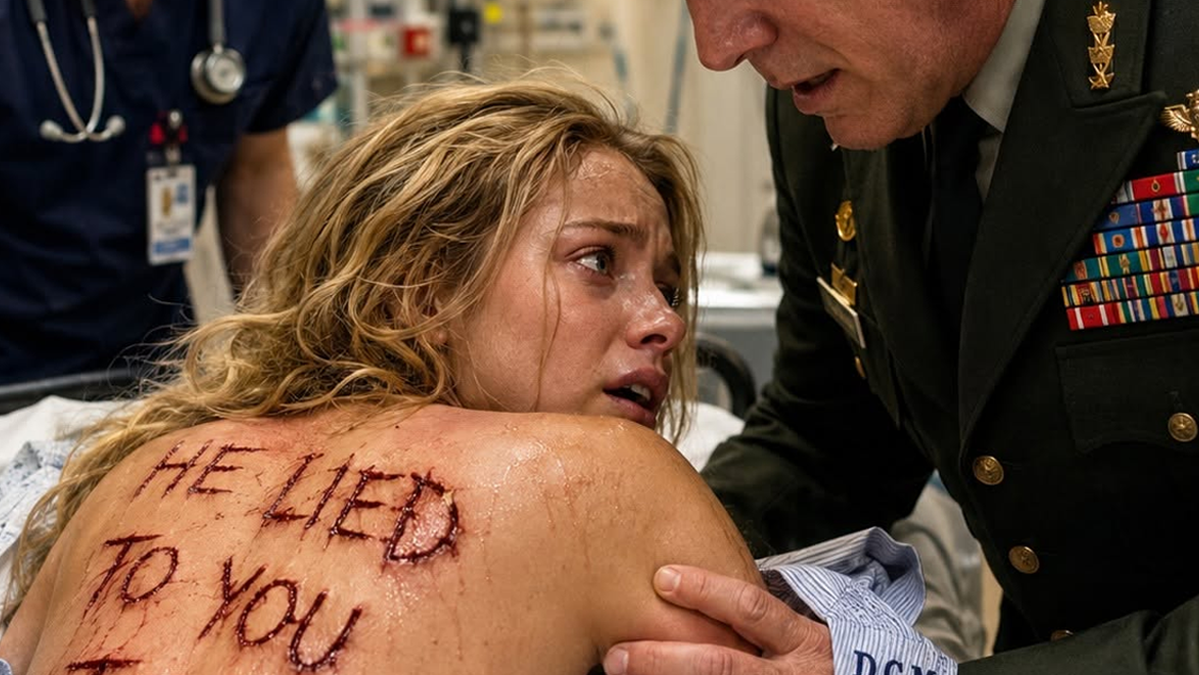
He had stood beside Emily’s hospital bed while I studied the message carved into her back.
He lied to you too.
The words had not been written for me by an unknown attacker.
They had been written about Alan.
Detective Ortiz opened the personnel file’s final envelope.
Inside was a recent photograph of a man in his early twenties standing outside St. Mary’s Hospital. He had my eyes, Margaret’s guarded expression, and a red bracelet tied around his wrist.
Lucas.
On the back, someone had written a date.
Today.
And beneath it:
Ask why Alan called Richard before the police knew Emily’s name.
I looked at the detective.
Alan had claimed Emily asked for me when she arrived.
But Emily had been unconscious when the paramedics found her, and she had carried no identification.
There was only one way Alan could have known who she was before anyone else did.
He had known where she would be found.
My phone rang.
Emily’s number appeared on the screen.
I answered immediately.
A young man spoke.
“Colonel Hayes?”
“Who is this?”
“My name is Lucas.”
I closed my eyes.
“Where is my daughter?”
“She’s still at the hospital. Daniel is with her.”
“Where are you?”
“Outside Alan Mercer’s house.”
Ortiz was already signaling officers.
“Leave,” I said. “Do not go inside.”
“I can’t.”
“Lucas, listen to me.”
“I’ve been listening to other people tell me who I am my entire life.”
His voice trembled, but he continued.
“Alan has Margaret’s missing letters. He also has a video recorded the night Greyhaven ended.”
“What video?”
“The one that proves who ordered the operation.”
“Who?”
Before he could answer, another voice sounded behind him.
Alan.
Calm. Familiar.
“Give me the phone, Lucas.”
The line rustled.
Then Alan spoke directly to me.
“You always were quick to choose the most obvious enemy, Richard.”
“Step away from him.”
“He came willingly.”
“What do you want?”
“The key opened Margaret’s box, didn’t it?”
Police officers were moving toward the bank entrance. Ortiz gestured for me to keep him talking.
“Yes,” I said.
“Then you know Lucas is your son.”
“I know what the report claims.”
“You still doubt evidence when it threatens the story you prefer.”
“Let him leave.”
Alan sighed.
“I never intended for Emily to be hurt. She trusted the wrong person.”
“Crane?”
“No.”
“Who attacked her?”
“That is the question Margaret’s letters answer.”
A door opened on his end of the call.
Lucas said something I could not hear.
Alan’s voice became distant.
Then Lucas returned to the phone, breathing quickly.
“Colonel, there’s someone else here.”
“Who?”
“I don’t know.”
A woman spoke in the background.
Her voice was older, unsteady, yet unmistakably familiar.
I had heard it every day for thirty-two years.
I had heard it whisper beside me in the dark, laugh across crowded rooms, and say goodbye from a hospital bed four years earlier.
Margaret.
My dead wife.
Lucas lowered his voice.
“She says Alan didn’t hide her from you.”
My hand tightened around the phone.
“Then who did?”
The woman took the phone from him.
“Richard,” Margaret whispered, “Emily was right. Alan lied to you too—but he was not the person who ordered Greyhaven.”
I could barely form the next question.
“Who was?”
Margaret drew a trembling breath.
“You were.”
END OF PART 2 – LIKE, SHARE AND COMMENT “THE ENTIRE STORY” IF YOU WANT TO READ THE FULL STORY








