“DON’T SHOOT—I’LL BE YOUR OBEDIENT WIFE!” THE APACHE WIDOW BEGGED… THEN THE COWBOY TURNED HIS GUN TOWARD THE DARK
Part 3
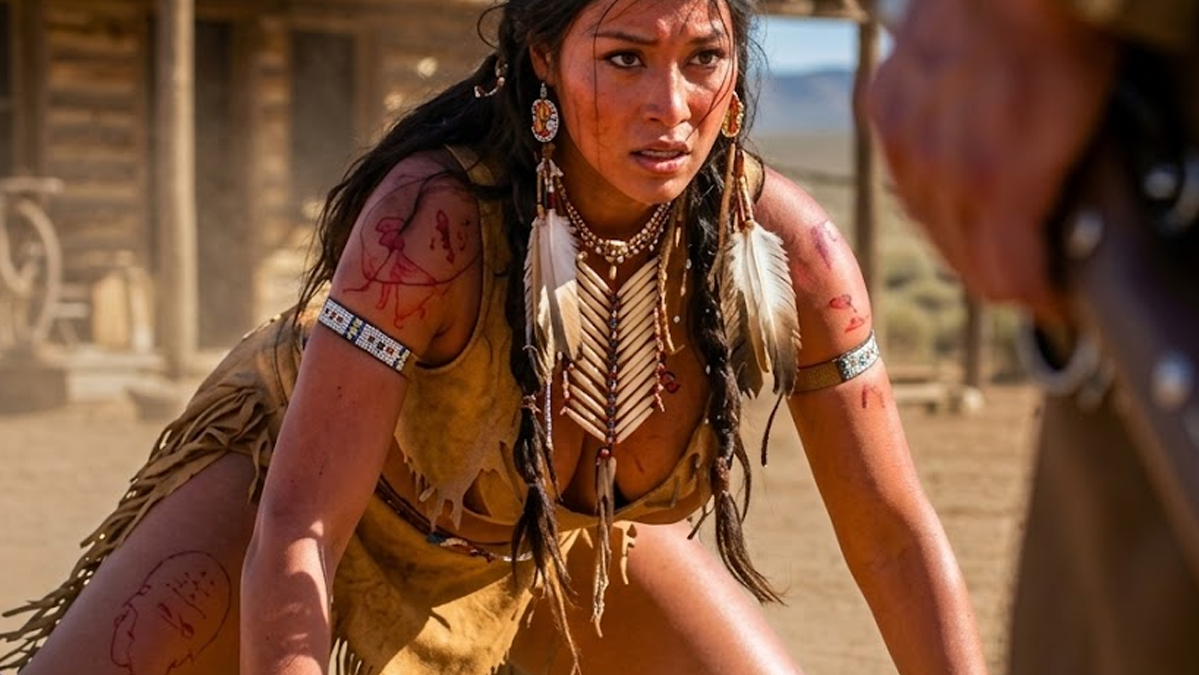
The two riders advanced slowly, their horses pressing through the dry grass toward the fence.
Calder stood outside the doorway.
Behind him, Nia held the second rifle so tightly that the old wood creaked beneath her fingers.
The leader smiled.
“Last chance, scout. Hand her over.”
“She’s not yours to take.”
“Then let her come tell us that herself.”
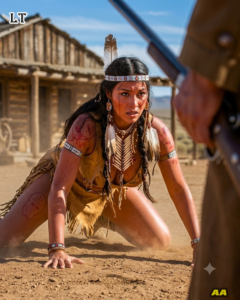
Inside, Nia’s stomach tightened.
She recognized his voice. She remembered hearing it beyond a wagon while a rope cut into her ankle. She remembered how casually he had discussed her future.
Calder did not turn around.
“You heard me.”
The leader glanced at his companions.
“Look at him. Can barely stand.”
Calder’s right leg throbbed. He shifted his weight, and one rider laughed.
Nia saw what they saw: a limping man in a worn coat, defending a cabin that a hard winter might flatten.
But she had seen other things.
The way his hands remained steady when a deer stepped from the brush.
The way he heard approaching horses before she did.
The way he had stopped moving when she raised an arm against an expected blow.
She moved closer to the doorframe.
Calder heard her.
“Keep behind the wall,” he said quietly.
“I’m here.”
“I know.”
The first rider reached the fence.
He drew his revolver.
Calder fired.
The sound struck the cabin walls and rolled through the canyon.
The rider fell. His horse wheeled away, reins snapping against its neck.
The second man jerked his mount sideways.
For one terrible moment, everything seemed suspended: dust, breath, the echo of the shot.
Nia’s body wanted to fold.
She held her ground.
Calder worked the rifle’s action.
“Stop there.”
The leader’s smile had vanished.
One of his men began moving to the left, toward the cabin’s exposed side.
Nia saw him.
She brought her rifle into the narrow opening beside the door.
“Calder. Left.”
Her voice was clear enough that the rider heard it.
He looked up.
For the first time, he saw her looking back.
Not kneeling.
Not pleading.
The rifle trembled slightly in her hands, but its barrel followed him.
He stopped.
The leader turned on him.
“Well?”
The man’s gaze flicked toward his fallen companion.
Nobody answered.
They had ridden into that yard expecting an easy capture. Now one of them lay motionless beside the fence, and two rifles covered the approach.
Calder’s voice cut through the silence.
“You can leave.”
The leader spat into the dust.
“This isn’t finished.”
But he pulled his horse around.
The others followed.
They rode faster once their backs were turned.
Calder remained outside long after the ridge swallowed them.
His leg shook.
He could still hear the shot, although the canyon had gone quiet.
When he finally stepped inside, Nia lowered her rifle.
Neither spoke.
Then Calder reached for the table and missed.
She caught his arm before he fell.
“Sit.”
He tried to straighten.
“Need to check—”
“Sit, Calder.”
This time, he obeyed.
Nia set both weapons safely aside and knelt in front of him. His hands had begun to tremble.
She had expected courage to look different afterward.
She had expected someone who could stand against six armed men to remain made of stone.
Instead, he sat on the edge of his chair, breathing carefully, staring at the floor.
“You’re hurt?”
“Old leg.”
“That isn’t what I meant.”
He looked at her then.
“I hoped they’d turn back.”
“I know.”
“I didn’t want that.”
“I know.”
She placed a cup of water between his hands.
He drank.
Outside, the wind dragged dust across the yard.
Inside, she stayed beside him until his breathing settled.
Later, they went out together.
The fallen rider was dead.
Calder stood over him with his hat in his hands. Nia waited a few steps away.
There was no victory in the sight.
Only the terrible fact that a man had chosen to cross the fence with a weapon drawn, and another man would have to remember stopping him.
They buried him before nightfall.
The ground was hard. Calder’s leg slowed him. Nia took the shovel when he could no longer hide the pain.
He began to protest.
She held out her hand.
After a moment, he gave it to her.
They finished together.
That night, neither was hungry.
Nia warmed the broth anyway.
Calder watched her place two bowls on the table.
“You don’t have to stay because of today,” he said.
She stopped.
He forced himself to continue.
“There’s food now. When your feet heal, I can help you get somewhere else. If that’s what you want.”
“Do you want me gone?”
“No.”
The answer was almost painful.
“But I need you to know you can go.”
Nia sat across from him.
For days, she had searched his kindness for a hidden demand. She had waited for him to remind her what she had promised in the yard.
He never had.
Now he was offering her the very thing the raiders had tried to take: a say in what happened next.
“I was frightened when I said I would be your wife,” she told him.
“I know.”
“I would have promised anything.”
“I know that, too.”
She looked down at her hands.
“But I wasn’t frightened when I kissed you.”
Calder did not move.
She reached across the table.
“I’m staying because I want this life with you.”
His fingers closed around hers.
For a while, the broth cooled untouched.
The next morning, Nia woke to find Calder standing before an open trunk.
A small bundle rested in his hands.
He looked almost guilty when she sat up.
“What is it?”
“My wife’s things.”
Nia stayed quiet.
He unfolded a piece of cloth. Beneath it lay a comb, a ribbon, and a few carefully preserved letters.
“I kept thinking,” he said, “if I left everything where it was, something of her would stay where it belonged.”
Nia approached slowly.
“And now?”
“Now I’ve given you her boots. Her rifle.”
His voice roughened.
“I don’t want you thinking there’s a place you’re supposed to fill.”
She looked at the letters.
“Was she kind?”
“Yes.”
“Then keep what you need to keep.”
He glanced up.
“My husband used to sing when he worked,” she said. “Badly.”
The memory surprised a small laugh from her.
“He knew three songs. I think he believed he knew thirty.”
Calder’s expression softened.
“I haven’t said that aloud since he died.”
“What?”
“Something about him that wasn’t about dying.”
She touched the cloth in Calder’s hands.
“I don’t want to forget him.”
“You shouldn’t.”
“And you shouldn’t forget her.”
He sat on the cot.
After a moment, Nia sat beside him.
They spent the morning telling stories.
Some hurt.
One made Calder laugh so unexpectedly that he covered his mouth, startled by the sound.
Nia laughed with him.
For the first time, the people they had lost were allowed into the cabin as more than an ache.
Winter did not become gentle.
The water barrel froze. Wind loosened a roof board. Calder’s leg stiffened so badly on some mornings that Nia had to bring his boots to the cot.
They argued once over firewood.
“You’re carrying too much,” he told her.
“You say that every time.”
“Because you do it every time.”
She dropped the logs beside the stove.
“And you pretend your leg doesn’t hurt until you can barely walk.”
He opened his mouth.
Closed it.
“That’s different.”
“No, it isn’t.”
A long silence followed.
Then Calder pulled out a chair.
“All right.”
“All right?”
“We both stop before we fall over.”
She considered that.
“All right.”
It was a small agreement.
To Nia, it felt enormous.
She had disagreed with him, and the roof had remained hers. Supper still went on the table. He still reached for her hand that evening.
Gradually, she stopped listening for anger in every quiet moment.
The riders did not return that winter.
Calder still checked the ridge. Nia still woke sometimes with her heart racing.
On those nights, he learned to speak before reaching for her.
“It’s Calder. You’re here.”
Sometimes she wanted his arms around her.
Sometimes she needed the lamp lit and room to breathe.
He learned the difference by asking.
She learned his silences, too.
When old memories kept him awake, she no longer tried to pull an explanation from him. She made room beside the stove, set down a second cup, and waited.
Some nights, he talked.
Others, they simply watched the fire.
By spring, the cabin needed another shelf.
Nia’s sewing things occupied one end of the table. Calder’s tools occupied the other. Neither could eat without moving something.
He built the shelf badly enough that she tilted her head at it.
“It leans.”
“The wall leans.”
“The shelf leans more.”
He looked from the shelf to her.
Then he took it down and started again.
Later, while she arranged the thread and needles, he stood in the doorway with something hidden behind his back.
Nia raised an eyebrow.
“What have you broken?”
“Nothing yet.”
He brought out a pair of boots.
Plain leather. Sturdy soles. Her size.
She touched them, then glanced at the worn pair beside the stove.
“How?”
“Traded some hides.”
“You needed a new coat.”
“Coat still works.”
She knew better than to argue immediately.
Instead, she sat and pulled on the boots.
They fit.
For a moment, she could not speak.
Calder crouched with difficulty in front of her.
“There’s something I want to ask.”
She went still.
“I’d like to marry you.”
Her eyes filled.
He waited, giving her the silence in which to answer.
At last, she smiled through her tears.
“I’m going to disagree with you.”
“You already do.”
“And ask questions.”
“More than anybody I know.”
“And sometimes you’ll listen.”
His mouth curved.
“I’m learning.”
She took his face between her hands.
“Then yes.”
Months earlier, Nia had knelt in that yard and offered obedience because she believed it might keep her alive.
Now she stood in the doorway wearing boots chosen for her, watching the man she loved repair a fence they both depended on.
“Calder!”
He looked up.
“Supper.”
“In a minute.”
She folded her arms.
“It’ll be cold in a minute.”
He set down the hammer.
As he approached, he noticed she had left the door wide open to the evening air.
Once, she had checked its bolt again and again.
He stepped inside.
Nia followed, carrying the last warmth of the sunset with her.
At the table stood two bowls.
Beside the stove waited two chairs.
And when Calder reached for her hand, she gave it freely. ❤️
This story is entirely fictional and created for entertainment purposes only. It does not represent any organization or individual, nor does it encourage inappropriate behavior. Content created with the aid of artificial intelligence.








