HE FREED HER FROM A DEAD MAN’S WAGON. MONTHS LATER, A PREACHER ARRIVED CLAIMING SHE STILL BELONGED TO HIM.

PART 2
Daniel turned slowly.
The preacher stood in the sunlight with his papers in his hand, speaking about Tyen as though she were a missing horse.
Pike claimed she was a ward of his mission, entrusted to him for education and salvation. He accused Daniel of abducting her.
Daniel remembered the bloody iron around her ankle.
“She was chained to your wagon.”
Pike insisted the documents entitled him to take her back.
Then Sheriff Brody crossed the plaza.
Daniel expected the sheriff to recognize what stood before him: a man using religious authority to reclaim someone he had bought.
Instead, Brody said the papers appeared legal.
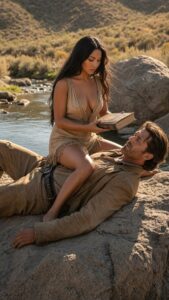
They named Tyen as a church ward until she turned twenty-one. Pike claimed Daniel was holding her against her will.
Daniel denied it.
Pike challenged him to bring her into town.
The thought of leading Tyen within reach of that man made Daniel’s hand move toward his pistol. Brody stopped him before the confrontation became a shooting.
Then, quietly, the sheriff delivered the warning that mattered.
Pike had been talking to Clay Hackett and Jeb Smith—the men Daniel had fought in the store. If the preacher brought men to the homestead, Brody could not promise to stop them.
Daniel left his supplies in the street.
He rode home.
Tyen was sitting at the table, practicing the letters of her name on a slate, when he burst through the door.
He told her Pike was alive. That he had papers. That men would come.
Then Daniel began packing.
Rifles. Cartridges. Blankets. Food.
They could follow the river north, disappear into the mountains, find shelter where nobody knew their names.
Tyen watched him.
Then she walked to the doorway.
Outside stood the corn they had planted, the roof they had repaired, the corral, the chickens she fed every morning. She touched the doorframe.
“No.”
Daniel tried to make her understand what would happen if they stayed.
“I will not be stolen again.”
She lowered the barrel of the rifle in his hand.
Her other hand rested on her belly.
“This is our place now.”
Daniel stopped packing.
He had brought her there because she had nowhere else to go.
Now she was telling him she had somewhere worth defending.
For two days, they prepared.
Daniel hid a spare rifle and ammunition high on the ridge. He cleared lines of sight through the brush and showed Tyen where to hide.
He taught her to reload his pistol until her movements became steady.
If the men came, she was to leave the cabin immediately.
One warning shot.
Then run.
On the third morning, their drinking water was nearly gone.
Daniel took two buckets to the creek, leaving Tyen to watch the trail.
The riders came while he was below the cabin.
Four of them.
Pike. Hackett. Smith. The drifter who had joined the fight in town.
They approached over the northern ridge, avoiding the trail Daniel had expected them to use.
Tyen raised the rifle.
The warning shot cracked across the valley.
She grabbed the pistol and ran toward the trees.
The horses were faster.
The drifter cut off her escape. Hackett jumped from his saddle and tackled her, driving her to the ground.
For a moment, the present collapsed beneath the past.
The weight of a man pinning her down. Hands reaching for her wrists. Voices discussing what to do with her.
Pike ordered them to bind her.
Smith brought a rope.
But Tyen had been slicing dried apples before the riders appeared. Her little knife was still tucked into her waistband.
When Hackett loosened his grip on one arm, she reached for it.
She slashed his face.
He recoiled, screaming.
Tyen scrambled free and vanished into the brush.
Smith and the drifter followed.
At the creek, Daniel dropped the buckets.
He climbed the canyon wall, grabbing roots and rock, praying that Tyen had reached the hiding place.
Instead, he found horses near the cabin and Hackett bleeding on the ground.
Pike raised a pistol and shouted accusations.
Daniel demanded to know where she was.
Then a voice carried from the trees.
They had trapped her.
Daniel ran.
He knew the ground better than the men pursuing her. Cutting across the rocks, he came upon them from above.
Tyen stood on a ledge with a sheer drop behind her.
The knife was still in her hand.
Below, Smith tried coaxing her down while the drifter began climbing toward her.
Daniel raised his rifle.
His first shot killed the climbing man.
Smith turned and drew.
Daniel fired again.
Then the canyon fell quiet.
Tyen stared down at him.
“Daniel.”
Pike appeared on the trail and began shouting that Daniel was a murderer. Even with two men dead at his feet, he insisted Tyen belonged in his custody.
Daniel kept the rifle trained on him.
Then hoofbeats broke the silence.
Sheriff Brody arrived with two deputies. They had heard the gunfire while on patrol.
Pike immediately appealed to him, describing a peaceful attempt to retrieve his ward and accusing Daniel of shooting his men without warning.
Brody looked at the bodies.
At the rifle.
At Hackett’s wounded face.
Daniel could see the story taking shape before anyone had asked Tyen what happened.
Then she spoke.
“He is no holy man.”
She had climbed down from the ledge.
Her dress was torn. Blood marked her arm. Her body trembled, but she walked forward until she stood beside Daniel.
And when she addressed the sheriff, her words came clearly.
The halting speech the men might have expected was gone. Her voice carried the precision of the education Pike claimed to have given her.
“Reverend Pike is a liar, Sheriff.”
She told him the price.
Twenty silver dollars.
That was what Pike had paid the former soldiers who captured her.
She told him about the month chained to the wagon. About the preacher calling her suffering God’s will.
Pike tried to interrupt.
Tyen continued.
She identified Hackett as the man who had attacked her. She described escaping, being pursued, and ending up cornered above the canyon.
Daniel had saved her.
Then she faced the preacher.
“I am not your ward. I am a free woman, and I am this man’s wife.”
Brody looked at Daniel.
Daniel affirmed it.
The sheriff turned back to Pike, his expression hardening.
He arrested the preacher for kidnapping, slave trading, and inciting the attack.
Pike protested his position in the church.
Brody put him in handcuffs.
“First, you’ll answer to the circuit judge.”
The deputies took him away, with Hackett also in custody.
Brody agreed to record the shootings as self-defense, but he offered no promise that the town would forgive them.
Pike had friends. Hackett’s family had money.
There would be people who remembered the dead men and ignored why they had come.
“Let them remember,” Daniel said. “Just so long as they remember to stay away.”
When the sheriff left, Tyen’s strength gave out.
Daniel caught her and carried her home.
The cabin had been disturbed. The door was damaged, the table overturned. Her writing slate lay broken on the floor.
He sat with her in his arms while she cried.
There was nothing he could say that would erase what had happened.
He stayed.
That night, after he repaired the door and settled her into bed, Tyen took his hand and placed it against her belly.
“The deer,” she whispered. “It is still with me.”
She had once dreamed of a deer that stopped running and walked beside her. That dream had helped them recognize the possibility of a child.
Now she was reminding him that their future was still there.
Daniel held his palm against her.
Their baby had survived.
The days that followed were watchful and quiet.
They buried the dead far from the cabin. Daniel repaired what had been damaged. Gradually, meals, chores, and evening fires began filling the hours that fear had occupied.
As Tyen’s pregnancy became visible, he looked around the cabin and saw how little space there was.
He began building.
The small porch room where she had first slept behind her own latch came down. In its place, he added a proper room with a wide window for morning light.
Tyen sat nearby sewing tiny clothes from soft deerskin while his hammer sounded through the valley.
After the room came the cradle.
Daniel shaped and smoothed the wood with the same scarred hands that had broken her chain.
Then he carved toys.
A deer.
A bird.
A horse like Sully.
He lined them along the windowsill, waiting for hands small enough to hold them.
In the evenings, Tyen taught him lullabies.
He protested that he could not sing.
She insisted.
The baby knew her voice, she told him. It needed to know his, too.
So Daniel practiced, stumbling over the words until she laughed and made him try again.
The cabin that had held five years of silence began filling with his uncertain singing.
One evening, she returned to a word in her reading book.
Love.
She understood that it meant warmth. Something that stayed.
But it meant more now.
Daniel placed her hand over the baby’s movement, then against his heart. He pointed to the cradle and the new room.
“It’s the work.”
Tyen looked at what they had made together.
The word had become something she could touch.
Before the birth, they needed supplies again.
Daniel intended to go alone.
Tyen refused.
“I will not hide.”
They rode into Santa Fe together.
Conversation stopped as they crossed the plaza. Tyen sat straight on her mule, her pregnancy plain to everyone watching.
Daniel kept his hand near his gun.
She kept her eyes ahead.
Outside the store, rancher Jedediah Miller confronted Daniel about the deaths of his men.
Daniel reminded him why they had come to the homestead.
Miller looked at Tyen.
After a moment, he warned Daniel that the town remained hostile. He asked why Daniel would stay with her when he knew what the world would make of their life.
Daniel answered without hesitation.
“Because she’s mine. And I’m hers.”
They finished loading their supplies and rode home.
No one followed.
When labor finally began, a storm was battering the cabin.
Tyen woke Daniel with her hand gripping his.
“It is time.”
He built the fire and heated water.
Then the hours stretched.
He watched her endure contraction after contraction, and the memory he had carried for five years rose around him.
Elara’s exhausted face.
His daughter’s silence.
The helplessness of standing beside a bed while everything he loved slipped away.
His fear spilled into the room.
Tyen caught his hand.
“Daniel, stop.”
He knelt beside her.
“Look at me.”
Through her own pain, she called him back to the woman in front of him.
“We are both made from storms,” she told him.
Then she gave him his own words.
“Be the work.”
Daniel steadied himself.
He held her. Supported her. Gave her water.
When he could think of nothing else to say, he sang the lullabies she had taught him.
Near dawn, lightning struck the ridge.
Tyen cried out.
And another voice answered.
Small.
Furious.
Alive.
A daughter.
Daniel wrapped her in the soft flannel they had bought and placed her against Tyen’s chest.
Tyen smiled.
Only then did he sink to the floor and weep—for the family he had lost, for the fear he had carried, and for the child whose cries now filled his home.
They named her Nantani Reed.
Tyen said the name meant she brings light.
The following spring, they rested beneath the cottonwood beside the creek. Tyen leaned against Daniel, their daughter asleep in her arms.
She studied the baby’s dark hair and pale gray eyes.
Then she looked up at him, remembering the question she had asked before she understood what their life could become.
“So,” she whispered, “this is how white people make children.”
Daniel kissed the top of her head.
“No,” he replied. “We made her together.”








