HE SPAT ON A DYING ENSLAVED WOMAN—21 DAYS LATER, THE SAME SPOT ON HIS OWN NECK BEGAN TO ROT
PART 2
That night, Hargrove was still scratching.
When Joseph brought him dinner, the overseer sat behind his desk staring blankly at the wall.
His food remained untouched.
The skin at the back of his neck had already become red and raw.
Joseph noticed marks on the desk where Hargrove’s fingernails had dug into the wood.
He asked whether the overseer felt ill.
Hargrove snapped that he was fine.
But he wasn’t.
The next morning, December 5, Hargrove emerged to assign work as usual, yet those closest to him saw the change immediately.
His face was flushed.
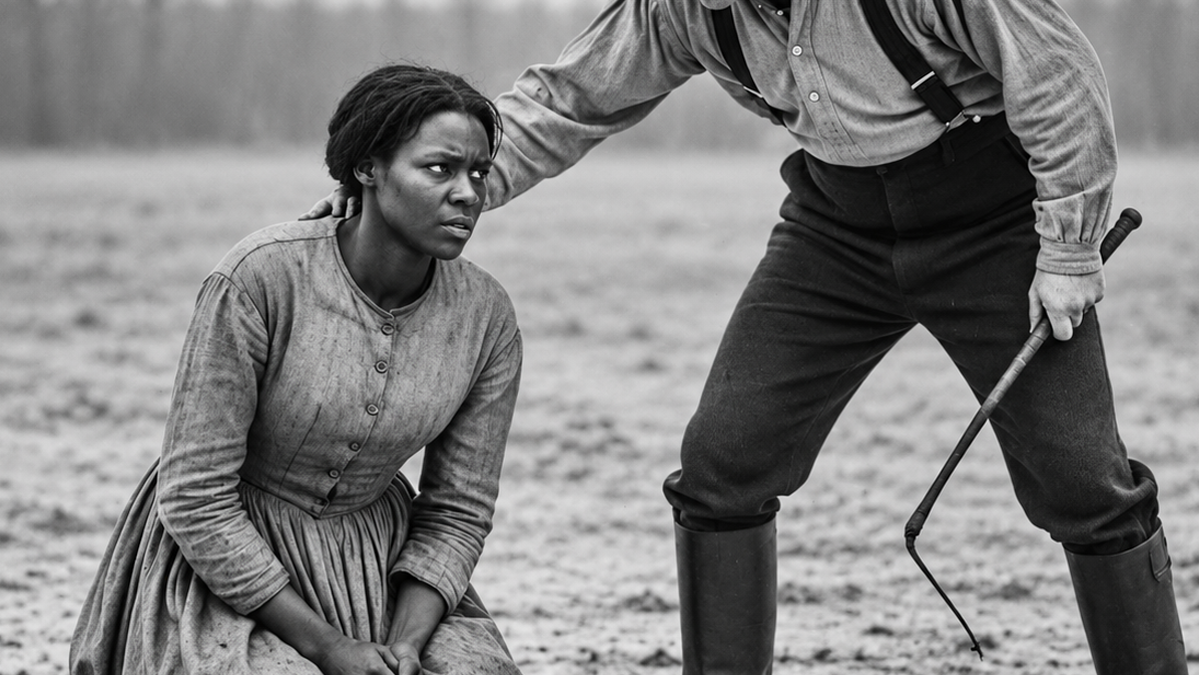
His temper was worse.
And every few minutes, his hand drifted back toward his neck.
Scratch.
Scratch.
Scratch.
By noon, he had retreated to his cabin.
The man who once spent his days watching everyone else was now sitting alone behind a closed door, staring at empty pages in his ledger.
That night, he called Joseph inside.
“Did you hear anything?”
Joseph did not understand.
Then Hargrove explained.
Singing.
He claimed a woman had been singing outside his window during the night.
Joseph knew the quarters had been almost completely silent since Ruth’s death.
No one had been singing.
But Hargrove insisted.
He had heard a woman’s voice.
Close.
Almost directly outside his cabin.
When he went to look, no one was there.
Joseph suggested it might have been the wind.
Hargrove became furious.
It was not the wind, he said.
Someone was watching him.
Within days, the overseer’s condition deteriorated.
The itching intensified until he scratched hard enough to break his own skin.
The wounds spread down his neck.
He began complaining about headaches.
Then whispers.
Then footsteps.
Then voices in the darkness.
On December 6, Hargrove asked Joseph to fetch Dr. Samuel Pritchard.
Before Joseph could leave, Hargrove changed his mind.
A doctor might think he was losing his sanity.
By December 7, paranoia had taken hold.
Hargrove refused to eat unless he personally watched Joseph prepare the food.
He accused people of poisoning him.
The scratches had become swollen and wet with infection.
He wrapped a scarf around his neck to hide them.
That only made the wounds worse.
When plantation owner Edmund Thornhill returned from Savannah on December 8, he was irritated to discover his overseer barely functioning.
Thornhill cared about production.
Hargrove had been hired to keep the plantation profitable.
Instead, he was barricaded inside his cabin.
Thornhill went to see him.
The man sitting inside barely resembled the overseer he knew.
Hargrove had lost weight.
The cabin was in disorder.
His eyes appeared wild and unfocused.
When Thornhill asked what was wrong with his neck, Hargrove tried to dismiss the question.
Thornhill pulled away the scarf.
He recoiled.
The skin was covered in infected scratches.
Some had scabbed over.
Others had been ripped open again.
Hargrove admitted he could not stop scratching.
It burned, he said.
It felt as though something were beneath his skin.
Thornhill sent for Dr. Pritchard.
The physician arrived December 9.
He examined Hargrove carefully.
There was nothing supernatural in his first diagnosis.
The scratches had become infected.
The infection was spreading.
The mystery was why Hargrove had begun scratching so violently in the first place.
Had he touched poison ivy?
Been bitten?
Suffered some other irritation?
Hargrove had no answer.
It had simply begun itching.
Dr. Pritchard cleaned the wounds, dressed them, and warned Hargrove that he had to stop scratching.
If necessary, the doctor said, his hands might need to be restrained.
Within hours of the doctor’s departure, Hargrove tore away the bandages.
And started scratching again.
By December 10, red streaks were creeping outward from the wounds.
The infection was entering his bloodstream.
Fever took hold.
His speech became confused.
His strength faded.
Across the plantation, people watched.
No one needed to say aloud what everyone was thinking.
Ruth had been buried only days earlier.
Hargrove’s illness had begun almost immediately after her death.
And the first wound appeared on the exact portion of his neck he had begun obsessively scratching after he spat on her.
Some called it God’s judgment.
Others whispered Ruth’s name.
A few of the elders spoke more cautiously.
They had seen enough suffering to understand that not every mystery needed a name.
Maybe it was illness.
Maybe guilt.
Maybe coincidence.
Maybe something else.
Dinah said little.
She kept hearing Ruth’s final words.
Some debts get paid whether you believe in the reckoning or not.
On December 12, another disturbing symptom appeared.
Hargrove could not tolerate being touched.
When Joseph tried to help him change clothing, Hargrove screamed that Joseph’s hands were burning him.
Dr. Pritchard returned.
The physician said the infection had spread into Hargrove’s blood and was affecting his mind.
He recommended constant supervision.
But Hargrove fought anyone who attempted to restrain him.
Eventually, people stopped trying.
They left him alone inside the cabin.
Those who entered reported increasingly strange scenes.
Sometimes Hargrove stood at the window, staring toward the slave quarters.
Sometimes he lay curled on the bed with his hands pressed against his ears.
And once, Sarah found him kneeling in the middle of the room.
He was crying.
Over and over, he said he was sorry.
Nobody knew exactly whom he was speaking to.
By December 14, Dr. Pritchard could see there was little hope.
The infection had spread across Hargrove’s neck and chest.
His face was gray.
The cabin smelled of sweat, infection, and decaying tissue.
Thornhill asked how long he had.
Days, the doctor answered.
Perhaps less.
Privately, the case troubled Pritchard.
The medical explanation was straightforward enough.
A scratched wound could become infected.
Before antibiotics, blood poisoning killed countless people.
But the pattern bothered him.
The obsessive scratching had begun before the wound became visibly severe.
It remained centered on one location.
And according to witnesses, it was the same area corresponding to where Hargrove had spat on Ruth.
Pritchard wrote about the case in his private journal.
He did not claim a curse.
He did not abandon medicine.
But he admitted there was something about the timing he could not comfortably dismiss.
On December 15, Joseph found Hargrove staring toward an empty portion of the room.
“Watching me,” Hargrove whispered.
Joseph looked around.
Nobody was there.
Hargrove insisted there was.
A woman.
Standing near the window.
Then he said her name.
Ruth.
He claimed she would not leave.
She stood watching him.
Sometimes smiling.
Sometimes simply staring.
Hargrove begged Joseph to tell her he was sorry.
Joseph answered that there was no one in the room.
But Hargrove was no longer listening.
His eyes closed.
His body jerked in fevered sleep.
When word reached the enslaved community, the reaction was complicated.
Hargrove had inflicted pain on many of them.
Few felt sympathy.
But there was something terrifying about watching another human being disintegrate physically and mentally.
Even justice, when it arrived through agony, could be difficult to witness.
Dinah interpreted it differently.
She remembered Ruth’s voice.
She remembered the promise that cruelty carried a cost.
Whether Hargrove was seeing a ghost, suffering hallucinations from septic fever, or being destroyed by his own guilty mind, Dinah could not know.
But something had finally forced him to look at what he had done.
By December 18, Hargrove was carrying on entire conversations with people no one else could see.
He argued with empty corners.
He begged unseen figures to leave him alone.
Again and again, he returned to Ruth.
She’s watching.
She’s judging.
She won’t leave.
Thornhill had already begun searching for another overseer.
His concern was practical.
Christmas was approaching.
The plantation needed someone to run it.
By December 20, Hargrove could no longer leave his bed.
The wounds on his neck had turned black in places.
The tissue was dying.
Dr. Pritchard returned and told Thornhill there was nothing more he could do.
The infection was systemic.
Hargrove was dying.
Thornhill could not understand how scratches had reduced a seemingly healthy man to this.
Dr. Pritchard explained blood poisoning again.
The doctor also believed fear and mental distress had contributed to Hargrove’s decline.
But he did not explain the deeper unease he felt.
He had treated infection before.
He had watched people die before.
This case felt different.
On December 22, an unusual cold settled across the plantation.
The water troughs froze.
Inside Hargrove’s cabin, his breathing became wet and uneven.
His face had swollen almost beyond recognition.
Thornhill stopped visiting him.
Joseph continued bringing water.
Then, on December 23, something changed.
Hargrove had spent most of the previous day barely conscious.
Suddenly, his eyes opened.
His voice returned with startling clarity.
“I’m sorry.”
Joseph turned.
Hargrove was crying.
He began speaking as though someone else stood in the room.
He said he understood now.
He spoke of every cruelty.
Every humiliation.
Every moment of suffering.
He said he could see all of it.
Then he begged for it to stop.
What followed haunted Joseph for the rest of his life.
Hargrove screamed.
Not in anger.
In terror.
The sound brought people running.
Sarah arrived.
Other house servants followed.
Then Thornhill entered.
Hargrove was thrashing so violently that several people had to hold him down.
His eyes remained fixed above him.
Whatever he believed he was seeing, nobody else could see it.
Finally, his body collapsed.
But he did not die.
He remained alive through December 24.
Christmas Eve.
His eyes stayed open.
His breathing slowed, stopped for several seconds, then returned in choking gasps.
The plantation fell unnaturally quiet.
Dinah sat outside beneath the winter sky that evening and thought about Ruth.
Was this justice?
Was this merely disease?
Was a man being punished by something beyond understanding?
Or had he simply scratched himself until bacteria entered the wounds, then lost his mind as infection spread through his blood?
There was no way to know.
Just before midnight, Joseph heard a long rattling breath from inside the cabin.
Then silence.
He entered.
Silas Hargrove was dead.
His eyes remained open.
His mouth was frozen in an expression that looked somewhere between a scream and a plea.
But Joseph’s attention went immediately to the neck.
The worst destruction had centered around the place Hargrove had been scratching from the beginning.
The tissue there was black and split open.
The wound was deep.
The odor of infection and death filled the cabin.
Dr. Pritchard arrived after dawn.
His official conclusion was septicemia: blood poisoning caused by an infected wound.
Medically, it made sense.
In 1854, without antibiotics, infection could turn a minor injury into a death sentence.
But the timing entered the story immediately.
Ruth had died December 4.
Hargrove died twenty-one days later, recorded on December 25.
Exactly three weeks.
And the infection that killed him had begun with obsessive scratching at the spot on his neck that witnesses associated with his final humiliation of Ruth.
Dr. Pritchard reportedly continued thinking about the case.
In his private account, he considered medical explanations, psychological stress, and coincidence.
But he never found an explanation that completely satisfied him.
Hargrove was buried on December 26 in a white cemetery near Statesboro.
The service was sparsely attended.
Thornhill went.
Dr. Pritchard went.
A few local businessmen appeared.
Joseph drove Thornhill’s carriage.
No one from the enslaved community came to mourn.
Back at Thornhill Plantation, life continued.
Another overseer was hired.
According to the story, the new man was still an enforcer of the same brutal system, but he was noticeably more cautious.
He did not destroy people’s gardens.
He did not spit on the sick.
When someone became ill, he occasionally permitted rest.
Perhaps he had heard what happened to the man before him.
Hargrove’s old cabin remained empty.
People claimed they sometimes heard scratching from inside after dark.
No one could prove it.
The more important legacy was the story itself.
It spread.
Across enslaved communities, details changed as stories always do.
In some versions, Ruth possessed supernatural powers.
In others, Hargrove died on Christmas Day or near New Year’s.
But the central image remained intact:
A powerful man spat upon a dying woman whom the law treated as property.
Three weeks later, he was dead.
Years passed.
The plantation eventually changed owners.
During the Civil War, the property was reportedly used as a Confederate supply location and later burned during Sherman’s March to the Sea.
The main house was never rebuilt.
Ruth’s grave had no lasting marker.
Like the graves of so many enslaved people, it risked disappearing into the landscape.
But her story did not disappear.
Decades later, oral histories preserved versions of it.
One account described Ruth as a healer whose knowledge made her indispensable to her community.
The storyteller did not claim certainty about magic or curses.
Instead, she emphasized consequences.
Cruelty has a cost.
That idea mattered because the legal system of Ruth’s world offered her almost no justice.
She could be whipped for caring for a sick child.
Her medicinal garden could be destroyed.
She could be worked while dangerously ill.
She could be humiliated publicly by a man who believed he had absolute authority over her.
There was no courtroom waiting to defend Ruth.
No authority preparing to punish Hargrove for what he had done.
That is why the story of his death became more than a story about infection.
It became a story about the possibility that power might not be permanent.
That cruelty might carry consequences even when the law refused to impose them.
The surviving plantation records described Ruth’s death simply.
Ruth.
Field hand.
Thirty-eight years old.
Died of fever.
A human life compressed into a few words.
Hargrove’s death was likewise reduced to an administrative record: overseer, dead of infection.
Yet between those two ledger entries lived an entire world of suffering, fear, memory, and unresolved questions.
One additional detail made later retellings even stranger.
Before Ruth became gravely ill, people reportedly saw her working with herbs and roots outside her cabin.
After she died, women cleaning her belongings found several bundles.
Most contained familiar remedies.
One did not.
The plants inside were unfamiliar to the others.
And according to the story, the bundle carried a single label:
“Justice.”
No evidence showed that Ruth ever used it.
Nothing established that the bundle had any connection whatsoever to Hargrove’s death.
The women eventually buried it near Ruth’s grave.
So the mystery remained.
Did Hargrove die because guilt, fear, and obsessive scratching created the perfect conditions for a fatal infection?
Very possibly.
Did fever and septicemia explain the voices, visions, terror, and claims that Ruth stood watching him?
They could.
Hallucinations can accompany severe illness.
Was the timing coincidence?
Perhaps.
A twenty-first-century observer does not need the supernatural to explain how a scratched wound could kill someone in 1854.
Yet facts alone do not explain why the story survived.
It survived because Ruth had almost no earthly power.
Hargrove had nearly all of it.
He controlled her labor.
He controlled punishment.
He tried to control her ability to heal others.
He destroyed something she had spent years building.
He humiliated her while she was dying.
And still, in the memory of the people who knew the story, Hargrove did not have the final word.
Ruth did.
Not because anyone could prove she cursed him.
Not because history can demonstrate supernatural revenge.
But because twenty-one days after Ruth’s death, the man who had tried so hard to convince her she was worthless was gone.
Ruth’s name endured.
Her healing endured through Dinah and the people she had taught.
Her final warning endured.
And the plantation system Hargrove believed permanent did not.
A decade later, war swept through Georgia.
Slavery itself would soon be abolished.
Thornhill Plantation would disappear.
Its house would burn.
Its owners would leave.
Its overseers would become names in old records.
But the woman Hargrove treated as though she were nothing became the person generations remembered.
That may be the most powerful reckoning in the entire story.
Silas Hargrove spent his final weeks terrified by the belief that Ruth was watching him.
Whether Ruth was actually there is a question no historian can answer.
Whether his death was supernatural cannot be proven.
But one truth requires no superstition at all:
Ruth lived in a system built to erase her humanity.
And somehow, she was remembered.
Hargrove used fear to make people obey him.
Ruth used knowledge to heal them.
He destroyed.
She restored.
He tried to reduce her to property.
Her community remembered her as a person.
And more than a century later, the story was still being told.
Maybe that is why Ruth’s final message feels larger than the mystery surrounding Hargrove’s death.
Some debts are paid in court.
Some are paid through consequences.
Some are paid when the powerful finally confront what they have done.
And some are paid when history refuses to remember the oppressor without also remembering the person he tried to erase.
Was Silas Hargrove killed by septicemia?
The historical record says yes.
Was his breakdown fueled by guilt, fear, fever, and infection?
It may have been.
Did Ruth somehow reach beyond death to collect a debt?
That belongs to belief, not proof.
But on one point, the story leaves little room for argument.
Hargrove believed Ruth was powerless.
Twenty-one days later, he was dead.
And Ruth’s name was still alive.








