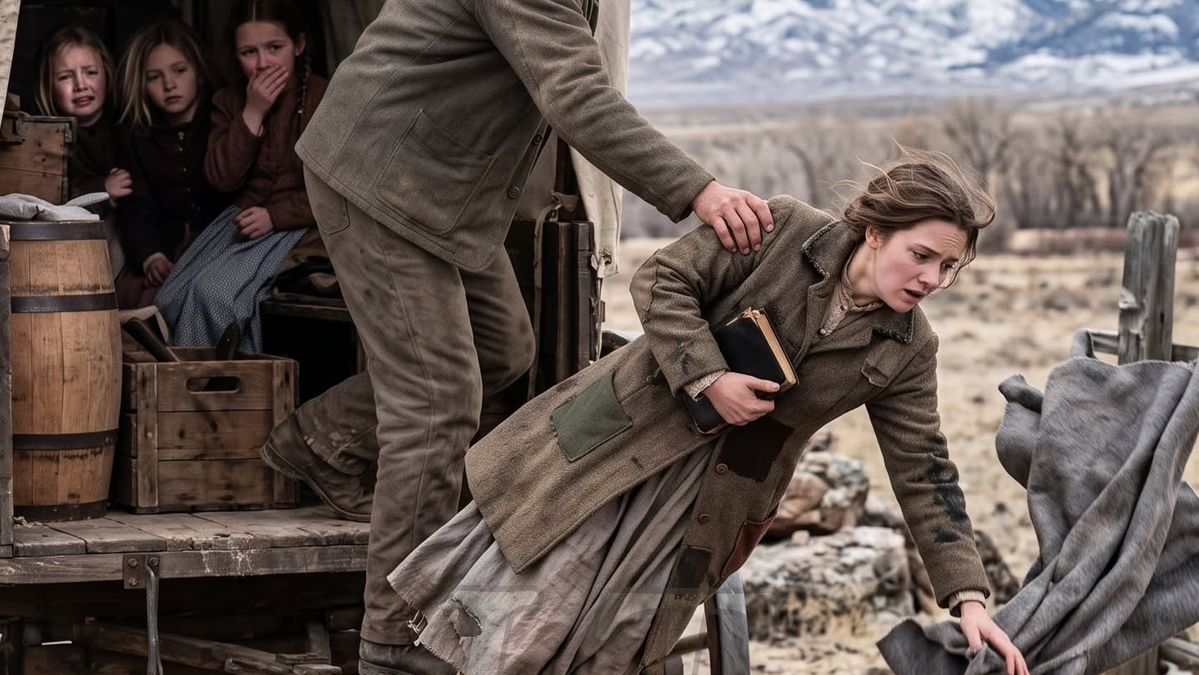
Her Father Threw Her From the Wagon at Sixteen, but the Frozen Stone House She Built Became the One Thing He Could Never Take Back The wagon did not slow when Cornelius Vance threw his sixteen-year-old daughter onto the frozen Wyoming trail.
Adeline built the heater the way she had survived the first night: one number at a time.
She quarried sandstone slabs from the western slope and dragged them to the creek on a sled of green cottonwood. She dug clay from the bank, mixed it with sand and creek water, and learned by failure how wet the mortar had to be before it held. Her first firebox cracked in the second week. Her second collapsed in a thaw. She sat among the ruins, hands raw, and opened the Bible to the charcoal lines.
“Two feet wide,” she whispered. “Eighteen inches high. Fifteen feet of rise.”
She started again.
By mid-December the house stood: a squat stone room with a sod roof, one low door, and at its center the heater, its channels snaking through the walls like veins. On the night she lit the first small fire, she watched the flames die to coals within two hours and thought, for one terrible moment, that she had been wrong.
But the stones kept the heat. At midnight, the wall against her back was warm. At dawn, it was still warm. Eighteen hours after the last ember, snow lay a foot deep outside and Adeline sat in her shirtsleeves, laughing until she wept.
The first rider came in January: a trapper named Tobias Reed, half frozen, following the thin line of smoke he had seen from the ridge. He stayed three days. When he left, he took a charcoal copy of the design and told everyone he met about the girl who had made stone hold fire.
By February, men rode in from forty miles. Ranchers who had buried children in the cold. A Norwegian carpenter. A widowed schoolteacher who stood in the doorway and said nothing for a long time, then asked quietly, “Could you teach me?”
Adeline taught them all. She charged nothing at first. Then Tobias, ashamed to leave empty-handed, pressed a silver dollar into her palm, and a rancher offered a milk cow, and she understood that knowledge was also a trade.
By the next autumn, she had built nine heaters across the Powder River country. Families slept through blizzards in homes that stayed warm until morning. The stone house by the creek had become something else: a school, a workshop, and a name people spoke with respect. Adeline’s Hearth.
She wrote letters to Clearwater, to every trading post along the trail, asking after her sisters. Her father’s wagon had been seen heading south. Nothing more.
She kept building. She kept listening.
Cornelius Vance returned on the fourteenth of November, 1882, exactly one year to the day.
Adeline was on the roof of a half-finished heater when she saw the wagon on the trail, its canvas patched and sagging. It was drawn by a single exhausted mule. Her father sat on the bench, thinner and grayer, his shoulders folded like a man carrying a weight he could no longer name.
She climbed down slowly. By the time the wagon stopped, she was standing in the yard with her arms crossed and twenty men and women gathered behind her, workers and students and families who had come for the winter’s first firing.
Cornelius looked at the stone house. At the smoke rising straight into the cold air. At his daughter.
“Adeline.”
She said nothing.
“The girls are in the wagon.” His voice cracked. “Ruth has the fever. We lost the claim in Nebraska. There’s been nothing but hunger since.” He swallowed. “I have nowhere else.”
Behind him, the canvas shifted. Two small faces appeared, pale and hollow-eyed. Ruth, eleven, coughed into her sleeve. Little Mary, eight, stared at Adeline as if she were a ghost.
Something hot rose in Adeline’s chest. She thought of the wheels that never slowed. The gray blanket. The night she counted to a thousand and began again.
“You threw me away,” she said.
“I was a fool.” Cornelius climbed down, knees trembling, and did something Adeline had never seen him do. He lowered his eyes. “And this house, this land. It’s a miracle. I can help. I can work. The land should be in the family name, and as your father, by law—”
The yard went silent.
There it was. Not apology, but arithmetic, his old trade. He had not come back for her. He had come back for the thing she built.
“By law,” Adeline repeated softly.
“A minor cannot hold title.” He straightened, the old hardness returning. “I am your guardian. Everything on this land belongs to me.”
Tobias Reed stepped forward, his hand drifting to his belt. Adeline raised her palm, and he stopped.
“You’re right about the law,” she said. “I was sixteen. I couldn’t have filed a claim.”
Cornelius’s mouth curved.
“But the schoolteacher filed it.” Adeline turned. The widow, Eleanor Marsh, stepped from the crowd holding a folded paper stamped with the seal of the Clearwater land office. “Eleanor filed the homestead claim the week I finished the walls. She holds the deed. The land is hers, and she signed me a lifetime lease, witnessed by the territorial judge.”
Cornelius stared at the paper. His face went the color of ash.
“You planned this,” he whispered.
“I learned it,” Adeline said. “From watching men who never noticed I was listening.”
He stood there a long time. The mule shifted. The wind carried the smell of wood smoke and baking stone. In the wagon, Ruth began to cough again, a thin, rattling sound that cut through everything.
Adeline looked at her sisters. Then at the father who had taught her only cold.
She walked past him without a word, climbed into the wagon, and lifted Ruth into her arms. The girl weighed almost nothing. “Bring Mary inside,” she told the nearest woman. “Fill the kettle. Put them by the heater.”
“Adeline,” Cornelius said.
She paused at the door of the stone house, warm air spilling out around her.
“My sisters will stay. They will be fed, and they will be warm, and they will never be thrown from anything again.” She did not turn. “You may stay the night in the barn. Then you will go.”
“You would turn out your own father?”
Adeline finally looked back. The sixteen-year-old girl on the frozen trail was gone. In her place stood a woman with scarred hands and steady eyes.
“No,” she said. “I’m doing what you taught me. I’m letting the wagon move on.”
She went inside. The door closed. Behind it, the stone drank the heat, held the heat, and gave it back, and for the first time in her life, Adeline Vance was not counting.
THE END








