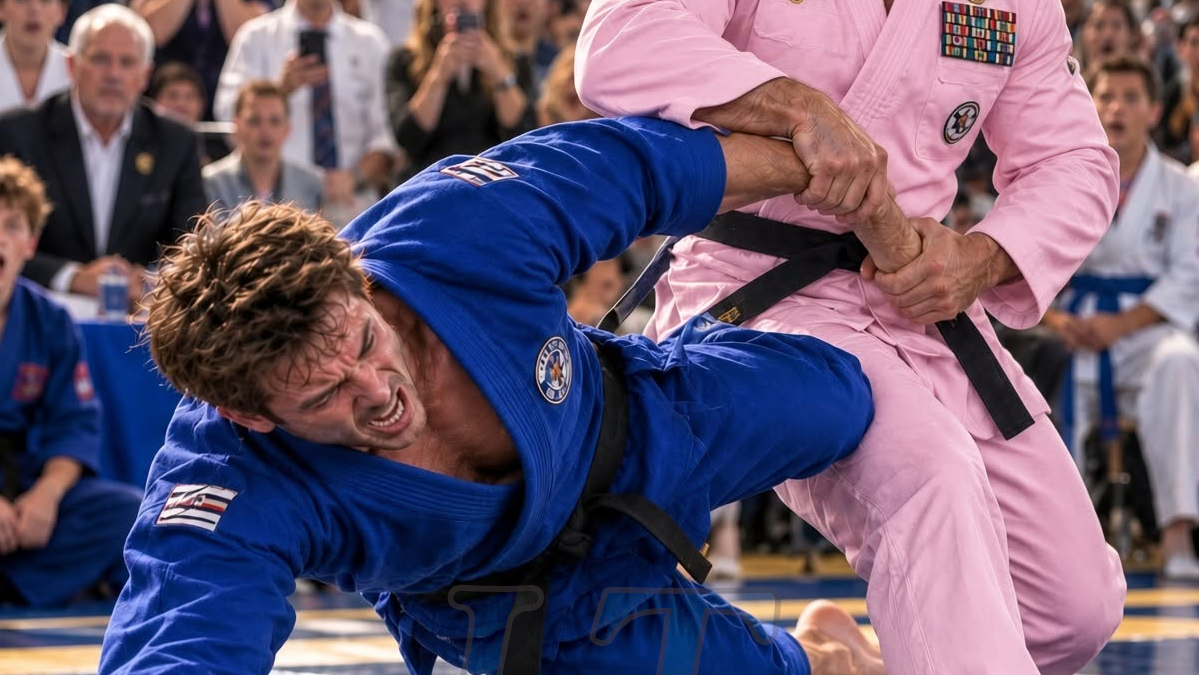
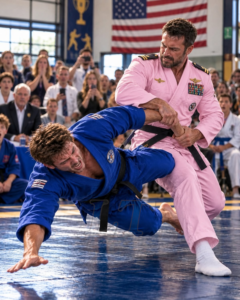
“My thirteen-year-old son was lying on a gym floor struggling to breathe while his martial arts instructor stood over him smiling like he’d just won a championship.
The door swung wider, and the man behind Evan stepped into the light.
He was fifty, maybe older, in a charcoal coat too heavy for September. His face was lined and gray-stubbled, but I knew it before he said a word. Victor Strand had been a private contractor in Kandahar, and I was the reason he’d spent eleven years in a federal prison.
“Damon Cross,” he said softly, like he was tasting the name. “Nine years of looking. And you were fixing sinks.”
Evan turned. Strand’s right hand rested on my son’s shoulder, almost gently. His left stayed in his coat pocket.
Nobody in the gym breathed.
“Let him go, Victor,” I said.”
“You buried me,” Strand said. “You and your friends in the valley. I lost my contracts, my name, my wife. And you got to disappear and play house.” His eyes flicked to Evan. “Does the boy know what his father did?”
“I know my father,” Evan said. His voice shook, but he didn’t look away.
Strand smiled. “Then he should know the price.”
Blake took a half-step forward, then froze when the pocket shifted. Reeves moved a hand toward his hip, but he was an old man with no weapon, and every parent in that room had a child sitting on that floor. Strand knew it. He had always been good at reading rooms.
I understood then that this was the real fight, the one I had spent nine years running from.
I took off my socks.
It sounds strange, but I did it without thinking, because bare feet grip a mat. I walked toward Strand slowly, hands open and low, the way you approach a frightened animal.
“You want me,” I said. “Not him. Take me outside.”
“No.” His voice cracked. “I want you to feel it. I want you to stand there and watch.”
“Then you’re not Victor Strand anymore,” I said. “The man I knew would never have put a hand on a kid.”
Something flickered in his face. It was only a second, but a second was all I had ever needed.
“Evan,” I said quietly. “Breathe with me.”
My son understood. He inhaled, and when Strand’s attention snapped toward the sound, Evan dropped his full weight straight down, the way I’d shown him once when he was seven, playing on the living room carpet.
Strand’s grip slipped. I crossed the distance in a single step, caught his left wrist as it came out of the pocket, and turned it up and away. A small black pistol skittered across the mat and spun to a stop at Blake’s feet.
Strand swung with his free hand. I let it graze my jaw, because I needed him close. Then I folded his arm behind him, swept his leg, and put him face-down on the floor. I didn’t strike him once. My knee pinned his shoulder, and my hand held the back of his neck, and I felt his whole body shaking.
“It’s over, Victor,” I whispered. “It was over a long time ago.”
He started to sob.
Behind me, a dozen phones that had been filming Blake’s humiliation now recorded something else. Sirens rose in the distance. Reeves had called them the moment Strand walked in.
Blake picked up the pistol with two fingers, as if it might burn him, and set it on a folding chair, far from everyone. His hands were trembling. When the police took Strand out in cuffs, Blake stood in the middle of the mat, no longer a champion, only a young man who had learned what real danger looked like.
An hour later the gym was nearly empty. Parents had taken their kids home. An officer had taken my statement. Reeves lingered by the bleachers, turning his cap in his hands.
“I never meant to expose you,” he said.
“You didn’t,” I said. “I did that the moment I stepped on the mat.”
“Was it worth it?”
I looked across the floor. Blake was standing by the doorway, waiting. He crossed the room slowly and stopped a few feet from me.
“I owe your son an apology,” he said, his voice rough. “And you. I used him to feel big. I’m sorry.” He pulled an envelope from his gym bag. “That’s the month’s fee, and the next three. I’ll understand if he never wants to come back.”
“That’s his decision,” I said. “Not mine.”
Blake nodded and walked out. I never saw him act that way again. I heard later that he rebuilt the program from scratch, with a rule posted over the door: Strength protects. It never performs.
I found Evan in the truck, in the passenger seat, staring through the windshield. I climbed in and sat in silence for a while.
“You were a SEAL,” he said finally.
“Yes.”
“You lied to me.”
“I hid it,” I said. “I thought if you knew who I used to be, you’d see that man instead of your dad. I was wrong to decide that for you.”
He was quiet for a long moment. Then he said, “When he grabbed me, I wasn’t scared. I knew you were coming.”
My throat closed. I couldn’t speak.
“I said I wasn’t strong enough,” Evan went on. “But you didn’t win by being stronger than Blake or Strand. You won by staying calm, and not hurting anyone you didn’t have to.”
“That’s the only strength that ever mattered,” I said. “It took me sixteen years and a lot of wrong turns to learn it.”
He reached over and took my bruised hand in both of his. “Then teach me that. Not the fighting. The other part.”
I started the Silverado. For the first time in nine years, I didn’t feel like a man hiding. I felt like a father with nothing left to bury.
“Deal,” I said.
We drove home with the windows down, past the repair shop, the old oaks, and the quiet streets of Cedar Falls. Damon Cross had finally stopped pretending he didn’t exist, and my son was beside me, safe, and proud to call me Dad.








