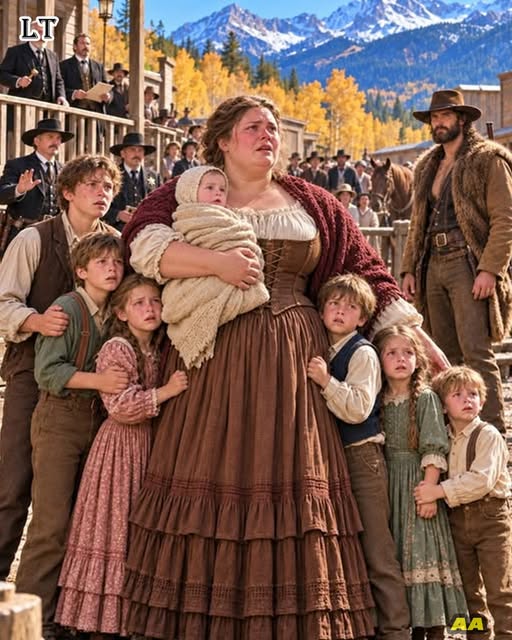
Oak Haven had already begun auctioning a widow’s seven children to pay her dead husband’s debt when a massive shadow crossed the square.
Silas Blackwood stared at the yellowed deed spread across Josie’s kitchen table. For a long moment, he didn’t breathe.
Original claimant: Eleanor Dalton Blackwood. Filed June 1871.
“Eleanor,” he whispered.
Josie looked up from the lamp. “You knew Arthur’s sister?”
“Knew her?” Silas’s voice cracked like dry timber. “I married her.”
The kitchen went silent. Even little Pearl stopped fussing in Josie’s arms.
Silas sank onto the bench, his huge frame suddenly looking very tired. “Seven years ago, Eleanor and I had a cabin on this very ridge. She found silver ore in the creek bed. She was so excited. She rode into Oak Haven to file the claim while I was up in the high country trapping.” He closed his eyes. “Two nights later, our cabin burned. They told me she was trapped inside. A lamp knocked over, they said. An accident.”
He opened his eyes, and they were full of something terrible.
“I never came down from the mountains again. Folks started calling me a wild man. Maybe I was.”
Wyatt stepped forward with the bank ledger he had smuggled out of Reed’s office. “Mr. Blackwood, look at this.” He pointed with a trembling finger. “Two weeks after your wife died, Reed’s bank transferred her claim to Uncle Arthur, her only blood kin. But there’s a note in the margin. Holder unaware of mineral value. Acquire through debt.“
Josie’s hand flew to her mouth.
It all came together like the pieces of a broken plate. Reed had known about the silver for seven years. He had lured Arthur into gambling debts and pressed him for money. Arthur had paid off the two thousand dollars, and Reed had hidden that payment.
“And Arthur died in the Deep Vein mine,” Josie whispered. “Reed’s mine. Arthur never wanted to work there, but Reed said it was the only way to clear his name.” Her voice broke. “Arthur told me the night before he died that he’d found something in Reed’s books. Something he was going to take to the territorial marshal.”
Silas rose slowly to his feet.
“Then Arthur Dalton didn’t die in an accident,” he said. “And neither did my wife.”
They came that night.
Silas heard the horses first, a full mile out. He had spent seven years listening to the mountains. Six riders were coming hard from town, carrying torches.
“Get the children into the root cellar,” he told Josie. “All of them.”
Josie didn’t argue. She moved through the dark cabin with her heavy, steady footsteps, scooping up Seth and Ruth, herding the twins, pressing Pearl into Clara’s arms. Wyatt grabbed the old shotgun from above the door.
“Wyatt. You too.”
“No, ma’am.” The boy’s jaw was set exactly like his father’s. “I’m staying.”
Outside, the riders reined in. Torchlight flickered across the yard. At their head, wrapped in a fine wool coat, sat Clement Reed.
“Blackwood!” he called. “This doesn’t concern you. Hand over that ledger and ride back to your mountain. Nobody else needs to get hurt.”
Silas stepped onto the porch, alone and unarmed. He was a massive shadow against the lamplight.
“Seven years ago,” he said, “you burned my wife alive for a silver claim.”
Reed’s smile faltered. Just for a second.
“Prove it.”
“I don’t have to prove it to you.” Silas stepped down into the yard. “I just have to stop you.”
Reed nodded to his men. “Burn it.”
A rider swung his torch toward the cabin roof.
The cellar door burst open.
Josie Dalton came up out of the ground like a mother grizzly, holding a cast-iron skillet in one hand. She hit the nearest rider so hard his torch went spinning into the water trough. His horse reared and threw him into the mud.
“Not my children’s home!” she roared. “Never again!“
The yard exploded into chaos.
Silas pulled the second rider from his saddle with one hand. Wyatt’s shotgun blast went over their heads, and three horses bolted into the darkness. A torch hit the porch and caught, and Josie threw a bucket of water on it before the flames could climb.
Reed wheeled his horse and drew a pistol.
He aimed it at Josie.
“You fat, stubborn cow,” he snarled. “You should have just let them take your brats.”
He fired.
Silas was already moving. He threw himself between them, and the bullet tore through his side. He staggered. He didn’t fall.
He kept walking toward Reed.
Reed fired again and missed, his hand shaking. Silas reached him, tore the pistol from his grip and dragged the banker from the saddle like a sack of grain.
Behind them came the thunder of more hooves. A dozen lanterns swung up the road.
It was the town. Mayor Higgins was there, and the sheriff, and the deputies. Even Harriet Montgomery sat in a buggy, wrapped in a shawl. Little Amos had slipped out of the cellar during the fight and run the whole two miles to Oak Haven in the dark, shouting for help.
The sheriff took in the scene. There were torches in the mud, Reed’s hired men groaning on the ground, the banker pinned beneath a bleeding mountain man, and a widow standing guard over her children with a skillet in her hand.
Wyatt handed him the ledger.
The sheriff read it by lantern light. His face hardened. “Clement Reed, you’re under arrest for fraud, arson, and murder.”
The territorial court in Denver took three months to sort it out.
Reed’s own clerk confessed to everything: the fire seven years ago, the falsified records and the bribed mine foreman who had weakened the timbers in Arthur’s tunnel. Reed was sentenced to hang.
The silver claim was ruled to belong to Eleanor Blackwood’s rightful heirs. Eleanor’s will was found in the bank vault where Reed had hidden it. She had left the claim to my husband Silas, and to my brother Arthur and his children, in equal share.
Silas read the will standing in the Denver courtroom, and for the first time in seven years he wept.
Spring came to the Dalton land with wildflowers along the creek.
The new house had eight bedrooms. Silas and Wyatt had built most of it with their own hands, while Josie ran the kitchen like a general and the younger children carried nails.
Harriet Montgomery came to the house-raising with three pies and an apology she could barely get out of her mouth. Josie accepted both graciously.
That evening, Silas found Josie on the new porch, watching the sun go down over the mountains.
“You took a bullet for me,” she said quietly. “A woman you’d known for one week.”
“I’d known you long enough.” Silas leaned on the rail beside her, his side still stiff beneath the bandages. “I saw you stand in front of a whole town and threaten to tear them apart for your babies. Eleanor would have liked you.”
Josie looked down at her broad, work-roughened hands. “The whole town laughed at me. Said nobody would ever want a woman like me.”
Silas turned to face her.
“Then the whole town,” he said, “was blind.”
From the doorway, seven children watched in breathless silence as the mountain man everyone had feared took off his hat and gently took the widow’s hand.
Pearl clapped.
And Josie Dalton, for the first time since that terrible morning in the square, laughed.








