“PLEASE DON’T LEAVE ME TO FREEZE”—WHAT HE DID NEXT WILL RESTORE YOUR FAITH IN HUMANITY 💔❄️
PART 3
The coin sat on the table between them like it held the answer to a question neither wanted to ask out loud.
Jonah picked it up and turned it over in his palm. Old. Worn smooth from gripping hands. The kind of coin someone saves for the moment when everything else fails.
“How long have you been running?” he asked quietly.
Nia didn’t look away. “Since the night before I found your door. They were drinking. I waited until the one holding the rope fell asleep, then I ran. I thought the cold would kill me before they woke sober.”
“But you made it here.”
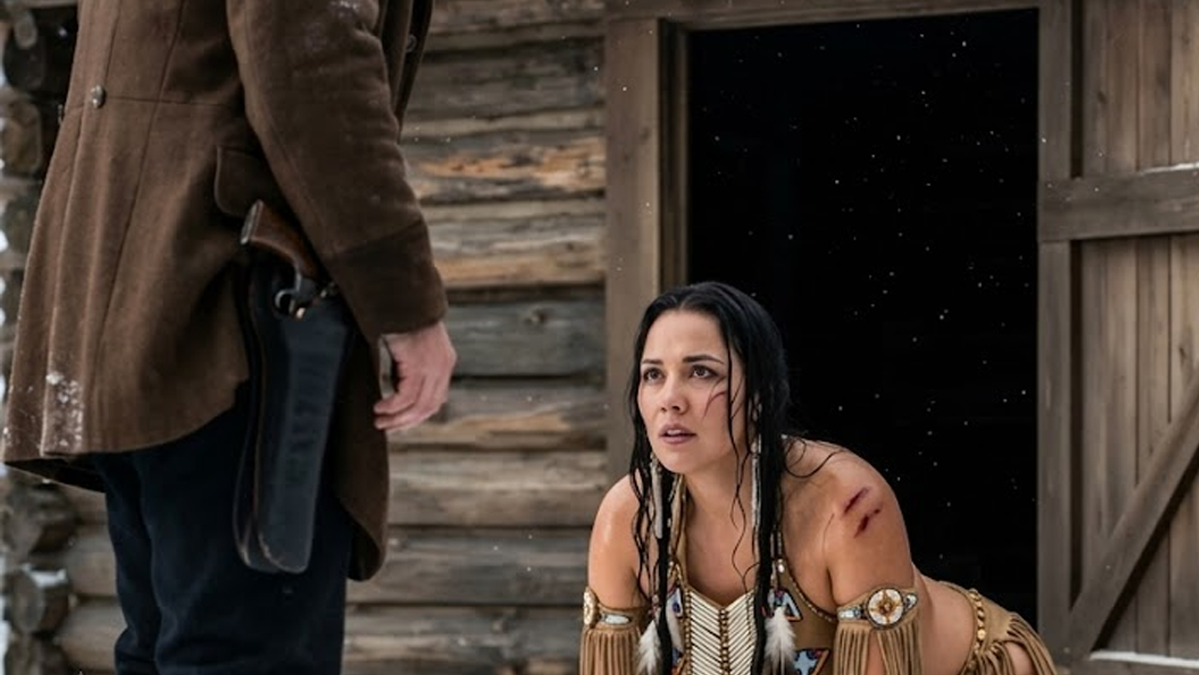
“Barely,” she said. “I thought maybe an animal would find me first. That death would be cleaner than what they planned.”
Jonah set the coin back on the table and pushed it toward her. “You kept one thing. That shows you planned to survive.”
She stared at the coin like it was something breakable. “Or it shows I’m too stubborn to accept when I should have frozen.”
“Maybe both,” he said.
That night, everything changed.
Jonah didn’t unroll his bedroll near the wall like he had the first night. Instead, after the fire was banked and the cabin had settled into that peculiar silence that holds between two people aware of each other’s breathing, he nodded toward the bed in the corner.
“You should sleep there tonight,” he said. “The floor’s getting colder.”
Nia looked at him long before she answered. “I won’t take your place.”
“I’m not made of glass,” he said. “I’ve slept on worse ground than this.”
She studied his face, trying to see if there was trap beneath the offer. Finally, she stood and gathered the blanket around herself. She walked to the narrow bed frame, and when she lay down, she faced the room rather than the wall.
Jonah lowered himself to the floor near the stove, rolling an extra blanket over his shoulders. The boards were rough but familiar, and the fire’s heat reached him better there.
He closed his eyes, and for the first time in three years, the smell of wool and smoke didn’t remind him only of the night his world narrowed to graves.
But sometime near midnight, he woke to the sound of movement.
Not panic. Just a shift of weight.
He opened his eyes and saw her sitting up on the bed, hair falling around her face, eyes fixed on the window where frost had crept in a white web.
“You hear something?” he asked, voice low.
She didn’t startle. “I heard your breath stop. Thought you woke from something bad.”
He blinked once. He hadn’t spoken of the dreams—the ones that came when his guard dropped. The nightmares that still held him some nights.
“Just the cold of my bones,” he said.
She laid back down but didn’t close her eyes right away. “I won’t leave in the night,” she said quietly. “You don’t need to keep watch.”
“I know,” he said. Though his body still woke the way it did when he used to scout enemy trails after dark. Silent. Half-ready to fight. Or run.
The next morning came clear and quiet.
By the time frost had thickened on the window into glass, Jonah knew he couldn’t ride to town and leave her alone without changing everything between them.
He’d lived three years in solitude after his wife and daughter died of fever. Three years of silence so deep it had become a kind of religion. No one else knew about the graves on the ridge. No one asked why the banker’s son never mentioned the cabin further up the ravine. No one cared what happened to a man who’d already lost everything.
But she knew now. And he couldn’t un-know her.
Nia woke to the sound of iron scraping ash and sat up, the blanket falling to her lap. The shirt had slipped low again, the curve of her cleavage showing before she pulled it closed without comment.
He poured water into the pot to warm. Supplies were nearly gone. Flour dusted the bottom of its sack. Coffee was finished. Only two strips of jerky and a handful of dried beans remained.
“Weather holds another day,” he said before she could read the worry on his face. “I’ll ride for town tomorrow. Get flour, salt, beans. Whatever I can haul.”
She didn’t offer to go. Instead, she asked something that caught him off guard.
“Are there men there who will ask why you aren’t alone anymore?”
He met her eyes, the truth plain. “Some will. Some won’t care. But if word spreads that a woman like you is here, others might come for reasons that don’t end kind.”
She took that in without flinching. “Then I won’t step outside while you’re gone.”
By late afternoon, something shifted between them that neither could name yet.
Jonah stepped outside to mend a section of fence near the small pasture. He didn’t ask her to help, but she followed him anyway, carrying rope and nails without being told.
She stood beside him and held the boards when he hammered the hinge back into place. When the wind cut harsher across the ridge, she stepped closer without meaning to, her shoulder brushing his arm.
He set the hammer down and looked at her.
She didn’t move away.
“You said something the night you came,” he murmured, voice low. “About giving me a bed. About the only way to stay alive.”
She didn’t lower her eyes. “I thought it was the only bargaining chip I had.”
“And now?”
She hesitated—not in fear, but in honesty. “Now I stay because you didn’t ask it of me. You gave me shelter and didn’t take what I offered. That’s not something I’ve ever had from a man.”
The air between them thickened with a different kind of question. One no one needed explained.
He didn’t reach for her, but he didn’t step back either.
That night, when the fire burned low and the world outside turned white and silent, Jonah sat at the table and watched her move near the stove.
Her dress, half-mended by his rough stitches, hung from the peg to dry. The work shirt slipped at her shoulder again. This time, she didn’t adjust it right away. And he didn’t pretend not to see her skin—warm now, flushed from the fire, not blue with cold anymore.
She set down the flatbread she’d been warming and turned to face him.
“I need to know something,” she said quietly. “If they come looking for me—the men who took me, or anyone hunting Apache—what will you do?”
He didn’t look away while he spoke. “I’ll tell them this is my land and my cabin. Whose inside it is my business.”
She absorbed that with a slow nod. “And if they bring others?”
“Then they’ll learn this cabin doesn’t belong to them.”
She took that answer not as bluster, but as a fact she could place weight on. Something shifted in her shoulders. Some burden lifted.
When she finished eating, she didn’t return to the space by the hearth like she had the nights before. Instead, she stood at the foot of the narrow bed and rested one hand on the blanket.
“You sleeping there again?” she asked, not timid—just testing the ground between them.
“I can take the floor,” he said, though the words felt half out of habit.
Her gaze didn’t waver. “You gave me the bed so I wouldn’t freeze. I’m not freezing now.”
Something in the air shifted with that, and understanding neither had voiced until then settled between them like smoke settling in still air.
Jonah didn’t move closer right away, but he didn’t step back either.
The stove popped, throwing a thin crackle of sparks up the pipe.
“You want a hand?” she asked quieter this time.
“Not if you leave it,” he said.
That settled it without either of them stating terms.
She lay down first, though she stayed on the far side of the narrow mattress. The blanket pulled across her middle. He dowsed the lamp, leaving only the fire’s glow across the walls, then sat at the edge of the bed.
The boards creaked under his weight. She didn’t flinch or turn away.
When he lowered himself beside her, there was barely space between their bodies. The heat from her skin reached him through the blanket, and the scent of smoke in her hair mixed with something warmer that hadn’t been there when she arrived half-frozen.
He lay on his back at first, staring at the low roof beams, hands resting over his ribs. She shifted once, and the fabric of the mended dress brushed his arm.
The brush was light, but it carried weight no words could match.
“You don’t have to stay,” he said after a long stretch of silence, though it sounded more like a test of himself than her.
“I know,” she said softly. “That’s why I am.”
He turned his head then. In the dim light, her eyes were open, watching him—not in fear or debt, but with the same sharp calm she’d carried when she knocked on his door. The difference now was she didn’t look ready to run.
The first touch happened without planning.
She shifted again under the blanket, and his hand brushed her hip through the fabric. He didn’t pull away fast enough, and she didn’t move at all for a breath.
Neither of them spoke.
Her voice came low, not a whisper but close. “You still don’t want what I offered that night?”
He looked at her then, the memory of her on the porch—skin blue with cold, voice cracked from wind—no longer the only picture in his mind.
“I didn’t want you to give it to live,” he said. “That don’t mean I don’t.”
He stopped himself there, the words catching somewhere between truth and restraint.
She reached out then, not desperate, not timid. Her fingers touched the side of his jaw, light as breath, but intentional.
“I’m not offering to survive,” she said. “I’m offering because I’m warm now. Because you saw me when I was breaking and didn’t break me further.”
Her thumb grazed the edge of his beard, and something in him that had been locked down since the graves on the ridge loosened.
He didn’t crush her close or rush. He moved slow, the way a man does when the thing he’s touching might vanish if he’s careless. He slid his arm beneath her shoulders and drew her toward him an inch at a time.
Her breath hitched once when his chest met hers, but she didn’t pull away.
The blanket slipped to her waist, and the repaired collar of the dress shifted, bearing more skin than at any point before. His eyes dropped for a second before his hand covered the place where fabric and skin met.
The first kiss wasn’t rushed or clumsy. He leaned in only after she didn’t turn her face. And when his lips pressed to hers, she breathed out like she’d been holding that air since the night she arrived.
He tasted smoke and cold and something stubbornly alive.
She put one hand on his chest, not to stop him, but to feel the weight of him there. To prove he was real, solid, and not about to turn cruel like every other man who’d had her in his arms.
When they broke apart, neither spoke right away. The breath between them was enough.
Outside, snow fell heavier. Inside the bed that had been empty for three winters now held two bodies that didn’t turn from each other.
By morning, everything was different.
The snow had stopped sometime before dawn, leaving the world blank and heavy with silence. Jonah woke first. Though for the first time in years, his body hadn’t jerked awake from some memory he couldn’t outrun.
Nia lay against him, her head resting near his shoulder. One arm draped across his chest. The mended dress was still half on her, the neckline slipped low and tangled in the blanket.
Her breathing was steady, unhurried—nothing like the shallow gasps of the first night on his floor.
He didn’t move right away.
When she stirred, it was slow. Natural. Not out of fear. Her eyes opened, and she looked at him without flinching or trying to pull away.
“You slept,” he said quietly.
“So did you,” she answered.
She didn’t rush to cover herself or retreat to the other side of the bed. Instead, she stayed where she was, her fingers tracing the seam of the shirt before she sat up.
The blanket fell to her waist, and the curve of her back showed where the dress had slipped down an arm. She reached to pull it up, but not with haste.
Later that morning, Jonah didn’t ride to town.
Instead, he stepped outside to clear snow from the lean-to roof before the weight collapsed the beams. The air cut hard, but the quiet settled deeper than fear. He shoveled a path to the wood pile and water trough, breath fogging the air, boots sinking almost to the knee.
From the doorway, she watched him work, her arms wrapped across her middle. When he paused at the rail, she stepped out into the snow—barefoot, surprising him.
Before he could speak, she bent, lifted a chunk of split wood from the pile, and carried it inside.
“Her feet will freeze through,” he said when he came back in, stamping snow from his boots.
She set the wood near the stove and wiped melted flakes from her ankles with the hem of the dress. “I’ve walked on ice with no skin left at the heel. This is just winter.”
He didn’t argue, but he fetched a scrap of wool from the trunk and laid it near the fire.
By midday, Nia stood near the stove, rubbing salve across her wrist where rope scars still showed.
“Why did they take you in the first place?” he asked, the question finally ready to be asked.
She kept her eyes on her hands as she answered. “My band split after soldiers came through. Some were killed, some taken. I stayed with my aunt’s family. Thought we were far enough. White trappers found her camp. They killed two men and tied three women. I was one.”
Jonah stood still, not demanding more. She kept speaking anyway.
“They traded us at a way station. One woman was sold south. Another died on the trail. I was kept, then fought. They beat me, so they tried to trade me again. I ran before they could agree on who got what part.”
Her voice held the calm of someone long past the shock stage.
Jonah’s hand tightened on the back of the chair, but he didn’t speak the anger that flared through him.
“You think they’ll still look?” he asked.
“They’ll look if they’re sober,” she said. “But not long in this cold. They’d sooner catch another than chase one that bit them.”
That answer settled part of what had remained unspoken. The danger was distant now. Not gone, but far enough.
Then came the day that tested everything.
Jonah had delayed his trip to town as long as he could. But supplies were truly running out now, and winter would hold for at least another month.
He saddled the horse before dawn, his coat pulled high, his hat pulled low.
Before he mounted, he pointed to the rocks along the ravine. “If riders come down the slope, you’ll hear them before you see them. Don’t wait to know who they are. Go behind the dry creek and stay low.”
She didn’t blink. “If you don’t come back by dark, I’ll come looking.”
It wasn’t a promise. Just a fact spoken like she intended to make it true.
He paused then, something unsaid sitting between them. There was a question—one any listener might have wondered. Did he trust her not to leave while he was gone?
She answered it before he could ask.
“I won’t run,” she said. “If they come for me, they’ll find the door empty. Not your blood.”
He studied her face a beat longer than necessary, then nodded once and swung into the saddle.
She stepped out far enough to see him ride off, but didn’t follow him down the slope with her eyes. Instead, she scanned the ridge and the trail beyond it, as if expecting someone else might appear.
The road to town cut through frost-bitten scrub.
Jonah rode with his coat collar high and his hat pulled low. The reins loose but his grip sure. The cold bit through the leather, but his mind kept drifting back to the cabin.
Not in fear. Just in a way that marked it as no longer an empty place.
By the time he reached the outskirts of town, he knew what he had to do.
Inside the trading post, the storekeeper squinted when Jonah stepped in. “Thought you’d hold up till spring.”
“Almost did,” Jonah said, setting a coin pouch on the counter. “But I need supplies. For two now.”
The words hung in the air like smoke.
Cole’s eyes narrowed. “Two? You got company out there?”
“I got someone staying,” Jonah said flatly. “That’s all you need to know.”
Cole weighed the words, and Jonah could feel suspicion settling like frost. Folks remembered who buried their dead and stayed gone from company. While Cole filled the sacks—flour, beans, lard, coffee, thread, lamp oil, salt—a man and his son came in for nails.
The man glanced at Jonah once, then again at the supplies piling up on the counter.
By the time Jonah loaded the goods onto the horse, he knew word would spread. By tomorrow, half the valley would be wondering who he’d taken in. By the end of the week, speculation would turn to suspicion. And suspicion was the soil where trouble grew.
But he didn’t care anymore.
When Jonah crested the last rise before the cabin, the sun had dropped behind cloud cover.
Nia heard the horse before she saw it. She didn’t rush out. Instead, she opened the door and waited. The rifle leaned within arm’s reach, but not in her hands.
He unloaded the supplies onto the porch and brought them in two trips. She helped without being asked, setting each sack on the table, her hair falling forward as she worked.
When she lifted one bag too heavy for her size, he took it from her hands. Their fingers brushed, and for the first time since she’d arrived, she didn’t pull back.
“You were gone longer than I thought,” she said.
“Road thawed and refroze. Slowed me some,” he said, though part of him knew waiting was how trouble began.
She stood at the table and rested her hands on the wood. “If they come, I don’t hide behind you. I stand beside or I disappear. Not between.”
He studied her face—steady, unshaken, not afraid of earning her place, but unwilling to cost him for it.
“They won’t come today,” he said. “But they might come before spring.”
“Then we’ll be ready,” she said simply.
Outside, the first flakes of snow began to fall, slow and deliberate, the kind that stayed when it landed.
By the time spring came softly to the valley, the danger had passed.
Word had spread in town, yes. But Jonah’s coldness when asked about her had discouraged further inquiry. No one wanted to tangle with a man who’d lost everything and had nothing left to fear. And Nia, when the marshal finally rode out to check on rumors, wasn’t visible—just evidence of her presence in two cups on the shelf, her dress hanging near the stove, her careful mending on the seat of his old coat.
The marshal took one look at the cabin, read the set of Jonah’s jaw, and rode back to town without a word.
By May, the snow had melted, and new life pressed green against the thawing earth. Jonah took Nia up the ridge to the graves of his wife and daughter. She didn’t ask permission to come. She simply followed when he started walking.
At the markers, he knelt and brushed snow from the crosses. Nia stood beside him, not speaking, not intruding, only witnessing.
When he rested a hand on one of the small wooden crosses—the one for the child—his shoulders loosened instead of locking.
“You want me here when spring comes,” she asked quietly. Not a question but a statement.
“Yes,” he said without pause. “If you still want it.”
She reached down and swept snow from the base of the markers too, as if tending them were now part of her place.
When they walked back down the ridge, he reached for her hand. She took it without hesitation.
One evening in late May, Jonah came in from mending the south fence.
The cabin smelled of beans simmering and bread warming. Nia stood at the stove, hair braided loosely over one shoulder, wearing both the dress he’d mended and the flannel trousers beneath.
She turned when he entered, and something in her eyes had changed. They held something that hadn’t been there when she arrived—not just safety, but purpose.
“I’m pregnant,” she said simply. No fear in her voice. Just fact.
Jonah didn’t panic. Didn’t even blink. He just pulled her close, pressed a kiss to her temple, and said, “Then we’ll make room for more.”
By the time summer settled across the valley, the cabin was no longer a place for one man.
A second coat hung beside his. Her dress hung near the door—not the torn traveling gown, but a new one he’d traded for in town, along with fabric for baby clothes. Two mugs sat ready at the table. And outside, where the porch rail had worn down from years of solitary leaning, two sets of arms rested together every evening, watching the last light sink behind the hills.
They never talked much about the past. Some things didn’t need retelling. What mattered was what stayed.
And Nia had stayed—not because she had nowhere else to go, but because she had chosen this. She had chosen him.
And Jonah, for all his silence and scars, had chosen her right back.
The desperate woman who knocked on his door in the freezing dark had become the woman who stood beside him as the seasons turned. The Apache girl who thought she had nothing left to bargain with had become the woman who taught him that some kinds of wealth can’t be bought or sold.
Forever wasn’t something they spoke about. It was something they lived.
Every morning when she woke beside him. Every chore they did together without needing words. Every look across the dinner table. Every time his hand found hers in the dark.
In their cabin, on their land, where the mountains stood sentinel and the world couldn’t touch them—Jonah had finally found what he lost.
Not a replacement for what death had taken. But something new. Something that grew in the silence between two people who understood that sometimes the greatest gift we can give each other is simply to stay.
Note: This story is entirely fictional and created for entertainment purposes only. It does not represent any organization or individual, nor does it encourage inappropriate behavior. Content created with the aid of artificial intelligence.








