SHE SAVED A DYING LAKOTA WARRIOR—THREE DAYS LATER, FIFTEEN ARMED MEN SURROUNDED HER CABIN
PART 2
Elara kept her hands open.
The man before her was called Mato. His gaze moved past her shoulder toward the blankets on the floor, then returned to her face.
Behind him, horses shifted in the snow. At least fifteen armed Lakota men watched the doorway.
A younger warrior urged his horse forward and lifted his rifle.
Mato stopped him with a sharp command.
The younger man halted.
It gave Elara a moment to breathe, though she still had no idea whether Mato believed she had helped his brother—or harmed him.
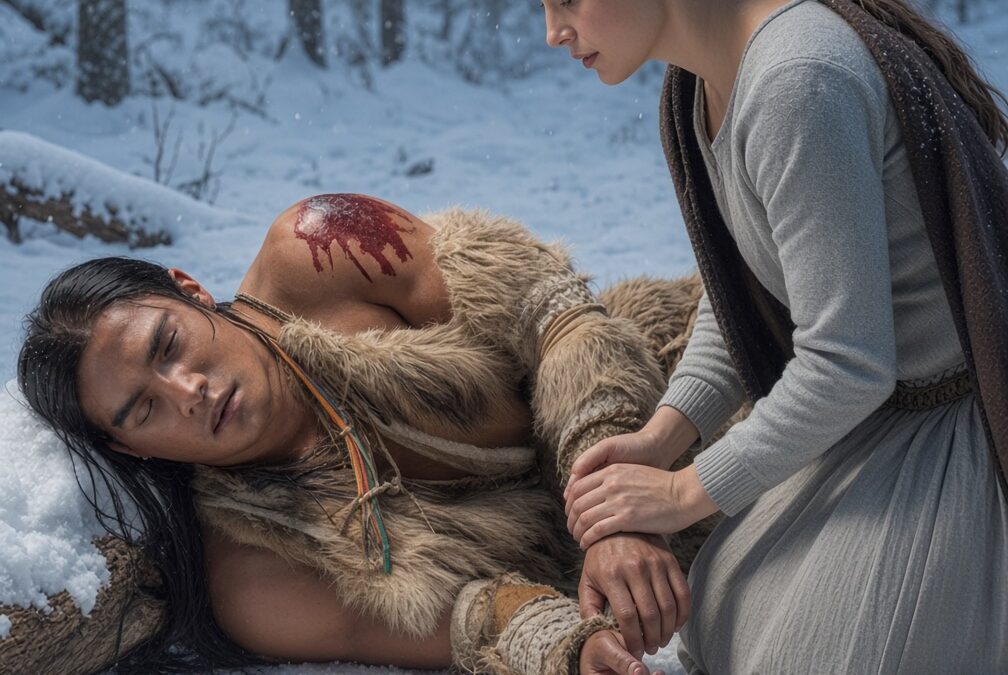
“He was hurt,” she said.
She pointed toward the clearing, then touched her own side.
“In the snow. Dying.”
The words sounded terribly small.
How could she explain three days of carrying water, tending the fire, watching a stranger’s breathing? How could she make him understand that the blood on her hands was there because she had refused to let his brother die?
Then she remembered the arrowhead.
She reached into her apron pocket and brought it out slowly.
The small, dark stone rested in her open palm.
Mato looked down.
His attention sharpened.
He took it from her and turned it between his fingers, studying its shape. Something in his expression changed, though Elara could not tell what he recognized.
He called to the men behind him.
Two dismounted and approached with their rifles ready.
This time, Elara stepped aside.
They entered the cabin and went straight to the wounded man. One knelt, touched his forehead, then checked his neck.
He spoke urgently.
For a moment, Elara heard only the fire.
Then the man beneath the blankets answered.
His voice was weak. The exchange was brief.
But he was speaking.
After all those hours when she had wondered whether each breath might be his last, he could finally tell someone what had happened.
Elara stood near the doorway, afraid to move.
She learned his name was Wanacha.
Until then, he had been the man in the snow, the stranger beneath Daniel’s quilt, the life she could not bear to lose. Hearing his name made her painfully aware of everything beyond that room: the people who knew him, the place he belonged, the worry that had brought his brother through the wilderness.
The kneeling warrior reported to Mato.
Mato listened, still holding the arrowhead.
Then he entered.
He seemed to fill the little room, but when he knelt beside Wanacha, his movements became gentle.
He placed a hand on his brother’s shoulder.
Wanacha answered him and made a slight gesture toward Elara.
She could not understand their conversation. She watched Mato’s face instead.
Its hardness softened as he looked at his brother. Only slightly, but enough for her to recognize the fear beneath his anger.
She knew something about kneeling beside a man and wondering whether he would live.
She had done it for Daniel.
Mato remained there a little longer. When he rose, he examined the bloodied cloths, the bandage around Wanacha’s side, the signs of her desperate work.
Then he mimicked pulling an arrow free.
Elara nodded.
His response was brief, but she understood the approval in it.
He knew.
Her knees nearly gave beneath her.
She had been holding herself upright against the possibility that they would mistake her care for cruelty. Now, at last, someone understood what she had tried to do.
Yet Mato still held the arrowhead.
He gestured toward the northeast and spoke about an enemy. Elara caught a name she thought she recognized, but she could not follow enough of his meaning to be certain.
She would not have known how to explain that uncertainty even if he had asked.
What she did understand was the warning that followed.
Whoever had wounded Wanacha was still outside.
Somewhere beyond the walls.
Mato gave more orders.
Two men brought in a buffalo robe and began wrapping Wanacha for the journey. Outside, others prepared a travois from long pine saplings and hide so a horse could pull him through the snow.
Elara moved out of their way.
Relief came with an unexpected ache.
For three days, the cabin had held another person’s breathing. Every small task had mattered to someone besides herself. Now he was leaving, and she would return to the quiet that had filled the years since Daniel’s death.
Wanacha looked at her as the men prepared to lift him.
He gave a faint nod.
It was enough.
She had never needed a speech of thanks. She had needed him to survive.
Mato turned his attention to the tracks outside. He indicated the forest, then the snow that had hidden so much of what happened there.
Elara followed his gestures uneasily.
Before she could make sense of them, a cry came from the lookout.
Every man in the cabin stopped.
Mato went to the door.
Elara moved to the window.
Four figures were coming out of the trees.
White men.
They wore rough winter clothing and carried long rifles. Their attention was fixed on the cabin and the fresh tracks leading toward it.
From where they approached, they had not yet seen most of the Lakota men.
Elara recognized two of them.
Months earlier, they had passed through claiming to be prospectors. Their manner had unsettled her then—watchful, hard, too interested in what they might find.
Now they were back.
“Them,” she breathed.
She could not have named everything they had done, or proved why they had attacked Wanacha. But watching them approach, she understood the danger Mato had been trying to describe.
Mato saw the recognition in her face.
He looked toward the men.
Then back at her.
There was no need for a longer explanation.
His orders came quickly.
Outside, warriors moved into cover among the trees. Inside, Wanacha was lowered carefully against the wall, where he would have some protection. One man stayed beside him with a rifle.
Another joined Mato near the door.
The room seemed to shrink around Elara.
Only moments earlier, she had feared the men inside it.
Now they were preparing to defend it.
Mato glanced toward Daniel’s rifle on the table.
Then he looked at her.
He did not reach for it.
He left the choice to her.
Elara picked it up.
The familiar weight settled into her hands. Daniel had taught her to use it, and for three years it had helped keep food on her table.
This was different.
Outside were men capable of leaving someone wounded in a killing storm. Inside was the man she had dragged through that snow, still too weak to stand.
Her home stood between them.
She checked the load.
Mato gave a short nod.
The largest of the approaching men had a matted red beard. He called toward the house.
“Hello, the cabin. Anybody home?”
Elara stood beside the window, keeping the log wall between herself and the clearing.
“We saw your smoke, just checking if you’re all right in this snow.”
His friendliness did nothing to ease the way she watched his rifle.
The men kept coming.
At roughly thirty yards, one of them noticed the horse tracks around the cabin.
“Jed,” he said. “Looks like company already here. Lots of it.”
The red-bearded man’s expression changed.
“Indians.”
He spat into the snow.
“What are they doing here?”
Elara tightened her grip.
Mato waited by the partly open door. A word from him, quiet and firm, held her still.
Then Wanacha cried out.
The strength of it startled her.
The man who had scarcely been able to lift his head gave a fierce cry from his place against the wall—a warning, a declaration that he was alive.
Outside, rifles came up.
“Ambush!” one of the men shouted.
Mato threw open the door and fired.
Shots answered from the trees.
A man screamed and grabbed his shoulder. A rifle fell into the snow.
Another shot tore through a fur cap.
Jed tried to find cover behind a drift, firing toward the cabin.
Elara raised Daniel’s rifle.
She found him in her sights.
For a moment, all the sound seemed farther away than the man in front of her.
Then she squeezed the trigger.
The rifle struck back against her shoulder.
Jed cried out and caught at his thigh.
Elara had hit him.
There was no time to think about it. Gunfire still cracked across the clearing, and the wounded man on her floor still needed to get home alive.
The fight ended quickly.
Outnumbered and caught by surprise, the four men could not hold their ground. Two Lakota warriors rushed Jed as he tried to resist. Another attacker turned to run and was brought down by a shot.
Then the firing stopped.
The quiet felt wrong after so much noise.
Elara lowered the rifle.
Her hands began to shake.
She had hunted. She had killed animals because she needed to eat. None of that had prepared her for watching a man stagger from a bullet she had fired.
There was no pleasure in it.
Only nausea, trembling, and the terrible understanding of how close the violence had come.
Outside, Mato’s men secured the clearing and took the attackers’ weapons.
The wounded groaned in the snow.
The dead did not move.
Elara stood in the doorway with Daniel’s rifle and tried to steady her breathing.
Mato approached.
He looked toward the place where Jed had fallen, then at the weapon in her hands.
When his eyes returned to hers, the suspicion was gone.
He spoke in front of his men, acknowledging her courage. Elara could not follow every word, but she understood the changed way they looked at her.
Then he thanked her.
Inside, Wanacha managed a weak smile.
That small expression reached her more deeply than the words.
He was still there.
After the cold, the fever, the bleeding, and now the gunfire, he was still there.
The men began preparing to leave again.
Two attended to Jed and another wounded attacker. They were not executed in the clearing; their fate would be decided later by the Lakota. Those who had died remained in the snow.
Elara did not learn how every consequence of that afternoon would unfold.
What she knew was that the immediate danger had ended, and Wanacha was going with people who would care for him.
They settled him on the travois.
His face was still pale, his body badly weakened, but his eyes were clearer. She watched them secure the robe around him and thought of the motionless shape she had first seen through her window.
He had seemed so alone then.
Now his brother stood nearby, and men who had come searching for him were ready to carry him home.
Before mounting his horse, Mato returned to Elara.
He took a small leather pouch from his belt.
It was beautifully beaded.
He pressed it into her hand as a gift of thanks—for his brother, and for what she had done when the attackers returned.
Elara looked down at the careful work, then up at him.
“You would have done the same for your kin,” she said softly.
She did not know how much of the sentence he understood.
Mato held her gaze.
Then he nodded.
There was no ceremony beyond that.
He mounted, gave the signal, and the party began moving toward the trees. Wanacha traveled safely behind them on the travois.
Elara watched until the last rider disappeared.
Then she stood alone outside the cabin.
Blood marked the snow. Inside were stained cloths, cooling water, and blankets that needed washing. The fire would need wood soon. There were ordinary things to do after an afternoon she would never forget.
She opened her hand and looked at the pouch again.
Three days earlier, she had nearly locked her door.
Fear had given her plenty of reasons. Grief had taught her how much it hurt to try to save someone and fail.
Still, she had gone into the snow.
Now Wanacha was alive and on his way home, and his brother had left her with something she could hold.
When Elara finally stepped back inside, the cabin was quiet.
For the first time in years, that quiet did not feel quite so empty.








