SHE WAS 67, CHILDLESS OF LIVING HEIRS, AND STONE-COLD SOBER WHEN HER BODY BETRAYED HER.
THREE ENSLAVED MEN ALREADY KNEW WHY.
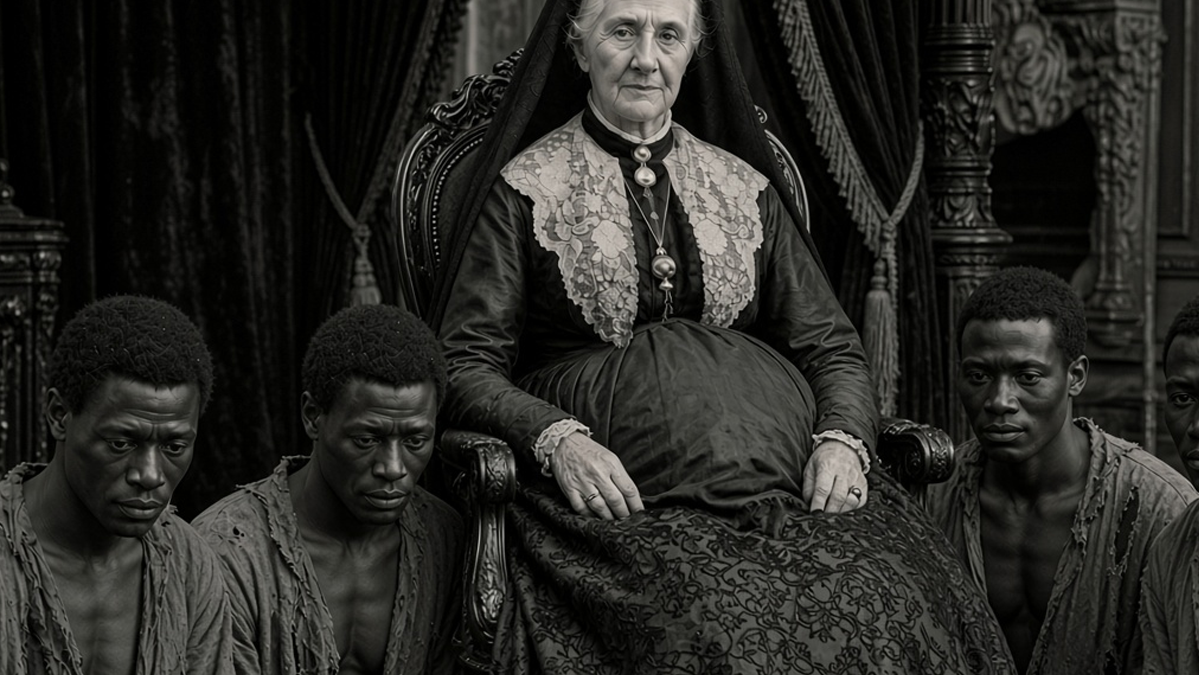
**The Living Contradiction**
Elijah did not look away from Margaret’s abdomen when he spoke again.
“A single father would have been convenient,” he said.
“A name you could hang.
A body you could bury.
That was never the design.
Samuel’s jaw worked.
Isaac stared at the floor as if the boards themselves might open and swallow him.
The muskets did not move.
“We knew what this house does with inconvenient children,” Elijah continued.
“We have seen them named after no one and sent to the fields.
We have seen women beaten for speaking the truth of how they were made.
We also knew what this house does with an heir.
Paper.
Law.
Blood written down as property and as power at the same time
Margaret’s hands were white on the arms of the chair.
“You meant for the child to be both.
“Yes.
” Elijah’s voice stayed quiet, almost careful.
“Enslaved by the law that made us property.
Heir by the law that made you owner.
A living contradiction walking these halls.
Every time Charles reached for Blackwood, he would have to reach through a child whose fathers you bought.
Every time a court asked whose blood sat in the cradle, the answer would tear the estate in half.
”
Grace made a small sound.
Eleanor had covered her mouth.
Margaret rose.
For a moment she looked as if she might order the muskets to fire.
The room waited for it.
Samuel lifted his chin, ready.
Isaac closed his eyes.
She did not give the order.
“Lock them in the old cellar,” she said.
“No visitors.
No messages.
They eat what I send.
They live until I decide they do not.
”
The guards dragged them out.
Elijah glanced back once.
He was no longer smiling.
—
Spring thickened into summer.
Margaret’s body, which should have been winding down toward death, instead became a battleground she could not leave.
The child moved.
The nausea faded.
Her appetite returned with a violence that frightened Eleanor.
At night Margaret stood before the same mirror and pressed her palms to the curve and whispered questions no one could answer.
Which night.
Which man.
Whether it mattered.
She had Grace examine her weekly.
The midwife’s face grew graver each time.
A woman of sixty-seven carrying a child was not a miracle in Grace’s language.
It was a sentence with a short calendar.
Margaret wrote nothing to Charles.
She forbade Eleanor from speaking of the pregnancy to anyone beyond the three people who already knew.
Rumors still leaked, as rumors always did on an estate built on watching.
A swollen waist could be called illness for only so long.
In July she went down to the cellar.
The three men sat chained to the wall.
The air smelled of damp stone and old wine.
Margaret stood just inside the light.
“Tell me the rest,” she said.
Samuel spoke first, rough.
“You want confession.
You already have it.
”
“I want the medicine,” she said.
“What went into the syrup.
What went into the tea.
”
Elijah answered because the others would not.
Herbs to deepen sleep.
Herbs to quiet pain.
Herbs, he said without ornament, that some women used when they wished a barren body to become less barren.
He did not describe the nights.
He did not have to.
Margaret had already lived the blank space between the swallow and the morning.
“You used my own physician’s bottle,” she said.
“We used what the house already trusted,” Elijah said.
“That was the point.
”
She left without promising them life or death.
—
Charles arrived in August, two months earlier than his usual pilgrimage.
He came with a lawyer and a physician of his own and the thin smile of a son who had smelled weakness across hundreds of miles.
He found his mother seated in the great hall, a shawl arranged to hide what it could not hide.
He stared.
“This is a joke.
”
“No,” Margaret said.
Charles laughed, then stopped laughing.
“You are sixty-seven.
You have not—this is fraud.
Illness.
A tumor.
Someone has poisoned your mind.
”
“I am with child,” she said.
“Grace Holloway will tell your physician the same.
”
The two doctors argued in the next room for an hour.
When they returned, Charles’s man looked ill.
Grace looked tired.
Charles paced.
“Then it is some servant’s trick.
A substitution.
You will not humiliate this family.
You will not hand Blackwood to a bastard born of—”
“Born of me,” Margaret said.
He slammed his hand on the table.
“Who is the father?”
Margaret looked at him for a long time.
In that look was every year he had stayed away, every letter that asked after the cattle and the ledgers and never after her.
“There are three names,” she said.
“Samuel Reed.
Isaac Bell.
Elijah Stone.
They are in the cellar.
They have admitted they entered my room.
They have admitted why.
”
Charles went white, then red.
“Hang them tonight.
”
“No.
”
“Mother—”
“They live until the child is born,” Margaret said.
“If I die in the bearing, you may do as you like.
If I live, I will decide.
Not you.
”
Charles’s lawyer began speaking of competency, of courts, of a widow made unsound by age and shock.
Margaret listened as if he were weather.
That night she had Eleanor bring her the estate books and a clean sheet of paper.
—
September came in hot.
The child dropped lower.
Margaret could no longer climb the stairs without stopping.
She dreamed of her dead children and woke with her hands on a living one.
She dreamed of enslaved women she had chosen not to see, and woke ashamed in a way that had no useful language.
She went to the cellar one last time before her confinement.
“If this child lives,” she said, “it will carry a name I choose.
It will also carry what you intended.
I will not pretend I am clean.
I will not pretend you are righteous.
Revenge that uses a body the way this house used bodies is still the same machine.
”
Elijah’s voice was hoarse from weeks underground.
“Then kill us and end it.
”
“I may,” she said.
“Or I may make you watch the contradiction you wanted walk across this floor.
I have not decided which is crueler.
”
Samuel laughed once, without joy.
“You sound like us now.
”
She left them there.
—
Labor began on a night of rain, the kind that turned the fields to black water.
Margaret was sixty-seven years old and the pain was not like the three births she remembered.
It was older, slower, and it did not care that she had ruled anything.
Grace worked.
Eleanor wept and then stopped weeping and held Margaret’s hand hard enough to hurt.
Charles waited in the hall with his lawyer, listening like a man outside a vault.
Hours.
More hours.
Margaret thought she would die and found, with a strange calm, that she did not mind as much as she had expected.
Then she minded very much, because the child was still inside her and she had not finished the paper on the desk.
Near dawn the child came.
A boy.
Small.
Alive.
Crying with a thin, astonished sound.
Grace cut the cord with hands that shook.
Eleanor wrapped him.
Margaret, gray-faced, asked to see him.
They laid him against her.
She looked at the face as if searching for a verdict.
There was no verdict.
There was only a living infant who did not know the house that had made him.
“Name,” Eleanor whispered.
Margaret’s voice was almost gone.
“Nathaniel.
Nathaniel Ashford.
”
Charles pushed into the room.
He saw the child and stopped as if struck.
“You will not—”
Margaret turned her head on the pillow.
“Bring me the paper.
And ink.
Now.
”
They brought it.
She signed while the child breathed against her.
The document did two things at once, and that was the point.
First: Nathaniel Ashford was her son and her heir, born of her body, entitled to Blackwood under the same law that had always served her family.
Second: the circumstances of his conception were recorded in her own hand—three enslaved men named, the winter syrup named, the cellar named—so that no future court could pretend the heir had appeared from respectable air.
A living contradiction, written down.
Charles snatched at the paper.
Margaret’s fingers held it until Eleanor took it and sealed it and put it where Charles could not reach without witnesses.
“If you destroy it,” Margaret said, “Grace and Eleanor will swear to what they saw.
If you hang the three men tonight, the story still stands.
If you call me mad, the child still lives.
You wanted Blackwood when I died.
You may have the fight instead.
”
She closed her eyes.
She did not die that hour.
She lived three more days, long enough to have Nathaniel brought to her each morning, long enough to look at Charles and see not a son but a man who had inherited her hardness and none of her late, useless clarity.
On the third night she called Eleanor close.
“When I am gone, do not let them disappear the boy.
Do not let them disappear the paper.
If Charles tries, take both to the magistrate in town.
Let the contradiction walk.
”
Eleanor nodded, crying again.
Margaret Ashford died before sunrise, sixty-seven years old, a mother once more, her fortune no longer a clean line from one white hand to another.
Charles hanged Samuel, Isaac, and Elijah at dusk the next day.
He called it justice.
The estate called it order.
Rose Carter, who had seen them leave the manor in February, left Blackwood that same week and was never found.
Nathaniel lived.
He grew in a house that could not decide what he was.
Heir on paper.
Scandal in every corridor.
Charles spent years in court trying to break the will and failed just often enough that the land itself seemed to hesitate.
The vineyards produced.
The wheat came in.
None of it felt like victory.
People said the boy had Margaret’s eyes.
People said other things they did not say in front of Charles.
The contradiction Elijah had wanted did not topple Blackwood in a single night.
It did something slower and, in its way, more complete.
It made the estate explain itself, again and again, to judges and neighbors and to the child who would someday read the paper his mother signed while her blood was still on the sheets.
A fortress can survive weather.
It does not survive a truth it is forced to keep in the nursery.








