“Sleep Beside Me, Just Tonight,” the Lonely Blacksmith Whispered—Then She Discovered Whose Clothes She Was Wearing
Part 3
Nora’s fingers remained against Dr. Morrison’s wrist.
But everything inside her reached for the doorway.
“What about Callum?”
The ranch hand bent forward, hands on his knees.
“He sent me. Says we’re bringing people here. Smoke’s got into their lungs.”
Nora closed her eyes for one brief second.
“Is he hurt?”
“Standing. Giving orders, mostly.”
The breath she released shook.
“Clear the benches,” she told the waiting patients. “Bring clean blankets. Those who can walk, make space for those who can’t.”
The ranch hand hurried away.
Beneath Nora’s fingers, Dr. Morrison’s pulse remained faint, but he stirred again.
“Doctor?”
His eyes opened.
For a moment, he seemed unable to understand the ceiling above him or the faces gathered nearby.
Then he saw Nora.
“You?”
“Yes.”
He tried to rise.
“Please stay still.”
“The bell…”
“There’s a fire at the hotel. Help is coming.”
He looked toward the door, alarm fighting its way through his exhaustion.
“My patients.”
“I’ll help them.”
Something changed in his expression.
He had spoken to her as though kindness were a trespass, as though a town’s suffering belonged to the man whose name hung outside the clinic.
Now he had to place those patients in her hands.
He gave a small, reluctant nod.
By the time the first hotel guests arrived, Nora had organized the room.
A woman shivered beneath a borrowed coat. An elderly traveler coughed into his handkerchief. A kitchen boy clutched a bundle of clothes he had carried from the building, then stared at it as though wondering why he had saved something so useless.
Nora moved among them.
She listened. Reassured. Asked for help when she needed it.
The townspeople followed her instructions because there was work to do, and she knew how to begin.
Near midday, Callum appeared.
Soot streaked his face. His coat smelled of smoke. One sleeve had torn at the cuff.
Nora crossed the room so quickly that he straightened in surprise.
“You said buckets,” she whispered.
“Buckets,” he answered. “And a great deal of shouting.”
She searched his face.
“The hotel?”
“We kept the fire from spreading. Everyone’s accounted for.”
Only then did she take his hand.
His fingers closed around hers.
For a moment, with frightened people all around them, neither said another word.
They had spent weeks being careful with what was growing between them.
The sight of each other alive made that care suddenly difficult.
“You’re shaking,” he murmured.
“So are you.”
“Long morning.”
“Yes,” she said. “It was.”
Across the room, Dr. Morrison watched them from his chair.
He looked away before either noticed.
Later, when the clinic had quieted and Morrison had recovered enough to speak comfortably, he asked Nora to sit.
“I owe you an apology.”
She folded a clean cloth.
“You need rest.”
“I need to say this while I still have the courage.”
She set the cloth down.
For years, he explained, every illness in Dust Hollow had found its way to his door. Every accident. Every worried parent arriving after midnight.
He had grown tired.
Then proud of being tired.
Somewhere along the way, he had begun confusing being needed with being the only person allowed to help.
“When people praised you,” he admitted, “I heard it as criticism of me.”
Nora considered him.
“I wasn’t trying to take your place.”
“I understand that now.”
“People shouldn’t have to wait for us to understand each other before they receive care.”
His eyes lowered.
“No,” he said. “They shouldn’t.”
That evening, he came to the red door with a cane in one hand and his hat in the other.
Callum opened it.
“You ought to be in bed.”
“Probably.”
“That doesn’t sound like medical advice.”
For the first time, Morrison smiled at him without effort.
Nora appeared behind Callum.
The doctor reached into his coat and took out a brass key.
“My second examination room has been empty for years.”
He held it toward her.
“I’d like you to use it.”
Nora did not immediately reach for it.
“Some of the people I visit can’t pay.”
“Then we’ll work that out.”
“Not by turning them away.”
“No,” he said. “Not by turning them away.”
She accepted the key.
It was small, worn smooth along the edges.
Yet she stood holding it as though he had handed her something astonishing.
After Morrison left, Callum glanced at her closed fist.
“Well?”
Nora laughed softly.
“I think I have somewhere to go tomorrow.”
He looked around the kitchen, suddenly quiet.
She understood.
“To work, Callum.”
His eyes returned to hers.
Then she placed the key on the table beside his.
Winter loosened its grip slowly.
Water began running beneath the creek’s crust of ice. Mud replaced snow along the road. The first wildflowers appeared in sheltered patches of earth.
Nora crossed to the clinic each morning.
Callum went to the forge.
In the evenings, they returned to the little house and told each other about the day.
Sometimes she came home with coins.
Sometimes with eggs, a sack of flour, or a pie that had tilted alarmingly during the walk.
Once, she found firewood stacked beside the porch and never discovered who had left it.
Callum began making small things for her examination room.
A hook for her coat.
A latch that no longer stuck.
A sturdy stand so her basin sat at a comfortable height.
“You’ll run out of things to repair,” she teased.
He looked around thoughtfully.
“Unlikely.”
She learned that his quietness could hold humor.
He learned that her strength did not mean she never grew weary.
On difficult evenings, he put supper before her without asking her to explain herself.
On nights when his old wound ached, she sat beside him until he stopped pretending it didn’t.
They disagreed, too.
About how long he should stand at the forge.
About whether she could visit one more household after working all day.
Their arguments were awkward at first. Both had become accustomed to making decisions alone.
But neither reached for the door.
They learned to stay through discomfort, to listen after speaking too sharply, to return with an apology before resentment settled.
One Sunday, Callum opened the chest at the foot of the bedroom wall.
Nora paused in the doorway.
Inside lay Grace’s folded clothes.
“I thought,” he began, then stopped.
“You don’t have to put her away for me.”
He rested his hand on the lid.
“I know.”
He lifted a blue shawl.
For a moment, his face changed—not with the raw shock of grief, but with recognition.
“She wore this even when the weather didn’t call for it.”
“What was she like?”
Callum looked at Nora.
Then, slowly, he told her.
About Grace’s terrible singing.
Her stubborn belief that every stray animal could be persuaded to behave.
The way she always left a little flour on the kitchen table, no matter how carefully she cleaned.
Nora listened.
He laughed once in the middle of a memory, then grew quiet, surprised by the sound.
They kept the shawl.
The other clothes, he decided, might help someone who arrived with less than she needed.
When he closed the chest, his hands were steady.
By the spring picnic, Thomas Harper was running again.
His mother still watched him with the anxious concentration of someone who remembered how close she had come to losing him.
But Thomas had other concerns.
Winning races.
Stealing a second piece of pie.
Convincing the other children that his recovered leg made him faster.
Callum watched him streak past the long tables in the square.
“He’ll outrun us both by summer.”
“He already could,” Nora said.
“Speak for yourself.”
She glanced at his leg.
He sighed.
“All right. Both of us.”
Her laughter made him smile before he could help it.
A little later, Mrs. Harper climbed onto the wooden platform beside the musicians.
She waited until the square grew quiet.
“I’ve been trying to decide how to thank someone for giving me ordinary mornings back.”
Her voice trembled.
“Mornings when my boy complains about breakfast. When he tracks dirt across my clean floor. When I hear him running and don’t have to wonder whether I’ll ever hear it again.”
Thomas stopped fidgeting.
Mrs. Harper looked toward Nora.
“You came here needing shelter. Some of us should have offered it sooner.”
Several people lowered their eyes.
“Callum opened his door. Then the two of you kept opening it, in one way or another, for the rest of us.”
Dr. Morrison stepped beside her carrying a wooden sign.
Fresh lettering shone across its polished surface:
REED & WYATT
HEALING & BLACKSMITH SHOP
“It seems,” he said, “this town depends upon both kinds of work.”
Applause spread through the square.
Nora touched the edge of the sign.
Callum stared at their names.
Together.
In public.
As though the town had spoken aloud something he had been carrying carefully in his pocket for days.
When the clapping faded, he turned toward her.
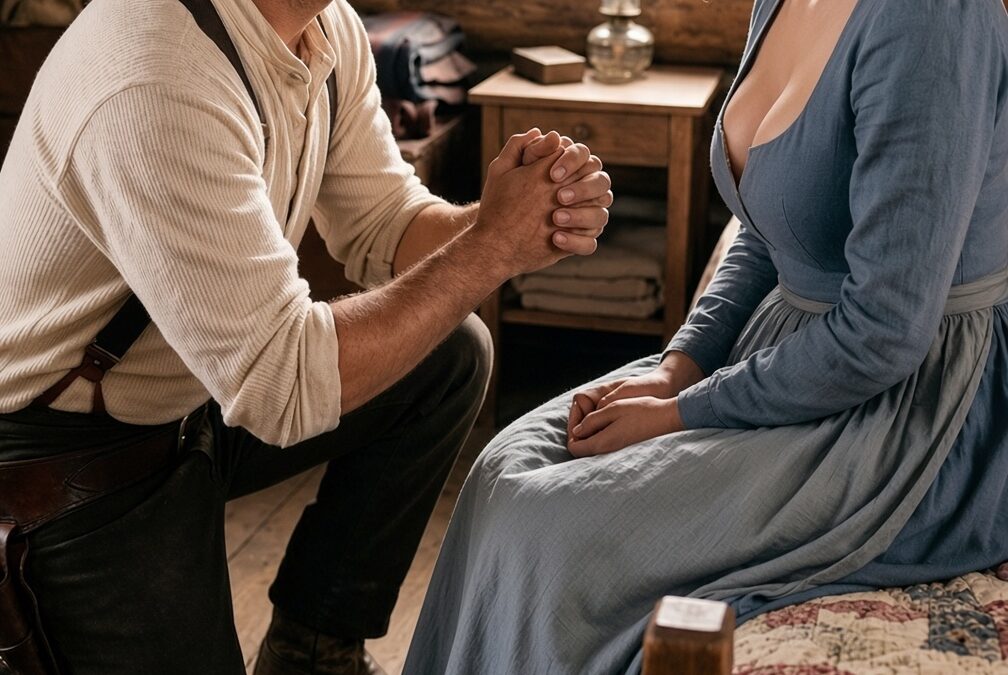
“There’s something I ought to ask.”
Nora saw the small velvet box before he opened it.
Her breath caught.
Inside lay a plain gold ring.
Callum’s hands, so steady around hot iron, trembled.
“The first night you came,” he said, “I asked you to sleep beside me because I couldn’t bear how quiet the house had become.”
Nora’s eyes filled.
“I remember.”
“I didn’t know your laugh yet. Or how you take your coffee. Didn’t know you’d argue with me about my ankle and be right every time.”
A gentle laugh moved through the crowd.
He swallowed.
“Now I find myself saving things to tell you. Little things. Things nobody else would care about.”
“I care.”
“I know.” His voice softened. “That’s what changed everything.”
He held the ring toward her.
“Would you stay beside me for every tomorrow we have?”
For a moment, Nora could hear the breeze moving through the cottonwoods.
She remembered wet steps.
A red door.
A man who had let her warm her hands before asking her name.
“Yes,” she whispered.
Then, smiling through her tears, she said it so he could be certain.
“Yes, Callum.”
She slipped the ring onto her finger.
When he embraced her, the square erupted.
Thomas cheered loudest.
Mrs. Harper cried openly.
And Callum laughed—a full, unguarded sound Nora had never heard before.
They walked home slowly beneath the evening light.
At the porch, Nora stopped and ran her hand across the weathered red door.
“What is it?” Callum asked.
“I only asked for one dry night.”
He looked at her ring.
“I remember.”
Inside, there would be supper to make. Tomorrow, there would be work, aching muscles, worried patients, stubborn iron.
They would still have difficult days.
But Nora’s medical bag had a place beside the wall now. Her coat hung beside his. Two cups waited on the kitchen shelf.
Callum opened the door.
This time, she carried her own key.
And when darkness settled over Dust Hollow, neither of them had to listen to it alone. ❤️
This story is entirely fictional and created for entertainment purposes only. It does not represent any organization or individual, nor does it encourage inappropriate behavior. Content created with the aid of artificial intelligence.








