“SOLD FOR 7 CENTS: THE BOY WITH MANY HEARTBEATS WHO LIFTED A STONE NO MAN COULD MOVE, AND THE NIGHT A THOUSAND DEAD SPOKE THROUGH HIS MOUTH”
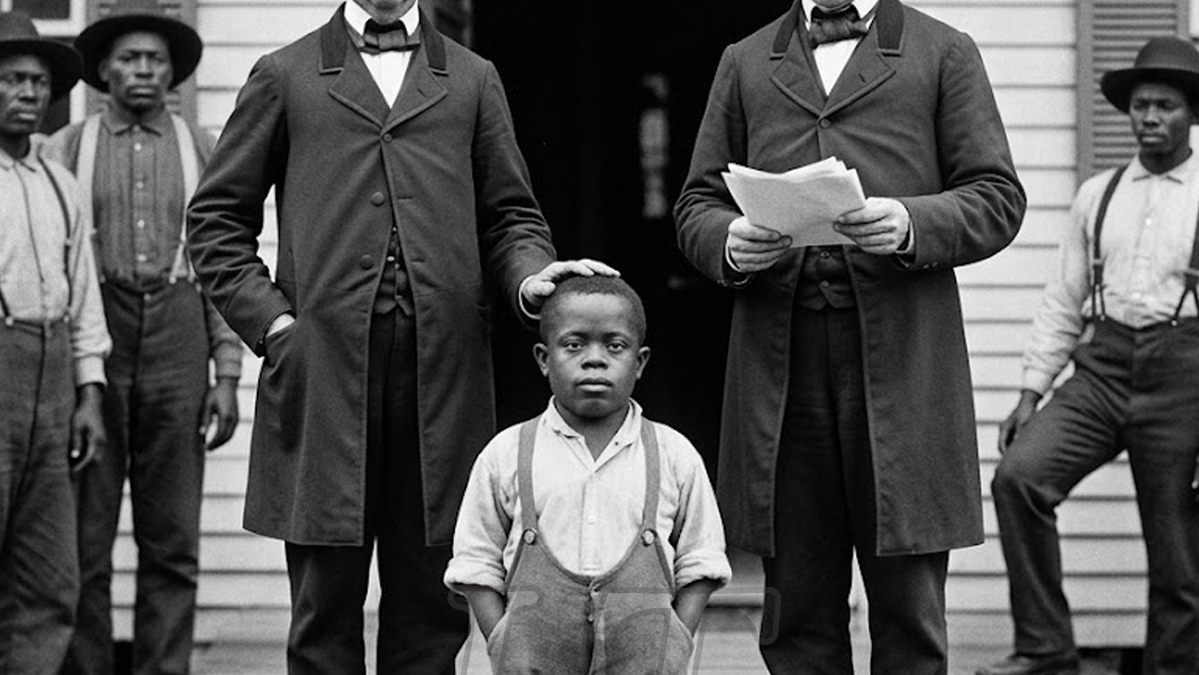
Benji looked down at Calhoun, who was on his knees in the mud, cradling a wrist that bent where no wrist should bend.
Every worker in the field waited for the second blow.
Calhoun waited for it too, with his eyes shut. It never came.
Instead, Benji let go. He bent, picked up the whip from the mud,
and, with a small, terrible patience, tied it into a knot,
then another, then a third, until the leather was a hard black lump.
He dropped it at the overseer’s feet. Then he opened his mouth,
and the plantation heard him speak for the first time.
It was not one voice. It was a chorus, low and layered,
men and women and children speaking through the same small throat,
in English, and in languages no one in Alabama had ever heard.
“Amara,” it said. “Kofi. Nandi. Esther. Isaac.
Little Ruth, who was six.” They were names. Hundreds of them,
then thousands, spoken without anger, one after another,
like a roll being called at the end of a very long journey.
Old Thomas dropped to his knees. Moses began to weep openly.
Someone in the back of the crowd cried out,
“That’s my mother’s name,” and Benji’s head turned toward her and said it once more,
slowly, as if returning something that had been lost.
On the porch of the great house,
Whitmore gripped the railing so hard his knuckles went white.
“Stop this,” he said. His voice cracked. “Whoever you are, stop.”
The chorus fell silent. Benji walked across the yard,
small and barefoot in the rain, and stopped at the foot of the steps.
Up close, Whitmore could see what he had missed before.
The enormous eyes were not cruel. They were exhausted.
When Benji spoke again, it was a single voice, thin and young,
the voice of an actual child. “I did not ask to carry it.”
Whitmore had no answer.
“They put it into me because there was nowhere else for it to go.
All the years. All the ships.” The boy looked at his own scarred hands.
“I only wanted to put it down.
But I cannot put it down while they are still chained.”
He turned and walked toward the old limestone boulder at
the edge of the property.
That night, Benji did what no man in the county had ever dreamed of doing.
He did not burn the great house. He did not touch Whitmore,
or Calhoun, or any of the white families in Mobile County.
Moses, who followed him through the dark,
later told the story to his grandchildren in a quieter voice every year.
Benji walked to the corn crib where the plantation’s iron was kept,
and he lifted the whole of it, every shackle and fetter and chain,
and carried it down to the river in six trips.
He dropped it in the deepest part of the current.
The water took it without a sound.
Then, one by one, Benji went to the cabins and woke the sleeping.
“There is a road north,” he told them, in that child’s voice.
“Moses knows the first part of it. I will carry what you cannot.”
He gestured with one small hand toward the dark.
“Go now, before the light.”
Sixty-three men, women, and children left the Whitmore plantation before dawn.
The old and the sick rode on a wagon Benji pulled himself, with no mule,
over forty miles of broken road.
When the overseers’ dogs were set loose,
the animals reached the edge of the woods and simply lay down, whining,
and would not follow.
Calhoun watched them go from the porch, his broken arm in a sling.
He had a rifle across his knees and a dozen men beside him.
Nobody raised it.
Each of them could still hear the roll of names in their heads,
and none of them could say why that stopped them.
Whitmore stood in his study with the ledger open. Dwarf boy.
Unusual strength. Seven cents.
He read the line until the words stopped meaning anything.
Then he took up a pen, crossed out the entry, and wrote beneath it,
in a hand that shook: Paid in full. The debt was never mine to settle.
He sold the plantation in the spring and left Alabama.
He lived the rest of his life in a small house in Ohio,
where neighbors said he never again attended a church service,
and never again slept through a night without waking to the sound of someone counting.
Dr. Webb burned his notebook the week after the boulder.
Dr. Bogard kept his, and it sits in a university archive today,
labeled only “case of anomalous physiology, unresolved.”
By the third night of the journey,
the wagon had reached the edge of a wide, slow river.
On the far bank, a lantern burned in a farmhouse window.
Moses had been told what that lantern meant, and he wept when he saw it.
Benji lifted the ferry onto his shoulders,
with all sixty-three people on board, and walked it across the water.
He set it gently on the northern shore.
The people climbed off one by one,
and each of them touched his shoulder as they passed.
He did not seem to notice. He was looking at his hands.
They were changing. The rough calluses were softening.
The old scars were fading, one by one,
as if somebody were slowly erasing a very long page.
When the last person had stepped off the ferry, Benji’s knees gave way,
and he sat down in the wet grass. Moses knelt beside him.
“Benji?” The boy looked up. For the first time,
the enormous eyes were no longer patient, or ancient, or terrible.
They were only a child’s eyes, brown and tired and very young.
“It’s gone,” he whispered. “I can’t feel it anymore.
It was so heavy, and now it’s gone.” “Where did it go?” “I think…”
He turned his head toward the sixty-three people on the bank,
who were holding each other and laughing and crying all at once.
“I think it just needed somebody to leave.”
He laid his head against Moses’s arm and closed his eyes.
His breath was slow and even.
It was the breathing of a small boy who had finally,
after a very long time, been allowed to sleep.
His name, it turned out, was Benjamin. A widow named Delphine Carter,
who kept the lantern in the farmhouse window,
told the others that a child with so many scars needed more than a wagon and a road.
She took him in. For eleven years,
until a day in 1864 when he was old enough to enlist,
he lived in her house, ate at her table, and learned to read.
He never spoke again in the voice of the many.
He was, by every account, quiet and kind, and unusually strong for his size.
The doctors, if they had ever examined him again,
would have found nothing unusual. A heartbeat. A single one.
A boy’s heart, beating at an ordinary pace.
Moses lived to see the end of the war. In 1866,
he stood in the doorway of a small school in Ohio and watched a grown man named Benjamin write a single line on a chalkboard,
in a firm, neat hand,
for a room full of children who had been born in chains.
Their names are not lost, because we say them.
Moses never told anyone what the boy had spoken in that Alabama field.
He did not need to. Every year on the anniversary of the crossing,
those sixty-three, and later their children,
and later still their grandchildren,
gathered at a river in the north and called a long roll of names out loud,
one after another, until the last of them had been remembered.
It was a debt, they said, that could never be paid in full.
But it could be carried together.








