The trading post was dead quiet when she said it. Just the wind howling outside and the sound of a woman’s dignity shattering against the floorboards. My children haven’t eaten today.
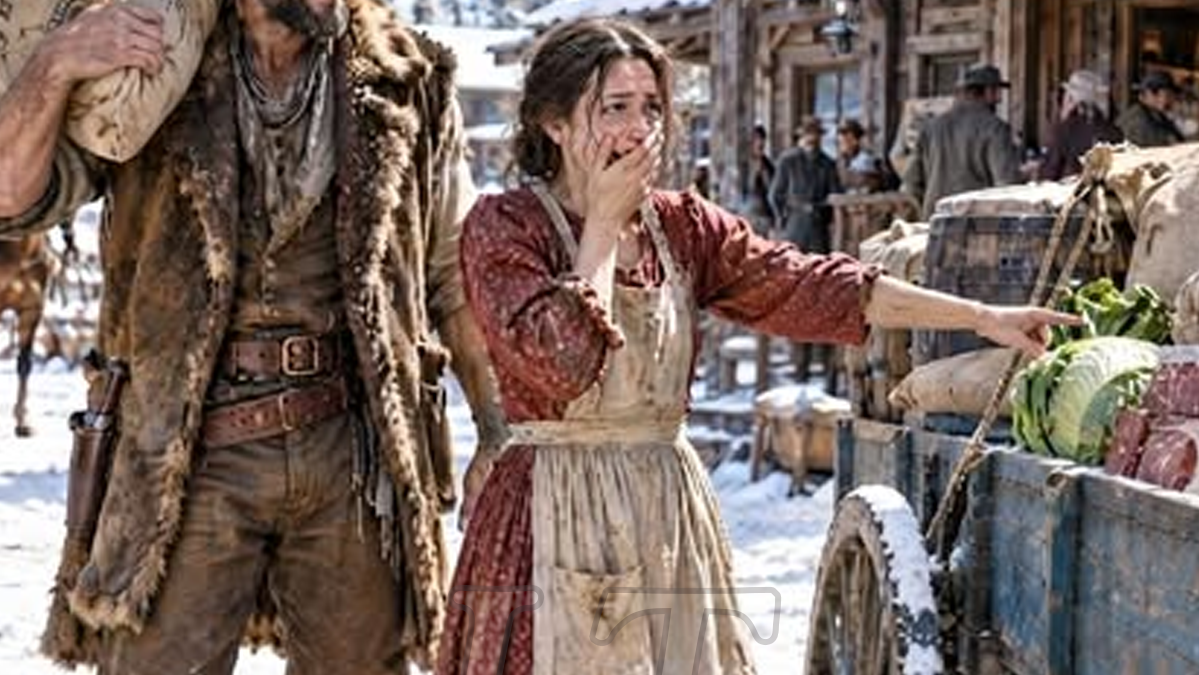
Abigail had seen men like this before. They gave a little and then took back far more. She braced herself for the price.
Amos set the last sack in the wagon and spoke without turning around.
“Get in. Your children are waiting.”
“I don’t even know your name,” she whispered.
“Amos.” He lifted the reins. “That’s all you need.”
The Hayes homestead sat at the end of a rutted track, a sagging cabin with smoke thinning to nothing above its chimney. Two small faces appeared at the window, Tom, nine, and little Lily, five. When the door opened and Amos filled the frame with his arms full of flour and ham, Lily hid behind her brother.
“Ma?” Tom said, gripping a splitting maul far too heavy for him.
“It’s all right,” Abigail said, and her voice broke. “It’s food.”
Within the hour, the cabin smelled of frying pork and coffee. Amos sat on an overturned crate by the door, refusing a chair, and watched the children eat like they’d forgotten how. He split a week’s worth of wood without being asked. He patched the roof where the snow leaked through.
When he finally turned to leave, Abigail caught his sleeve.
“Why?”
He looked at her hand, then at the children. “Had a sister once,” he said. “Nobody stood in that door for her.”
He said nothing more, and left.
Three days later, the blizzard came.
It howled down off the ridges and buried the track. Abigail was feeding the stove when she heard hooves, and then a fist pounding the door.
Miller stood on the porch with Sheriff Dunn and a thin man in a black coat, Mr. Crane from the Territorial Bank. Behind them waited two hired men with rifles.
“Abigail,” Miller said, smiling like a man at a funeral he’d paid for. “Mr. Crane has the foreclosure papers. You have until sundown.”
“The note isn’t due until spring!”
“The bank has accelerated it,” Crane said smoothly. “And that wagon in your yard is stolen property. Mr. Miller reports a theft.”
“A man paid for that wagon!” Tom shouted from behind her.
“A man nobody can find,” Miller said. “Convenient.”
Abigail understood then. This wasn’t about flour or a dead man’s debt. Two weeks earlier, a railroad surveyor had walked her land, and she’d thought nothing of it. Now she saw Crane’s eyes sweep her pasture like a man counting gold.
“The railroad is coming through my valley,” she said slowly. “You knew.”
Neither man denied it.
“Pack what you can carry,” Dunn said, not meeting her eyes. “I’m sorry, Mrs. Hayes.”
Lily began to cry. Abigail pulled her children against her skirts, staring into the white fury of the storm. There was nowhere to go, no one to call.
Then, from the swirling snow, came a sound like a mule’s heavy tread.
A shape rose out of the blizzard, huge and dark, frost clinging to a buffalo coat. Amos walked into the yard leading his pack mule, now loaded with something very different from supplies.
“Evening, gentlemen,” he said.
Miller’s smile curdled. “You. The wagon thief.”
“I bought that wagon, Miller. You wrote the receipt yourself.” Amos pulled a folded paper from his coat and tossed it at the sheriff’s feet. “Seven double eagles. Signed. Dated. Witnessed by that boy in your back room, who heard every word.”
Dunn picked it up. His jaw tightened.
“That proves nothing about the foreclosure,” Crane said coldly.
“No.” Amos reached back and dragged a canvas pack off the mule. It fell open in the snow. Out spilled bundles of the finest pelts in the territory, black wolf and prime beaver, worth a king’s ransom. “This does.”
Crane’s eyes widened.
“There’s another two hundred dollars of fur on the mule,” Amos continued, “which more than covers the note. I rode to the land office in Cutter’s Ford yesterday. Paid it in full this morning, in Abigail Hayes’s name. The clerk wrote the receipt.” He drew out a second paper. “Stamped and sealed.”
Crane snatched at it. His hands shook as he read. “This… this is irregular…”
“And so,” Amos said, voice dropping to that boulder-grinding rumble, “is a banker who knows where a railroad’s going before the railroad does.”
Silence fell, broken only by the wind.
One of the hired men lowered his rifle. The other glanced at Dunn, who straightened slowly and stepped away from Miller.
“I’ll be wanting a word with you gentlemen,” the sheriff said quietly, “about that surveyor’s report. And about forged ledger entries.”
Miller went the color of old tallow. “Now hold on, Dunn…”
He bolted for his horse. He got three steps before Amos moved. For a man his size, he moved terrifyingly fast. One huge hand caught Miller by the collar and flung him face-first into a snowdrift, where he lay gasping and cursing as the sheriff’s cuffs clicked shut.
Crane tried to run too. Tom, nine years old, stuck the maul handle neatly between his ankles. The banker went down like a felled tree.
“Good aim,” Amos said.
Tom grinned.
By dawn the storm had passed. The valley glittered, white and silent, and the men were gone in chains.
Abigail found Amos at the woodpile, loading his mule.
“You’re leaving,” she said.
“Mountain’s home.”
“You paid my whole debt. I can never repay…”
“Didn’t ask you to.”
She stepped closer, breathing hard. “I have eighty acres, a roof with your patches on it, and children who haven’t stopped talking about you since Thursday.” Her voice trembled. “I’m saying there’s an empty chair at my table, Amos. It’s yours if you want it.”
He stood very still. For ten years, the wind had been his only company.
Lily slipped out the door and tugged his coat. “Mr. Amos? Are you staying for breakfast?”
He looked down at her, at Tom in the doorway, at the woman with fierce blue eyes. Something cracked open behind that frost-dusted beard.
“I suppose,” he said gruffly, “a man can’t leave without eating.”
Abigail laughed through her tears. Amos unloaded one pelt from his mule, then another, then the rest.
The mountain would wait. He had finally come down to stay.
THE END








