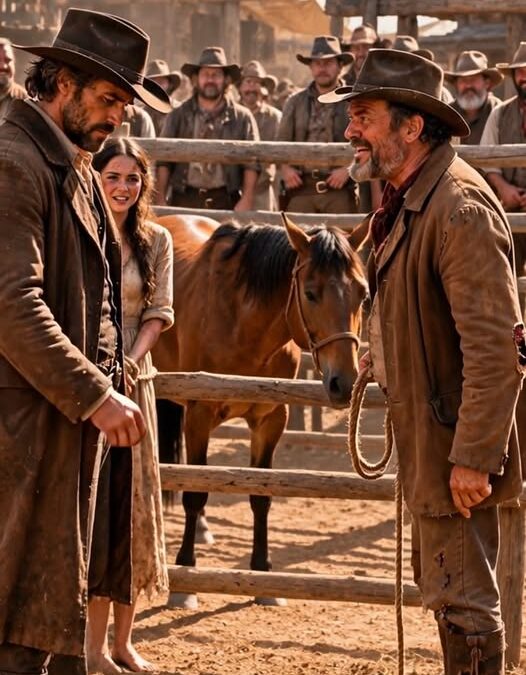
“THE WOMAN COMES WITH THE HORSE.”
A tornado.
It came out of the dying light like the hand of God reaching down to wipe the prairie clean. It was a black, twisting column wider than any river Silas had ever crossed, and it was dragging half the sky behind it.
For one frozen heartbeat, Silas could not move.
Emmeline could.
She yanked his sleeve again, so hard the seam tore, and pointed not at the cattle shed but past it, to the low wooden door half-buried in the hillside. It was the root cellar. Silas had dug it his first summer on the land and hadn’t opened it in two years.
He understood. The shed would be torn apart. The house might be too. Only the earth would hold.
“Go!” he shouted over the rising roar. “Get inside!”
She ran. Silas ran with her, his boots pounding the hard ground, the wind already clawing at his hat and tearing it from his head. The cattle stampeded past them, bawling in terror, and scattered toward the creek.
They reached the cellar door. Silas wrenched it open. Darkness and the smell of cold earth rushed up at them.
Emmeline stepped onto the first stair.
Then the mare screamed.
Silas turned. The bay mare was still in the corral, the gate latched, her injured leg trapping her as she reared and plunged against the rails. The fence was too high for her to jump. She would be crushed or carried away.
Silas looked at the mare. Then at Emmeline.
“Stay here,” he said.
Her eyes went wide. She grabbed for his arm, but he was already running.
The wind hit him like a wall. Dust and straw and splintered boards whipped past his face. He fought his way across the yard, bent nearly double, every step a battle. The roar was everywhere now, a freight train with no end, shaking the ground beneath his feet.
He reached the corral. His fingers found the latch.
It was jammed.
Silas pulled. He kicked. The mare reared above him, hooves slashing the air. Behind him, the old oak tree split with a crack like cannon fire and was torn from the earth, roots and all.
The latch gave.
The gate swung open and the mare bolted, limping but free, straight toward the low ground by the creek.
Silas turned back toward the cellar.
Something struck him hard across the back. It might have been a board or a beam; he never knew. The world tilted. He went down into the dirt, and the darkness came down with him.
He heard a voice.
It was faint and cracked and rough with disuse, like a door that hadn’t been opened in years. It was calling a word over and over, somewhere above the howling wind.
“Silas.”
He forced his eyes open.
Emmeline was on her knees beside him in the storm, her dress whipping around her, her hair torn loose. Both her hands were clenched in the collar of his coat. She was dragging him, inch by inch, across the yard.
“Silas.” Her voice broke. “Get up. Please. Get up.”
She could speak.
He didn’t understand how, or why, or what it had cost her. He only knew that she had come back for him. She had left the only safe place on earth and walked into the storm, for him.
Silas got up.
They stumbled the last ten yards together, her arm around his waist, his weight on her narrow shoulders. They fell through the cellar door and down the stairs. Silas reached up with the last of his strength and dragged the door shut above them.
Then the world ended.
The roar became everything. The earth shook. Dirt rained from the ceiling. Somewhere above them, wood screamed and glass shattered, and something enormous rolled across the cellar door with a sound like thunder.
In the dark, Emmeline’s hand found his.
Silas held on.
When the silence came, it was total.
Silas pushed the cellar door open slowly. Grey light spilled down the stairs.
The barn was gone. Not damaged. Gone. Only its stone foundation remained. The cattle shed lay scattered across half a mile of prairie. The old oak was nowhere to be seen.
But the house still stood.
The porch was torn away and every window was shattered, but the walls were standing and the roof was holding.
And on the kitchen doorframe, untouched by the storm, the single chalk word was still there.
Emmeline.
They stood in the ruined yard a long time without speaking. Then Emmeline lifted her face to him.
“I used to talk,” she said quietly. Her voice was still hoarse, as if each word scraped its way out. “Before. My family had a farm in Kansas. A storm like that came when I was fourteen. I heard it coming. I tried to tell them.” She swallowed. “Nobody listened. I was the only one who made it to the cellar.”
Silas said nothing. He just listened.
“The man who took me in after… he said I was cursed. That I brought storms. He sold me to the next man, and that one sold me again.” Her fingers tightened around her bruised wrist. “After a while, there didn’t seem to be any point in speaking. Nobody ever listened anyway.”
“I’m listening,” Silas said.
Her eyes filled. “I know. That’s why I came back for you.”
A soft sound came from the creek.
They both turned.
Limping across the wreckage came the bay mare. She was covered in mud, her leg still wrapped in Emmeline’s bandage, but she was alive. She walked straight past Silas, lowered her head, and pressed it against Emmeline’s shoulder, just as she had that first morning in the barn.
Emmeline laughed. It was the first time Silas had ever heard the sound. It broke through her like sunlight through clouds.
They rebuilt through the autumn.
Neighbors came from twenty miles away. Some of them had laughed at the auction yard that day. Now they had heard how a quiet woman had sensed the storm before anyone else and dragged a grown man to safety through a tornado. They brought lumber and nails, and they didn’t laugh anymore.
On the first day of the new barn, Silas found an old coil of rope in the wreckage. It was rough and frayed, the same rope he had untied from her wrist in the auction yard. He had thrown it into the barn that first night and forgotten it.
He carried it to the stove and dropped it into the fire.
Emmeline watched it burn. Then she took a piece of chalk from her apron pocket, walked to the doorframe, and wrote beneath her name in careful letters:
Home.
Silas read it. Then he took the chalk from her fingers and added one more word below it.
Stay.
Emmeline looked at him. For a long moment, the prairie wind was the only sound.
Then she answered him, not with chalk but with her own voice, clear and certain.
“Yes.”








