“They Torched a Widow’s Barn at Night… At First Light, Her Buffalo Rifle Spoke
“You’re lying,” Ruth said again, softer this time.
Eleanor set the cup down on the step. Her hand was steady, but her eyes had gone somewhere far beyond the creek.
“I don’t know their names,” she said at last. “But I know what they are. And I know who sent them.”
Ruth waited.
“Before I came here, I was Eleanor Marsh. My husband, Thomas, ran cattle in Wyoming Territory. A man named Silas Pike wanted our water. Thomas refused.” She drew a slow breath. “Pike’s men burned us out on a winter night. Thomas went back into the house for our daughter’s blanket. Neither of them came out.”
Ruth closed her eyes.
“I was in the barn with the buffalo rifle my father left me. I could see them all, lit up against the flames. And I did nothing. I was too afraid.” Her voice never rose. “I promised myself that if they ever found me again, I would not be afraid.”
“Eleanor…”
“He never stopped looking, Ruth. Five years. Now his men have my name.”
Ruth stood, leaning hard on her cane. “Then we tell the sheriff.”
“And say what? That a dead man’s brother is hunting a widow? Garrett would ride out here with one deputy and get them both killed.” Eleanor shook her head. “No. Go home, Ruth. Lock your door tonight. Whatever you hear, stay inside.”
The old woman looked at her a long time. Then she touched Eleanor’s cheek, once, and mounted her horse.
That night the moon rose thin as a scar.
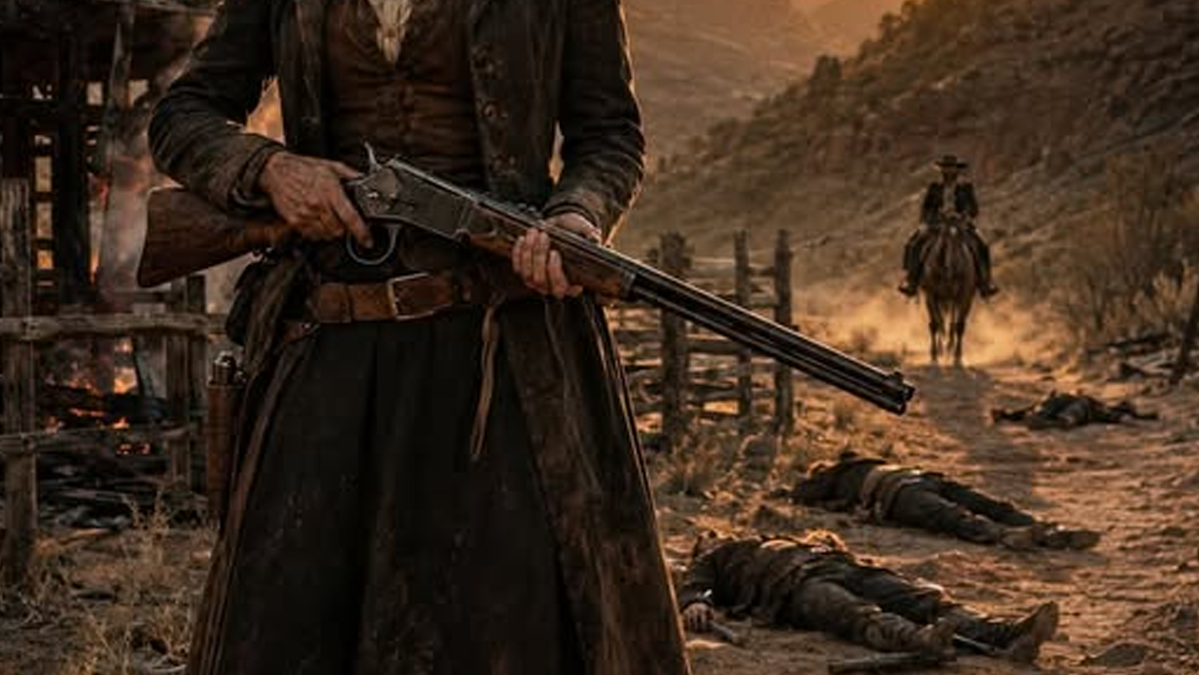
Eleanor did not sleep. She sat in the dark kitchen with the rifle across her knees, a Sharps, forty-five inches of blued steel and walnut, and a box of brass cartridges she had polished herself. She had cleaned the barrel twice. She did not need to. It was only something for her hands to do.
At two in the morning, she smelled kerosene.
She did not move. Through the window, shadows crossed the yard, five of them, carrying cans. One knelt by the barn door. A match flared, orange against a bearded face.
“Burn the barn first,” a voice whispered. “Let the widow come running out.”
Fire licked up the dry wood. It spread with a hungry roar, and the night bloomed gold.
Eleanor rose calmly. She took the rifle, the cartridges, her father’s old spyglass, and slipped out the back door into the tall grass. She was already gone when the first men kicked in her front door and found an empty house.
“Where is she?” one of them shouted.
“She can’t have gone far!”
She crossed the creek at a crouch, water black around her boots. Behind her the barn burned like a torch. Every inch of that yard was lit as bright as noon, and every man in it stood clear as a target on a paper board.
She could have shot them right there.
But she knew Pike’s men. Shoot one and the rest would scatter into the dark, and they would come back with the others, and the valley would burn.
She needed them to follow her.
So Eleanor stepped up onto a rock in the moonlight, raised the Sharps, and fired a single shot into the air.
The crack rolled across the valley like thunder.
Every head turned.
“There!” a man howled. “There she is!”
Eleanor was already running.
She ran the way she had been taught by her father, low, quick, up the eastern trail toward the canyon. She had scouted it for years without knowing why, learned every stone, every angle of the walls, the way the wind pooled and turned at dawn. Perhaps some part of her had always known she would need it.
Horses thundered behind her. Five men, pushed by rage and whiskey and the promise of a payday.
By the time gray light touched the ridge, she was flat on a shelf of rock above the canyon mouth, breathing slowly, the rifle steady on a folded coat.
Below, the pass lay silent.
Then the hoofbeats came.
The first rider entered the canyon at a gallop. Eleanor set the crosshairs on his chest and thought of a blanket, a burning door, a small hand she never got to hold.
She squeezed the trigger.
The shot cracked and doubled off the walls until no one could say where it had come from. The first man fell without a sound.
The others reined in, panicked, spinning, searching every ridge. She was already sliding backward along the rock to her second position.
Wind, light, echo, she had learned them all. She fired again.
The second man dropped. The third and fourth broke and charged up the slope on foot, only to find nothing but shifting shadow. Eleanor moved and fired, moved and fired, each shot arriving from a place the last one had not.
By the time the fifth man reached the standing stone at the throat of the pass, he was alone, sobbing, throwing his pistol down.
“Please! I got a wife! It was Pike’s orders, I swear!”
Eleanor rose from the rocks above him, dust on her face, the Sharps in her hands.
“Where is he?”
“Camped at Miller’s Ford! Two days’ ride! He said to bring proof you were dead!”
She lowered the rifle by an inch.
“Then you’ll bring him proof,” she said quietly. “Tell him a widow is waiting.”
The man ran. He did not stop running until he reached the horizon. She let him go.
That was where the sheriff found her tracks.
—
Ruth Hawthorne arrived at the ranch just after Garrett, leaning on her cane, tired and stubborn. They found the barn a smoking skeleton and the house untouched.
Eleanor sat on the porch steps with the Sharps beside her and a cup of coffee in her hands. Her face was drawn with exhaustion, but her eyes were calm.
Garrett stood in front of her for a long time.
“There are five men dead in my canyon,” he said at last.
“I know.”
“Every one of them shot from a ridge no man could reach.”
“I know that too.”
He looked at the rifle. Then at her hands, small and scarred, resting quietly on her knee.
“I found small boot prints.”
“Did you?”
He took off his hat. Slowly, he crouched so his eyes were level with hers.
“Ma’am, I’ve got a job. And I’ve got a conscience. And somewhere between the two, I remember what this valley suffered for two years while I did nothing.” His voice thickened. “Those men burned your barn. They meant to burn you. As far as I can tell, this is a matter of self-defense on a private ranch.”
Eleanor stared at him.
“But Pike’s not finished,” she said.
“No.” Garrett stood and put his hat back on. “Which is why I’m riding out to Miller’s Ford with a dozen men from town. Ruth’s already knocked on half their doors.”
Behind him, in the road, a line of riders had gathered: shopkeepers, ranch hands, a blacksmith with a shotgun, the young deputy Collins looking terrified and proud.
“We should have done it years ago,” Garrett said. “You gave us the courage. Let us finish it.”
Eleanor rose, and for the first time in five years, she smiled.
“I’ll ride with you,” she said. “I know the way.”
—
They found Silas Pike at dawn on the third day, waiting at the ford with his last fifteen men. The fight was short and hard. When the powder smoke cleared, Pike lay dead in the shallows, felled by a single shot from a ridgeline he never saw.
Eleanor lowered the Sharps.
Somewhere far away, a fire went out.
She rebuilt the barn that summer, with the town’s help, and painted it red. On the door, Ruth carved a name into the beam above the lintel: *Thomas and Rose*.
Every evening, when the wind came off the ridges and the light turned gold, Eleanor sat on her porch and watched the road, no longer waiting for anyone.
Only the valley, quiet at last.








