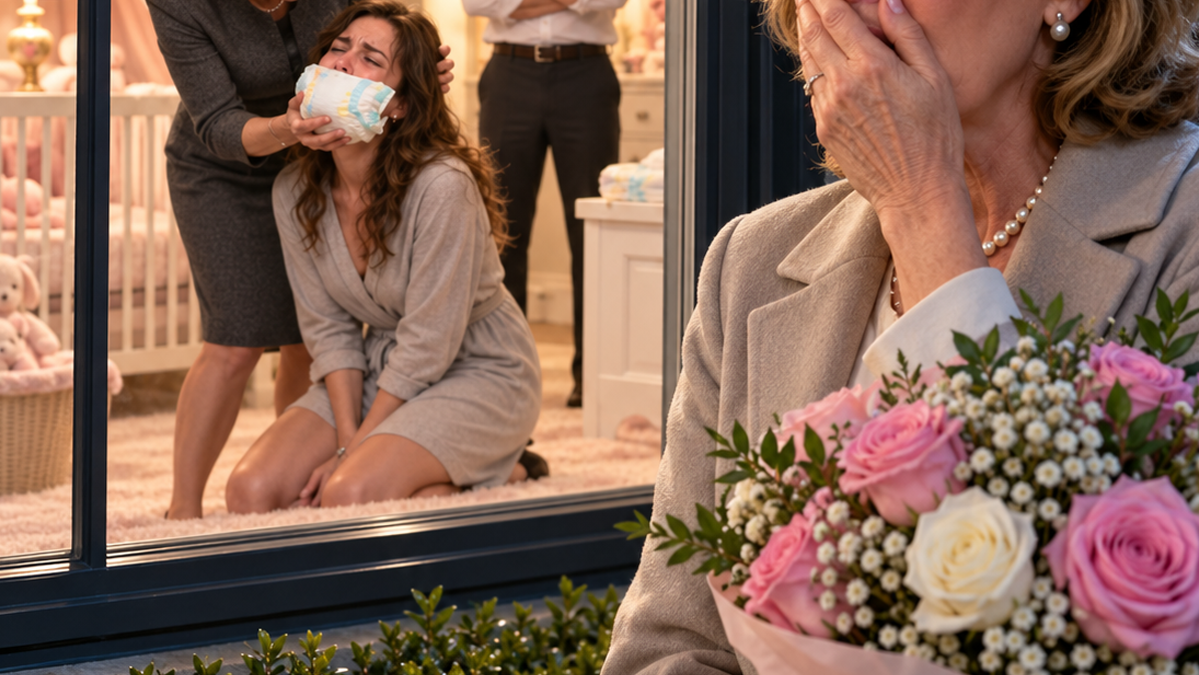
When I arrived to meet my newborn granddaughter, I found my daughter trembling in the nursery, her mother-in-law forcing a baby diaper against her mouth.
Part 3
Bradley reached the stairs first, smoothing his shirt, already rehearsing the smile he used on investors.
“Officers,” he said, opening the door. “There’s been a misunderstanding. My mother-in-law is confused. My wife has postpartum issues, and—”
“Lieutenant Dana Ruiz.” A tall woman in a dark coat stepped past him without waiting for permission. Two uniformed officers followed. “We received a report of an assault on a postpartum woman in this residence.”
“An assault?” Margaret descended the staircase like a queen entering a ballroom. “Lieutenant, my family has supported this city’s police foundation for twenty years.”
“I know,” Ruiz said. “I’ve read the donor list. Where is Mrs. Lily Whitmore?”
“Here,” I said from the top of the stairs.
Lily stood beside me in her robe, holding the baby against her chest. She was shaking so hard I kept one hand on her back. But she was standing.
Ruiz’s eyes moved to the red mark around Lily’s mouth, then to the hospital bracelet still on her wrist. Something in her face went flat and professional, the way faces do when they’ve seen this too many times.
“Ma’am, are you safe in this house?”
Lily opened her mouth. Closed it. I felt her glance at Bradley, at the years of practiced fear.
Bradley stared back at her. “Tell them, Lily. Tell them you’re tired and confused.”
My daughter looked down at the tiny face sleeping on her shoulder.
“No,” she said. “I’m not safe. And neither is she.”
The silence after that was the loudest sound I had ever heard.
Margaret recovered first. She always would.
“This is absurd. Evelyn has been poisoning my daughter-in-law against us for months. She’s a bitter retired lawyer who resents our family. There’s no evidence of anything.”
I came down the stairs slowly and handed Lieutenant Ruiz a small flash drive.
“Front porch camera, synced to Lily’s account. Eleven months of footage. Voicemails. Pharmacy records showing withheld medication. Text messages discussing a planned custody grab.” I unpinned my brooch and set it in her palm. “And this. Recording since I walked in tonight. You’ll want to start at minute four. That’s when the diaper comes out.”
Margaret’s lipstick-red mouth went white at the edges.
Bradley lunged. Not at me. At the brooch.
It was the most honest thing he had done all night, and it was the stupidest. One officer caught his arm and turned him against the wall in a single practiced motion. A framed family portrait crashed to the floor: the Whitmores in matching cream sweaters, smiling under the words Legacy. Faith. Family.
“Get your hands off me!” Bradley shouted. “Do you know who I am?”
“Yes, sir,” the officer said. “That’s in the report now too.”
At 10:40 p.m., Helena Ross arrived.
She was seventy-four, silver-haired, and wrapped in a camel coat that had probably outlived three of Margaret’s husbands’ business partners. Twenty years on the bench had given her a stare that could make defense attorneys forget their own names.
She didn’t greet Margaret. She walked straight to Lily, looked at the baby, then at the mark on my daughter’s face.
“Margaret,” she said quietly, without turning. “I watched the first six minutes in the car.”
“Helena, you can’t possibly believe—”
“I’ve known you thirty years. I believe my eyes.” Helena turned at last. “Effective tonight, under Article Nine of the Whitmore Family Trust, I am exercising emergency board authority. Your seat on the Foundation is suspended. Bradley’s executive voting rights are suspended. All discretionary funds are frozen pending investigation.”
Margaret laughed, a high, brittle sound. “You can’t. Charles would never—”
“Charles wrote the clause,” I said. “I sat across from him while he did. Do you know what he told me, Margaret? He said, ‘Money protects monsters. I want this money to stop them.'”
For the first time, Margaret Whitmore had no answer.
They arrested Bradley for assault, obstruction, and attempting to destroy evidence. Margaret was charged with assault and endangering a vulnerable adult after Ruiz reviewed minute four twice, her jaw tight.
As they led Margaret to the cruiser, she twisted toward me, diamonds trembling in the blue light.
“You’ve destroyed this family!”
“No,” I said. “I documented it.”
Neighbors had gathered on their lawns in coats and slippers. Phones glowed. By midnight, the first video was online. By morning, three local stations had the story. By noon, the Whitmore name had been quietly removed from the children’s hospital wing it had paid for.
Their perfect family name was burning, exactly as I’d promised myself it would.
The custody hearing came four months later.
Bradley’s lawyers tried everything. They called Lily unstable. They called me vindictive. They introduced a sworn statement from a nanny describing Lily as “emotionally fragile.”
Then my investigator located that nanny, and she recanted under oath. Margaret had paid her five thousand dollars to sign it.
That was the moment Bradley’s attorney stopped meeting his client’s eyes.
At the end, the judge asked Lily if she wanted to speak.
My daughter stood. Four months earlier, she couldn’t finish a sentence in her own home. Now she wore a navy suit, her hair pulled back, her hands steady on the podium.
“For two years, they told me I was weak,” she said. “That I was too soft to be a mother. But I kept my daughter alive through all of it. I learned to be quiet so she’d be safe. Now I’m learning to be loud for the same reason.”
The judge granted her full legal and physical custody. Bradley received supervised visitation only, contingent on completing a batterer intervention program. Margaret was barred from any contact with the child.
Outside the courthouse, reporters shouted questions. Lily didn’t answer them. She just held her daughter up to the spring sunlight and laughed, a real laugh, the first I’d heard from her in years.
“What’s her name?” a reporter called.
Lily looked at me.
For six days, the Whitmores had refused to let her choose. Margaret had insisted on Victoria, after her own mother.
“Her name,” Lily said clearly, “is Grace Evelyn Hart.”
Not Whitmore.
I pinned a new brooch to my jacket that afternoon. Just a pearl this time. No camera.
I didn’t need one anymore.
My daughter had found her own voice, and the whole city was listening.
THE END.








