Wyatt married me for my father’s valley, then told his ranch hands I would never survive a Texas summer.
The Weight of Willow Creek
The wagon had never known a driver like me.
I took the road to the far ridge at a pace that made the mules lay back their ears, the medicine chest rattling beside a crock of hot beans wrapped in wool. Behind me, the iron-colored storm swallowed the sky. The young hand, Tobin, clung to the seat and prayed aloud.
“Slow, Mrs. Mercer? They said you were slow.”
“I am careful,” I said. “Careful is not the same thing. Hold the lantern.”
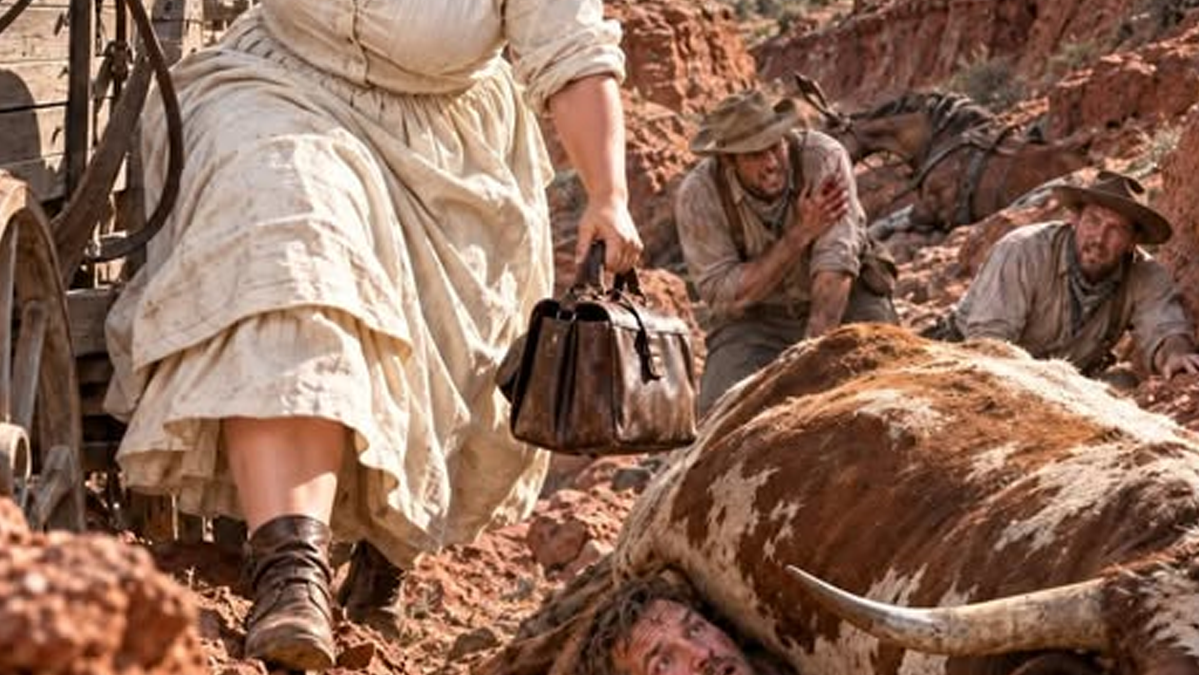
The first hail struck as we reached the ravine. Stones the size of walnuts hammered the wagon bed and the backs of the mules. Below the collapsed bank, six men were scrambling through red mud and tumbled rock, and beneath a dead steer lay my husband, his leg pinned, his face gray.
I climbed down without waiting for help.
“Nell,” Wyatt rasped when he saw me. “Go back. The bank’s still moving.”
“Then we shall be quick.”
Hollis had a rope. I had the wagon and the mules. It took four minutes to understand the problem and thirty seconds to solve it. I looped the rope through the wagon’s rear axle, looped the other end around the steer’s horns, and stood at the mules’ heads, coaxing them forward one step at a time while the ridge groaned above us.
“Pull!” Hollis bellowed.
The carcass shifted, and Wyatt screamed. The rope sang like a fiddle string. The mules slipped, and I planted my boots in the mud and leaned my whole considerable weight against the lead animal’s bridle, holding it steady.
“Steady, Duchess. Steady, girl. You are stronger than this hill.”
The steer slid free. Two men dragged Wyatt clear as the bank above us gave a long, wet sigh and collapsed exactly where he had lain.
Nobody spoke. The hail thinned to rain.
We reached the ranch house after dark, the hurt men laid in the wagon bed between sacks of flour, their heads on folded blankets. I sent Tobin for the doctor in Amarillo, though it was thirty miles and the road was mud. Then I set to work.
The kitchen I had scrubbed for three days became a field hospital. I boiled water, tore clean linen, and split Wyatt’s trouser leg with my sewing shears. His shin was broken, the bone straining against skin, and the fever of shock already climbing in him.
“Hold him,” I told Hollis. “Hold him hard.”
I set the bone. I bound it with a splint of oak slat from the wagon, and I did not flinch at the sound he made. When it was done, I fed each man a cup of broth. I had simmered the beef bones since dawn, salted low and spiced with pepper, the same broth that had once brought color back to my father’s face.
By midnight, the color had come back to Wyatt’s too.
“Why,” he whispered, his eyes half open in the lamplight, “would you do this?”
“Because you are my husband, however poorly you use the word.”
“I thought you were…” He stopped, ashamed.
“Slow,” I said. “Soft. Dependent.”
His jaw tightened. “Yes.”
“I am all of those things, sometimes. So are you.” I wrung out a cloth and laid it across his forehead. “It is a pity you did not ask what else I was.”
He slept for two days. On the third, the rider came.
I heard the hooves from the kitchen window, where I was kneading dough, and I knew from their rhythm that this was no neighbor. Five horses, coming hard and unhurried. Hollis met me at the door, his cataract-clouded eyes wide.
“It’s Carver Boyd, ma’am. From the Rocking B. He’s got men.”
I knew the name. Carver Boyd was the county’s largest cattleman and the loudest of those who had said a woman could not hold a deed. He rode into the yard with a document in his gloved fist and four hired guns at his shoulder.
“Mrs. Mercer,” he said, without dismounting. “Word is your husband’s laid up. Word is you’re alone with a crew of cripples. I’ve come to make an offer for Willow Creek Valley.”
“The valley is not for sale.”
“Everything is for sale, ma’am. You just don’t know your price.” He smiled. “Sign, and I let you keep the house and a hundred dollars. Refuse, and my men will find your creek unaccountably poisoned by morning, and your cattle dead in a week.”
Behind me, I heard the floorboards creak. I did not turn.
“That is unfortunate, Mr. Boyd,” I said. “Because I have already prepared for you.”
“Prepared?” He laughed. “With what, biscuits?”
“With the truth.”
I lifted the small brass bell hanging by the door and rang it once.
From the barn, from the bunkhouse, from the cellar, from behind the smokehouse, the ranch hands emerged. Bandaged, splinted, and limping, every one of them carrying a rifle. Twelve men, whom I had fed for a week. Twelve men who had lain in my kitchen with burning wounds and awakened to broth.
Hollis stood at the front. “Sorry, boss,” he said to Boyd. “Wrong ranch.”
Boyd’s smile died. His hand moved to his pistol.
“Do not,” said a hoarse voice from the doorway.
Wyatt stood behind me, gripping the frame, sweat shining on his face. He had dragged himself from his sickbed on a broken leg, a shotgun in his fists.
“That’s my wife’s land,” he said. “And that is my wife.”
Boyd’s men hesitated. The moment stretched, thin as wire.
Then Boyd drew.
The shotgun roared. The blast tore Boyd’s hat from his head and his pistol from his hand and drove him backward out of the saddle into the dust. The rifles answered in a ragged volley over the heads of the hired men, and they threw down their weapons and scattered, leaving their leader groaning in the dirt.
Wyatt sagged. I caught him, all one hundred and eighty pounds of him, and did not stumble.
“You’re heavier than you look,” I said.
“You,” he whispered, “are stronger than I ever knew.”
The sheriff came from Amarillo the next morning, and Carver Boyd left in irons. His poisoned-creek plot lay in his own saddlebags, written in his own hand.
That autumn, Wyatt walked again, with a cane and a limp that never entirely left. He moved the dinner table onto the porch and ate every meal beside me. He learned which apple made the best pie and which cut of venison needed longest to cook, and he asked each question as though it mattered.
On the first cold night of October, he brought me a chair by the stove and knelt awkwardly before it.
“I married you for a valley,” he said.
“I know.”
“I would like to stay married to you for the woman.”
I looked at this proud, stubborn, foolish man on his bad leg. Outside, the wind whispered across Willow Creek, and for once it carried no dust.
“Then ask me what I like to eat,” I said.
Wyatt laughed, and the sound filled the house I had built from ruin.
“What do you like to eat, Nell?”
I smiled and reached for his hand.
“Everything,” I said. “Come. I will show you.”
THE END








