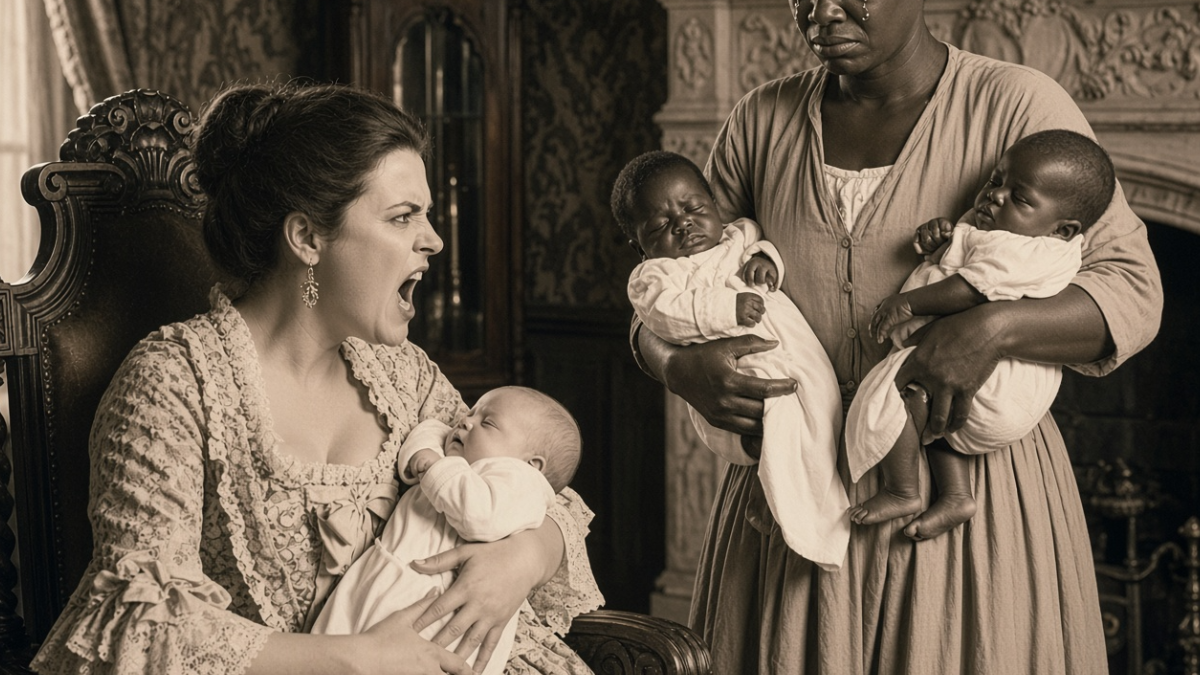
THE DUCHESS GAVE BIRTH TO TRIPLETS—THEN ORDERED HER SERVANT TO MAKE TWO OF THEM DISAPPEAR BEFORE SUNRISE
ENDING
The footsteps grew louder. Heavy boots struck the stones outside the market—slow, deliberate, unmistakably coming closer.
Grace’s eyes snapped toward the doorway as the morning noise of Kingsport suddenly seemed to fade behind the pounding of her own heart.
“Get behind me,” she whispered. Samuel and Benjamin exchanged a frightened glance. Edward remained frozen beside the vegetable stall, his face drained of color after hearing the words that had shattered fourteen years of his life.
Three brothers. One mother. One birth. And a secret powerful enough to destroy the Whitmore family.
The door swung open. A tall man in a dark riding coat stepped inside, rainwater dripping from the brim of his hat.
Behind him stood two armed servants wearing the silver crest of Blackwood Estate. Grace stopped breathing.
“mr. Carter.” William Carter had served Duke Henry Whitmore for more than twenty years. Grace remembered him as a young estate clerk who recorded harvests, punishments, purchases—and the names of enslaved people as though they were livestock.
His face had aged. His eyes had not. “Grace,” he said quietly. “His Grace wants you brought home.”
Benjamin stepped forward. “She isn’t going anywhere.” Carter looked at him. Then at Samuel. For one terrible second, recognition passed across his face.
“My God.” His gaze moved to Edward. The resemblance was impossible to ignore now that all three boys stood together.
Carter understood everything. “Take her,” he ordered. The two men moved. Benjamin grabbed a wooden crate and hurled it into their path.
It exploded against the floor, sending onions rolling beneath boots and scattering customers toward the exits.
“RUN!” Samuel seized Grace’s hand. They bolted through the rear of the market. Edward followed.
Behind them came shouting, crashing wood and Carter’s furious voice ordering his men after them.
They burst into a narrow alley filled with laundry lines and barrels. Grace’s shoes slapped against wet stones while Samuel pulled her forward.
A pistol fired. The blast cracked through the alley. Grace screamed. The ball struck the wall beside Benjamin’s head, spraying fragments of brick across his cheek.
“Keep moving!” They turned sharply into another street. Carts blocked the road. Horses screamed as people scattered, and vendors abandoned baskets of fruit beneath trampling feet.
Edward knew these streets better than Carter’s men. “This way!” He led them through a courtyard, over a low wall and into the rear entrance of an old church.
The heavy wooden door slammed shut. For several seconds nobody spoke. Only breathing. Fast. Ragged.
Terrified. Then Grace noticed blood running down Benjamin’s face. She rushed toward him. “It’s nothing,” he insisted.
“It could have been your head.” “But it wasn’t.” Samuel turned toward Edward. “Why are they chasing us?”
Edward stared at the floor. “Because my father knows.” Silence. Grace slowly raised her head.
“How?” “I questioned my mother before coming to Kingsport. She told me enough to make me suspicious.
My father must have realized what I was searching for.” Benjamin laughed bitterly. “So now what?
He makes us disappear again?” Edward looked directly at him. “Not this time.” Something had changed in his voice.
Until that morning, Edward Whitmore had lived between two worlds without understanding either. Now he had seen armed men chase his brothers through the streets simply because their existence threatened his family’s reputation.
He finally understood what Grace had protected them from. And what his own comfort had been built upon.
“We need proof,” Samuel said. Grace looked at him. “Proof of what?” “That we were born at Blackwood.”
Grace shook her head. “There is none.” Edward suddenly remembered something. “The parish register.” Everyone turned.
Edward explained that every legitimate birth and baptism connected to the estate was recorded by the local parish.
If the original entry had been made before his father altered the story, there might be evidence that three children had been born.
“But the priest would never help us,” Grace said. “He doesn’t have to.” Edward’s jaw tightened.
“I know where the register is kept.” Three nights later, under a moon hidden behind storm clouds, the brothers rode toward Blackwood Estate.
Grace begged them not to go. They went anyway. Rain hammered the road as their horses climbed through the hills.
Lightning revealed the plantation in violent white flashes—the mansion on the ridge, the workers’ quarters below it, the chapel standing beyond the trees.
Samuel stared at the place where his life had begun. “So this is home?” Benjamin looked toward the enormous house.
“No.” One word. Cold and final. They left their horses among the trees and approached the chapel on foot.
Edward opened a side window he remembered from childhood. Inside, the building smelled of damp wood, wax and old paper.
Samuel held the lantern while Edward searched the cabinet. Then— His hands trembled. He opened the register.
Page after page turned beneath his fingers. February. March. Then he stopped. March 15. Samuel brought the lantern closer.
The ink had faded, but the entry remained readable. Three male children delivered to Eleanor Whitmore.
The first name had been scratched away. The second had been scratched away. The third remained.
Edward. Someone had attempted to erase the other two entries, but the original writing was still visible beneath the cuts.
Samuel touched the page. His finger shook. Benjamin said nothing. For the first time, they possessed something the Whitmores could not dismiss as rumor.
They had existed. From the beginning. A floorboard creaked behind them. Edward turned. His father stood in the doorway.
Duke Henry Whitmore held a pistol. Behind him stood Carter and four estate guards. “You should never have come back.”
Rain roared against the chapel roof. Edward stepped between the pistol and his brothers. “Put it down.”
Henry’s face twisted. “You have no understanding of what you’re destroying.” “I understand perfectly.” “You are my son!”
“So are they.” The words struck harder than the thunder. Henry’s pistol remained raised. Samuel carefully closed the register.
“You knew we were alive.” Henry looked at him. For the first time, father and son saw each other clearly.
“I knew,” Henry answered. Benjamin’s fists tightened. “And you left us to die.” “I protected my family.”
“We are your family!” Benjamin’s shout filled the chapel. Henry flinched. Only slightly. But Edward saw it.
Then another voice came from the doorway. “No more.” Eleanor stood behind the guards. She looked older than Edward remembered from only weeks earlier.
Her hair hung loose around her shoulders, and rain had soaked through her dress. Her eyes found Samuel.
Then Benjamin. She stared at the two sons she had last seen as newborns wrapped in cotton blankets.
Her knees nearly collapsed. “Oh God.” Benjamin stepped backward. “Don’t.” Eleanor covered her mouth. “I thought about you every day.”
“You thought about us?” Samuel’s voice was quieter than Benjamin’s, which somehow made it more painful.
“Did you wonder whether we were hungry? Whether we were sick? Whether Grace survived carrying us through the night?”
Eleanor began crying. “Yes.” “Then why didn’t you come?” She had no answer. Henry turned toward her.
“Go back to the house.” “No.” “Eleanor.” “I said no.” For perhaps the first time in their marriage, she walked past him without lowering her eyes.
She approached Samuel and Benjamin. “I was afraid,” she whispered. “I cared more about what society would say than about my own children.
There is no excuse that can make that less monstrous.” Benjamin stared at her. “So what do you want from us?”
“Nothing.” Eleanor swallowed. “I only want the truth to stop being buried.” Henry’s expression changed.
“Think carefully.” “I have done nothing but think for fourteen years.” She reached inside her dress and removed several folded papers.
Henry went pale. Grace recognized the handwriting. Letters. Eleanor had written them over the years but never sent them—confessions describing the birth, Grace’s escape and Henry’s decision to preserve the lie.
“I kept everything,” Eleanor said. Henry lunged for the papers. Benjamin moved first. He struck Henry’s arm.
The pistol fired. The chapel exploded with sound. Eleanor screamed. Edward staggered backward. Then Samuel saw blood.
“EDWARD!” Edward collapsed against the altar. The bullet had entered beneath his shoulder. Grace rushed to him, pressing both hands against the wound.
Henry stared at the smoking pistol. His face emptied. “My son…” Edward looked up through clenched teeth.
“Which one?” Henry froze. Nobody moved. Outside, thunder rolled across Blackwood. Henry slowly lowered the weapon.
For the first time, he appeared not powerful, not aristocratic, not untouchable. Only old. And defeated.
The scandal could no longer be contained. Copies of Eleanor’s letters and the parish entry reached lawyers, clergy, merchants and families throughout Kingsport.
The Whitmore name survived, but its carefully manufactured image did not. Henry withdrew from public life.
Eleanor publicly acknowledged all three sons. Samuel and Benjamin accepted the truth but refused her offer to bring them back to Blackwood.
They already had a mother. Grace. Edward survived the gunshot. Recovery took months. When he could finally move his arm again, the three brothers returned to Kingsport together.
Their relationship was not magically healed by blood. They argued. Benjamin resented Edward’s privileged childhood.
Edward sometimes struggled to understand wounds he had never experienced, while Samuel often found himself standing between them.
But they stayed. They learned one another slowly. Edward taught Benjamin Latin. Benjamin taught Edward how to repair a broken chair instead of calling a servant.
Samuel wrote everything down. Years passed. The brothers transformed the small room behind Thomas Reed’s market into a school where children excluded from formal education could learn reading, arithmetic and history.
At first there were six students. Then twelve. Then thirty. Grace would sit near the doorway in the afternoons, listening to children reciting letters while sunlight poured through the windows.
Sometimes she closed her eyes. And remembered another morning. Darkness. A wicker basket. Two crying babies.
A road she had walked without knowing where it would lead. One evening, many years later, Samuel found Grace sitting outside the school as the sun disappeared behind the rooftops.
Her hair was completely gray. Children were laughing inside. Edward and Benjamin were arguing cheerfully over a mathematics lesson.
Samuel sat beside her. “Do you ever regret it?” Grace smiled. “What?” “Leaving Blackwood.” She looked through the doorway.
Edward laughed at something Benjamin said. Three brothers stood together beneath the same roof. Grace’s eyes filled with tears.
“I was terrified every step of that road,” she said. “I had no money. No protection.
No idea whether any of us would survive until morning.” She took Samuel’s hand. “But courage isn’t knowing everything will end well.”
The church bells began ringing across Kingsport. “Courage is knowing something is wrong and refusing to obey anyway.”
Samuel rested his head against her shoulder. Inside, Benjamin called for them. Grace slowly stood.
For fourteen years, powerful people had tried to make two children disappear because their existence threatened a lie.
They failed. Samuel lived. Benjamin lived. Edward found them. And the woman who had once walked alone through darkness carrying two unwanted babies now entered a room filled with their voices, their laughter and the children whose futures they were helping change.
Behind her, the last sunlight vanished. Inside, dozens of candles burned. Grace stopped at the doorway for one final moment.
She remembered Eleanor turning toward the wall. She remembered lifting that basket. She remembered whispering, Not again.
Then Benjamin wrapped an arm around her shoulder. Samuel took her hand. Edward smiled. And Grace walked inside.
The door closed gently behind them. Not because their story had been erased. But because, at last, it belonged to them.
Disclaimer: This story is entirely fictional and created for entertainment purposes only. It does not represent any organization or individual, nor does it encourage inappropriate behavior. The content was generated with AI assistance.








