THE ENSLAVED GIRL THREE BROTHERS FOUGHT TO POSSESS—UNTIL SHE DISCOVERED THE SECRET THAT COULD DESTROY THEM ALL | SOUTH CAROLINA, 1833
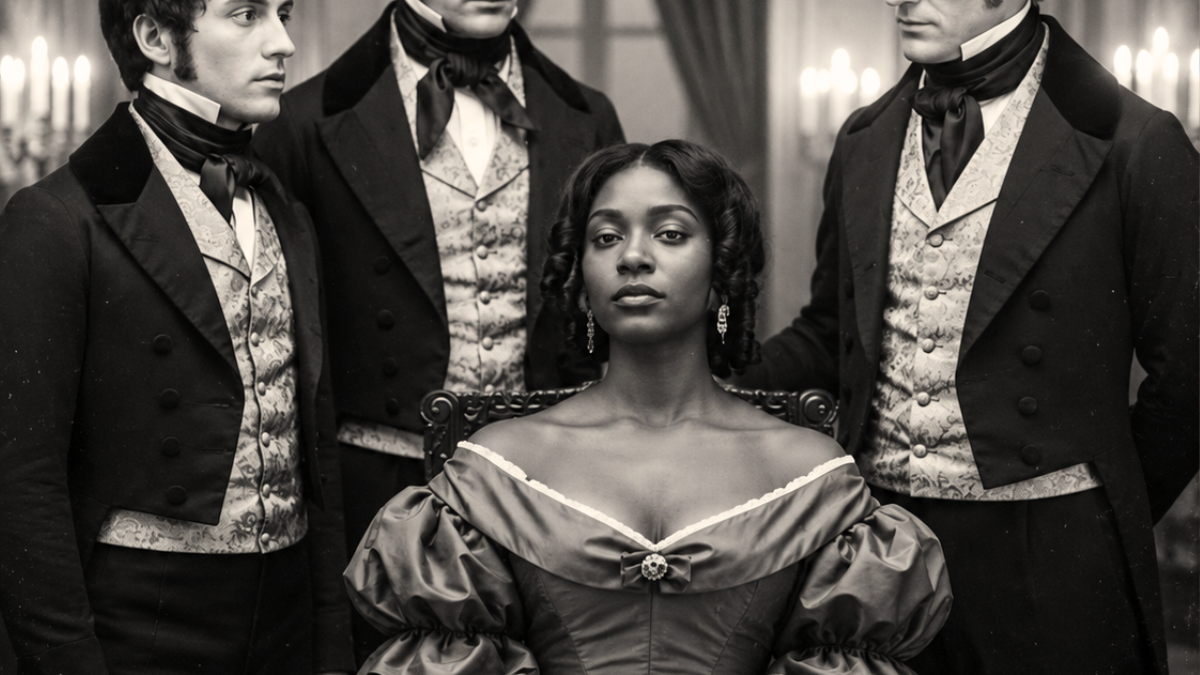
ENDING
Edward froze in the doorway. For one breath, nobody moved. The candle on Charles’s table hissed softly, its flame bending in the draft from the corridor, while somewhere outside the mansion a horse stamped against the stable floor.
Edward’s eyes moved from Clara to Charles, then to the leather book lying between them.
“What is she doing here?” Charles leaned against the table. “Saving your life, perhaps.” Edward stepped inside and shut the door behind him.
The click of the latch sounded like a pistol being cocked. “Explain.” Charles smiled. “The northern acreage.”
Edward’s face changed. Only slightly—but Clara saw it. “The mortgage,” Charles continued. “The money Father believes you sent to the bank.
The money that somehow found its way into a private investment in Charleston instead.” Edward turned toward Clara.
She had seen anger in his eyes before. This was different. Fear. “You listened at my door.”
“I was ordered to clean your office.” “You had no right—” “No right?” Clara’s voice cut through the room so sharply that even Charles stared at her.
For months she had lowered her eyes, softened her voice, swallowed every answer that might bring punishment.
Now she stood perfectly still, hands trembling at her sides, and looked directly at Edward Blackwood.
“You are sending me away tomorrow because I know too much,” she said. “But selling me will not make what I know disappear.”
Edward crossed the room in two strides. Charles stepped between them. “Touch her tonight,” Charles said, “and Father hears everything before breakfast.”
Silence. Rain began tapping against the window. Edward stared at his brother. “You would destroy this family over her?”
Charles’s smile vanished. “No. You nearly destroyed it over money.” Edward’s fist tightened. Then another voice came from the hallway.
“What money?” Samuel. Nobody had heard him approach. The youngest brother stood outside the half-open door, pale in the candlelight.
Edward swore under his breath. Samuel entered. Within minutes the secret Edward had hidden for months belonged to all three brothers.
The argument exploded. Edward accused Charles of blackmail. Charles accused Edward of risking land that would eventually belong to all of them.
Samuel demanded to see the correspondence. And Clara watched. Something extraordinary was happening. For the first time since she had entered Blackwood House, the brothers were no longer united by the power they held over her.
They were frightened of one another. She slipped from the room unnoticed. The corridor was dark.
Rain hammered the roof now, rolling from the eaves in silver sheets, and thunder shook the windowpanes.
Clara hurried downstairs. She did not go to the kitchen. She went to Edward’s study.
Her fingers searched beneath the desk, behind the ledger shelf, inside the drawer she had watched him unlock dozens of times.
Nothing. Then she remembered. The loose floorboard. Edward always placed his boot over it when anyone entered.
Clara dropped to her knees. Her fingernails caught the edge. The board lifted with a dry wooden groan.
Underneath lay a bundle of letters tied with black ribbon. She opened the first. Bank notices.
The second. A letter from an investment agent in Charleston. The third made her stop breathing.
Edward had not merely diverted plantation money. He had borrowed against part of the estate without his father’s knowledge.
If the investment collapsed, the northern land could be seized. Footsteps thundered above her. Clara shoved the letters beneath her dress, replaced the floorboard and ran.
She had barely reached the servants’ passage when Edward’s voice ripped through the house. “CLARA!”
She ran faster. Behind her came the crash of a door. “Find her!” Rain swallowed the world outside.
Clara burst through the kitchen door and into the storm. Mud splashed beneath her shoes.
Lightning tore across the sky, illuminating the cotton fields for a single white instant. She headed toward the workers’ quarters.
Then a hand seized her arm. Clara screamed. “Quiet!” Samuel. His hair was plastered to his forehead, rain streaming down his face.
“Edward knows you took something.” Clara pulled away. “Then let me go.” Samuel stared at her.
“I can help you.” She almost laughed. Even now. Even here. “You said that before.”
Samuel flinched. Thunder rolled over them. “I was wrong.” “No,” Clara said. “You knew exactly what you were doing.
You simply wanted to believe you were kinder than your brothers.” He looked as if she had struck him.
Clara stepped closer. “You wanted me to choose you when you knew I wasn’t free to choose anything.”
Samuel lowered his eyes. For once, he had no answer. Then lantern light appeared near the mansion.
Edward. Charles was behind him. “Clara!” Edward shouted. Samuel looked toward them, then back at her.
“Go.” Clara didn’t move. “What?” “Go!” Samuel pointed toward the tree line beyond the quarters.
“I’ll tell them you ran toward the stables.” Clara searched his face. “Why?” His answer was barely audible beneath the rain.
“Because you were right.” She ran. Branches clawed at her dress as she plunged into the woods.
Mud sucked at her shoes, insects shrieked from the wet darkness, and every few seconds lightning turned the trees into black skeletons.
Behind her, voices scattered. One toward the stable. One toward the road. Clara kept moving.
But she wasn’t escaping. Not yet. There was one person she needed to see first.
Henry Blackwood. The patriarch slept in a detached bedroom at the rear of the mansion during his worst attacks of gout, where the noise of the household disturbed him less.
Clara circled through the trees. She reached his window. Light glowed inside. She tapped. Nothing.
Again. The curtain moved. Minutes later, an elderly Black servant named Joseph opened the side door.
His eyes widened. “Girl, what happened?” “I need mr. Blackwood.” “You’ve lost your mind.” “Maybe.”
She pulled out the letters. “But he needs these.” Henry Blackwood was awake in bed, his face gray with illness.
Clara stood before him dripping rainwater onto the polished floor. “What is the meaning of this?”
She placed Edward’s letters on his blanket. “Read them.” His eyes hardened. “You forget yourself.”
“No, sir,” Clara replied. “Tonight I remembered myself.” Henry unfolded the first letter. Then the second.
His breathing changed. By the third, his hands were shaking. “Where did you get these?”
“Your son’s study.” “You stole them.” “Yes.” The old man looked up. Clara expected him to call for someone.
Instead he read the final page again. Outside, shouting approached. Edward had realized where she was.
The door burst open. “Father!” Edward entered first, followed by Charles and Samuel. He saw the papers.
His face went white. “She is lying.” Henry raised one trembling hand. “Quiet.” Edward stopped.
The old man’s eyes returned to the documents. “You mortgaged my land?” “I invested the money.”
“My land?” “The return would have doubled—” Henry hurled the papers across the bed. “You gambled with Blackwood!”
Charles gave a short laugh. “Apparently I’m not the only gambler in the family.” “Shut your mouth!”
Edward roared. Henry tried to rise. His body failed him. Samuel rushed forward. “Father—” “Don’t touch me!”
The old man’s voice cracked like dead timber. He looked at his sons. Then at Clara.
And something shifted inside that room. Not justice. Nothing could erase what had been done to her.
But power had suddenly become unstable. Henry pointed at Edward. “You will give the financial books to my attorney tomorrow.”
Then Charles. “You will stay away from those accounts.” Then Samuel. “You will fetch mr. Harris at sunrise.”
Finally, his eyes settled on Clara. Edward spoke first. “She must be sold.” Charles immediately said, “No.”
Samuel said nothing. Henry stared at Clara for a long time. “Leave us.” Clara didn’t move.
“Sir, those letters are the only reason I’m still standing here.” Henry’s eyes narrowed. “You bargain boldly.”
“I learned from your sons.” Charles almost smiled. Edward lunged toward her. Henry slammed his cane against the bedframe.
“ENOUGH!” The sound echoed through the room. Then Henry Blackwood clutched his chest. His face twisted.
The cane fell. Samuel caught him before his head struck the bedpost. “Father!” Chaos erupted.
Joseph ran for the doctor. Charles pushed furniture aside. Edward shouted orders no one followed.
Clara stood against the wall. Henry Blackwood tried to speak. Only fragments emerged. “Attorney…” Samuel bent closer.
“Tomorrow…” His fingers tightened around Samuel’s sleeve. Then released. By sunrise, Henry Blackwood was dead.
The storm had passed. Water dripped from the trees, and a thin mist hovered above the cotton fields.
But inside Blackwood House, another storm had only begun. Henry’s attorney arrived before noon. The old man had amended his instructions months earlier because of concerns about his sons’ rivalry.
The plantation would remain temporarily undivided while its debts were investigated. Edward’s secret investment surfaced immediately.
The losses were worse than anyone knew. Within weeks, creditors arrived. Then surveyors. Then lawyers.
Blackwood Plantation had looked enormously wealthy. It wasn’t. It was drowning. Edward blamed Clara. Charles blamed Edward.
Samuel blamed himself. Their alliance shattered completely. But Clara still belonged legally to the estate, which meant she could be sold along with livestock, furniture, and land to satisfy creditors.
The morning the inventory began, Samuel found her in the kitchen. He placed a folded document on the table.
Clara didn’t touch it. “What is it?” “A manumission paper.” She stared at him. Samuel swallowed.
“Father signed several blank transfer documents before he died. His attorney agreed that my inherited personal property can be disposed of before the creditors finish dividing the estate.”
Clara’s eyes narrowed. “And you inherited me?” Samuel looked sick hearing the words. “Yes.” The kitchen clock ticked.
Clara picked up the document. “You expect gratitude?” “No.” “Forgiveness?” “No.” “Then what?” Samuel looked toward the window.
Morning sunlight was spilling across the wet yard. “Nothing.” Clara unfolded the paper. Her hands began trembling.
Not because she trusted him. Because she could read. She read every line. Twice. Then she took it directly to the attorney herself.
He confirmed it. Clara Reed was free. She walked out of Blackwood House carrying one dress, several silver coins Charles had quietly placed inside a cloth pouch, and Samuel’s battered book of poems.
At the gate she stopped. Behind her stood the mansion that had consumed years of her life.
Edward watched from an upstairs window. Charles stood beside the stable. Samuel remained on the porch.
None approached her. Clara turned toward the road. Gravel cracked beneath her shoes. One step.
Then another. No bell called her back. No voice ordered her to stop. At the bend in the road, she heard hoofbeats.
Her body stiffened. Charles rode toward her. He stopped several yards away. For once, he did not smile.
“I could take you to Charleston.” “No.” “The road isn’t safe.” “I know.” He looked down at his reins.
“Then take the coins.” “I already found them.” A faint trace of his old smile appeared.
Clara stared at him. “Why?” Charles thought for a moment. “Maybe because I finally understood that protecting someone isn’t the same as owning them.”
Clara said nothing. Charles turned his horse around. “Goodbye, Clara.” She watched him ride away.
Then continued walking. Years later, travelers passing through that part of South Carolina would speak of the ruined Blackwood mansion.
The northern acreage was seized first. Then the horses were sold. Then sections of the plantation disappeared into neighboring properties.
Edward left for Charleston and never rebuilt the fortune he believed should have been his.
Charles went west. Samuel sold his remaining interest and vanished into a quieter life, carrying a shame he could neither romanticize nor erase.
But Clara survived. She eventually found paid work in Charleston under the protection of a free Black household and quietly taught children letters whenever she could do so safely.
She kept the poetry book. Not because it reminded her of Samuel. Because the book no longer belonged to his story.
It belonged to hers. Years later, she opened it beside a window while rain whispered against the glass.
She found the poem she had first been forced to read in Blackwood House—the one about the sea, about waves leaving the shore and returning again.
Clara smiled. Once, those words had sounded impossible. Now she closed the book, walked outside and disappeared into a crowded street where no Blackwood brother was waiting for her.
People passed in every direction. Carriage wheels rattled over stone. Church bells rang above the rooftops.
Someone shouted the price of apples. A child laughed. The world was loud. Ordinary. Alive.
Clara stood still for a moment simply listening to it. Then she began walking. And this time, no one owned the direction.
Disclaimer: This story is entirely fictional and created for entertainment purposes only. It does not represent any organization or individual, nor does it encourage inappropriate behavior. The content was generated with AI assistance.








