HER HUSBAND LEFT THE PLANTATION—THEN THE WHITE MISTRESS CROSSED A LINE WITH THE ENSLAVED MAN NO ONE COULD EVER UNDO

FINAL PART
Edward’s boots stopped on the wet floorboards. Clara heard the rain before she heard anything else.
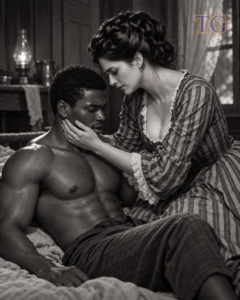
It hammered against the windows, rushed from the roof in silver sheets, and hissed against the gravel outside.
Somewhere upstairs, a floorboard gave the faintest creak. Edward slowly raised his head toward the staircase.
“What was that?” Clara’s mouth went dry. “The house settling.” Edward did not answer. His coat dripped onto the floor as he stared upward, listening.
Then his eyes dropped to the bottom step, where a small streak of red marked the pale wood.
Blood. Clara saw it at the same instant he did. Edward crouched and touched it with two fingers.
When he stood again, the warmth had disappeared from his face. “Who is in my house?”
“No one.” The lie came too quickly. Edward moved toward the stairs. Clara stepped in front of him.
For eleven years she had moved aside whenever her husband approached. At doors. In hallways.
At dinner parties. In arguments that had never truly become arguments because Edward’s opinion always ended them.
Tonight, she did not move. His eyes narrowed. “Get out of my way.” “No.” The rain seemed to grow louder.
Edward stared at her as though he had never seen her before. Then a chair scraped upstairs.
That was enough. He shoved past her. Clara caught the banister and spun around. “Edward!”
He was already climbing. The study door opened before he reached it. Samuel stepped into the hallway.
For a heartbeat, nobody moved. Samuel had blood at the corner of his mouth from an injury sustained earlier that evening while working near the barn.
He had wiped most of it away, but a thin line remained beneath his lip.
Now Clara understood how a drop had fallen unnoticed onto the staircase. Edward saw only a Black man emerging from his study after midnight while his wife stood below trying to stop him.
Every suspicion Caldwell had planted suddenly had a shape. “Samuel Reed.” Edward’s voice was almost a whisper.
Samuel remained still. “Sir.” “What are you doing in my study?” “mrs. Ashford called me there.”
Clara felt the answer strike the hallway like lightning. Edward slowly looked down at her.
“You called him?” “To discuss your letter and Blackwood.” “At midnight?” “I believed we were in danger.”
Edward descended one step. “From whom?” “Silas Blackwood.” Another step. “And you required him to protect you?”
“No. I required information.” Edward laughed once. There was no humor in it. Samuel could see what Clara could not.
Edward’s right hand was moving beneath his coat. “mrs. Ashford,” Samuel said quietly, “move away.”
Edward pulled the pistol. Everything happened at once. Clara screamed. Samuel threw himself sideways as the shot exploded through the hallway.
The flash illuminated Edward’s face for a fraction of a second, white and furious, before darkness swallowed it again.
The ball tore into the study door. Downstairs, Martha screamed. Samuel hit the floor and rolled behind the heavy writing desk.
Edward charged upward, boots pounding against the stairs. “Edward, stop!” Clara grabbed his coat. He swung his arm backward and knocked her against the wall.
The impact drove the air from her lungs. Samuel heard it. He came out from behind the desk.
That was the mistake Edward had been waiting for. The pistol was empty, but Edward carried the weapon like a club.
He struck Samuel across the temple with its steel barrel. Samuel staggered. The second blow caught his shoulder.
He dropped to one knee. “Edward!” Clara rushed between them. Edward froze with the pistol raised.
Clara stood directly over Samuel. “Move.” “No.” “Clara.” “You will have to strike me first.”
Lightning flashed beyond the windows. For one brilliant instant the hallway appeared frozen in white light: Clara barefoot and shaking, Samuel bleeding behind her, Edward with his pistol raised.
Then darkness returned. Edward lowered the weapon. Not because he had forgiven anyone. Because voices were rising downstairs.
People had awakened. Martha stood at the foot of the stairs. Rose was behind her.
Others were gathering outside beneath the porch roof, drawn by the gunshot. There were witnesses now.
Edward looked at them. Then he looked at Samuel. “Get off my property.” Samuel slowly stood.
Clara turned. “Samuel—” “Don’t.” His voice was barely audible. His eyes told her everything. Do not make this worse.
Samuel walked downstairs through the silent crowd and stepped into the rain. Edward watched him disappear.
“Tomorrow,” he said, “I sell him.” Clara turned. “You cannot.” “I can sell anything I own.”
“Anything?” Edward looked at her. Clara’s voice became quieter. “Is that what you believe I am too?”
He said nothing. And in his silence, she finally received the answer to eleven years of marriage.
Morning came gray and wet. Samuel did not appear in the east field. Edward discovered that before breakfast.
By seven, three horses had been saddled. By eight, men were searching the road. But Samuel had not run blindly.
He had gone to Martha. For years, Martha had kept things no ledger recorded: names, birth dates, marriages, sales, disappearances.
Hidden beneath a loose stone behind the kitchen chimney was a bundle of letters and receipts she had collected whenever Edward or his overseers discarded papers they considered unimportant.
One document was not unimportant. It bore Silas Blackwood’s signature. Samuel had discovered it months earlier among papers from a broken cabinet he had been ordered to repair.
Blackwood had secretly paid Edward’s former overseer to falsify cotton weights and debt records, slowly creating the appearance that Hawthorne Manor owed Blackwood thousands of dollars.
Caldwell’s inspection had never been about disorder. It had been preparation for seizure. Samuel had known something was wrong, but until Edward’s letter arrived, he had lacked enough pieces to understand the plan.
Now he did. And he knew exactly where to take the evidence. The county courthouse stood twelve miles away.
Samuel had covered perhaps eight when he heard horses behind him. He looked back. Three riders.
Edward was in front. Samuel ran. Mud sucked at his boots. Branches whipped his face.
His lungs burned as the horses gained ground. Ahead, through the trees, he saw the river.
Too wide. Too fast from the storm. Behind him came Edward’s shout. “STOP!” Samuel reached the bank.
There was nowhere else to go. Edward dismounted twenty yards away. The other men spread out.
Samuel backed toward the water. “Give me the papers,” Edward said. Samuel’s chest heaved. “So you know what they are.”
Edward’s face changed. That was confirmation enough. Samuel looked at the documents inside his coat.
Then at Edward. “You knew Blackwood was cheating you.” “I suspected.” “And you let him inspect the property anyway.”
“I needed proof.” “You used us as bait.” Edward’s jaw tightened. “My property. My decision.”
Samuel almost laughed. Even now. Always ownership. Always possession. Then another horse thundered through the trees.
Everyone turned. Clara. Her dress was soaked to the knees, hair loose behind her, face pale from the ride.
She pulled the horse to a violent stop. “Edward!” “What are you doing here?” “Ending this.”
Clara dismounted. Edward stared at her. “Go home.” “No.” Again that word. Smaller than a bullet.
More powerful than one. Clara walked toward Samuel. Edward’s hand moved to his pistol. “Don’t take another step.”
She kept walking. “Clara!” She stopped beside Samuel. Then she held out her hand. Samuel understood.
He gave her the papers. Edward’s face went white. Clara opened them. “I know your signature,” she said.
“And I know Blackwood’s. I kept your books for eleven years, remember?” Edward said nothing.
“These records prove fraud. They also prove you suspected it and allowed Blackwood’s men onto the property anyway.”
“I was protecting what belongs to us.” “No,” Clara said. “You were protecting what belongs to you.”
Edward stepped closer. “And what exactly do you think you’re doing?” Clara looked at Samuel.
Then back at her husband. “Something I should have done long ago.” She turned toward one of the riders.
“mr. Hayes, you are a witness. These papers will be delivered to Judge Bellamy today.”
The man shifted uncomfortably. Edward stared at him. Hayes removed his hat. “I heard her.”
Edward’s control finally cracked. “You ungrateful—” He lunged for the papers. Samuel moved instinctively. Edward struck him.
Samuel struck back. The sound was shockingly ordinary: fist against flesh. Edward fell into the mud.
Silence. Samuel stared at his own hand. Everyone understood what had just happened. Under the laws and customs governing their world, that single blow could destroy him.
Edward slowly rose. Blood ran from his nose. His hand reached for the pistol. Clara stepped directly between them.
“If you kill him,” she said, “you kill me first.” Edward stopped. She was crying now, but her voice remained steady.
“Because I will testify to everything. The fraud. The forged accounts. Caldwell. Tonight. All of it.”
Edward looked around. Hayes was watching. The other rider was watching. Samuel was watching. For perhaps the first time in Edward Ashford’s life, authority did not automatically become obedience.
His hand fell away from the pistol. Clara rode to the courthouse with Samuel and Hayes.
The documents did what truth sometimes does when enough people are finally forced to look at it.
They opened doors. Then they opened graves. An investigation uncovered years of falsified debts, bribery, illegal transfers, and fraudulent accounts connected to Blackwood and several associates.
Caldwell disappeared from the county before he could be questioned. Blackwood did not. But Clara understood something more important.
Stopping Blackwood changed nothing fundamental about Samuel’s captivity. So she made another decision. Edward fought it.
Then threatened it. Then begged her not to do it. She did it anyway. Using property inherited independently from her mother, Clara negotiated legal manumission for Samuel and, over the following months, several members of his family on the plantation whose freedom could be secured under the laws then in force.
The process was ugly, expensive, uncertain, and painfully incomplete. Not everyone could leave. Not everyone survived long enough to see freedom.
There was no clean ending available in such a world. Samuel understood that better than anyone.
On the morning he finally departed Hawthorne Manor, he carried one small bag. Martha embraced him beside the road.
Rose cried. Samuel looked toward the east field where he had spent nearly half his life.
Then he saw Clara standing on the porch. Neither moved for several seconds. Finally, she walked toward him.
“I don’t know what to say,” she whispered. Samuel looked at the manor behind her.
“You don’t have to say anything.” “I am sorry.” “I know.” “For all of it.”
Samuel’s expression softened, but only slightly. “Being sorry isn’t the same as making something right.”
“No.” “But it’s where making something right can start.” Clara swallowed. “Where will you go?”
“North.” “Will you ever come back?” Samuel looked down the road. Morning sunlight was breaking through the clouds, illuminating the wet earth in long golden strips.
“I’ve spent eighteen years being told where I had to go.” Then he smiled. It was the first genuine smile Clara had ever seen on his face.
“I think I’d like to find out what it feels like to choose.” He turned and walked.
Clara remained beside the road until he became a small figure beneath the trees. Then even that figure disappeared.
Years later, after war finally tore apart the world Hawthorne Manor had been built upon, Clara received a letter bearing a Pennsylvania postmark.
There were only a few lines. Samuel was alive. He worked as a carpenter. He had married.
And after years of searching through churches, aid societies, advertisements, and freedmen’s networks, he had found someone he once believed lost forever.
His younger sister. Clara sat beside the window and read that sentence again. Then again.
Outside, the fields moved beneath the autumn wind. Edward had been gone for years by then.
Hawthorne Manor was no longer what it had once been. The ledgers had disappeared, the old cotton empire had collapsed, and many of the people whose names had once been reduced to numbers had scattered across the country searching for families, wages, homes, and lives of their own.
Clara folded Samuel’s letter carefully. At the bottom, beneath his signature, he had added one final sentence.
I finally know where I’m going. Clara pressed the letter against her chest. Then she looked through the open window toward the road where she had watched him disappear all those years before.
For the first time, she did not imagine him walking away from Hawthorne Manor. She imagined him walking toward something.
A workshop filled with the clean scent of freshly cut wood. A table surrounded by people who knew him not as property, not as a price written in somebody else’s ledger, but simply as Samuel.
A door he could open whenever he wished. A road he could travel without permission.
And when evening settled over the old house, Clara carried Edward’s last surviving ledger outside.
She placed it in the empty fireplace. One page caught first. Then another. The flames moved across columns of names, ages, prices, and numbers until the ink curled black and vanished.
Clara watched until nothing remained but ash. But far away, beyond those fields and beyond the reach of the world that had once assigned a dollar value to his existence, Samuel Reed was still writing his own name.
And this time, it belonged only to him.
Disclaimer: This story is entirely fictional and was created solely for entertainment purposes.
It does not represent any organization or individual, nor does it promote inappropriate behavior. This content was created with the assistance of AI.








