It Looked Like an Ordinary 1859 Farm Photo — Until Someone Zoomed In on the Wife’s Neck… And Saw Something That Shouldn’t Exist
FINAL PART
She whispered something through the locked door—his full name, followed by four words that changed everything.

“Daniel Mercer. You’re on the list.” Daniel stopped breathing. The security monitor cast a cold blue glow across the kitchen.
Outside, rain hissed against the porch roof, silver lines slashing through the camera image, yet the woman did not move.
Water streamed from her black coat and gathered around her shoes, but she never blinked.
Daniel backed away from the door. “Who are you?” For several seconds there was only rain.
Then the woman tilted her head. The movement was strangely precise, almost mechanical. “My name was Eleanor Whitmore.”
Daniel’s stomach tightened. “No.” A faint smile touched her mouth. “You found the photographs.” Daniel glanced toward the dining-room table.
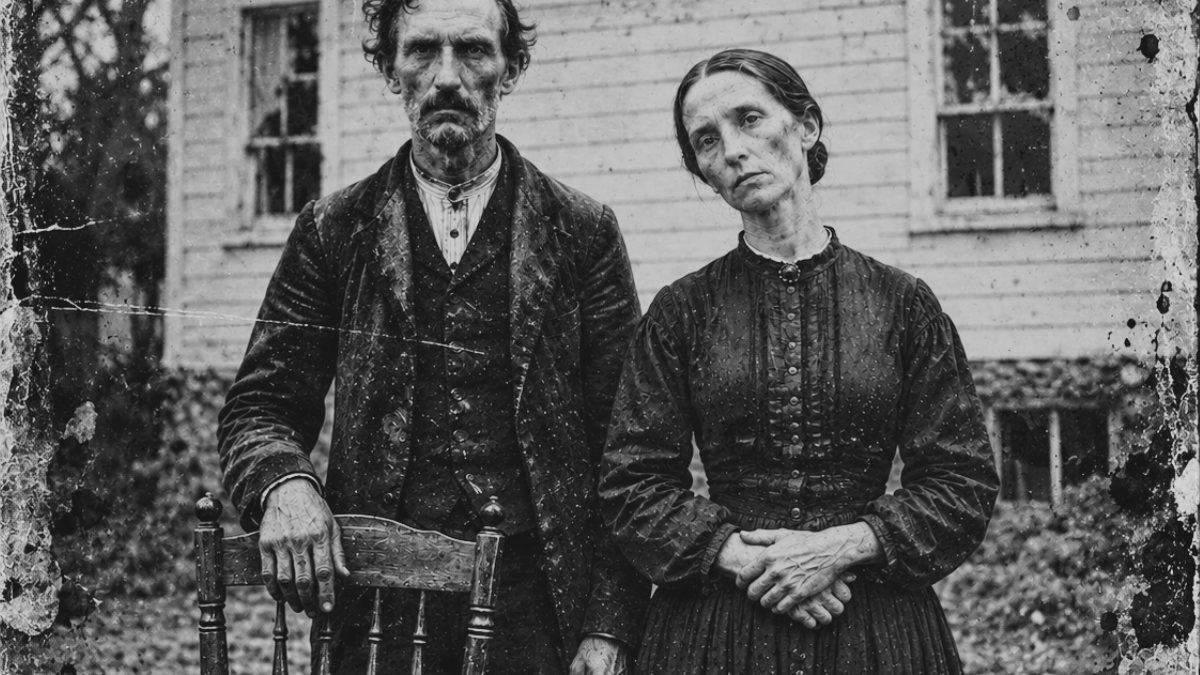
The 1859 photograph lay beneath a lamp beside the enlarged maps of Ashford, asylum records, railway schedules, and the list he had discovered only hours earlier.
Eleanor Whitmore was standing outside his house. The same woman. The same face. One hundred and sixty-seven years later.
Another knock struck the door. BANG. Daniel jumped. This one had not come from Eleanor.
It came from the back of the house. Then another. BANG. Kitchen window. A third sound came from upstairs.
Not a knock. A footstep. Daniel looked toward the ceiling. The old floorboards creaked directly above him.
Someone was already inside. “Open the door,” Eleanor said. Daniel grabbed the fireplace poker leaning beside the hearth.
“Why?” “Because they know you found the register.” The upstairs floor creaked again. Closer to the staircase.
Daniel stared at the dark hallway. “Who are they?” Eleanor looked past him, as though she could see through the house.
“The people who never left the works.” A floorboard groaned at the top of the stairs.
Daniel unlocked the door. Eleanor slipped inside. “Turn off the lights.” He obeyed. Darkness swallowed the house.
Only the security monitor remained illuminated, throwing pale rectangles across Eleanor’s face. Up close, Daniel could see the seam.
It was finer than it appeared in the photographs. A perfectly straight ridge began behind her ear and descended beneath her collar.
Not scar tissue. Something else. From upstairs came a soft click. Eleanor grabbed Daniel’s wrist.
“Move.” They ran. Daniel followed her through the kitchen and out the back door into hammering rain.
Cold water struck his face as they crossed the yard toward his truck. Behind them, the upstairs bedroom light came on.
Daniel stopped. A silhouette stood behind the curtain. Tall. Motionless. Watching. “Daniel!” He ran. They climbed into the truck, and Daniel twisted the key.
The engine coughed. Nothing. Again. Click. Click. Click. His headlights suddenly came on by themselves.
In their white beams stood three people. A man. Two women. All wearing dark clothes.
All standing in the road with their hands folded at their waists. Daniel felt his throat close.
Eleanor whispered, “Reverse.” He slammed the transmission backward. The engine exploded to life. The truck shot across the wet grass, tires tearing mud from the yard.
Daniel spun the wheel, crashed through a section of wooden fence, and reached the adjoining field.
In the mirror, the three figures remained exactly where they had been. They did not chase him.
They simply watched. “Where are we going?” Daniel shouted. “Marrow Point.” Daniel looked at her.
“You’re insane.” “That is what they called me in 1899.” Lightning split the sky. For an instant Eleanor’s face became the face from the photograph—young, pale, expressionless, untouched by more than a century.
“The works are still there,” she said. “They flattened them.” “No. They covered them.” The truck bounced violently along the county road.
Eleanor directed him toward an abandoned highway north of town, then onto a narrow service road nearly invisible behind weeds.
Trees closed around them. Branches scraped the doors like fingernails. Daniel saw the fence first.
Chain link. Ten feet high. Beyond it stood the weathered sign he had photographed months earlier.
HOLLOWAY SOIL CONSERVATION DISTRICT. There was no such agency. Eleanor pointed toward a gap hidden behind blackberry vines.
“There.” Daniel drove through. Marrow Point rose ahead of them. The top looked exactly as Daniel remembered it: a broad, unnaturally level field above the river, grass moving under the storm.
Eleanor told him to stop near the center. “There’s nothing here.” “Get out.” Rain hammered the truck roof.
Daniel followed her into the field. Eleanor walked thirty paces, knelt, and pushed her fingers through the grass.
Beneath the mud was a circular iron plate Daniel had never seen. She pulled. Metal screamed.
A hatch opened. Warm air rose from below. Daniel smelled iron, dust and something faintly electrical.
Impossible. Stone steps descended into darkness. Eleanor looked at him. “This is where your story ends unless you see it yourself.”
They went down. Daniel switched on his phone flashlight. The stairs continued far deeper than the bluff should have allowed.
Twenty feet. Forty. Sixty. Then they reached a corridor. The walls were not brick. They were made from enormous blocks fitted so tightly Daniel could not insert a fingernail between them.
A low vibration hummed through the floor. He could feel it in his teeth. “What is this place?”
“The works.” A light flickered ahead. Daniel raised the poker. They entered a vast chamber.
He stopped. Rows of glass cylinders disappeared into the darkness. Most were empty. Some were not.
Inside the nearest cylinder floated a human figure. A woman. Eyes closed. Hands folded. A pale line circled her throat.
Daniel staggered backward. “No…” Another cylinder held a man. Another, a child. Another, an elderly-looking woman whose face Daniel recognized from one of the photographs.
The woman beside the well. mrs. Aldis. She had been photographed in 1878. She was here.
Now. Daniel approached the glass. Her eyelids moved. He jumped backward. Eleanor did not. “They were never immortal,” she said.
“What?” “We were maintained.” The hum beneath them deepened. Somewhere far away, machinery awakened. Eleanor touched the seam on her neck.
“The people who built this place knew how to preserve a body, repair it, replace what failed.
We were caretakers. Not machines. Not ghosts. Human beings.” Daniel stared at her. “The seam?”
“An access scar.” She unbuttoned her collar. The line continued downward farther than he expected.
“They opened us here. Again and again.” Daniel felt sick. “For what?” “To keep us alive long enough to maintain what remained.”
She looked across the chamber. “Ashford was never supposed to last. None of the towns were.”
The pieces suddenly aligned. The fires. The floods. The vanished settlements. The people sent to the works.
The repeated photographs. “What happened?” Eleanor’s expression changed. For the first time, Daniel saw something behind her calmness.
Grief. “The builders died.” “Who were they?” “Our parents.” Daniel said nothing. Eleanor explained quickly.
There had been no supernatural civilization, no ageless species hiding among ordinary people. Generations earlier, a network of experimental communities had been established around hidden facilities like Marrow Point.
The works contained medical knowledge decades ahead of what existed outside. But knowledge was not the same as wisdom.
Something had gone wrong. “The treatments extended life,” Eleanor said. “But every repair damaged memory.”
Daniel understood. “That’s why you were caretakers.” “We could live long enough to protect the facilities.”
“But eventually…” “We forgot what we were protecting.” A metallic crash echoed behind them. Eleanor turned.
“They’re here.” The lights came on. Hundreds of lamps ignited simultaneously, revealing the true scale of the chamber.
Daniel nearly dropped his phone. There were not dozens of cylinders. There were hundreds. Some broken.
Some occupied. And at the far end stood a steel door. Three figures entered. The people from the road.
Behind them came others. Ten. Twenty. Thirty. High collars. Folded hands. Seams at their throats.
The oldest people. Eleanor stepped in front of Daniel. A tall man approached. Daniel recognized him immediately.
Thomas Whitmore. The farmer from the 1859 photograph. He had not aged either. “Eleanor,” Thomas said.
His voice was gentle. Almost affectionate. “You should not have returned.” “You put Daniel on the list.”
“He found us.” “He found the truth.” “That is why he is on the list.”
Daniel tightened his grip on the poker. Thomas barely looked at it. “We have erased this story many times,” he said.
“Historians. Photographers. Journalists. Surveyors. Curious men with notebooks. Now a man with an audience.” Daniel remembered the vanished historian.
The photographer from the 1960s. “They weren’t missing,” he whispered. Thomas looked toward the cylinders.
Daniel followed his gaze. His blood turned cold. Two cylinders near the wall contained men.
One wore glasses. The other had a camera hanging from his neck. “They’re alive?” “Preserved,” Thomas replied.
“Why?” “Because killing attracts questions.” Thomas extended his hand. “Give me your phone.” Daniel slowly reached into his pocket.
Instead of handing it over, he looked at Eleanor. She nodded. Daniel hit SEND. Thomas’s expression changed.
“What did you do?” Daniel smiled despite his terror. “The mistake everyone before me made was keeping everything in one place.”
His phone showed a progress bar. UPLOAD COMPLETE. “All the photographs. The maps. The asylum records.
The freight schedules. Everything.” Thomas lunged. Eleanor slammed her palm against a red lever beside the nearest cylinder.
Sirens erupted. Glass chambers unlocked simultaneously. The sound was deafening. HISS. CLANG. HISS. CLANG. All around them, cylinders opened.
Bodies fell forward. People gasped. Some screamed. Others collapsed onto the floor, breathing air for the first time in decades.
Chaos swallowed the chamber. Daniel ran. Thomas grabbed his jacket. Daniel swung the poker. Metal struck bone.
Thomas fell. Eleanor seized Daniel’s arm. “This way!” They raced toward the stairs. Behind them, alarms shrieked.
The vibration beneath the floor became a roar. “What did you do?” Daniel shouted. “Opened everything.”
“That sounds bad!” “It is.” They climbed. Halfway up, the ground shook. Dust poured from the ceiling.
Eleanor stopped. Daniel turned. “Come on!” She remained below him. “I can’t.” “What?” “The system is failing.”
“So?” “So the maintenance stops with it.” Daniel understood before she finished. Her body depended on the works.
“How long?” Eleanor smiled. This time there was nothing strange about it. Nothing mechanical. She looked simply tired.
“I’ve been twenty-five years old for one hundred and ninety years, Daniel.” Another explosion shook the stairwell.
“Go.” Daniel hesitated. Eleanor reached into her coat and handed him the original 1859 photograph.
Thomas and Eleanor. The farmhouse. The seam. “People will call it fake.” “Then let them.”
“People will say none of this happened.” “Some will.” “What am I supposed to tell them?”
Eleanor looked upward toward the square of stormy night visible through the hatch. “The truth.”
Daniel climbed. When he reached the surface, dawn was beginning to break behind the storm.
He ran across the field. The earth trembled. Then Marrow Point collapsed. Not explosively. It sank.
The perfectly level bluff folded inward as chambers beneath it failed, grass and soil sliding into a vast depression.
Daniel stood in the rain and watched the works disappear. Eleanor never came out. Six months later, investigators descended into what remained.
Authorities called it an abandoned nineteenth-century industrial complex. They recovered human remains. They recovered medical instruments no historian could satisfactorily identify.
They recovered glass chambers. They also found records. Thousands of pages. Names. Dates. Transfers. The evidence was too large to erase.
Ashford returned to state maps the following year, marked simply as a historic settlement. The photographs entered public archives.
Experts argued over them. Historians fought. Scientists disagreed. Some called the entire affair an elaborate fraud.
Daniel never tried to convince everyone. He had learned something from Eleanor. Truth did not need everyone.
It only needed somewhere to survive. He eventually bought the old Whitmore farmhouse. One autumn afternoon, while repairing the front hall, he removed the wooden panel where the original photograph had once hung.
Something fell from inside the wall. A small envelope. The paper was brittle. His name was written on the front.
Daniel stared at it for a long time before opening it. Inside was a note in Eleanor’s handwriting.
Only two sentences. If you are reading this, the works are gone. Thank you for letting us finally grow old.
Daniel sat on the floor. For the first time since Marrow Point, he cried. Years passed.
The farmhouse changed. The buried lower windows were excavated and opened again. Sunlight entered rooms that had faced packed earth for more than a century.
Daniel married. He had a daughter. Then a son. He grew gray. And every year on the anniversary of the collapse, he placed Eleanor’s photograph on the mantel.
Not because he feared her. Because he remembered her. When Daniel was seventy-three, his granddaughter asked him about the woman in the picture.
“Was she family?” Daniel studied Eleanor’s young face. Outside, late-afternoon sunlight poured through the restored basement windows.
In the photograph, Eleanor still stood beside Thomas Whitmore, hands folded patiently at her waist.
But Daniel no longer thought she looked as though she were waiting. “No,” he said softly.
“She was someone who waited a very long time to become free.” His granddaughter pointed at the pale line on Eleanor’s neck.
“What happened there?” Daniel smiled. “That’s a long story.” “Is it scary?” “At first.” “And at the end?”
Daniel looked through the window. Beyond the fields, Marrow Point was green again. There was no fence anymore.
No false sign. Children sometimes climbed the hill and flew kites where the works had once stood.
“At the end,” he said, “it’s about people finally getting to leave.” His granddaughter considered this, satisfied, and ran outside.
Daniel remained beside the photograph. The evening light slowly crossed Eleanor’s face. For nearly two centuries, she had appeared unchanged in every image.
But sometimes, when the sun struck that old photograph at exactly the right angle, Daniel could swear her expression looked different.
Not younger. Not older. Just peaceful. And the frame never tilted toward Marrow Point again.
Disclaimer: This story is entirely fictional and created for entertainment purposes only. It does not represent any organization or individual, nor does it encourage inappropriate behavior. The content was generated with AI assistance.








