SHE RETURNED TO THE PLANTATION AFTER 10 YEARS—THEN TURNED DEATHLY PALE WHEN SHE SAW THE ENSLAVED WOMAN…
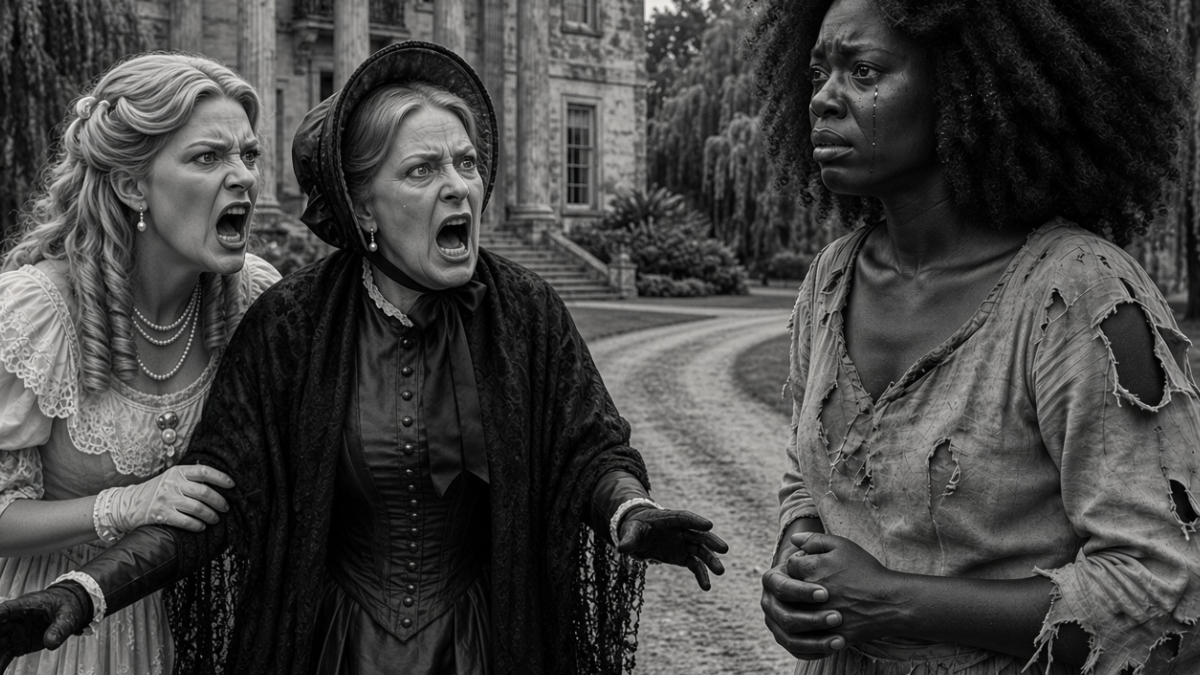
FINAL PART
Samuel’s lips moved, but for a second no sound came out. Outside his little house, the wind scraped dry branches against the roof, and somewhere beyond the coffee fields a horse gave a sharp, restless cry.
“It was your mother, Clara,” he finally said. “Catherine Whitmore.” Clara stared at him as if the room had tilted beneath her feet.
“My mother?” Samuel nodded slowly. “I saw her feeding the Carter records into the fireplace with her own hands.”
The blood drained from Clara’s face. She remembered Catherine as a quiet woman who smelled of lavender soap, who closed the curtains every evening before sunset and kissed her daughter’s forehead before bed; the image of those same hands pushing documents into flames felt impossible.
“No,” Clara whispered. “There must be some mistake.” “There isn’t.” Sarah said nothing. The ticking of Samuel’s wall clock suddenly seemed deafening.
Samuel explained that Catherine had discovered Edward’s involvement in Victor Langley’s fraudulent land deal. Edward had signed the original agreement without knowing the land rightfully belonged to Margaret’s family, but once the truth emerged, Catherine understood what restitution would mean: scandal, disgrace, a smaller inheritance for Clara, and perhaps the collapse of Blackwood itself.
“So she destroyed the evidence?” Clara asked. “Some of it.” “To protect us?” Samuel’s expression hardened.
“People have committed terrible wrongs using that sentence.” Clara flinched. Sarah stood beside the window, looking toward the distant white roof of Blackwood.
“Did Edward know what she had done?” “I don’t know when he discovered it,” Samuel replied.
“But I heard them arguing one night.” He remembered Edward’s voice shaking the walls of the main house.
“You are protecting our name at the cost of someone else’s life!” After that night, Edward began trying to locate Margaret.
But she had already left the village where she had been waiting for Henry to complete Sarah’s freedom papers, and every message sent after her seemed to vanish into silence.
Sarah’s jaw tightened. “So everyone knew enough to do something,” she said, “and somehow I remained enslaved.”
No one answered. The walk back to Blackwood felt longer than before. Their shoes crushed dry leaves beneath them, cicadas screamed from the trees, and Clara walked several paces behind Sarah as though ashamed even to share the same road.
By the time they reached the house, Eleanor was waiting. She had spent the morning tearing through Henry’s old study.
Books lay open across the floor. Drawers had been emptied, dust floated in shafts of sunlight, and Eleanor’s gray hair had escaped its pins.
“I found something.” She held an old letter. Henry had addressed it to Margaret. His confession was brutally simple: he had secured Margaret’s legal freedom, but Sarah’s freedom and the restoration of the Carter property had been delayed because he had tried to protect Edward from public disgrace while correcting the fraud quietly.
Sarah read one sentence twice. In trying to protect everyone, I allowed the injustice to continue.
Her fingers tightened around the paper. “He knew.” Eleanor swallowed. “Yes.” “He knew I should have been free.”
“Yes.” “And he waited.” Eleanor’s voice broke. “Yes.” Sarah placed the letter on the desk.
“Then don’t tell me he was a good man because he eventually felt guilty.” “I wasn’t going to.”
For the first time, Eleanor did not defend her father. At the bottom of the letter was a strange reference to Henry’s silver medallion: The remaining evidence will stay with you.
If anything happens, look where the month was recorded. Sarah pulled the medallion from beneath her dress.
Her thumbnail caught a nearly invisible groove along its edge. Click. The medallion separated. Clara gasped.
Inside was a scrap of paper no larger than a fingernail. Three words had been written on it.
Chapel. Ledger. August. They ran. The old chapel stood beyond the orchard, its wooden doors swollen from years of rain.
Eleanor shoved one shoulder against them until they opened with a crack, releasing a wave of hot, stale air smelling of wax, dust, and damp paper.
Clara searched the shelves while Sarah pulled down ledgers. “August!” Eleanor shouted. They found the volume.
Several pages had been torn from it. For one terrible moment, nobody moved. Then Sarah noticed that the leather spine bulged slightly.
She pushed a thin blade beneath it. A folded document slipped onto the table. Henry Whitmore’s signature appeared at the bottom beside those of two witnesses.
The statement acknowledged Jonathan Carter’s ownership of the disputed land, Margaret’s inheritance, the missing will, and Henry’s obligation to return the property to Margaret—or, if she could not be found, to Sarah.
Then Clara found another line. Edward is aware of his responsibility and has requested that Sarah never be transferred from Blackwood while we attempt to secure her freedom.
Clara covered her mouth. “My father kept you here because he was afraid someone would sell you away.”
Sarah looked at her. “He still kept me here.” Clara lowered her hand. “Yes.” There was nothing else to say.
As they returned to the house, a rider was approaching the veranda. He carried no luggage except a rectangular bundle wrapped in faded cloth.
“This was sent from Samuel Briggs.” He placed it on the table. Eleanor stopped dead.
Beneath the cloth sat a dark wooden box. Brass clasp. Exactly the box she had asked about on the night she returned.
Across the top, written in faded ink, were two words: Sarah Carter. Sarah’s heartbeat seemed to fill the room.
She opened the clasp. Inside lay old deeds, receipts, a tiny portrait of a younger Margaret, and one sealed envelope.
Sarah recognized her own name on it. Her mother’s handwriting. She broke the seal. Margaret’s voice seemed to rise from the page.
She described Jonathan and Rose, the vanished will, Victor’s fraud, Edward’s reckless signature, Henry’s hesitation and Catherine’s deliberate destruction of evidence.
But near the end, Margaret revealed one final truth she had told no one at Blackwood.
She knew how Victor had obtained Jonathan’s papers in the first place. Sarah stopped reading.
“What is it?” Clara asked. Sarah’s eyes moved across the final paragraph. “My father.” The room went silent.
Sarah had grown up knowing almost nothing about the man who had fathered her. Margaret now gave him a name: Thomas Carter, a free wagon driver who transported documents and goods between estates.
Years earlier, Thomas had been carrying a leather case belonging to Jonathan. Victor offered him money for it.
Thomas handed it over. He did not understand that the case contained information about Jonathan’s will and property, but Victor did.
By the time Thomas learned what he had helped unleash, it was too late. He confessed to Margaret and fled the region in shame.
Sarah lowered the letter. Until that moment, she had wanted the story to divide cleanly into two sides: the people who had stolen and the people who had suffered.
It didn’t. Her own father had opened the first door. Victor had knowingly walked through it.
Edward had signed what he had not bothered to investigate. Henry had discovered the truth but delayed justice to protect his son.
Catherine had burned evidence to protect her family. Eleanor had run away because knowing the truth frightened her more than confronting it.
Margaret alone had been forced to live with the consequences of every choice. Sarah continued reading.
One sentence made her stop again. There was no single day when everything was stolen from us.
There were many small days when someone chose comfort over truth. Sarah pressed her fist against her mouth.
Then something fell from between the pages. A folded legal document. Eleanor opened it. Jonathan Carter’s original will.
Nobody breathed. The signatures were intact. The boundaries of the land were described precisely, along with funds Jonathan had set aside to purchase Margaret’s freedom.
And one clause was unmistakable. If Margaret had descendants, the land passed to them. Clara walked slowly to the window.
Beyond the glass, coffee fields rolled beneath the evening light—fields she had spent her entire life believing she would inherit.
“How much?” She asked. Eleanor checked the boundary descriptions. “A considerable part of Blackwood.” Clara closed her eyes.
Sarah watched her carefully. This was the moment. Not Henry’s moment. Not Edward’s. Not Catherine’s.
Clara’s. She could hide the box. Burn the will. Claim the papers were false. Every generation before her had found a reason to delay the truth.
Instead, Clara turned around. “Send for the lawyer.” Eleanor stared at her. “Tonight.” “Clara, you understand what this could do to the estate?”
“Yes.” Clara looked directly at Sarah. “If I keep that land after reading this, then my mother’s choice becomes mine.”
The following morning, wheels rattled across Blackwood’s courtyard before breakfast. A lawyer arrived with two clerks.
For hours, paper covered Henry’s old desk. The will was compared with account books, chapel records, witness statements, boundary maps and Henry’s confession.
Outside, clouds gathered. Thunder rolled across the fields. Finally, the lawyer removed his spectacles. “There is sufficient evidence to recognize the Carter claim.”
Sarah’s chest tightened. “And Sarah herself?” Clara asked. The man hesitated. “Her legal status must also be corrected.”
“Then correct it.” Rain struck the windows. The sound grew from scattered taps into a roar.
Sarah sat at the same desk where Henry had once taught her letters. But this time, no one was telling her where to stand or when she could leave.
The clerk pushed a document toward her. “How do you wish your name to appear?”
Sarah stared at him. Nobody had ever asked her that in a legal matter. “Sarah Carter.”
He dipped the pen. Sarah reached for it instead. “I’ll write it.” Her hand trembled only once.
S. A. R. A. H. Carter. Thunder cracked above the house. Clara began to cry.
Eleanor turned toward the window, pressing her fingers to her lips. Sarah put down the pen.
The sound was tiny. Yet after a lifetime of other people making decisions in her name, it felt louder than the storm.
Weeks passed before every registration was completed. When the final documents arrived, Clara carried them to Sarah herself.
“Your land,” she said. Sarah took the papers. “And your freedom.” Sarah looked at her.
“Neither came from you.” Clara’s eyes lowered. “No.” “They were already mine.” “Yes.” That answer mattered.
Sarah moved out of the great house. She chose a modest cottage on the returned Carter land beside a narrow stream where willow branches brushed the water.
The first night there, she lay awake listening to frogs, running water and wind moving through trees that belonged to no master.
She could leave in the morning. Or stay. That was the miracle. The choice was hers.
Eleanor remained at Blackwood for several months, organizing Henry’s papers and recording everything she could recover about Margaret.
Among Edward’s belongings, she found an unsent note addressed to Sarah. I kept you close because I feared they would take you away before I corrected what I helped begin.
Now I understand that keeping you close without telling you the truth was another way of deciding for you.
Sarah read it once. Then folded it. She neither forgave Edward nor cursed him. The dead could no longer repair anything.
The living could. Clara removed Henry’s enormous portrait from the main parlor. She did not burn it; she placed it in the study beside portraits of Edward and Catherine.
“I don’t want to erase them,” she told Sarah. “I just don’t want the dead hanging above everyone who still has to live with what they did.”
Months later, Eleanor prepared to leave Blackwood again. Her carriage waited on the same road where she had arrived.
Before departing, she walked to Sarah’s cottage. “Do you hate me for those ten years?”
Eleanor asked. Sarah considered the question. “I hated that everyone in this story had a reason to wait.”
Eleanor’s eyes filled. “Henry waited to protect Edward. Edward waited because he was ashamed. Catherine hid the truth to protect Clara.
You waited because you were afraid. My father waited too long to confess.” Sarah looked toward the fields.
“My mother was the only one who never had the privilege of waiting without losing something.”
Eleanor cried quietly. Sarah stepped closer. “But remembering isn’t the same as remaining trapped.” Eleanor embraced her carefully, leaving Sarah the choice of whether to return it.
After a moment, Sarah did. When the carriage disappeared beyond the trees, Sarah walked back toward Blackwood one final time to collect Margaret’s papers.
In the parlor, Henry’s old clock had stopped. Clara stood beside it. “Do you want it?”
Sarah shook her head. She opened the glass cover and turned the little key Henry had taught her to use as a child.
Tick. Tick. Tick. The mechanism came alive. Sarah listened. Once, that sound had belonged to Henry’s house, Henry’s rules, Henry’s secrets.
Now it was simply a clock. She looked at the pale rectangle on the wall where his portrait had hung, then stepped through the front door into the afternoon sun.
The road ahead shimmered beneath golden light. Behind her, Blackwood remained standing—but smaller now, stripped of the land it had no right to possess and stripped, finally, of the lie that had made it seem grander than it was.
Sarah walked toward her own property. She did not look back. For generations, people at Blackwood had believed silence could protect them from the consequences of the truth.
Victor hid a will. Edward hid his guilt. Catherine burned evidence. Henry buried justice beneath promises.
Eleanor fled. Thomas disappeared in shame. But Margaret had understood what none of them did: silence never destroys a debt.
It only chooses who will be forced to pay it. Sarah reached the boundary of her land as the sun slipped behind the trees.
Water murmured in the stream beside her cottage, insects sang in the grass, and from somewhere far behind her came the faint, steady ticking of Henry Whitmore’s clock.
She held her mother’s letter against her chest. Margaret had not left her only land.
She had left her something far more difficult to steal. The truth. And with it, the right to decide what happened next.
Sarah stepped onto her porch, opened the door to her own home, and entered without asking anyone’s permission.
Disclaimer: This story is entirely fictional and created for entertainment purposes only. It does not represent any organization or individual, nor does it encourage inappropriate behavior. The content was generated with AI assistance.








