22 STARVING HEIFERS DUG INTO DEAD SAND—WHAT ROSE FROM THE GROUND STUNNED AN ENTIRE COUNTY
PART 2
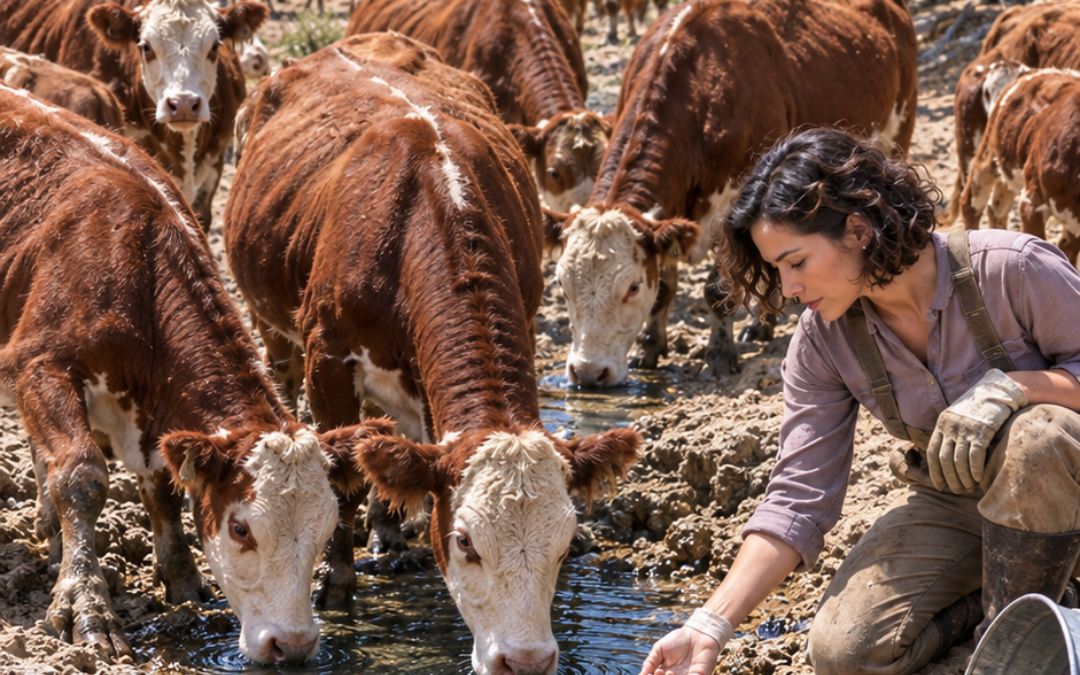
The dark patch spread beneath the cow’s hoof. At first Elara thought she was imagining it.
The August heat had become a shimmering wall, and exhaustion could make a person see almost anything.
But the cow dug again, tearing through another layer of sand, and this time the hole did not turn dusty gray after the hoof lifted.
It remained dark. Elara dropped to her knees. The sand was wet. For nearly an hour, the cattle continued pawing and scraping while Elara watched in disbelief.
These were not frightened animals digging randomly; they kept returning to the same depression beneath the cottonwoods.
The hole widened, the damp sand collapsed inward, and then something happened that seemed impossible in a county where ponds had become cracked bowls of mud.
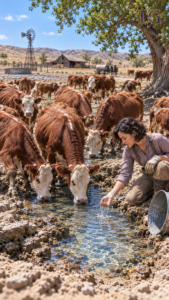
Water appeared. Not a flood. Not some roaring underground river. A tiny silver shimmer pushed through the bottom of the hole, disappeared beneath disturbed sand, then returned.
Seconds later another trickle joined it, and gradually a shallow pool of clear water began rising from beneath the earth.
Elara could barely move. Arthur’s notebooks had told her that the ground remembered. Now she finally understood that the sentence had never been poetry.
The cattle had uncovered an old sand spring. Somewhere beneath Burnt Fork, water still traveled through hidden layers of earth and sand, protected from the furnace above.
The cottonwoods had known it—their roots reaching toward moisture invisible from the surface. Arthur had probably known it too, or at least suspected it from decades of watching the land.
And somehow the original 22 heifers, animals once considered too weak and worthless to justify hauling home, had read the landscape better than any machine could.
They had found water. Elara laughed once, then covered her mouth as tears came unexpectedly.
She had spent years believing she was saving those animals. Standing beside the spring while they drank, she realized the relationship had never been that simple.
Now they were saving Burnt Fork. Within days, word escaped the farm. In Blackwood County, news traveled faster than weather, and the story sounded impossible enough to grow with every telling: the starving auction cattle had dug through sand and uncovered water in the middle of the worst drought anyone could remember.
Trucks slowed along Elara’s road again, but the people inside were no longer sightseeing. They were trying to understand.
Then a different truck appeared. It was gleaming, expensive, and instantly recognizable. Jedediah Vance had come to Burnt Fork.
A year earlier, his arrival would have filled the lane with confidence. This time he drove slowly.
When he climbed out, he removed his hat and held it in both hands, and Elara immediately saw what the drought had done to him.
He had lost half his herd. His corn crop was gone. The operation that had once seemed too large and technologically advanced to fail was bleeding money faster than he could stop it.
Irrigation had bought him time, but it had not created resilience, and the drought had exposed every weakness at once.
Vance looked beyond Elara toward the cattle, the living pasture, and the spring. For a long moment, neither spoke.
The silence carried the memory of the auction barn, his laughter, and those four words that had followed her out: twenty-two funerals.
Finally, he looked at her. “I was wrong.” No speech. No excuse. Then he asked the question Elara never expected to hear from Jedediah Vance.
“How?” That question changed Blackwood County more profoundly than the spring itself. Vance did not ask to buy Elara’s cattle.
He did not ask to buy the spring or purchase the farm. Instead, he offered her access to his own land—thousands of acres that now looked exhausted beneath the sun.
“Run your cattle on it,” he told her. “Do whatever it is you do. Just show me.”
The most powerful rancher in the county had arrived not as a competitor, but as a student.
Elara could have humiliated him. She could have repeated every joke he had made, every dismissive comment, every prediction of failure.
Instead, she walked into the pasture, knelt, pushed her fingers through the surface, and lifted a handful of dark soil.
“It starts here,” she said. Vance stared at it. The answer was almost insulting in its simplicity.
Soil. Not bigger machinery. Not another chemical. Not another loan. Not another attempt to force the land to produce on command.
Soil that could absorb rain instead of shedding it. Roots that reached downward instead of depending entirely on surface moisture.
Plant diversity. Rest. Manure. Hooves. Time. Observation. Most of all, patience. Elara began moving cattle through sections of Vance’s damaged ground.
She explained why a pasture that looked messy could be healthier than one clipped into perfect uniformity.
She showed him why bare soil was dangerous, why dead plant matter could become armor against evaporation, and why land needed periods when nothing was demanded from it.
At first, Vance kept asking when they would “fix” each field. Elara’s answer was always the same.
They were not fixing a machine. They were allowing a living system to recover. Vance’s surrender to that idea created a second shock wave through the county.
Elara’s success had been easy for skeptical ranchers to dismiss as luck, unusual soil, or one strange woman inheriting one strange farm.
But Jed Vance had been their symbol of certainty. If he was walking behind Elara through a pasture and asking questions, suddenly everyone wanted to know the answers.
The visitors began arriving quietly. Men who had farmed for thirty or forty years came through Burnt Fork’s gate with embarrassment in their faces and notebooks in their pockets.
Elara did not lecture them. She showed them earthworms beneath decomposing grass, flowering plants feeding pollinators, cattle moving onto fresh forage, and rested fields rebuilding themselves.
Then she showed them Arthur’s notebooks. The old farmer who had been mocked for leaving land fallow was suddenly teaching an entire county from beyond the grave.
But Elara refused to turn Burnt Fork into an empire. Demand for her beef increased.
Buyers wanted more cattle. Investors would have financed expansion. She could have borrowed heavily, bought equipment, increased stocking rates, and turned the accidental little brand into the kind of operation that once would have made Vance proud.
Then she remembered another sentence. Debt is a man telling the future what it has to do.
So Burnt Fork grew only as quickly as its soil could support. That decision brought another person into the story.
His name was Sam, a 16-year-old boy from a neighboring farm devastated by the drought.
At first he simply stood near Elara’s fence and watched. Then he started opening gates, carrying fencing, and appearing whenever work needed doing.
He asked few questions because he learned by watching. Elara recognized something in him. Arthur would have called it “the hands for it.”
She began paying him. Soon Sam was spending nearly every free hour at Burnt Fork, learning not only how to move cattle but how to notice things—how a herd behaved before weather changed, which plants appeared first in recovering soil, where water lingered, and where animals chose to stand.
Without ceremony, Arthur’s knowledge had passed from grandfather to granddaughter. Now it was passing again.
Two years after the drought, Great Aunt Maeve returned to the farm. She was extraordinarily frail by then.
Elara placed a chair on the porch and Maeve sat beneath the old roof, looking across pasture that had once been dismissed as worthless.
Healthy cattle moved through tall grass in the distance while Sam and several neighbors repaired the leaning barn.
Maeve watched everything. She had never been a woman who wasted words. When Elara helped her back toward the car, Maeve touched her hand.
“Arthur would be proud.” That was all. A month later, Maeve died peacefully in her sleep.
Her passing hurt, but her final visit left Elara with something grief could not erase.
The farm no longer felt like an inheritance she was desperately trying to protect. It had become a living bridge between generations.
Five years after the day Bill Strom dropped his gavel on those 22 starving heifers, Elara returned to the same auction barn.
This time she was not buying. She was selling. Three young bulls stepped into the ring.
They were direct descendants of the original cattle everyone had laughed at. They were not swollen into enormous shapes by heavy feeding.
They were lean, muscular, alert animals built from generations that had survived poor conditions, recovered on diverse pasture, and lived through the drought at Burnt Fork.
The crowd fell quiet. Bill Strom remembered. So did everyone else. Five years earlier, he had struggled to get a bid of ten dollars for the entire group.
Now ranchers had driven from multiple counties to compete for their descendants. Bill began the bidding.
Hands went up. The price climbed. And then Elara saw one bidder sitting near the front.
Jedediah Vance. He bought the first bull. The final price made people in the room gasp.
The second bull sold for even more. Then the third. Elara stood beside the rail listening to numbers climb through the same building where her judgment had once been treated as entertainment.
She did not smile because she had defeated anyone. That had never been the point.
Then something near the back of the barn caught her attention. A young woman stood alone beside a pen.
Inside were several miserable-looking lambs. Most buyers walked straight past them. The young woman remained.
She watched the animals carefully, uncertain but curious, studying where they stood and how they responded to one another.
For a moment, Elara saw herself five years earlier: worn boots, doubtful future, and a choice that made no financial sense to anyone watching.
Their eyes met. Elara smiled. And this time, nobody laughed. The story of the $40 heifers eventually became Blackwood County folklore.
People told it at feed stores, kitchen tables, auctions, and fence lines, but the details that mattered were never really about forty dollars.
They were about 22 animals everyone had judged by their worst moment. They had arrived starving.
They rebuilt a neglected farm. Their hooves helped push dead vegetation into exhausted soil. Their manure fed the ground.
Their grazing helped shape a landscape capable of holding precious moisture when neighboring fields baked beneath the sun.
And at the darkest moment, when even Elara’s well was beginning to fail, those same rejected animals had walked beneath old cottonwoods and started digging.
They had uncovered the water that nobody else knew was there. That was the part people loved telling.
But Elara understood something deeper. The miracle had not begun when water rose through the sand.
It began years earlier when Arthur decided that watching could sometimes teach more than controlling.
It continued when Elara refused to sell the farm, when she opened the old notebooks, when she listened to Maeve, and when she raised a bidding card for animals everyone else considered worthless.
The spring was only the moment the lesson became impossible to ignore. Nature had not suddenly rescued Burnt Fork.
Burnt Fork had spent years becoming capable of being rescued. The cattle survived because Elara gave them time.
The soil recovered because she gave it rest. The farm endured because Arthur had preserved things that seemed inefficient.
And the knowledge survived because no one tried to lock it away. Years later, Elara still kept the original notebooks in her grandfather’s desk.
Beside them sat newer volumes filled in her own handwriting. Some contained rainfall measurements. Others recorded calving dates, grazing rotations, birds, insects, wildflowers, strange weather, mistakes, surprises, and observations that might not matter for another twenty years.
And beside those would eventually sit Sam’s notebooks. Because Burnt Fork’s greatest product had never really been beef.
It was memory. Memory stored in handwriting. Memory stored in roots. Memory carried by cattle.
Memory hidden beneath sand. And somewhere below the old cottonwoods, the spring continued to rise quietly from the earth, long after the drought had ended and long after the laughter at the auction barn had disappeared.
Twenty-two cattle nobody wanted had once been called 22 funerals. Instead, they became the beginning of something that refused to die.
Disclaimer: This story is entirely fictional and was created solely for entertainment purposes. It does not represent any organization or individual, nor does it promote inappropriate behavior.
This content was created with the assistance of AI.








