A Peaceful 1859 Photo of Two Children Hid a Horrifying Secret—What Was Sewn Inside the Enslaved Girl’s Dress Left Historians Speechless!
PART 2
“HE IS STILL ALIVE.” Emily read the three words again, her fingers tightening around the photograph.
Beneath the scratched-out face, a small handwritten date had been added in faded brown ink: September 15, 1859.
It was the same day Clara had disappeared from Willow Creek Plantation. Rebecca leaned closer, the soft hum of the laboratory scanner filling the silence.
“That photograph was taken after the portrait of the two children,” she whispered. “Look at Clara’s dress.
The embroidery around the collar is different.” Emily lifted the image beneath the examination lamp.
Clara stood beside a tall man wearing a dark coat, his left hand resting on her shoulder, while behind them stood a wooden building with a narrow doorway and iron bars across its windows.
Although someone had violently scratched away the man’s face, a distinctive silver watch chain remained visible across his waistcoat.
Emily had seen that chain before. She rushed toward the Whitmore family archives, pulled open a drawer, and began searching through the photographs.
Papers scattered across the desk as she uncovered a portrait of Richard Whitmore, Edward’s father, standing beside his plantation overseer, Jacob Miller.
Hanging from Miller’s waistcoat was the same unusual silver chain. “Rebecca!” Emily called, holding up the photograph.
“The man standing beside Clara was the overseer!” But Rebecca was no longer looking at the photographs.
She had returned to the dress, carefully examining a section of fabric near the hem, where the hidden map appeared to end at a cluster of buildings.
“Emily, there’s something else here.” Under ultraviolet light, a tiny sentence emerged beside the outline of a wooden structure.
“The children are beneath the old mill. Follow the water.” Emily felt a cold sensation spread through her chest.
She remembered seeing an abandoned mill on the original plantation map, several hundred yards beyond the main house, near a narrow river that had once powered its enormous wooden wheel.
She immediately telephoned Henry Whitmore. “mr. Whitmore, does the old mill still exist?” For several seconds, the elderly man said nothing.
Then his voice became strangely quiet. “My grandfather told me never to go near that building.”
“Why?” “He said the foundations were dangerous. The entire structure was sealed before I was born.”
Emily looked toward Rebecca, who was still examining the glowing embroidery. “We need to go there.
Today.” By late afternoon, dark clouds had gathered above Willow Creek. Emily and Rebecca drove along the plantation’s abandoned service road, their tires crunching over loose stones and fallen branches.
Henry waited near the old mill with a flashlight in one hand and a rusted key in the other.
The building stood at the edge of the river, its wooden walls blackened by rain and age.
The enormous waterwheel had stopped turning long ago, but the river continued rushing beneath it, producing a low, relentless roar.
Thick vines covered the windows, and the heavy entrance door was secured with an iron chain.
“My grandfather kept this key,” Henry explained. “He told me it belonged to Edward.” The lock resisted his trembling hands before finally opening with a sharp metallic click.
Inside, the air smelled of damp timber, rotting leaves, and old machinery. Emily’s flashlight swept across broken barrels, collapsed shelves, and the remains of a massive grinding wheel.
Water dripped steadily from the ceiling, each drop striking the floor with a hollow sound.
Rebecca unfolded a printed copy of Clara’s hidden map. “The entrance should be somewhere beneath the grinding mechanism.”
They moved toward the rear wall, where a heavy wooden platform rested beneath the millstones.
Henry pushed against it, but the wood barely shifted. Emily found a rusted iron bar and wedged it beneath the platform.
Together, they pulled. The wood groaned, splintered, and suddenly lifted, revealing a narrow stone staircase descending into darkness.
A gust of cold air rose from below. Henry stumbled backward. “My God,” he whispered.
“There was a cellar.” Emily shone her flashlight down the steps. The beam disappeared into a black passageway, and somewhere beneath the building, water echoed against stone.
She descended first. The staircase was steep and slippery, its walls covered with moss. Rebecca followed closely, while Henry remained above, his flashlight illuminating the entrance.
At the bottom, Emily discovered a narrow underground corridor extending beneath the mill toward the river.
Iron rings had been fixed into the walls. A broken chain lay across the floor.
Emily stopped, staring at the small, rusted shackles attached to one of the rings. “Children were kept here,” Rebecca whispered.
Emily could not answer. At the end of the corridor stood a wooden door reinforced with iron strips.
Its surface was covered with scratches, some deep enough to expose the pale wood beneath the blackened exterior.
Rebecca directed her flashlight toward the lower section. There, carved into the door at the height of a child’s hand, were several names.
Mary. Samuel. Rose. Emily slowly knelt beside the markings. The letters were uneven, as though someone had carved them with a small piece of metal, pressing repeatedly into the wood.
Then she noticed another inscription. “Clara was here.” A sudden crash echoed from the entrance.
“Emily!” Henry shouted from above. “The platform is falling!” The wooden structure slammed shut, sending dust cascading down the staircase.
Emily heard Henry struggling with the heavy boards, his voice muffled by the thick timber.
Rebecca grabbed the iron handle on the underground door and pulled. It opened with a long, grinding shriek.
Beyond it lay a small chamber. A narrow shaft in the ceiling allowed a thin column of daylight to fall across the floor.
Against the far wall stood several wooden benches, a broken lantern, and an overturned bucket.
A child’s shoe lay beneath one bench, its leather cracked and stiff with age. Emily moved farther inside.
Near the back wall, beneath a loose stone, she discovered a small metal box. Its lid was sealed with a corroded clasp.
Rebecca handed her a screwdriver, and Emily carefully worked the metal free. The clasp snapped, sending a sharp echo through the chamber.
Inside were dozens of folded papers, a tiny silver thimble, and a leather-bound notebook. Emily opened the notebook.
The first page carried a familiar name. “Edward Whitmore, September 1859.” Her heart began pounding as she read.
“Father says Clara has been sold, but I saw mr. Miller take her toward the mill.
I followed them after dark. There were other children inside, and Clara told me they were being kept there until the trader arrived.”
Emily turned the page. “Clara says Mary is alive. Father told everyone she had been sold far away, but Clara saw her here three nights ago.”
Rebecca covered her mouth. The little girl had not merely been recording the names of children who had disappeared.
She had discovered that some of them were being secretly held beneath the mill before being transported and sold, while their families were given false explanations about their whereabouts.
Emily continued reading. “Clara has made a map. She says she will give it to me if they take her away.
I promised I would help her, but I do not know how.” A gust of wind whistled through the ceiling shaft.
Emily turned another page. The next entry was dated September 15, 1859. “mr. Miller brought Clara to the mill this morning.
Father told me she was leaving for Mississippi, but I heard them arguing about the other children.
Clara said she knew where they were and that she would tell everyone.” Emily’s eyes moved rapidly across the page.
“mr. Miller struck her. I ran toward them, but Father caught my arm and dragged me away.
I heard Clara screaming that the children were still alive.” The handwriting became uneven. “Later, they brought her back to the house.
She gave me her dress and told me to keep it safe. She said that if I could not save her, I must save the others.”
Emily stopped reading. For the first time, she understood the full meaning of the photograph hidden inside the dress.
Clara had been photographed beside Jacob Miller shortly before being taken away, and the scratched-out face had been an attempt to conceal the identity of the man who knew where the missing children had been held.
But the final pages of Edward’s notebook contained something even more extraordinary. A letter, written many years later, had been folded between them.
Emily carefully opened it. “I was eight years old when Clara was taken from Willow Creek.
I spent the rest of my childhood believing I had failed her, until the winter of 1866, when a woman arrived at my door carrying a small silver thimble.”
Emily looked down at the object inside the metal box. The letter continued. “Her name was Margaret.
She told me she was Clara’s mother.” Rebecca seized Emily’s arm. “Her mother found her?”
Emily read on. “Margaret had escaped from the plantation where she was enslaved and spent years searching for her daughter.
After the war, she discovered that Clara had been taken to a cotton plantation in Mississippi, where she became seriously ill during her first winter.”
The next sentence made Emily’s breath catch. “But Clara did not die there.” Outside, thunder rolled across the river.
Emily read the following lines aloud. “An enslaved woman named Sarah had cared for Clara during her illness.
When the plantation owner abandoned several sick workers during a severe winter storm, Sarah carried Clara to a nearby settlement, where a free Black family sheltered them.”
Emily could barely contain her excitement. “Clara survived.” Rebecca pressed both hands against her mouth, tears gathering in her eyes.
Emily continued. “Margaret found her daughter in 1866, seven years after their separation. Clara was fifteen years old, working as an assistant in a small school established for formerly enslaved children.”
For a moment, neither woman spoke. Then Emily turned to the final page. “Clara asked Margaret to deliver her thimble to me.
She said I had kept my promise by preserving her dress, but there was one more thing she wanted me to understand.”
Beneath the letter was a short message written in Clara’s own hand. “Edward, the children were never just names.
Some survived. Some found their families. Others were lost, but none of them should ever be forgotten.
Please tell their stories, and tell my mother that every stitch she taught me helped me find my way home.”
Emily lowered the letter. Above them, Henry finally managed to reopen the platform, and his flashlight illuminated the staircase.
“Are you both all right?” Emily looked toward him. “mr. Whitmore, your grandfather knew Clara survived.”
Henry slowly descended into the chamber, leaning against the stone wall for support. When Emily handed him Edward’s letter, his eyes filled with tears.
“My grandfather always said that Clara had given him a reason to live differently,” he whispered.
“But he never told us what happened to her.” Emily turned to the remaining papers inside the metal box.
They contained letters exchanged between Edward, Margaret, and Clara over several decades, along with records of children who had survived the secret holding cellar.
Some had been reunited with relatives after emancipation, while others had settled in different towns and established families of their own.
The documents also revealed that Edward had returned to the mill after the Civil War and recovered the records hidden there, preserving them alongside Clara’s letters.
He had kept the dress because it was the beginning of everything. For the next several months, Emily and Rebecca worked with historians, archivists, and descendants to examine the newly discovered records.
They carefully compared the names embroidered into Clara’s dress with surviving letters, family documents, and plantation records, gradually reconstructing the lives of children whose stories had been scattered across generations.
The investigation established that Clara had eventually moved north with her mother, where she became a teacher and spent decades helping formerly enslaved families preserve their histories.
She married a carpenter named Daniel Brooks, raised three children, and continued teaching until her death at the age of seventy-eight.
Her family had preserved her letters, but they had never known that the little navy-blue dress from her childhood had survived.
Emily eventually contacted Clara’s living descendants, inviting them to Willowbrook History Museum for the opening of a special exhibition.
On the morning of the ceremony, an elderly woman named Grace Brooks entered the gallery holding her granddaughter’s hand.
She stopped in front of the glass display case. Inside lay the small navy-blue dress.
Grace pressed her trembling fingers against the glass. “My grandmother used to tell us about this dress,” she whispered.
“She said it carried the names of children she loved, and that one day she hoped someone would find it.”
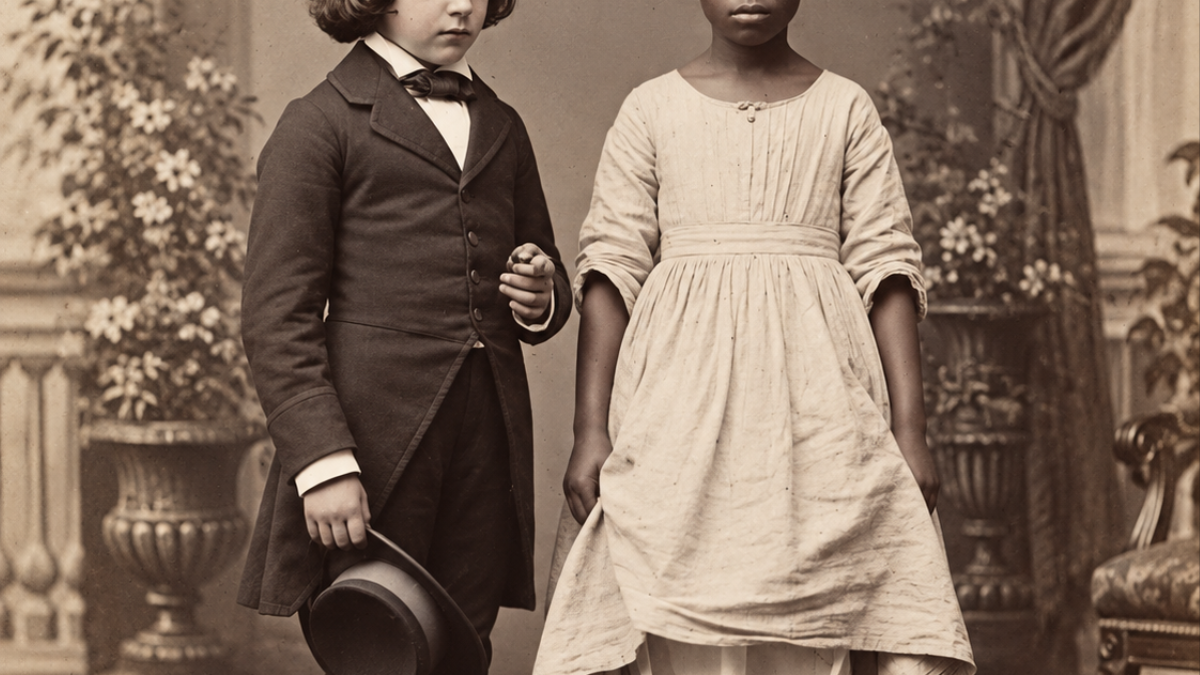
Emily gently placed a reproduction of the photograph beside the display. Grace studied the two children sitting together in their formal clothes.
“She told us about Edward, too,” she said. “She said he was the first person who promised to remember her friends.”
Henry Whitmore approached slowly. For several seconds, the descendants of the two children stood facing each other, separated by more than a century of history.
Then Grace extended her hand. “Your grandfather kept his promise.” Henry took her hand, his eyes shining.
“And your grandmother made sure those children were never forgotten.” Together, they turned toward the dress.
Under the museum’s carefully controlled lighting, the hidden embroidery appeared across the fabric, revealing the tiny names and memories Clara had sewn into it as a child.
Mary, who loved blue butterflies. Samuel, who collected shiny stones. Rose, who sang to frightened children.
Beside the display stood a newly discovered photograph of Clara as an adult, smiling gently with her mother and children outside a small schoolhouse.
Emily looked from the childhood portrait to the later photograph and felt the weight of the investigation finally lift from her shoulders.
The frightened little girl in the 1859 photograph had not vanished into history. She had survived, found her mother, built a family, and spent her life giving other children the education and dignity that slavery had tried to deny her.
And the dress she had entrusted to Edward had finally completed its journey. It had carried the memories of the missing children through generations of silence until their names could be spoken aloud once more.
As the museum visitors gathered around the display, Grace leaned toward her granddaughter and pointed to the tiny stitches glowing beneath the glass.
“Look carefully, sweetheart,” she whispered. “Your great-great-grandmother made those when she was only eight years old.”
The little girl studied the dress for a long moment. Then she looked up at Grace.
“Did she really remember all those children?” Grace smiled through her tears. “Yes, darling. She remembered every single one.”
And in the quiet gallery, surrounded by the voices of families who had finally found their way back to one another, Clara’s childhood promise was fulfilled.
Not because history had remembered her. But because she had refused to forget them.
Disclaimer: This story is entirely fictional and created for entertainment purposes only. It does not represent any organization or individual, nor does it encourage inappropriate behavior. The content was generated with AI assistance.








