They Ripped Her Daughter From Her Arms—What This Mother Did Next Sent the Entire Big House Into Panic
PART 2 — Her Daughter Was Being Used as Bait—But Rosa Turned Their Trap Against Them
Rosa remained hidden behind the trees, forcing herself not to run toward the voices. Every instinct screamed at her to find Helena immediately, but now she understood the trap.
The men wanted exactly that. They wanted a terrified mother charging into the clearing so they could capture both of them and make the entire problem disappear.
One of the men was the merchant Rosa had seen inside Constança’s office. The other was a stranger.
“The mother will come,” the merchant said. “Severino said she always does.” “Then we take both?”
“Both. And this ends.” Rosa slowly backed away. They thought fear would make her predictable.
They were about to discover how wrong they were. Rosa followed an old trail running along the riverbank, moving around the clearing rather than through it.
Branches scratched her arms, mud covered her dress, and every second felt unbearable. Then she saw a small wooden shack hidden behind the trees.
A sound came from inside. “Mãe?” Rosa almost collapsed. Helena. She reached a side window and looked through.
Her daughter sat on the floor with her hands tied. “Mother!” “Quiet.” Rosa climbed inside, dropped to her knees and pulled Helena into her arms.
For several seconds neither could speak. Helena buried her face against her mother’s chest. “I knew you would come.”
Rosa closed her eyes. “Always.” She found a piece of sharp metal and cut the ropes.
“Let’s go,” Helena whispered. But Rosa suddenly stopped. “Not yet.” Helena stared at her. “Why?”
“Because they need to believe you’re still here.” Rosa moved Helena through the window and hid her behind thick bushes.
Then she returned to the shack, rolled a blanket into the shape of a small body and covered it with sacks.
From the doorway, it looked like a child lying on the floor. Helena watched through the leaves.
“I can do this,” she whispered. Rosa looked at her daughter. “You’re sure?” “If you can, I can.”
Despite everything, Rosa smiled. Footsteps approached. The merchant entered the shack. “She’s still here?” The second man followed.
“There.” The merchant bent toward the covered figure. Rosa slipped from behind the building. She slammed the door shut.
“What was that?” The men rushed toward it. Rosa dropped a heavy wooden beam across the outside.
“OPEN THIS!” The door shook violently. Rosa grabbed Helena’s hand. “RUN!” They disappeared through the trees while the men shouted behind them.
They reached the river, where Teresa, Miguel and Joana were waiting near the canoe. “Helena!”
The children embraced. Teresa stared at Rosa as if she had returned from the dead.
“We need to keep moving.” Rosa shook her head. “No.” “What do you mean, no?”
“We’re going back.” Teresa thought she had misheard. “To Santa Augusta?” “Yes.” “Rosa, have you lost your mind?”
Rosa looked at Helena, then at the other children. “If we keep running, tomorrow they make another list.
Next week another wagon leaves. Then another mother spends the rest of her life wondering where her child went.”
Teresa slowly understood. Rosa was no longer trying only to save Helena. She wanted to destroy the secrecy that made the system possible.
They returned by river. Near sunset, the people of Santa Augusta saw figures approaching from the far end of the property.
First came Teresa. Then Miguel. Then Joana. And behind them walked Rosa holding Helena’s hand.
The courtyard exploded. Celina ran toward Joana and dropped to her knees. Families surrounded the children.
Helena refused to release Rosa’s hand. From the veranda, Dona Constança watched. Severino stood beside her.
“Arrest Rosa,” Constança ordered. Nobody moved. “I SAID ARREST HER!” Silence. Rosa walked into the center of the courtyard.
Helena remained beside Benedita. “Today they tried to take five children.” Constança snapped, “This does not concern you.”
Rosa looked directly at her. “It concerns every mother here.” “You created chaos.” “No.” “You stopped people from working.”
“No.” “You disobeyed me.” Rosa paused. “Yes.” Constança seized on the answer. “So you admit it.”
“I disobeyed because the order was cruel.” Severino stepped down from the veranda. “You think this ends here?”
Rosa turned toward him. “No.” For the first time, that answer seemed to disturb him.
“What do you want?” Rosa pointed toward the office. “The list.” Constança’s face changed. “What list?”
“The list of children.” “There is no list.” “I saw it.” Rosa began reciting the names.
“Helena. Miguel. Joana. Madalena. Rui.” Then she added quietly: “And there were other names.” Severino looked at Constança.
It lasted barely a second. But Rosa saw it. So did others. Constança immediately turned toward the house.
Then Rosa called one name. “Catarina.” The servant stepped from the crowd. In her hand was the document.
Constança stopped. “Give me that.” Catarina did not move. “Give it to me!” Instead, she handed the paper to Rosa.
Rosa unfolded it. Then she began reading. Names. Ages. Destinations. Values. Every line transformed a private secret into public knowledge.
Someone gasped when a familiar surname was read. Another woman began crying. A father pushed through the crowd to see the paper for himself.
Severino lunged forward. “That proves nothing.” Rosa lifted the document out of his reach. “Then explain the prices.”
He had no answer. Constança pointed at Catarina. “You stole from me!” Catarina’s hands trembled, but she remained standing.
“I took out what you were hiding from everyone.” “You had no right!” Rosa looked at Constança.
“And the mothers did?” Constança’s eyes hardened. “This property belongs to me.” Rosa’s voice remained steady.
“Children are not property.” Then Constança made the mistake that changed everything. She pointed at Helena.
“She should have gone.” Silence fell across the courtyard. Even Severino looked at her. Rosa slowly stepped forward.
“Say that again.” Constança realized what she had done. Too late. Everyone had heard. Rosa did not need to accuse her anymore.
Constança had done it herself. Severino rushed forward. “Enough!” He raised his hand toward Rosa.
This time it never reached her. Mateus caught his wrist. Tomás stepped beside him. Then another worker moved forward.
And another. Severino looked around. For years, his authority had depended on one assumption: when he ordered, others obeyed.
That assumption was disappearing in front of him. “Move,” he said. Nobody moved. “Are you afraid of me or not?”
Benedita answered. “We were.” Two words. That was all. But they changed the courtyard. Constança retreated toward the veranda.
“This will be dealt with tomorrow.” “No,” Rosa said. Constança turned. “What?” “Today.” “And who decides that?”
Rosa looked at the mothers. “The people whose children almost disappeared.” Rosa could have called for destruction.
She could have encouraged people to burn the wagon, destroy the office or attack the men who had terrorized them.
She did none of those things. Because during the journey back, she had realized something more powerful.
If they destroyed property, Constança could call them criminals. If they attacked someone, Severino could call it violence.
But what if everybody simply knew? What if every hidden name became public? What if every mother knew the route?
What if every worker knew who had signed the paper? What happened to power built on secrecy when there was no secrecy left?
Rosa called the families forward. One at a time. Teresa spoke first. She told everyone how Miguel had been taken without warning.
Celina described being told that Joana would spend only a few hours with Constança, even though the child’s name was already written on a transfer list.
Madalena’s family spoke. Rui’s family spoke. Then Benedita stepped forward. Her voice was old but clear.
She remembered another merchant. Years earlier. Two little girls. Daughters of a woman named Mariana.
The girls had left. They had never returned. Months later, Mariana disappeared too. Nobody had known where.
That testimony opened something the great house could no longer close. People began remembering. A sister who vanished.
A nephew transferred without explanation. A daughter sent somewhere nobody could name. A child whose mother had been told to stop asking questions.
The sun disappeared. Nobody returned to work. Torches were lit across the courtyard. The great house glowed behind Constança, but the real light was now outside it.
Story after story filled the darkness. Rosa spoke last. “They ripped my daughter from my arms.”
She looked at Helena. “They told me she was something that could be taken.” Then she looked at Severino.
“They threw me into the dirt when I tried to reach her.” Finally, Rosa faced everyone.
“They told me to accept it.” Helena walked toward her. Rosa took her daughter’s hand.
“Tonight she is here.” A pause. “But what about tomorrow?” Nobody answered. Rosa raised the document.
“As long as something like this can remain hidden, any child can be put on the next wagon.”
She handed the list to Benedita. “Read it.” Benedita read every name aloud. Then she handed it to Teresa.
Teresa read it again. Then Celina. Then another worker. And another. Until the list no longer belonged to an office.
It belonged to everyone who had heard it. The route was known. The names were known.
The merchants were known. The bridge was known. The secret was dead. That was Rosa’s revenge.
Not against one person. Against the silence that had protected them. Constança came down from the veranda.
“You will regret this.” “Maybe.” “You don’t understand what you’ve started.” Rosa looked around at the crowd.
“I understand.” “You will destroy this farm.” Rosa answered quietly. “If this place can survive only when mothers aren’t allowed to ask where their children are going, perhaps it was already destroyed.”
Constança had no answer. Severino tried to slip toward the side gate. Tomás noticed. “Where are you going?”
“That is none of your concern.” Tomás stared at him. “Now it is.” Mateus stood near the gate.
Several workers joined him. Nobody attacked Severino. Nobody needed to. They simply refused to let him disappear before questions could be asked.
By sunrise, a group was preparing to travel to the village carrying copies of the list, witness statements, descriptions of the merchants, information about Old Bridge and everything the families could remember.
Rosa would go with them. Helena would remain with Benedita. Before Rosa left, Helena grabbed her hand.
“You’re coming back?” Rosa smiled. “Yes.” “Promise?” Rosa crouched in front of her. “This time I don’t need to promise.”
Helena frowned. “Why?” “Because now everyone knows where I’m going.” Helena understood more than an eight-year-old should have needed to understand.
Before, people disappeared because information disappeared with them. Now everybody knew. Weeks passed. Santa Augusta did not transform overnight.
Constança remained in the great house while accusations were examined. Severino was removed from his position during the inquiry.
One of the merchants was eventually found; another vanished. Some old disappearances never received answers.
Some wounds never closed. But one thing changed permanently. No child left Santa Augusta again without questions.
Whenever a wagon was prepared, somebody asked where it was going. Who was traveling? Why?
Who authorized it? When would they return? The questions spread faster than fear ever had.
And that was what truly terrified the great house. Rosa had once told Helena that roads could take people away—and sometimes bring them back.
For years, the road outside Santa Augusta seemed to do only one thing. It took.
Children. Sisters. Brothers. Families. Names. But on the evening Rosa returned from the river, the road brought Helena home.
And Helena did not return alone. She returned with Miguel. With Joana. With questions. With witnesses.
With people who had discovered that fear worked best when each person believed they were frightened alone.
Years later, people at Santa Augusta still remembered the morning Helena was taken. But that was not the part they repeated most.
They remembered the moment she came back. Helena walked down the road holding her mother’s hand while the other children followed behind.
Families ran toward them. And from the veranda, Dona Constança saw something she had never expected to see.
Nobody waited for permission. Nobody lowered their eyes. Nobody asked whether they were allowed to embrace their own children.
That was when Rosa finally understood what she had done. The most devastating revenge was not destroying the person who tried to destroy her.
It was destroying the thing that made that person powerful. Constança still had the great house.
She still had expensive dresses. She still slept in the largest room. But there was one thing she could never purchase again.
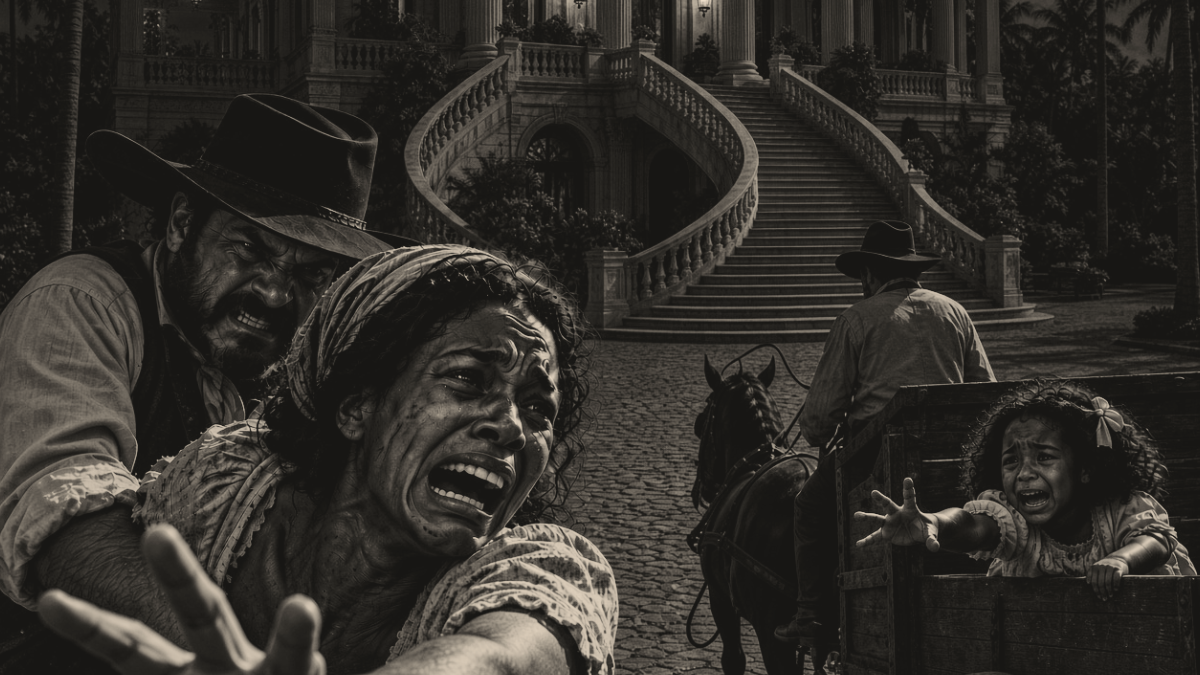
Silence. They had ripped Helena from Rosa’s arms. They had thrown Rosa into the dirt.
They had threatened to make her daughter disappear. They had even used an eight-year-old child as bait, believing a desperate mother would walk blindly into their trap.
Instead, Rosa came back with the one weapon they had never prepared themselves to fight.
The truth—shared by everyone. And once the silence died, the great house never slept peacefully again.
Disclaimer: This story is entirely fictional and was created solely for entertainment purposes. It does not represent any organization or individual, nor does it promote or encourage inappropriate behavior.
This content was created with the assistance of AI.








