HE EXPECTED A SIMPLE BRIDE—BUT ONE DINNER EXPOSED THE SECRET THAT HAD BEEN DESTROYING HIS ARIZONA RANCH FOR YEARS
PART 2 — SHE OPENED HIS OLD ACCOUNT BOOKS AT SUNRISE—BY NOON, AN ENTIRE TOWN WAS QUESTIONING THE MAN WHO CONTROLLED THEIR MONEY
By sunrise, Clara had covered the kitchen table with six years of Kai’s financial history.
Receipts. Cattle records. Purchase agreements. Handwritten notes. Some pages were yellow, others torn at the corners, but Clara examined every number as if the survival of the ranch depended on it.
Then she froze. “Kai.” He came to her side. Clara placed two records together. Six years earlier, Kai had delivered twenty cattle to Miller.
His ranch record showed twenty. Miller’s payment showed eighteen. Kai’s jaw tightened. He remembered that shipment.
He remembered counting every animal before they left his property. But he had been exhausted, overwhelmed, and accustomed to trusting the numbers Miller handed him.
“How many times?” Kai asked. Clara looked at the mountain of paper. “I don’t know yet.”
“Find out.” For hours, they worked without stopping. A few dollars missing from one vegetable sale.
A reduced price on hides somewhere else. Cattle counts that didn’t match. Interest charges that appeared to shift from one document to another.
Each discrepancy looked small enough to dismiss—but together they formed a pattern too large to ignore.
Kai sank into his chair. “All these years…” “You didn’t know,” Clara said. “I should have.”
Clara shook her head. “You trusted someone.” “That was my mistake.” “No. Trust wasn’t the mistake.
Trusting the wrong person was.” Kai looked at her, and suddenly the conversation was about more than Miller.
His father had trusted the wrong people and lost his land. Kai had responded by building walls around everything—his ranch, his money, his emotions.
Yet despite all those walls, he had still been vulnerable because protecting himself from everyone had prevented him from seeing the person quietly exploiting him.
By midday, Clara had enough records to confront Miller. Kai saddled two horses. “You don’t have to come,” he told her.
Clara climbed into the saddle. “Yes, I do.” “This is my problem.” She looked directly at him.
“Your problems became mine when I chose to stay.” Kai said nothing for the rest of the ride.
But those words followed him all the way into town. When they reached Miller’s office, several ranchers were already nearby.
Miller stepped outside and immediately recognized them. His face darkened when he saw the folder beneath Clara’s arm.
“I told you not to come back.” Kai dismounted. “We’re settling the accounts.” Miller laughed.
“You think your little bride understands my business better than I do?” Clara stepped forward.
“I understand arithmetic.” She placed two documents on the table outside his office. “Twenty cattle were delivered.”
Then she tapped Miller’s record. “You paid for eighteen.” A man standing nearby suddenly leaned closer.
“What did she say?” Miller turned toward him. “Nothing that concerns you.” But the rancher was already staring at the documents.
“That happened to me.” The street seemed to go silent. Miller’s face tightened. “You’re mistaken.”
The rancher disappeared into a nearby building and returned carrying his own receipt. He had sold twenty-three calves the previous year.
His payment didn’t appear to match what he remembered delivering. Then another rancher stepped forward.
“And you charged me twice for one shipment.” Miller snapped that they were confusing ordinary clerical errors with dishonesty.
Clara didn’t accuse him of anything she couldn’t prove. Instead, she opened another page. Then another.
And another. That was more powerful. Within minutes, curiosity became suspicion. Ranchers who had walked past Miller’s office for years began searching pockets, saddlebags, wagons, and nearby businesses for their own receipts.
Men who had always assumed Miller’s numbers were correct suddenly wanted to see those numbers again.
For the first time, Miller looked nervous. He insisted that bookkeeping mistakes happened. Some ranchers believed that explanation might account for at least part of the discrepancies.
Others clearly didn’t. But Kai refused to turn the confrontation into a shouting match. He wanted something simpler.
Correct accounts. Every disputed transaction involving his ranch would be reviewed against the records he had kept.
After hours of comparisons and arguments, enough discrepancies remained that Miller agreed to repay part of the disputed money and review the other accounts separately.
It wasn’t the kind of victory people tell stories about with gunshots and cheering crowds.
There was no dramatic confession. There didn’t need to be. Kai walked out carrying corrected records and money he had thought was gone forever.
More importantly, he walked out knowing he had finally stopped allowing fear of conflict to control his life.
Clara followed him toward the horses. “You’re quiet,” she said. “I’ve always been quiet.” “Not like this.”
Kai stopped. “I was thinking about how much I missed because I was too busy surviving.”
Clara studied him. “Then stop surviving.” Kai looked at her. “Start living.” Those two words followed him home.
As the ranch appeared beneath the evening sky, Kai saw things he somehow hadn’t noticed before.
The garden was green again. The broken fences had been repaired. Flowers grew near the porch.
The barn doors no longer sagged on rusted hinges. The property hadn’t magically changed. He had.
Before Clara, every broken thing had looked like another burden. Now it looked like something worth fixing.
That evening, Clara entered the kitchen and stopped. Kai was cooking. She stared suspiciously at the potatoes.
“Should I be worried?” Kai looked offended. “I can cook.” “You can burn potatoes.” “That happened once.”
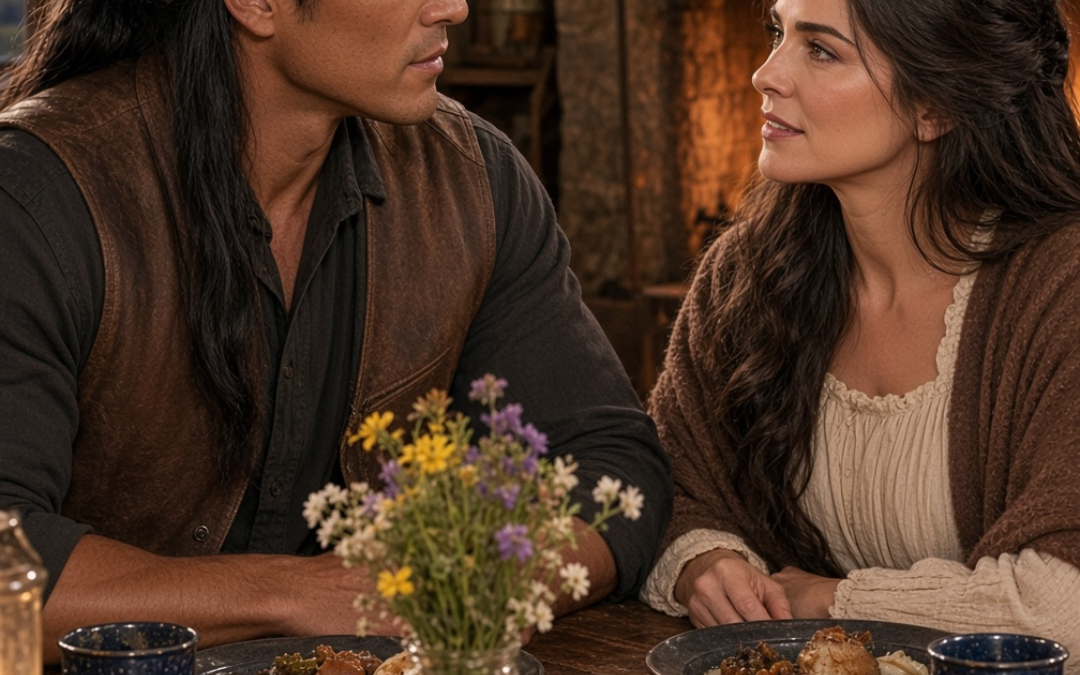
“Twice.” Kai pretended not to hear her. But when Clara approached the table, she saw a small jar of wildflowers standing in the center—the same kind she had placed there during the dinner when she first told him the truth.
Her teasing disappeared. “You remembered.” Kai nodded. They ate slowly. Neither seemed eager for the meal to end.
Finally, Kai put down his fork. “When you arrived, I thought I needed a simple wife.”
Clara raised one eyebrow. “A simple wife?” “Someone who wouldn’t complicate my life.” “And how did that work?”
Kai laughed. “You moved my furniture, changed my garden, reorganized my business, challenged the man I’d been dealing with for years, and turned half the town upside down.”
Clara fought a smile. “So… Badly?” “No.” Kai’s expression changed. “You changed everything.” Clara looked down at the table.
“I only helped.” “No.” His voice was softer now. “You made me care about things I’d stopped caring about.”
Silence filled the room. Not the cold silence that had occupied the house before Clara arrived.
This silence was different. It was the silence between two people who already knew what the other was trying to say.
Kai stood. “Come outside.” They walked onto the porch. The Arizona sky burned orange beyond the distant hills.
Horses moved quietly near the fence, and a cool evening wind crossed the land Kai had spent seven years defending from everyone.
“I used to think this place was mine because I owned it,” Kai said. “It is yours.”
Kai shook his head. “Land can belong to one person. A home can’t.” Clara turned toward him.
“When I came here,” she admitted, “I thought I’d escaped one prison and might be walking into another.”
Pain crossed Kai’s face. “But I wasn’t,” she continued. “Why?” “Because you gave me something nobody else had.”
Kai waited. “A choice.” He remembered her standing beside that tiny trunk while the stagecoach disappeared.
He remembered telling her she could leave. At the time, the words had seemed ordinary.
To Clara, they had meant freedom. Kai stepped closer. “I want you to stay.” Clara smiled.
“I know.” “No.” His voice trembled slightly. “I don’t mean because of an advertisement. I don’t mean because somebody paid for your journey.
I don’t mean because you have nowhere else to go.” He took her hand. “I want you to stay because you choose me.”
Clara’s eyes filled with tears. Then she squeezed his hand. “I already did.” There was no audience.
No orchestra. No grand speech. Just two people standing on a wooden porch beneath an Arizona sunset, finally understanding that neither had rescued the other.
They had simply given each other what both had been missing. A choice. A partner.
A reason to stop surviving alone. And that could have been the end of their story.
Instead, it became the beginning. Over the following months, Clara proposed an idea even Kai hadn’t expected.
Rather than keeping the ranch isolated, they could allow neighboring families to gather there and sell directly to one another.
Vegetables, eggs, leather goods, handmade items, meat, and other products could be traded without depending entirely on a single middleman.
Kai agreed. The first market day brought only two families. The next brought five. Soon there were ten.
Children ran beside the barn. Wagons crowded the road. Women compared prices and account books.
Ranchers exchanged tools, supplies, and advice. Kai repaired fences for neighbors who couldn’t afford new materials, while Clara showed families how to organize their records so nobody could easily confuse them with unexplained figures again.
The ranch that had once been silent became noisy. And Kai loved every second of it.
Months earlier, he had believed success meant owning enough land that he never needed anyone.
Now his porch was filled with neighbors. His kitchen smelled like fresh bread. His dinner table—the same table Clara had dragged toward the window without permission—was surrounded by people.
One evening, after everyone had gone home, Kai found Clara beside the garden. “I have something for you.”
He handed her a small wooden box. Inside was a simple silver pendant. Clara stared at it.
Then at him. Kai explained that he had found it in town and traded for it because it reminded him of what Clara had told him about her mother—the woman who had taught her gardening, bookkeeping, and the skills that had ultimately helped save the ranch.
Clara’s eyes filled with tears. “You remembered that?” Kai smiled. “I remember everything you tell me.”
She closed the box carefully and looked across the property. The woman who had arrived with almost nothing now stood in the middle of something money could never have purchased for her.
A place where she was wanted without being owned. Kai looked toward the house. “Do you remember our first dinner?”
Clara laughed softly. “How could I forget?” “I thought I was feeding the woman who might become my wife.”
“And instead?” Kai looked at the garden, the repaired barn, the market stalls, and finally the glowing windows of the house that had once been dark every night.
“You changed my ranch.” Clara shook her head. Then she took his hand. “No, Kai.”
She looked toward the home behind them. “We changed it.” Together, they walked toward the house.
Years later, people might have remembered the growing ranch, the little community market, or the financial records that finally forced everyone to look more carefully at whom they trusted.
But Kai would remember something much smaller. One dinner. One woman sitting across from him.
One sentence about a ranch becoming a home. Because the greatest thing Clara brought west had never been hidden inside her little wooden trunk.
She brought knowledge when Kai expected simplicity. She brought courage when he had chosen isolation.
She brought truth into a house built around silence. And Kai gave her the one thing she had crossed Arizona hoping to find.
Not money. Not rescue. Not even marriage. The freedom to choose where she belonged. And in the end, that choice changed everything.
Disclaimer: This story is entirely fictional and was created solely for entertainment purposes. It does not represent any organization or individual, nor does it promote inappropriate behavior.
This content was created with the assistance of AI.








