The Colonel Fathered a Child with His Most Beautiful Enslaved Woman—But His Wife’s Shocking Decision Changed Everything
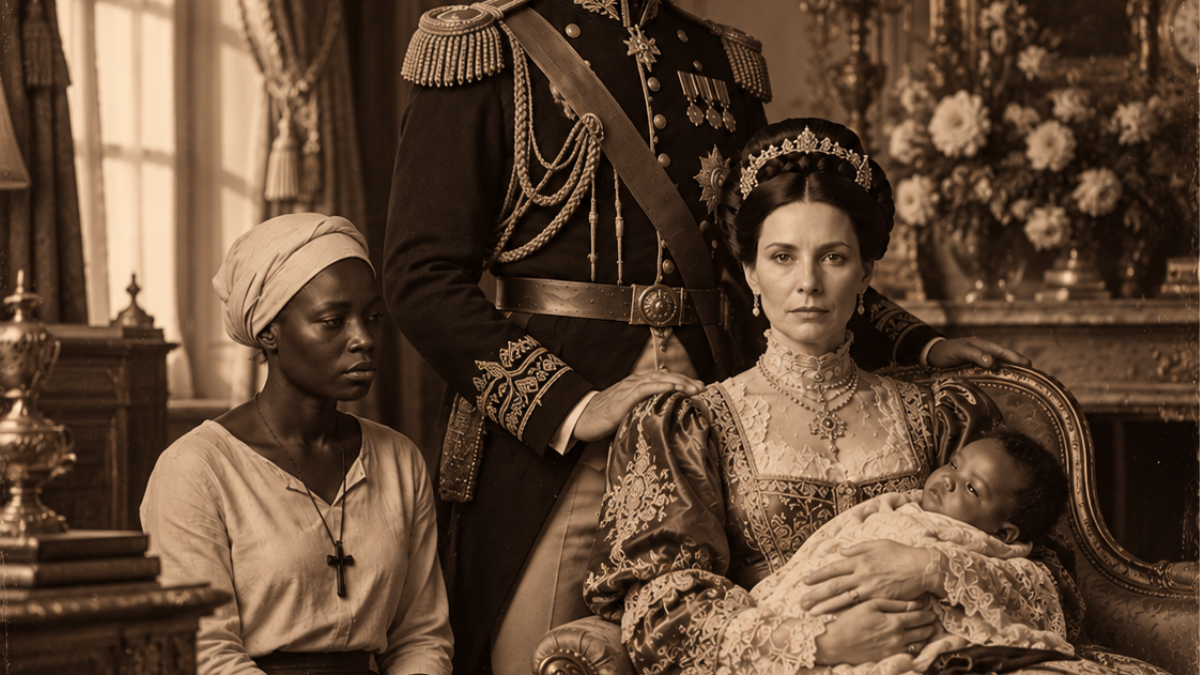
PART 2
Thomas Whitmore leaned across Edward’s desk, the bundle of papers resting beneath his fingertips like a loaded pistol.
Outside, rain hammered the shutters, and thunder rolled over the sugar fields hard enough to rattle the glass.
“Half the estate,” Thomas repeated. “Transferred legally into my name before the end of the month.
Do that, and these papers disappear.” Edward stared at his younger brother, remembering a boy who had once chased him barefoot through those same fields.
Now there was nothing boyish in Thomas’s eyes. Only hunger. Edward wanted to seize him by the throat.
Instead, he forced himself to remain seated. “And if I refuse?” Thomas smiled, slowly gathering the papers.
“Then Kingsport learns that your precious heir was born to Grace. The courts learn it.
The church learns it. And Henry learns it.” He paused at the door. “Two weeks, brother.”
Then he stepped into the storm, leaving Edward alone with the rain and the sound of his own breathing.
Margaret listened without interrupting when Edward told her that night. A single candle burned between them, throwing long shadows across the study walls.
Edward expected panic, perhaps surrender. Instead, Margaret’s expression hardened. “We give him nothing.” Edward stared at her.
“He has witnesses.” “Then we make certain that when he speaks,” she replied, “no respectable person believes him.”
What followed moved with the precision of a military campaign. Edward quietly contacted merchants Thomas had cheated in failed investments.
Old gambling debts were suddenly called in. Business partners who had tolerated Thomas because of the Whitmore name began withdrawing their money after learning that the colonel would no longer protect his brother’s reputation.
Within weeks, whispers spread through Kingsport’s counting houses and taverns: Thomas Whitmore was drowning in debt.
But Margaret understood that ruined men were often more dangerous than prosperous ones. Thomas might still expose Henry simply out of spite.
There was one piece of living evidence too dangerous to leave within his reach. Grace.
Margaret entered Grace’s room late one evening. A small oil lamp burned beside the bed, and Grace was folding Henry’s freshly washed shirts into a wooden chest.
She looked up immediately. Something in Margaret’s face made her hands stop. “You have to leave Kingsport.”
The shirt slipped from Grace’s fingers. “No.” “Grace—” “No.” She stood. “You promised me I could stay near him.”
Margaret’s voice tightened. “Thomas knows.” Silence swallowed the room. Grace’s eyes moved toward the ceiling, as though she could somehow see through it to the room where Henry slept.
“How much?” “Enough.” Grace sank onto the edge of the bed. Outside, insects screamed in the humid darkness.
For years she had endured the agony of watching another woman receive the name that belonged to her, but at least she had been able to see Henry each morning.
She knew the way he rubbed his eyes when sleepy, the crooked smile that appeared whenever he lied badly, the sound of his footsteps running down the corridor.
Now even those scraps were being taken away. “Where?” She whispered. “A tobacco property near Greenridge.
You’ll have papers identifying you as a free employee. No overseer will have authority to punish or sell you.”
Grace gave a bitter little laugh. “Free?” Margaret flinched. Grace looked directly at her. “A free woman chooses whether she leaves her child.”
Neither woman spoke for several seconds. Then Margaret slowly reached inside her dress and removed a small silver locket.
She opened it. Inside was a tiny curl of dark hair. “Henry’s,” she said. “I cut it when he was two.”
Grace stared at it. Margaret placed the locket in her palm and closed Grace’s fingers around it.
“I cannot give you back what this house has taken from you. But I swear that one day, when he is safe, Henry will know exactly who you are.”
Grace’s eyes filled with tears. “Promises disappear quickly when powerful people make them.” “I know.”
“Then don’t promise me.” Margaret swallowed. “Prove it.” At dawn, Grace left. Henry was still sleeping.
She stood outside his bedroom for almost a minute, one hand against the closed door, listening to the faint rhythm of his breathing.
She wanted desperately to enter, to kiss his forehead, to wake him and tell him everything.
Instead, she whispered, “Live well, my son,” and walked away before courage became recklessness. The carriage wheels disappeared into the morning mist.
Henry woke hours later and was told Grace had been transferred to another Whitmore property.
He cried. Margaret cried too, but only after locking herself inside her bedroom. Thomas’s destruction came faster than anyone expected.
Creditors descended upon him. His business collapsed. Horses disappeared from his stable, then paintings from his walls, then furniture from his house.
By the following year, the man who had demanded half the Whitmore estate was selling his silverware to pay interest on his debts.
He never brought his evidence before a court. Eventually, Thomas left Kingsport in a battered carriage with two trunks and no servants, still carrying the certainty that he knew the Whitmores’ secret but no longer possessing the influence to make anyone care.
The danger passed. The lie remained. Years moved relentlessly forward. Henry became tall, broad-shouldered and intensely curious.
Margaret hired tutors to teach him law, history, Latin and mathematics, but there were questions no tutor could answer.
Why did he remember a woman’s voice singing in words he couldn’t understand? Why did the smell of chamomile sometimes produce an inexplicable ache in his chest?
Why did the older servants become strangely quiet whenever he mentioned Grace? The first crack appeared when Henry was seventeen.
Martha Reed was dying. Age had reduced the once-formidable housekeeper to a thin figure beneath white sheets.
Rain tapped softly against her window when she asked Henry to sit beside her. “There are things,” she whispered, fighting for breath, “that become heavier the closer you get to the grave.”
Henry leaned nearer. Martha’s fingers closed around his wrist. “Grace loved you more than you know.”
Henry frowned. “I remember her.” “No.” Martha’s watery eyes fixed on him. “You remember almost nothing.”
“What are you trying to tell me?” But a coughing fit seized her. Henry held a cup to her lips until it passed.
“Greenridge,” she whispered. “What?” “She’s in Greenridge.” “Why should I—” “Find her.” Martha died twelve days later.
After the funeral, Henry could not let those words go. Find her. One afternoon, while searching Edward’s study for an estate ledger, Henry discovered an old letter wedged between accounting books.
The paper was yellow, the ink faded. It was from Martha to Margaret. One sentence froze him.
The boy sometimes asks about his old nurse. I pray God allows him to know the truth someday, as you promised Grace.
Henry read it again. Then again. His heartbeat thundered in his ears. That evening, he walked into the parlor where Margaret sat embroidering beside the fire.
He shut the door and placed the letter on the table. Margaret saw Martha’s handwriting.
The color left her face. “Tell me the truth.” “Henry—” “Please.” His voice cracked. “For once, don’t protect me from my own life.”
Margaret slowly put down her embroidery. And after seventeen years, she told him everything. She told him about Edward and Grace.
About the pregnancy. About the journey to Pinehaven. About waiting in one room while Grace screamed in another.
About taking a newborn boy into her arms and allowing the world to believe he had come from her body.
Henry sat motionless. Margaret told him about Thomas’s blackmail. About Grace being sent away. About the silver locket.
Finally, Henry whispered, “Grace is my mother.” “Yes.” The word seemed to change the air in the room.
“And you sent her away.” Margaret’s eyes filled with tears. “To keep you safe.” “You let me believe she was a servant.”
“Yes.” Henry stood so suddenly the chair scraped violently across the floor. “Seventeen years.” “I know.”
“Seventeen years!” “I know!” Margaret rose too, tears spilling now. Henry turned toward the door.
Then Margaret said the only thing that stopped him. “I am your mother too.” He froze.
“I did not give birth to you,” she continued, voice shaking. “But every fever frightened me.
Every time you fell from a horse, I ran before anyone else. I taught you to read.
I sat beside your bed when you had nightmares. I prayed for you every night for seventeen years.
Grace is your mother, Henry. Nothing can change that. But please don’t erase me in order to restore her.”
Henry slowly turned. For the first time that night, he saw not the architect of an enormous lie, but an aging woman terrified of losing her son.
Two days later, Henry rode for Greenridge. He carried the silver locket. The journey took him through muddy roads and cold mountain air.
By sunset on the second day, his horse climbed a final ridge overlooking rows of tobacco glowing bronze beneath the dying sun.
A foreman pointed toward a small cottage. Grace sat outside mending cloth. She heard hoofbeats and looked up.
The needle fell from her hand. Henry dismounted. For several seconds, neither moved. Grace recognized him instantly.
“Henry.” Hearing his name in her voice unlocked something inside him. A room in memory opened: cool hands on his burning forehead, chamomile, darkness, a melody whispered while fever consumed him.
Henry’s eyes filled. “They told me.” Grace covered her mouth. “They told me everything.” Her knees seemed to weaken.
Henry crossed the distance between them just as she began to fall, and suddenly they were holding each other.
Seventeen years collapsed in one embrace. Grace pressed both hands against the back of his head as if confirming he was real.
“My boy,” she sobbed. “My beautiful boy.” Henry buried his face against her shoulder. “Mother.”
Grace stopped breathing. It was the word she had waited seventeen years to hear. A sound escaped her that was half sob, half laughter.
That night they talked until the fire became embers. Grace told Henry about the mother she had lost, about the river beside her childhood village, about healing herbs and songs carried across an ocean in memory.
She told him about nursing him, protecting him through fever and leaving before dawn because remaining might have destroyed his future.
“Do you hate Margaret?” Henry eventually asked. Grace looked into the dying fire. “No.” He was surprised.
“She took my place,” Grace said quietly. “But she also gave you a place the world would have denied you.
I can hate what happened to us without pretending she never loved you.” Henry remained at Greenridge for weeks.
When he returned to Kingsport, he entered Edward’s study and placed a document on his father’s desk.
“Grace’s freedom.” Edward looked down. “I want it absolute. Legal. Immediate.” Edward did not argue.
This time, there would be no promise postponed until tomorrow. He personally traveled to Greenridge and signed the papers before witnesses.
Grace stood silently as the document was read aloud. When the pen was placed in her hand, she signed slowly.
For the first time since being brought across the ocean, no living person legally owned her.
Henry went further. He persuaded Edward to transfer part of the Greenridge tobacco land to Grace, arguing that she had managed it more successfully than any previous overseer.
Years later, Edward died knowing his son had forgiven him without excusing him. Margaret lived long enough to see something she once thought impossible: Grace entering the Whitmore home through the front door, not the servants’ entrance, and sitting at the family table beside Henry.
No announcement was ever made to Kingsport society. It no longer mattered. Henry eventually married and had children of his own.
They grew up knowing Margaret as their grandmother and Grace as their grandmother too. In Grace’s final years, Henry visited her often at Greenridge.
One evening, as sunlight faded across the tobacco fields, she taught him the old song her own mother had sung to newborn children in the homeland she would never see again.
Years later, when Grace lay dying beneath an open window, Henry held her hand. Outside, wind moved softly through the leaves.
Grace’s breathing grew shallow. Then Henry began to sing. His pronunciation was imperfect, his voice unsteady, but Grace recognized every word.
Her eyes opened. A faint smile crossed her face. The song that had traveled across an ocean, survived bondage, secrecy, separation and seventeen years of silence had finally returned to her in her son’s voice.
Grace died holding his hand. Henry buried her beneath a mango tree she had planted herself.
On the gravestone, he ordered a name carved that the world had denied her for most of her life.
Grace Whitmore. Years afterward, Henry gathered his own children beside the fireplace and placed the old silver locket into his eldest daughter’s palm.
Then he told them everything. He told them about Edward’s wrongdoing and remorse. About Margaret’s impossible decision.
About Martha’s loyalty. About Thomas’s greed. Most of all, he told them about Grace—the woman who had been forced to surrender the right to call her own child “son,” yet never surrendered her love for him.
The children listened until the fire burned low. And when Henry finished, he closed his daughter’s fingers around the locket.
“Keep this,” he said. “Not because our family was perfect. It wasn’t. Keep it because the truth matters, especially when people spend years hiding it.”
Outside, the night wind passed through the sugarcane with a sound like distant rain. And somewhere in Henry’s memory, the song of two mothers remained.
One had given him life. One had given him a name and a future. Both had loved him.
And in the end, the truth did not destroy their family. It finally made it whole.
Disclaimer: This story is entirely fictional and was created solely for entertainment purposes. It does not represent any organization or individual, nor does it promote inappropriate behavior.
This content was created with the assistance of AI.








