THE ENSLAVED GIRL WHO MADE A PRIEST BEG FOR MERCY — BUT WHAT SHE DID NEXT SHOCKED THE ENTIRE VALLEY, 1874
PART 2
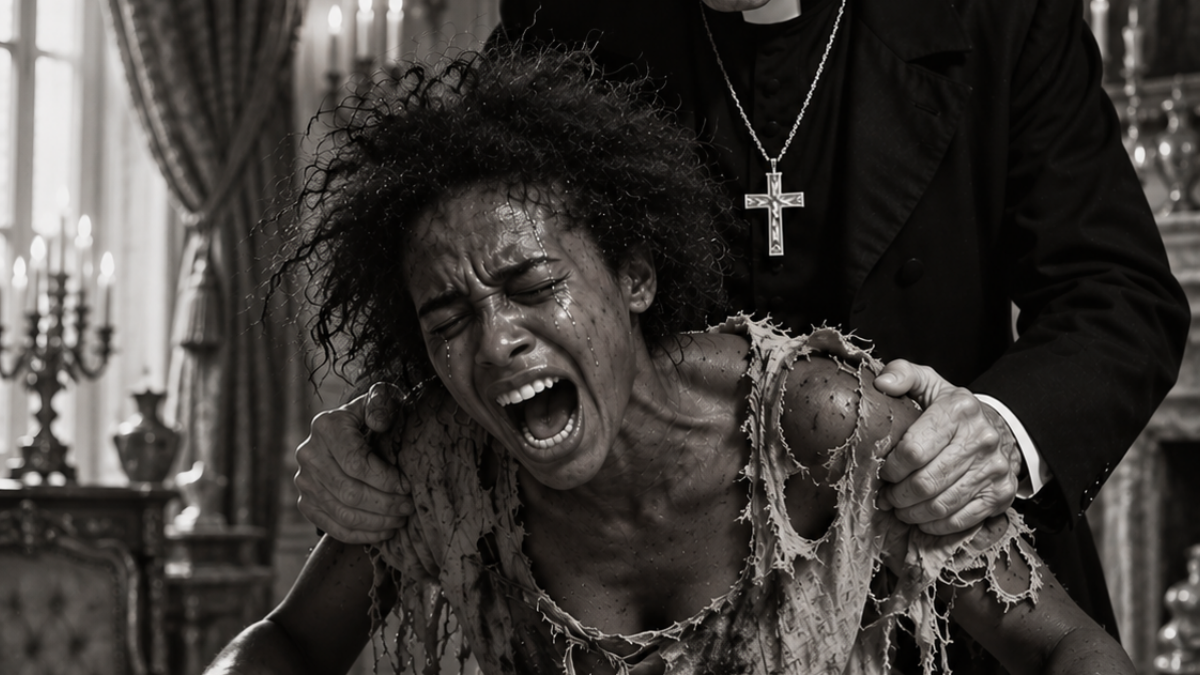
The footsteps outside the chapel grew louder. Abigail’s head snapped toward the wooden doors. Father Whitmore heard them too.
Hope flashed across his face, sudden and desperate, and he opened his mouth to shout.
Abigail tightened the rope just enough to silence him. “Not a sound.” A lantern glowed beyond the stained glass.
Someone crossed the courtyard, boots scraping against wet stones. Abigail could hear rain beginning to strike the chapel roof, first in scattered taps, then in a steady hiss.
Father Whitmore stared at her. “There are things you don’t know,” he rasped. Abigail’s hands remained locked around the rope.
“What things?” “The girls.” For the first time that night, she hesitated. Whitmore swallowed painfully.
“You weren’t the first.” A fist struck the chapel door. “Father?” Abigail recognized the voice.
Thomas Crane, one of the estate’s overseers. Father Whitmore tried to answer, but Abigail pulled him backward into the darkness beside the altar.
“Father?” Crane called again. The door handle rattled. Abigail’s heart hammered so violently she could feel it in her throat.
She grabbed a heavy brass candlestick and held it against her chest, ready for the door to open.
Instead, Crane muttered something under his breath. His footsteps slowly faded. Abigail waited. Ten seconds.
Twenty. Thirty. Only the rain remained. She turned back to Whitmore. “What girls?” The priest was trembling now.
Not the theatrical trembling of a preacher describing damnation, but the uncontrollable shaking of a frightened man who finally understood that his title could no longer protect him.
“There were others before you.” “How many?” He looked away. “How many?” “I don’t know.”
The answer hit Abigail harder than she expected. For three years she had believed her suffering was a private nightmare, something that existed between the walls of Whitmore’s bedroom and nowhere else.
Now she imagined other girls standing where she had stood, hearing the same words, staring at the same crucifix, wondering why heaven remained silent.
“Where are they?” “Some were sold.” “And the others?” Whitmore said nothing. Abigail understood. The chapel suddenly seemed colder.
She loosened the rope and pushed him toward the stairs leading to the bell tower.
“Walk.” “Abigail—” “Walk.” He climbed. Each wooden step groaned beneath his weight. Abigail followed close behind, holding the rope like a leash.
Wind screamed through narrow openings in the tower as they climbed higher. At the top hung the great iron bell.
Lightning flashed across Blackwood Valley. For one white instant, the coffee fields appeared below them like an endless black ocean.
Workers’ cabins crouched in the distance. Beyond them stood the manor house where Abigail had spent three years serving a man everyone else called holy.
The bell rope swung gently in the wind. Father Whitmore saw it. His knees nearly failed.
“No.” Abigail said nothing. “No, Abigail. Listen to me.” She reached for the thick rope.
“I can free you.” Her hand stopped. “All of you,” he continued rapidly. “Samuel. Everyone on the estate.
I have documents. I can sign them tonight.” Abigail looked at him. “You could have freed us yesterday.”
“I can do it now.” “You could have stopped hurting me yesterday.” His breathing became faster.
“I was sick.” “You called it sacred.” “I was wrong.” “You called it God’s will.”
“I was wrong!” His voice cracked against the tower walls. Abigail stepped closer. For three years she had dreamed of hearing those words.
Yet they brought no relief. Only emptiness. “You aren’t sorry because of what you did,” she whispered.
“You’re sorry because you’re afraid.” Whitmore collapsed onto his knees. The man who had forced others to kneel before him now knelt before an enslaved woman.
“Please.” Abigail stared down at him. That word. She remembered saying it herself. Please. The first night.
The second. The tenth. Eventually she had stopped saying it because she had learned that begging only entertained him.
“Please,” Whitmore repeated. Abigail’s face hardened. “I know that word.” Thunder shook the tower. She tied the heavy bell rope around him.
Whitmore began fighting. Suddenly there was nothing priestly about him. He clawed at the rope, kicked against the floorboards, screamed for Crane, for the workers, for God.
Abigail struggled to control him. They crashed against the wooden railing. The tower shook. Whitmore seized her wrist and twisted.
Pain shot through her arm. She stumbled. For one terrifying second, he gained the advantage.
“You stupid girl!” His old voice had returned. The frightened penitent vanished, replaced by the man Abigail knew.
“You think anyone will care what I did to you?” He shoved her against the wall.
“You are property!” Abigail’s head struck wood. Her vision blurred. Whitmore lunged for the stairs.
She grabbed the loose end of the rope. He stopped violently. They stared at each other.
Then Abigail pulled. Whitmore fell backward. The rope snapped taut. The bell moved. BOOM. The sound exploded through the tower.
Whitmore’s eyes widened. Abigail pulled again. BOOM. Across Saint Mercy Estate, lamps appeared in windows.
Workers stepped from their cabins. Crane turned toward the chapel. Samuel Gray lifted his head into the rain.
BOOM. The bell had never rung at this hour. Something was wrong. People began running.
Inside the tower, Whitmore desperately tried to loosen the rope. Abigail braced both feet against a beam and pulled with every ounce of strength left in her body.
The bell swung again. BOOM. “Stop!” Whitmore’s voice had become a strangled whisper. Abigail looked directly into his eyes.
“No.” She pulled once more. Then the struggle ended. For several seconds, Abigail could hear nothing except the bell vibrating above her and rain beating against the roof.
She released the rope. Her hands were bleeding from friction. She looked at them almost curiously.
Then she descended. Slowly. One step at a time. When she reached the chapel floor, the doors burst open.
Crane entered first with a lantern. Samuel and several workers crowded behind him. Nobody spoke.
Their eyes moved upward. The bell gave one final, fading toll. Crane’s lantern shook. “My God.”
Abigail walked toward the altar. “Abigail,” Samuel whispered. She turned toward him. His expression contained horror, understanding, and grief all at once.
“Tell them,” she said. Samuel knew exactly what she meant. “I promised.” Within an hour, mounted officers arrived from the nearest town.
Abigail made no attempt to escape. When an officer asked who had killed Father Whitmore, she stepped forward.
“I did.” Crane stared at her as though she had become something impossible. The officer bound her wrists.
Samuel watched silently. As they led Abigail outside, dozens of enslaved workers stood in the rain.
Nobody dared cheer. Nobody dared move. But they looked at her. For perhaps the first time in her life, Abigail walked through Saint Mercy Estate without lowering her eyes.
News traveled faster than any horse. A priest had been killed. Not merely killed, whispered the townspeople, but killed by an enslaved woman inside his own chapel.
Within days, Abigail’s name was being spoken in taverns, churches, plantation houses, kitchens, and workers’ quarters across Blackwood Valley.
Her trial became a public spectacle. The courtroom overflowed. Landowners demanded punishment. Church officials insisted that Father Whitmore’s reputation should not be destroyed by accusations he could no longer answer.
Then Samuel Gray testified. He described Abigail’s years of fear. He described the nighttime summons.
He described the threats. Then other voices appeared. An elderly woman testified that her daughter had served Whitmore years earlier and had been sold suddenly after becoming pregnant.
Another man remembered a young servant who disappeared after threatening to expose the priest. A former worker described screams from the rectory at night.
The courtroom grew quieter with every testimony. Finally Abigail was brought forward. She wore a plain gray dress.
Her wrists were chained, but she stood straight. “Did you kill Jonathan Whitmore?” The prosecutor asked.
“Yes.” “Did you plan his death?” “Yes.” “Do you regret it?” Abigail looked toward the crowded gallery.
Samuel was there. So were several workers from Saint Mercy. She thought carefully before answering.
“I regret that I lived in a world where a girl had to become dangerous before anyone cared that she was in danger.”
Nobody moved. The judge sentenced her to death. The execution was scheduled for dawn two weeks later.
During those two weeks, something unexpected happened. Abigail’s story escaped the courtroom. Copies of testimony circulated through the valley.
Questions began appearing that powerful men had hoped nobody would ask. How many people had known?
How many had remained silent? How many other estates hid similar crimes? On the morning of Abigail’s execution, hundreds gathered around the square.
A cold mist hung over the rooftops. Abigail climbed the wooden steps without assistance. Samuel stood near the front of the crowd.
Their eyes met. She smiled faintly. He placed one hand over his heart. The executioner asked whether she had any final words.
Abigail looked across the faces before her. Some hated her. Some feared her. Some quietly wept.
“I was born without freedom,” she said. “I lived without freedom. But there was one thing no person ever owned.”
She touched her chest. “My choice to stop being silent.” The square became completely still.
“If you remember me, don’t remember the rope.” Her eyes found Samuel again. “Remember why it was there.”
The executioner stepped forward. Samuel closed his eyes. A church bell began ringing somewhere beyond the square.
Years passed. Saint Mercy Estate never recovered. Whitmore’s successors tried to erase the scandal, but workers carried Abigail’s story wherever they went.
Samuel repeated it until age bent his back and weakened his voice. When slavery finally ended decades later, he was still alive.
On his first morning as a legally free man, Samuel returned to the abandoned chapel.
The roof had partially collapsed. Weeds covered the entrance. Birds nested in the tower. He climbed the old stairs slowly, leaning on a wooden cane.
The bell remained. So did the rope. Samuel placed one hand against it. For a moment he was young again, standing in the rain while Abigail was led away in chains.
He remembered her final request. Tell them. Samuel had kept his promise. He walked outside as sunlight broke through the clouds.
Near the chapel stood a group of children whose parents had once been enslaved. One girl approached him.
“mr. Gray?” “Yes?” “Is it true what they say about this place?” Samuel looked back at the bell tower.
“What do they say?” “That a woman once fought back against a man everyone was afraid of.”
Samuel smiled. “They’ve got part of it right.” The children gathered closer. “What part did they get wrong?”
Samuel lowered himself onto a stone. “The important part.” They waited. “She wasn’t fearless,” he said.
“She was terrified. Courage isn’t having no fear. Sometimes courage is deciding that something else matters more.”
Wind moved through the coffee trees. High above them, the old bell shifted. A single note rolled across Blackwood Valley.
The children looked upward. Samuel did too. Then he smiled. For decades, that bell had summoned people to obey.
Now its sound meant something else. Abigail Reed had entered Saint Mercy Estate as property, lived there as a victim, and left it in chains.
Yet the story that remained belonged to no master. And no one could silence it again.
Disclaimer: This story is entirely fictional and was created solely for entertainment purposes. It does not represent any organization or individual, nor does it promote inappropriate behavior.
This content was created with the assistance of AI.








