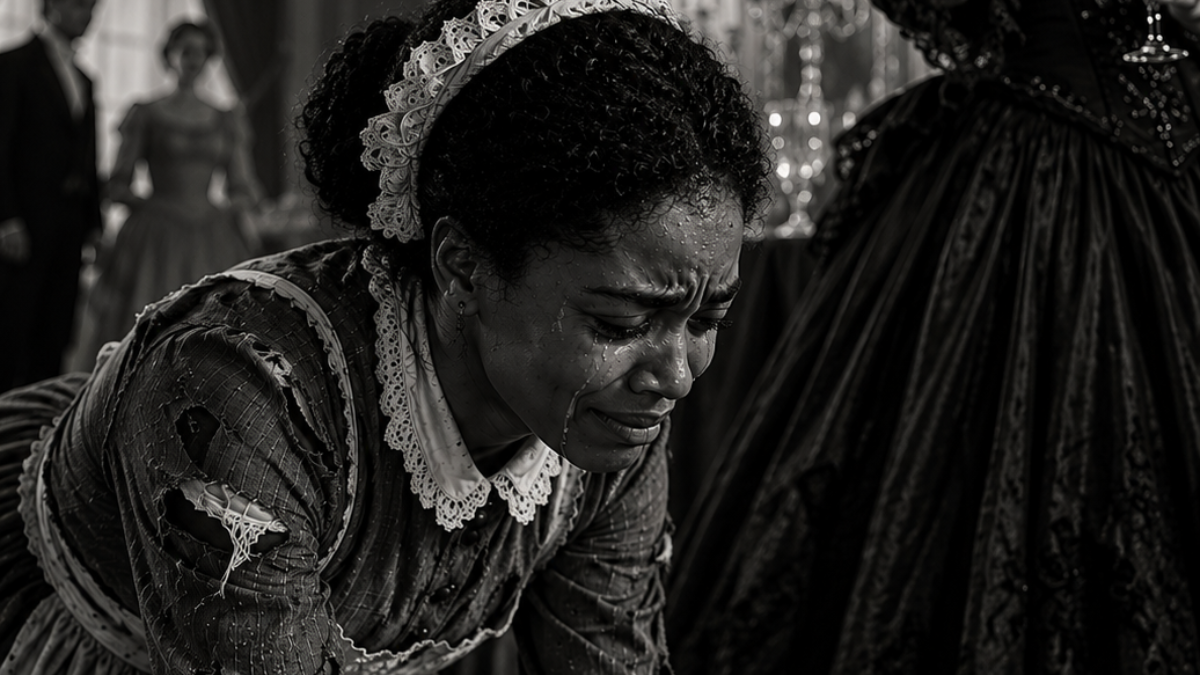
The Mistress Forced Her Enslaved Maid to Kneel Before Everyone—But One Silent Guest Was About to Destroy Everything She Had Built
PART 2
Daniel’s hand remained frozen around the brass handle. “I know what you’re planning,” his uncle repeated from the hallway.
For one terrible second, Daniel could hear nothing but the pounding of his own heart.
The folded pages inside his coat suddenly seemed impossibly loud, as though the paper itself might betray him with every breath he took.
He opened the door. His uncle stood there in his shirtsleeves, his face gray from a sleepless night.
Behind him, morning light stretched across the corridor, catching dust in the air. “You’re going back to that house,” his uncle said.
“Don’t.” Daniel stared at him. Then he understood. His uncle didn’t know about the article.
“Why would I go back?” “To confront Margaret.” His uncle lowered his voice. “I saw your face last night.
Whatever you think you’re going to accomplish, forget it.” Daniel felt the tension leave his shoulders, but only for an instant.
His uncle stepped closer. “The Whitmores have friends everywhere. You are twenty-three years old. You have no position, no money of your own, and no idea how quickly powerful people can close doors.”
Daniel’s fingers pressed against the manuscript beneath his coat. “Then perhaps someone should open a window.”
His uncle frowned. Daniel walked past him. “Where are you going?” “For air.” “Daniel.” He did not turn around.
By eight o’clock, the streets were already alive with wagon wheels, vendors calling from corners, horses striking the stones with iron shoes.
Daniel moved through the crowd quickly, one hand repeatedly touching his coat to make certain the pages were still there.
At every intersection he imagined someone following him. Nobody was. Still, he walked faster. He finally entered a narrow printing office where the smell of ink struck him before the door had fully closed.
Metal type clicked against trays, presses groaned rhythmically, and men shouted over the machinery while stacks of fresh newspapers rose beside the walls.
Daniel approached a thin young clerk. “I have something for the editor.” “Your name?” “No name.”
The clerk barely looked at him. “No name, no meeting.” Daniel pulled the manuscript from his coat.
“Then don’t give me a meeting. Give him this.” The clerk glanced at the first page.
His expression changed. He read another line. Then another. The noise of the press seemed to recede around them.
“You witnessed this?” Daniel hesitated. “Yes.” The clerk looked toward the back room. “Wait.” Daniel waited twenty-seven minutes.
They felt like hours. Finally the clerk returned without the manuscript. “The editor will read it.”
“Will he publish it?” “I said he’ll read it.” Daniel leaned closer. “The woman in that story is still inside that house.”
The clerk met his eyes. “I understand.” Daniel stepped back into the street with nothing in his hands.
For the first time since the dinner, he felt afraid not of what might happen if the article appeared—but of what might happen if it didn’t.
Three days passed. Nothing. On the fourth morning, Margaret Whitmore sat at breakfast complaining that her tea had gone cold.
Eleanor stood beside the sideboard. Outside, rain tapped against the tall windows. A servant entered carrying several newspapers tied with string and placed them beside mr. Whitmore’s plate.
Margaret barely noticed. Her husband did. He unfolded the first paper. The room became strangely quiet.
Eleanor heard the crisp rustle of the page. Then nothing. mr. Whitmore stopped chewing. Margaret looked across the table.
“What?” He kept reading. “What is it?” His eyes moved rapidly down the column. Then he slammed the newspaper onto the table so hard that the silverware jumped.
Eleanor flinched. Margaret stared at him. “What on earth—” “Read it.” He shoved the paper toward her.
Margaret pulled it closer. Her irritation disappeared after the first paragraph. By the second, her lips had parted.
By the third, the color was draining from her face. The article described an elegant dinner in Bayside.
Thirty guests. An enslaved woman asked to sing. A supposed wrong note. A command to kneel.
An apology demanded before the entire room. No names appeared. None were necessary. Margaret’s hands began trembling.
“Who wrote this?” Her husband said nothing. “Who wrote this?” She stood so quickly that her chair scraped violently across the floor.
Eleanor felt her stomach tighten. Margaret looked directly at her. “You.” Eleanor’s eyes widened. “Ma’am?”
“You told someone.” “No, ma’am.” “You lying little—” Margaret rushed around the table. mr. Whitmore caught her wrist.
“Stop.” Margaret spun toward him. “She did this!” “She cannot write.” The words landed brutally.
Eleanor lowered her eyes. Margaret breathed hard. “Then she told someone.” “There were thirty witnesses.”
Margaret stared at her husband. He released her wrist. “And apparently one of them had a conscience.”
For the first time Eleanor had ever seen, Margaret had no answer. By noon, the article had traveled farther than Daniel imagined possible.
Copies appeared in cafés, offices, drawing rooms and carriage houses. People read sections aloud, lowered their voices, then immediately began guessing the identity of the unnamed hostess.
By evening, the guesses had become certainty. The Whitmore dinner had been too distinctive. Everyone knew.
The first invitation cancellation arrived the next morning. Then another. Then three more. A prominent merchant sent apologies for being “unexpectedly unavailable.”
A judge’s wife postponed a visit indefinitely. Two families who had attended Margaret’s dinners for years suddenly discovered other obligations.
Margaret began tearing the notes apart as soon as they arrived. But paper could not stop whispers.
One afternoon she entered a fashionable shop and heard two women talking behind a display.
“…made the poor woman kneel…” Margaret stopped. The women saw her. Silence. That silence was worse than laughter.
She walked out without purchasing anything. At home, her fury grew sharper. Doors slammed. Glasses shattered.
Servants learned to disappear when her footsteps approached. Eleanor lived in constant fear that Margaret would punish her for a story she had never told.
Then, one evening, the front door opened with such force that everyone in the house heard it.
mr. Whitmore stormed inside. His face was red. He went directly to the drawing room where Margaret was sitting.
“Three contracts.” Margaret looked up. “What?” “I lost three contracts this week.” “That has nothing to do with me.”
“It has everything to do with you!” His voice shook the room. Eleanor stood in the hallway, unseen.
mr. Whitmore threw a newspaper onto the table. “Do you understand what people are calling this house?”
Margaret rose. “So now you believe gossip?” “I believe customers who refuse to meet me!”
“I did nothing illegal.” “No,” he said quietly. “You merely made cruelty into entertainment in front of thirty people.”
Margaret recoiled as though he had struck her. “You were there.” “And I should have stopped you.”
Silence. Even Eleanor stopped breathing. mr. Whitmore’s voice dropped. “That is the part I cannot defend.”
Margaret’s eyes filled with rage. “You expect me to apologize to her?” “I expect you to fix this.”
“How?” He looked toward the hallway. Toward Eleanor. Margaret followed his gaze. And Eleanor understood before either of them spoke.
“No.” Margaret’s voice was barely audible. Her husband did not move. “No,” she repeated. “You want the invitations to return?
You want people to believe you have changed?” Margaret’s jaw tightened. “Then prove it.” Two months later, Eleanor stood in the same drawing room where she had once been ordered to kneel.
A lawyer sat at the table. Rain whispered against the windows. Margaret stood near the fireplace, rigid and pale, refusing to look at her.
The lawyer opened a document. He read slowly. Eleanor understood only pieces at first. Her name.
Her age. Then one word. Free. She looked up. “Would you repeat that?” The lawyer did.
The document declared Eleanor Reed a free woman. Her knees weakened. For a terrifying instant, she thought she might fall.
Margaret finally looked at her. “After everything I have done for you,” she said coldly, “I hope you understand how generous this is.”
Eleanor stared at her. There were a hundred things she could have said. Instead she said only, “May I have the paper?”
The lawyer handed it to her. Eleanor held it with both hands. It weighed almost nothing.
Yet she had never held anything heavier. She walked out of the Whitmore mansion carrying everything she owned in one small bag.
At the gate she stopped. Behind her stood the house where she had spent most of her life.
The windows glowed in the evening. For years those windows had meant captivity. Now they were simply windows.
Eleanor stepped into the street. And kept walking. Months later, Daniel attended a fundraising gathering organized by an abolitionist society.
He stood near the back of a crowded hall when a woman walked onto the small stage.
He recognized her immediately. Eleanor. But something about her was different. Not her face. Not her clothes.
The way she stood. Nobody had ordered her onto that stage. Nobody owned the song she was about to sing.
The room became silent. Eleanor began. Her voice was stronger than Daniel remembered. The same warmth filled it, the same ache, but now there was something else woven through every note.
Choice. When the song ended, the audience erupted. People stood. Coins and bills dropped into collection boxes to help purchase freedom for others still enslaved.
Daniel remained motionless. Eleanor noticed him. Their eyes met across the room. She walked toward him after the crowd began thinning.
“You were at the dinner,” she said. Daniel swallowed. “Yes.” “I remember you.” He looked uncomfortable.
“I’m sorry.” “For what?” “For sitting there.” Eleanor studied him. “You didn’t laugh.” “I didn’t stop it either.”
“No.” Daniel lowered his eyes. Then Eleanor said quietly, “But somebody wrote about it.” He looked up.
Neither spoke. The noise of the hall continued around them. Finally Eleanor smiled—not because she needed an answer, but because she already had one.
“You should know something,” she said. Daniel waited. “The money from tonight will help free a mother and her two children.”
His eyes filled. Eleanor glanced toward the stage. “She once made me sing so people would admire her.”
Then she looked back at him. “Now I sing so somebody else can walk out of a house like hers.”
Over the following years, Eleanor performed again and again at abolitionist gatherings. Her voice helped fill collection boxes.
Those collections helped purchase freedom. One person. Then another. Then another. The woman once forced to kneel became known in those rooms not for the humiliation she had suffered, but for what she did afterward.
And Daniel never publicly claimed credit for the article. He did not need to. Four years after that terrible dinner, slavery finally ended across the country.
On the evening the news reached Bayside, streets filled with shouting. Church bells rang. People embraced strangers.
Eleanor stood among the crowd as sound rolled through the city like thunder. She closed her eyes.
For one moment she heard another room. Crystal glasses. Polite laughter. Margaret’s voice ordering her to kneel.
Then the memory disappeared beneath the bells. Eleanor opened her eyes. Beside her stood Daniel, older now.
Neither said anything. They simply listened. Years later, people would remember the scandal differently. Some remembered the newspaper article.
Some remembered the wealthy hostess whose cruelty had become public. Others remembered the anonymous witness who refused to remain silent.
But Eleanor remembered something smaller. A sheet of paper in her hands. A gate opening.
The first step into the street when nobody had the right to order her back.
And whenever she sang the song her mother had taught her, she no longer remembered Margaret standing above her.
She remembered Rose. There are things another person may take from you. But guard your voice carefully.
It can remain yours. Margaret had believed humiliation would remind Eleanor who she was. Instead, that humiliation exposed Margaret.
She had forced Eleanor onto her knees to demonstrate her power before thirty people, never imagining that somewhere among those silent faces sat one man willing to turn what he had witnessed into words.
But Daniel’s article was only the spark. Eleanor was what came afterward. Because the voice once used as proof that another human being owned her eventually helped other people become free.
And that was the part Margaret Whitmore could never undo. She had commanded Eleanor to sing.
She had commanded her to kneel. She had even commanded her to apologize. But years later, when Eleanor stood before another crowded room and opened her mouth to sing, there was one thing no person in that room could command anymore.
Whether she would use her voice. That choice belonged entirely to her.
Disclaimer: This story is entirely fictional and created for entertainment purposes only. It does not represent any organization or individual, nor does it encourage inappropriate behavior. The content was generated with AI assistance.








