The Mistress Ordered Her Slave to Hide Her Deformed Baby—15 Years Later, He Stood Face-to-Face with His Perfect Twin
PART 2
Eleanor’s lips trembled. For several seconds, the only sound in the bedroom was the faint ticking of the brass clock beside her bed.
Edward stood perfectly still, fists clenched, while afternoon light slipped through the curtains in narrow golden blades.
Then his mother whispered the words he would remember for the rest of his life.
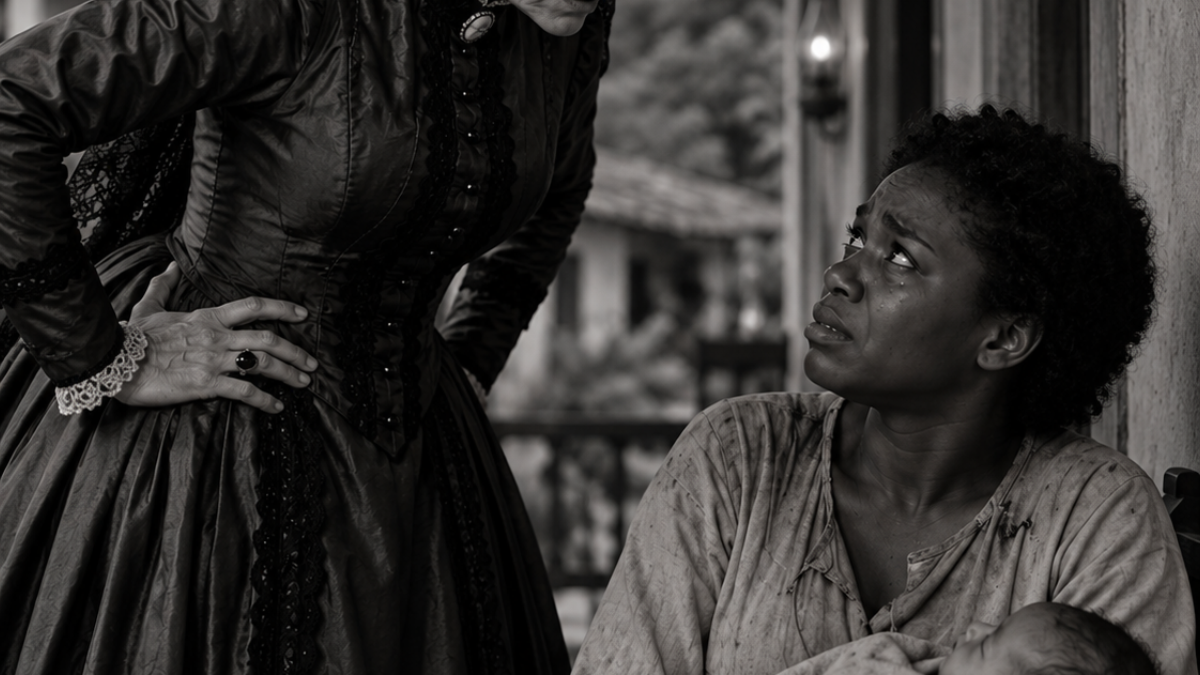
“I told Ruth to kill him.” Edward stared at her. Eleanor covered her mouth, but the confession had already escaped.
“I told her to drown him in the river, abandon him in the woods—anything, as long as no one discovered I had given birth to a child with a cleft lip.”
The silence afterward felt heavier than a scream. Edward stumbled backward until his shoulders struck the door.
Suddenly he saw Samuel kneeling among the shattered pieces of the cedar chest. He heard his own laughter again.
He remembered calling him worthless, remembered the hatred in his own voice—and now understood that the boy he had humiliated had spent fifteen years alive only because an enslaved woman had refused his mother’s command.
“You tried to murder my brother because of his face?” Eleanor lowered her eyes. “And Father?”
“He never knew.” Edward left before she could say another word. He thundered down the staircase, shoved open the front doors, and crossed the courtyard at a run.
Minutes later his horse tore down the road toward Willow Creek, hooves pounding the dry earth like cannon fire.
Dust burned Edward’s eyes, branches clawed at his coat, and sweat ran beneath his collar, but he did not slow.
At Martha Carter’s cottage, another confession was already beginning. Ruth had arrived before him. Samuel stood in the tiny room beside the wooden table while Martha sat trembling on a stool.
Ruth’s voice cracked as she described the stormy morning fifteen years earlier: two newborn boys, one mahogany cradle, one death sentence, and the desperate journey through darkness that had saved his life.
Samuel did not interrupt. His face became frighteningly still. When Ruth finished, he looked at Martha.
“My parents didn’t die of fever?” Martha began crying. “No.” “You lied to me.” “To protect you.”
“My mother wanted me dead.” Martha reached toward him, but Samuel stepped away. “My father doesn’t even know I exist.
My brother destroyed four months of my work without knowing who I was.” His breathing became shallow.
“And every Sunday you came to see me, Ruth. Every Sunday. You knew.” “I knew.”
Samuel pushed open the door and walked outside. The afternoon sun struck him hard. Chickens scattered from the path as he wandered through Willow Creek without knowing where he was going.
Every familiar thing suddenly seemed unreal—the blacksmith’s hammer ringing against iron, wagon wheels grinding through dirt, women calling across the market.
His entire life had been built upon a merciful lie. Then hoofbeats exploded behind him.
Samuel turned. Edward pulled his horse to a violent stop, jumped down before the animal had fully settled, and stood several yards away.
For once, there was no mocking smile on his face. “I know,” Edward said. Samuel stared at him.
“So do I.” Neither moved. They looked at each other beneath the merciless sunlight: the privileged son and the rejected son, separated by seven minutes at birth and fifteen years of choices made by other people.
“I’m sorry about the chest,” Edward said. Samuel almost laughed. “The chest?” Edward lowered his eyes.
“You think this is about furniture?” “No.” “You rode into my village because you were bored.
You destroyed something I spent four months making. You called me a dog.” Samuel stepped closer.
“And now you discover we share blood, so suddenly I deserve an apology?” Edward had no answer.
Samuel’s voice dropped. “Would you be sorry if I weren’t your brother?” That question struck harder than any fist.
Edward opened his mouth, then closed it. “No,” he finally admitted. Samuel nodded slowly. “Then go home.”
Edward did. But nothing at Blackwood Estate remained the same. Colonel William Whitmore learned the truth that evening.
His roar shook the mansion. A chair crashed against the bedroom wall. Servants froze in the corridors as fifteen years of deception collapsed in a single confrontation.
“You told me there was one child!” Eleanor wept uncontrollably. William rode to Willow Creek the following morning.
When Samuel opened Martha’s door, the colonel seemed to forget how to breathe. He saw his own eyes in the boy’s face, his own jaw, his father’s nose.
Even the shape of Samuel’s hands resembled Edward’s. “My son,” William whispered. Samuel’s expression hardened.
“Don’t call me that.” The colonel flinched. William offered recognition, money, land, education—everything a wealthy man knew how to offer.
Samuel refused it all. “I already have a family,” he said, glancing toward Martha and Ruth.
“The people who kept me alive when yours wanted me gone.” William left with tears on his face.
Weeks passed. Then months. Edward began returning to Willow Creek. At first Samuel refused to speak to him.
Edward would stand awkwardly outside Henry Turner’s workshop while saws rasped through timber and hammers struck nails.
Eventually he stopped arriving in polished boots and expensive coats. One morning he appeared wearing an ordinary shirt, rolled up his sleeves, and silently began carrying lumber.
Samuel watched him struggle with a heavy cedar plank. “You’re holding it wrong.” “I know.”
“No, you don’t.” For the first time, Samuel almost smiled. Reconciliation did not happen in a single dramatic moment.
Edward had spent fifteen years becoming cruel; he could not become decent in fifteen days.
He slipped backward. He lost his temper. Samuel challenged him. Edward learned to apologize without expecting forgiveness as payment.
Slowly, something changed. The brothers discovered the same dry humor, the same dislike of boiled carrots, the same habit of tapping their fingers when nervous.
Sometimes they would reach for the same tool simultaneously and stare at each other in disbelief.
Blood had remembered what life had tried to erase. Eleanor watched the transformation from behind the curtains of Blackwood Estate.
Her health deteriorated rapidly. Guilt, sleeplessness, and years of laudanum reduced her to a shadow of the beautiful young woman who had once ordered a newborn child erased because she feared society’s judgment.
Two years after the truth emerged, she asked to see Samuel. He nearly refused. Then Martha said quietly, “Forgiveness and reconciliation are not the same thing.
You can release hatred without pretending nothing happened.” Samuel went. Eleanor lay in the same bedroom where the twins had been born.
Her hair was streaked with gray, her cheeks hollow. Rain tapped softly against the windows.
Samuel stopped beside the bed. She looked at his cleft lip. This time she did not turn away.
“I spent fifteen years afraid you would return,” she whispered. “Now I understand I was afraid because your existence proved what I had done.”
Samuel said nothing. “I cannot ask you to love me.” “No.” “I cannot ask you to call me Mother.”
“No.” Tears filled her eyes. “Can you forgive me?” Samuel stood there for a long time.
Then he remembered Martha’s hands washing clothes until the skin cracked. Ruth walking miles every Sunday.
Henry teaching him to turn rough wood into beauty. “I forgive you,” he said. Eleanor sobbed.
“But not because what you did was small. I forgive you because I refuse to let what you did decide what kind of man I become.”
She died that night. Years moved forward. William legally recognized Samuel as his son and rewrote his will so that both brothers would inherit equally.
Samuel resisted until Edward confronted him inside Henry’s workshop. “This isn’t charity,” Edward said. “It was always yours.”
Samuel eventually accepted his inheritance on one condition: much of it would be used for something greater than either brother.
In 1876, construction began outside Willow Creek. Hammers rang from sunrise until dusk. Brick walls rose where weeds had grown.
Windows appeared, then workshops, dormitories, classrooms, and long wooden benches. Above the entrance hung a simple sign:
THE HENRY TURNER SCHOOL OF TRADES. Poor children came first. Then orphans. Then children of freed families.
They learned carpentry, blacksmithing, tailoring, shoemaking, reading, arithmetic, and something Samuel considered even more important—the knowledge that poverty, birth, or appearance did not determine human worth.
Henry Turner lived long enough to see the first students graduate. Standing beside Samuel beneath the school’s doorway, the old carpenter wiped his eyes with the back of his scarred hand.
“You made the wood sing, boy,” he whispered. Samuel shook his head. “We did.” Ruth died years later after an illness contracted in the miserable quarters where she had spent most of her life.
Samuel remained beside her until her breathing became shallow. “You saved me,” he whispered. Ruth smiled weakly.
“No, child. I carried you down a road. You did the living.” When she died, Samuel and Edward buried her with honor.
On her stone they carved: SHE REFUSED TO OBEY CRUELTY. Time continued its relentless march.
William died an old man after years spent trying, imperfectly, to repair what his household had broken.
Henry followed. Martha lived long enough to see Samuel marry, become a father, and fill the little cottage with grandchildren who climbed into her lap and called her Grandma.
Samuel never hid his scar. When two of his children were born with cleft lips, he held them proudly before the family.
“They are beautiful,” he said. Edward stood beside him. “Yes,” he replied. “They are.” Decades after the afternoon when Edward destroyed the cedar chest, the brothers entered Henry Turner’s old workshop together.
Dust floated through beams of sunlight. The same stone floor remained beneath their feet. Samuel opened a cloth covering an object on the workbench.
It was a small cedar chest. Mother-of-pearl birds flew across its polished surface. Edward recognized the design immediately.
His eyes filled with tears. “You remade it.” “No,” Samuel said. “The original belonged to anger.
This one doesn’t.” He handed Edward the chest. Inside lay the Whitmore family ring Edward had once offered him.
Edward looked up. “I thought you didn’t want the name.” Samuel smiled. “I didn’t then.”
“And now?” “Now I know a name belongs to whoever gives it meaning.” Edward embraced him.
For several seconds neither man spoke. Outside, the school bell rang, followed by the thunder of young feet and laughter spilling across the courtyard.
Hundreds of students moved between workshops carrying timber, tools, books, and possibilities that had once been denied to boys like Samuel.
The brothers stepped into the sunlight. Samuel looked across the courtyard and understood something that had taken him a lifetime to learn.
His mother had once believed the cleft in his lip would bring shame upon her family.
Instead, the child she tried to erase had become the man who gave that family its most honorable legacy.
And Edward—the supposedly perfect child—had learned that perfection without compassion was emptiness. One brother had been born with a visible scar.
The other had carried invisible ones. In the end, neither wealth nor blood had saved them.
Truth had. Choice had. And the courage of one woman who, on a dark morning many years before, had held a condemned newborn against her chest and decided that cruelty would go no further.
Disclaimer: This story is entirely fictional and was created solely for entertainment purposes. It does not represent any organization or individual, nor does it promote inappropriate behavior.
This content was created with the assistance of AI.








