The Plantation Master Who Knelt Before the Man He Owned — The Forbidden Secret of 1838
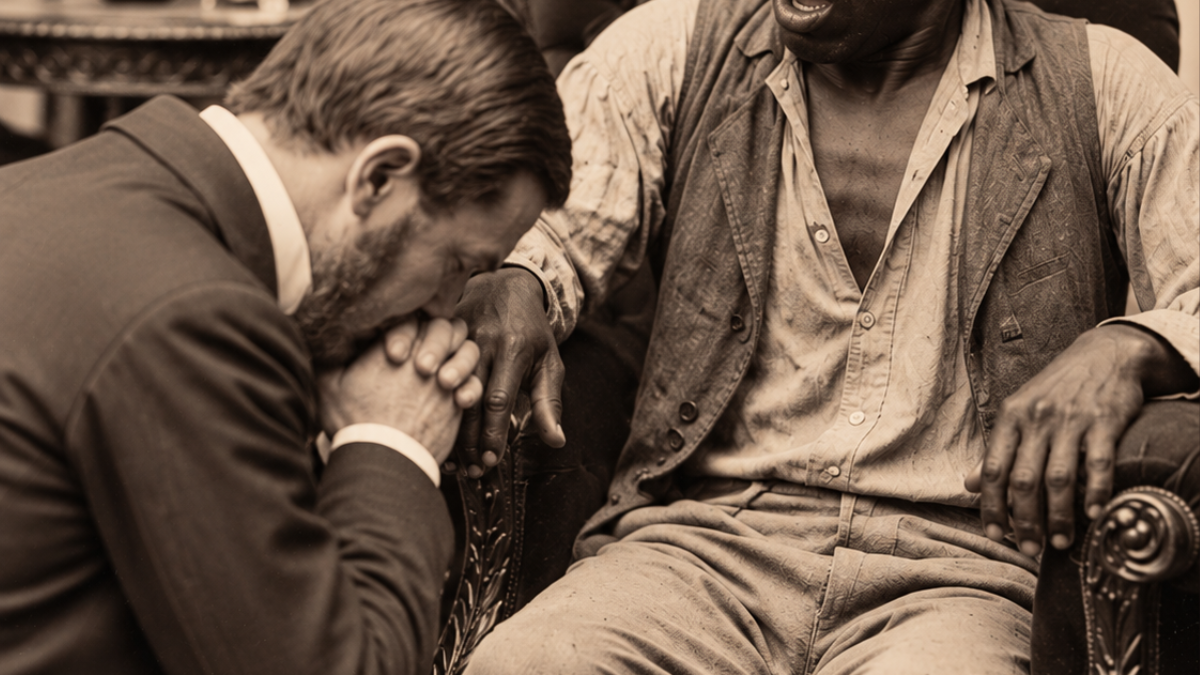
PART 2
Eleanor found the object just after sunrise. It lay in the center of Edmund’s desk, where she was certain there had been nothing the night before: a tarnished silver pocket watch, its lid blackened around the edges as though it had survived a fire.
The study smelled of wet earth, woodsmoke, and something metallic. Muddy footprints crossed the carpet from the doorway to the desk, but there were no prints leading back out.
Eleanor hesitated before touching the watch. When she finally opened it, the hinge gave a dry click.
Inside the lid, beneath decades of scratches, four words had been engraved: PROPERTY OF JONATHAN VALE, 1829.
Her stomach tightened. She knew that name. Jonathan Vale had owned Isaiah before the Louisiana planter who died of heart failure.
According to the stories Isaiah had told Edmund, Vale had tried to force the priest to surrender his knowledge.
Within months, the man had been committed to an asylum, screaming that invisible voices were following him through the walls.
Eleanor dropped the watch. It struck the desk with a sharp metallic crack. Behind her, someone breathed.
She spun around. Edmund stood in the doorway. His trousers were stained with red Georgia clay.
Ash streaked his cheeks. His eyes were bloodshot, and there was dried blood beneath his nose, but the expression on his face frightened Eleanor more than any wound could have.
He looked peaceful. “What happened to you?” Edmund glanced at the watch. “So he brought it.”
“Who?” “Isaiah.” Eleanor stepped away from the desk. “That belonged to Jonathan Vale.” “Yes.” “How did it get here?”
Edmund looked toward the window, where the first sunlight was crawling across the cotton fields.
“I don’t know.” For the first time since their marriage, Eleanor saw something approaching wonder in her husband’s face.
“But I watched Vale give it to him last night.” Eleanor stared at him. “Jonathan Vale is dead.”
“I know.” Three days later, William Harker resigned. He entered Edmund’s study shortly before noon, threw a ring of plantation keys onto the desk, and said he would not spend another night at Blackridge.
His hands shook so badly that the keys rattled against the wood. “Something walks those fields after dark,” Harker said.
“I’ve heard it outside my window.” Edmund barely looked up. “What did you hear?” Harker swallowed.
“Men crying.” He pointed toward the slave quarters. “Dead men.” Edmund told him to go home.
Harker left before sunset. He never reached town. His horse returned alone shortly before midnight, foam covering its mouth and saddle leather torn nearly in half.
Harker’s body was discovered the following morning beside the southern road. There were no wounds on him, no blood, no evidence of robbery.
But both knees of his trousers were soaked with mud. He had died kneeling. After that, fear spread beyond Blackridge.
Neighbors stopped visiting. Merchants refused to deliver supplies. At church, people moved away when Edmund entered.
Rumors traveled faster than horses: Whitmore had become bewitched; the enslaved had seized control of the estate; African spirits were roaming the fields.
Then four white men died in six days. One was a merchant who had threatened to report Isaiah to the authorities.
He collapsed on Blackridge’s front steps, blood pouring suddenly from his eyes. Another was a neighboring planter who had demanded Isaiah be sold.
His carriage overturned on a perfectly level road, although neither wheel was broken. The third was a minister.
He came carrying a Bible and announced that he intended to “cleanse” Blackridge. Before midnight, he was found hanging from an oak tree at the edge of the property.
The fourth was the physician who examined the bodies. His office burned. Only one wall survived.
On it, someone had drawn three vertical lines in soot. By late August, armed men arrived at Blackridge.
Eleanor watched from an upstairs window as twelve riders approached through clouds of dust. Their leader, Richard Harrow, owned one of the largest plantations in the county.
He dismounted before the front steps with a pistol visible beneath his coat. Edmund came outside wearing white linen.
Isaiah stood several feet behind him. “Send that man away,” Harrow demanded. Edmund said nothing.
“You have allowed a slave to poison your mind. People are dead. Your property is becoming a gathering place for rebellion.”
Still Edmund remained silent. Harrow stepped closer. “If you won’t remove him, we will.” A wind moved across the yard.
Eleanor felt it through the closed window. The curtains lifted behind her. Outside, every horse suddenly became restless.
Isaiah had not moved. Harrow reached for his pistol. “Don’t,” Edmund said. The word was almost gentle.
Harrow drew anyway. Thunder exploded above the house. The sound was so violent that windowpanes shook in their frames.
Horses screamed and reared. One rider fell backward into the dust. Yet there had been no clouds seconds earlier.
Now the sky was black. Harrow stared upward. Lightning tore across the heavens. For a fraction of a second Eleanor saw Isaiah illuminated beneath it, standing perfectly still while his shadow stretched across the ground far beyond where any natural shadow should have ended.
Harrow’s pistol slipped from his hand. The men retreated. None fired a shot. That night Edmund told Eleanor what he intended to do.
He would free every enslaved person at Blackridge. Sixty-three people. Eleanor sat opposite him at the dining table while candles flickered between them.
Outside, drums sounded softly from beyond the fields. “If you do this publicly,” she said, “they will destroy you.”
“They already intend to.” “The bank will take the land.” “Then let them.” “Your family name?”
“Let it disappear.” “Me?” That finally stopped him. For several seconds neither spoke. Then Edmund reached across the table.
Eleanor withdrew her hand. His fingers remained resting alone on the white cloth. “I never asked you to follow me,” he said.
“No. You simply walked somewhere I couldn’t follow.” At ten o’clock on the morning of September 15, nearly fifty people gathered outside Blackridge’s gates.
They had heard what Edmund intended. Some came out of curiosity. Others carried rifles. Edmund walked from the house with emancipation papers beneath his arm.
Isaiah walked beside him. Behind them came the sixty-three men, women, and children Edmund had legally owned the previous morning.
Richard Harrow pushed through the crowd. “You sign those papers and you’re finished.” Edmund stopped.
For a moment Eleanor thought she saw the old Edmund again—the cautious planter who calculated cotton prices, attended church, worried about reputation.
Then the moment vanished. He unfolded the papers. “I was finished months ago.” The crowd erupted.
Someone shouted traitor. Another man raised a rifle. Edmund signed the first page. Thunder rolled across a cloudless sky.
He signed the second. Wind struck the plantation like a wall. Dust exploded from the road.
Hats vanished into the fields. Horses tore free from their reins. He signed the final page.
The first drops of rain hit the paper. Isaiah leaned over and added his name as witness.
For one impossible instant, every sound stopped. No wind. No thunder. No voices. Then lightning struck the enormous oak beside the gates.
The trunk exploded. The crowd scattered. By sunset, sixty-three people at Blackridge were legally free.
By midnight, Richard Harrow was dead. Sixteen days later, the death toll reached seventeen. County officials closed the road to Blackridge, claiming there was an outbreak of disease.
Records concerning the property began disappearing. Merchants stopped mentioning the Whitmore name. Newspapers printed nothing.
Blackridge was being erased while it still existed. But Edmund no longer cared. Something else was approaching.
On October 23, Eleanor awoke at 11:47 p.m. To drums. Not distant drums. They seemed to be beating inside the house.
She stepped into the hallway barefoot. Boom. Boom. Boom. The floor vibrated beneath her feet.
At the eastern end of the corridor, light leaked beneath a door Edmund had kept locked for weeks.
She saw him approaching it. Isaiah was already waiting. Edmund unlocked the door. Eleanor followed.
What she saw inside stopped her breath. The room had been transformed. Symbols covered the walls in ash and dark red pigment.
Candles burned in seven circles across the floor. At the center stood an altar covered with fruit, iron tools, bowls of honey and the silver watch that had belonged to Jonathan Vale.
Isaiah turned toward Edmund. “Are you ready?” Edmund nodded. “You freed them. You surrendered your authority.
You surrendered your name.” Isaiah’s voice became quieter. “One thing remains.” Eleanor entered. “What?” Isaiah looked directly at her.
“Him.” The drums accelerated. Edmund stepped toward the altar. Eleanor seized his arm. “No.” He looked at her with terrible tenderness.
“You think this ends with you dying?” “I don’t know whether I’m dying.” “Then what are you doing?”
Edmund looked toward Isaiah. “Crossing.” Eleanor slapped him. The sound cracked through the room. “Listen to yourself!
You have given away your fortune, your marriage, your life. Isn’t that enough?” Edmund touched his cheek.
Then he smiled sadly. “I spent thirty-four years believing human beings belonged to me. Maybe losing everything is the first honest thing I’ve ever done.”
The candles bent simultaneously. There was no wind. Isaiah began chanting. Eleanor screamed at him to stop.
The drums became deafening. The walls shook. Edmund stepped into the innermost circle. Lightning flashed outside.
Once. Twice. Then every candle went out. Darkness swallowed the room. Eleanor heard Edmund inhale sharply.
She lunged forward. Her fingers touched his sleeve. Then something struck the house. The explosion threw her backward.
For several seconds she could hear nothing except a high ringing inside her skull. Then—
Silence. “E-Edmund?” No answer. “Edmund!” She crawled across the floor until she found the door.
Moonlight spilled through the hallway. She turned. The room was empty. No Isaiah. No altar.
No symbols. No candles. No Edmund. Only his white clothes lay folded neatly in the center of the floor.
Eleanor screamed until her throat bled. At dawn she ran outside. The cabins were empty.
All sixty-three freed people had vanished. Beds remained unmade. A pot of beans still sat beside cold ashes.
A child’s wooden toy lay outside one doorway. But there was nobody anywhere. She searched the fields.
The woods. The road. Nothing. Sixty-five human beings—Isaiah, Edmund and every freed person at Blackridge—had disappeared in a single night.
Eleanor locked the eastern room. She never opened it again. When officials questioned her, she said Edmund had gone insane and fled.
She said nothing about Isaiah. Nothing about the drums. Nothing about what she had seen.
Blackridge slowly died around her. Cotton fields became weeds. Vines climbed the empty cabins. Roofs collapsed beneath rain and heat.
Eleanor remained for fourteen years. When she died, the property was sold with one condition written into the deed:
The eastern room must never be opened. The next family obeyed. Their children sometimes complained about sounds behind the wall.
Whispering. Seeds rattling inside dried gourds. And drums. Then, in 1865, Blackridge Manor burned. The fire began in the eastern room.
By sunrise nothing remained except blackened foundations and four stone columns. Years passed. Then decades.
Blackridge disappeared from maps. The road changed. The woods swallowed the fields. But in 1897, nearly sixty years after Edmund Whitmore vanished, a newspaper reporter in Philadelphia interviewed an elderly Black man about spiritual traditions preserved by formerly enslaved communities.
The reporter noticed three scars on each of the man’s cheeks. He asked his name.
The old man smiled. “Isaiah.” The reporter later described something peculiar. Isaiah did not look elderly.
He looked approximately forty. Beside him sat a wooden box. Inside were several objects he refused to explain.
A silver pocket watch. A folded emancipation document dated September 15, 1838. And a small portrait.
The reporter picked it up. It showed a white man wearing plain clothes, standing among a group of free Black families outside a brick building somewhere in the North.
The photograph appeared to have been taken decades after Edmund Whitmore’s disappearance. Yet the man in it looked unmistakably like Edmund.
Same eyes. Same narrow jaw. Same scar above his left eyebrow. The reporter asked who he was.
Isaiah took the photograph gently from his hand. “A man who once believed he was a master.”
“Where is he now?” Isaiah looked toward the window. Outside, rain had begun tapping against the glass.
“Free.” The reporter waited. Isaiah said nothing more. When he returned the following morning, the apartment was empty.
Neighbors insisted no man named Isaiah had ever lived there. The wooden box was gone.
So was the photograph. Only the emancipation document remained on the table. At the bottom were sixty-three names.
And beneath them, written in faded ink, was a final sentence: No man crossed with us as master.
No man remained with us as slave. Whatever happened that October night at Blackridge was never proven.
Perhaps Isaiah organized an escape and used Edmund’s conversion to secure freedom for sixty-three people before secretly moving them north.
Perhaps the deaths surrounding the plantation were disease, violence, coincidence and frightened people transforming tragedy into legend.
Perhaps Edmund survived and deliberately vanished so those he had freed could begin lives beyond the reach of men determined to drag them back into bondage.
Or perhaps Eleanor really did watch an empty room swallow her husband. History preserved no answer.
But the final surviving Blackridge document preserved something else. Sixty-three names. Sixty-three people whom official records had once reduced to property.
People who vanished from one history and, perhaps, entered another as free human beings. And beside their names was Edmund Whitmore’s signature—the last surviving mark of a man who had spent most of his life believing ownership made him powerful, only to discover too late that the greatest power he would ever exercise was the power to surrender it.
Blackridge disappeared. Its mansion burned. Its master vanished. Its secrets were buried. But the sixty-three names survived.
And in the end, that was the one thing no one managed to erase.
Disclaimer: This story is entirely fictional and created for entertainment purposes only. It does not represent any organization or individual, nor does it encourage inappropriate behavior. The content was generated with AI assistance.








