“THERE ISN’T A ROOM WAITING FOR YOU.” — THE COWBOY SAID, THEN OFFERED TO SEND THE WOMAN WHO CROSSED 1,100 MILES FOR HIM STRAIGHT BACK EAST
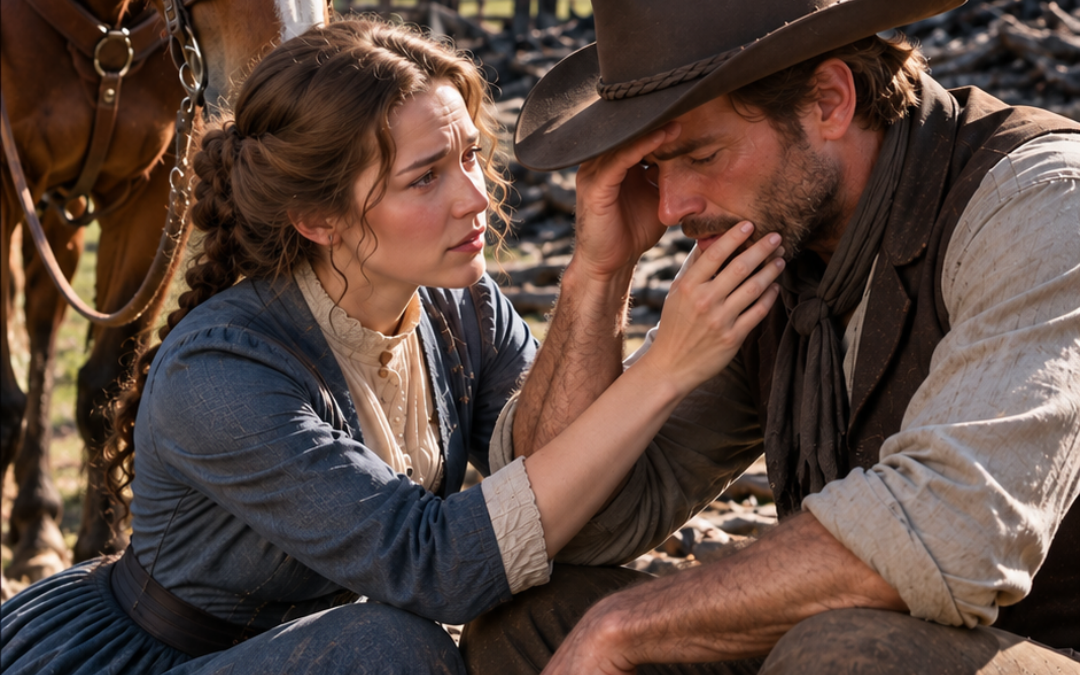
PART 2 — “YOU WERE BUILDING MY FUTURE WITHOUT ASKING ME AGAIN.” — EVA SAID, AND THE COWBOY FINALLY DESTROYED THE PLAN HIMSELF
Eva had come to Montana because Gideon Frost’s letters made him seem different from every man who had ever tried to choose her future for her.
Now she feared she had been wrong. As the thirtieth day approached, Gideon had watched her become part of Silver Creek.
Lydia wanted her to remain at the shop. Women were requesting her work by name.
Eva had adapted her Eastern designs to Montana weather, learned from her mistakes, and discovered that she could build a livelihood there entirely independent of Coyote Ridge.
Gideon should have been happy. Instead, fear took control. He became convinced that if Eva saw the ranch as nothing but ash, mud, temporary shelters, and an empty foundation, she would eventually return to Philadelphia.
So he did what he had always done when frightened: he tried to solve the problem before admitting that he was afraid.
He went to Malcolm. He discussed rebuilding the house. Not someday. Now. He wanted plans drawn, costs calculated, and work accelerated.
Most dangerously of all, he began imagining Eva’s workroom again—the windows, the table, the space she would need—as though enough careful construction could make her answer inevitable.
When Eva learned about it, she went cold. It wasn’t the house that frightened her.
It was the pattern. Months earlier, Gideon had designed a room for a woman he knew only through letters.
Now, after nearly thirty days of hearing Eva insist that her life must remain her own, he was doing it again.
“You were building my future without asking me.” Gideon tried to explain. He wanted her comfortable.
He wanted her to have a place to work. He wanted to give back everything the fire had taken before she arrived.
Eva stopped him. That was exactly the problem. He was still treating love as something he could secure by constructing the right circumstances around her.
A house. A workroom. Financial safety. A future so perfectly arranged that saying yes would become the obvious answer.
But Eva had not crossed 1,100 miles for an obvious answer. She had crossed it for a free one.
For the first time, Gideon saw what he had done. And instead of defending himself, he did something that surprised everyone.
He canceled the plan. No secret construction. No rushing the house. No trying to turn lumber and windows into an argument for marriage.
If Eva chose him, she would choose him while the foundation was still empty. That night, Gideon came to Tabitha’s boardinghouse without his usual emotional armor.
“I was trying to make staying easier than leaving,” he admitted. Eva watched him carefully.
“And?” “And I think I was doing it because I was afraid that if both choices were equally possible, you might choose the one without me.”
There it was. Not ranch logic. Not financial logic. Fear. Eva had waited thirteen months and twenty-nine days to hear him speak without hiding vulnerability inside responsibility.
“And if I do?” She asked. His face tightened. “Then I will miss you.” Nothing more.
No accusation. No bargain. No promise that he would become miserable so she would feel guilty.
Just the truth. Eva suddenly understood why those words mattered more than the house Gideon had tried to build.
For nearly thirty days, she had been waiting for him to stop trying to make himself indispensable.
Now he finally had. The next morning was day thirty. Eva packed. Not because she had decided to leave, but because the agreement demanded honesty, and honesty meant keeping both possibilities real until she chose.
Her trunks stood near the boardinghouse door. The return ticket remained inside her traveling case.
Then Gideon arrived. He did not ask her to unpack. Instead, he asked her to ride with him to Coyote Ridge one more time.
They reached the ranch under a hard Montana sky. The feed shelter stood finished. The horses were home.
The barn was being restored. Cattle moved through the pale grass as if fire, courtship, fear, and human indecision were completely irrelevant to them.
The house foundation remained empty. Exactly as it should. Eva climbed down and walked toward it.
She carried Gideon’s fifty-three letters beneath one arm. In her coat pocket was the brass latch she had pulled from the ashes on her first day.
Gideon stopped beside the foundation. “I need to tell you something.” Eva waited. “I love the woman in the letters.”
Her heart tightened. “That’s where this started,” he continued. “I read what you wrote and thought, ‘This is someone I could spend my life learning.’”
Then came the confession he had been resisting from the moment her carriage appeared. He had been terrified that the letters were larger than the man who wrote them.
Before the fire, Gideon had possessed evidence that he was ready for Eva: land, livestock, a house, a bedroom, a sewing table positioned where the light would fall correctly.
Then one lightning strike erased nearly all of it. Standing in the ashes, he had believed the fire had exposed him.
Without the house, what did he have to offer? That fear had followed him for thirty days.
Every time Eva became more independent, every time her work succeeded, every time Silver Creek gave her another reason to remain without him, Gideon had felt his control disappearing.
That was why he tried to rebuild too quickly. He was trying to recreate the evidence.
“But I was wrong,” he said. Eva said nothing. “The house wasn’t the proof.” He looked at the empty foundation.
“You were.” For thirty days, Gideon had watched her stay when she was free to leave.
He had watched her work without asking his permission, disagree with him without cruelty, miss Philadelphia without pretending Montana had failed her, and create a place for herself without demanding that he create one for her.
More importantly, she had watched him fail. And he had survived being seen failing. “The thing between us held without the house,” he said.
“It held when I couldn’t arrange the outcome.” Then Gideon reached into his coat. Eva’s breath caught.
He took out a simple gold ring. His mother’s. Eva knew it immediately because he had described it in one of his letters.
But Gideon did not take her hand. He did not slide it onto her finger.
He merely held it between them. “I love you if your work takes you back to Philadelphia,” he said.
“I love you in Silver Creek. I love you here when there’s hay to secure and cattle to count and thirty other things that aren’t romantic but are true.”
Eva’s eyes filled. Gideon continued. “I would rather spend ten years deciding honestly what we build together than finish one beautiful house you never chose.”
Then the cowboy who had spent thirteen months describing a future finally stopped describing it.
“Will you marry me, Eva—and decide the rest with me?” Silence. Wind moved over the empty foundation.
Eva looked at the ring. Then she reached into her own pocket. But instead of giving him her hand, she pulled out the burned brass latch.
“I have terms.” Something almost resembling a smile touched Gideon’s face. “I expected that.” “I continue working.”
“Yes.” “My earnings remain mine.” “Yes.” “I want to live in Silver Creek through the first winter, not in the bunkhouse.”
“Yes.” “If professional work requires me to travel East, we discuss it as work. Not as abandonment.”
“Yes.” “And I am making absolutely no promise that I will ever love Montana winters.”
This time Gideon actually smiled. “I wouldn’t believe you if you did.” Eva looked toward the empty foundation.
“And when we build the house, we design it together.” “Yes.” “Me, you, and Malcolm.”
“Cormack will demand an opinion about the mudroom.” “Then four of us.” She looked down at the ring.
“These aren’t conditions I’m asking your permission to have.” “I know.” “Good.” Then Eva finally held out her hand.
“Yes.” Gideon placed his mother’s ring on her finger. It was slightly too large. It was not perfect.
Neither was the ranch. Neither was Montana. Neither were they. And that, perhaps, was why Eva trusted it.
“May I kiss you?” Gideon asked. Eva looked at the burned latch in one hand, his ring on the other, fifty-three letters tucked beneath her arm, and a return ticket still waiting in the carriage.
“Yes.” They kissed beside the ruins of the house he had once believed he needed in order to deserve her.
When they separated, Eva placed the brass latch in Gideon’s palm. “Keep it until we know what it should open.”
Gideon closed his fingers around it. “We’ll decide together.” They married one week later. There was no grand ceremony.
Tabitha came. Lydia came. Cormack came, along with two ranchers who had fought the fire beside Gideon.
Eva wore a dark-green wool dress of her own design—a Montana version of the Eastern style she had once been too proud to change.
That winter, they rented a modest house in Silver Creek. Eva continued working with Lydia.
Gideon rode to Coyote Ridge most mornings. During storms or difficult ranch work, he slept in the bunkhouse and sent word into town.
Their marriage did not magically become easy. Sometimes Gideon stayed at the ranch when Eva expected him home.
Sometimes Eva worked late when Gideon wanted an evening with her. Once, during winter, an argument about calving season became so ridiculous that neither of them spoke sensibly for forty minutes.
But something had changed. When Gideon was wrong, he learned to say so. When Eva did not understand something, she asked.
And when neither knew the answer, they stopped treating uncertainty like an enemy. Spring came.
Only then did they begin designing the new house. Together. Eva chose her workroom according to the actual morning light instead of Gideon’s theoretical idea of where a dressmaker should work.
Gideon changed the ranch entrance. Malcolm revised his plans. Cormack, exactly as predicted, had unreasonable numbers of opinions about the mudroom.
The house took longer than expected. It cost more than expected. And it became something neither Eva nor Gideon could have designed alone.
One year after the fire, Eva was unpacking the last trunk in her finished workroom when she found something wrapped inside an old petticoat.
The brass latch. She stood holding it for several seconds. That little piece of metal had survived the night that destroyed Gideon’s first vision of their future.
Eva had carried it through thirty days of courtship. Then Gideon had kept it while they built a life that belonged equally to both of them.
Now she looked across the room. In one corner stood a wooden cabinet containing her patterns.
And Gideon’s fifty-three letters. Its door still needed a latch. Eva began laughing. Not the polite laugh she used with customers.
The real one. Gideon appeared in the doorway. “What?” Eva held the brass piece against the cabinet.
Gideon understood immediately. He instinctively reached for a screwdriver. Then stopped. A year earlier, Gideon Frost would simply have installed it.
Now he put the screwdriver back. “Want help?” Eva looked at him. “Hold the cabinet.”
He obeyed. Eva positioned the old latch and drove in the first screw herself. Then the second.
She closed the cabinet. Click. The latch caught perfectly. Behind that little piece of brass sat fifty-three letters that had once described a future.
Outside stood the rebuilt barn. Beyond it, cattle moved slowly across the autumn pasture beneath the enormous Montana sky.
And beside Eva stood the man who had finally learned that loving her did not mean building her world for her.
It meant helping hold it steady while she built too. Eva opened the cabinet once more, touched the letters, then closed it.
Click. The thing that had survived the destruction of one home had finally found the door it was meant to open.
Gideon watched her. Eva turned. “Come here.” He stepped closer. She took his hand. “Now you may kiss your wife.”
And he did. The fire had destroyed the house Gideon promised her. What replaced it was something neither of them could have promised in a letter—because neither of them could have built it alone.
Disclaimer: This story is entirely fictional and was created solely for entertainment purposes. It does not represent any organization or individual, nor does it promote inappropriate behavior.
This content was created with the assistance of AI.








