THREE MOUNTAIN MEN FOUND A CRYING WOMAN UNDER THEIR WAGON — THEN SHE REVEALED WHY SHE HAD NOWHERE ELSE TO PRAY
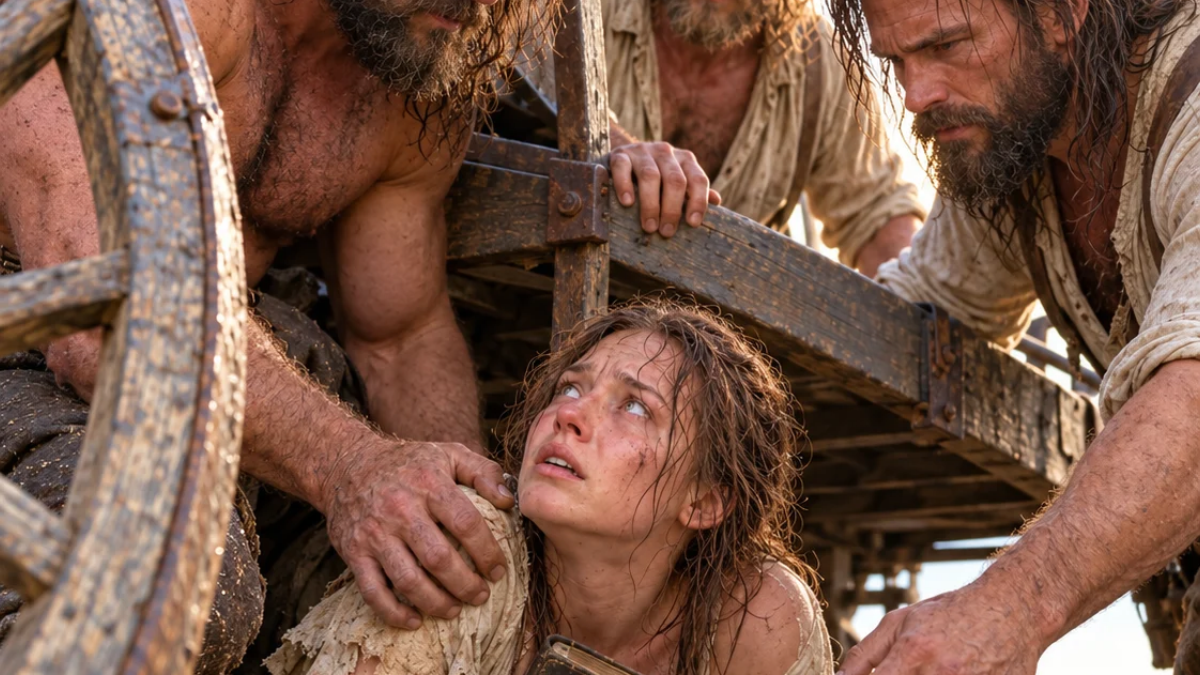
PART 3 — KILBURN WAITED FOR HER WITH THE SHERIFF… BUT THE SECRET INSIDE HER BIBLE DESTROYED EVERYTHING HE BUILT
When the Northrup wagon finally rolled into the valley, Junia knew the confrontation had already begun.
Morai Kilburn stood outside the freight office in a black coat, flanked by the sheriff, a deputy, clerks, and curious townspeople.
Callum was wounded, Declan was exhausted, and Junia was officially accused of theft. Kilburn looked at them as though the ending had already been written.
Then Emory climbed down. He walked past Kilburn without acknowledging him and approached the sheriff.
From his coat he removed the cracked spindle found beneath his own wagon. Then came the spindle recovered from the homesteader’s wagon at Devil’s Backbone.
Both carried the same mark. K inside a diamond. Then Junia reached into the battered leather Bible she had carried from the beginning.
Hidden inside its cover was a folded packet of papers. They were not prayers. They were proof.
Obadiah Stanton’s original bills of sale proved that the forge, dies, tools, and equipment Kilburn’s company had seized had belonged legally to Obadiah long before Kilburn could claim them.
More importantly, Junia possessed the original specification for the fatal coach contract. It clearly required hardened, drop-forged, tempered steel.
No substitutions. Obadiah Stanton had signed it. So had Morai Kilburn. The sheriff stared at the page.
Kilburn immediately called it meaningless, but Emory had one final piece of evidence. Before coming to the depot, he had obtained the actual spindle recovered from the Oak Grove crash—the accident that killed four people and destroyed Obadiah’s reputation.
He placed it beside the other two. Three pieces of iron. Three matching weaknesses. Three identical foundry stamps.
Kilburn could no longer blame one dead wheelwright for one tragic mistake. Callum stepped forward next.
For fifteen years, he had carried the memory of the mission fire like a hot coal inside his chest.
Now, looking directly at Kilburn, he spoke the name of the man whose saddle he had seen that night: Renick.
The same Renick who later became connected to Kilburn. The same Renick who had access to Obadiah’s specifications.
The same crossed-hammer mark that had appeared on the saddle of the rider who came looking for Junia at the Northrup cabin.
Then Callum told the sheriff exactly what he remembered. A burning lamp flying through the mission window.
Children screaming. A horse turning away through the snow. Two crossed hammers branded into the saddle.
And the man behind it. The sheriff turned toward Kilburn. For the first time, the wealthy businessman had nothing to say.
The sheriff ordered every Kilburn wagon in the freight yard inspected. Junia began crawling underneath them one by one.
She inspected the axles until her back hurt, her hands were black with grease, and lanterns had to be lit because daylight disappeared.
Whenever she found the dangerous iron, she marked the wheel with chalk. One cross. Then another.
Ten. Twenty. Thirty. People began gathering around the yard. Forty. Fifty. Two mothers whose sons had died in the Oak Grove crash arrived and stood silently against the fence.
Junia kept inspecting. Finally, she rose from beneath the last wagon. Sixty-one. Sixty-one wagons and coaches carried dangerous brittle iron where hardened steel should have been.
This was no accident. This was a system. The story spread through town before Junia had even washed the grease from her hands.
A newspaper boy arrived with a notebook. Families gathered outside the depot. Men who had once repeated the accusations against Obadiah Stanton now stared at the evidence lying in front of them.
The sheriff formally placed Kilburn under arrest. The accusations came one after another: fraud, forgery, conspiracy, responsibility for the deadly coach failure, deliberate endangerment, and finally the old mission fire and the death of preacher Amherst.
That last accusation broke something inside Kilburn. His coat shifted. Emory saw it immediately. Kilburn was not reaching for a handkerchief.
He was reaching inside his sleeve. “Junia.” Emory spoke her name once. Kilburn pulled a knife.
He lunged straight toward her. Declan moved first. The youngest Northrup—the boy who had spent fifteen years haunted by the night he could not save everyone—stepped directly between Junia and the blade.
The knife buried itself near his shoulder. Junia screamed. Declan staggered but refused to fall.
He seized Kilburn’s coat with his good hand and held on. Then Emory struck Kilburn.
Once. Kilburn collapsed onto the depot boards. Callum drew his revolver. For fifteen years, he had dreamed of the man responsible for the mission fire.
Now that man was lying helpless at his feet. His pistol pointed toward Kilburn’s head, his hand perfectly steady.
Junia grabbed his wrist. “Don’t.” Callum stared at her. Kilburn had killed people. He had destroyed her father.
He had nearly murdered Junia. He had sent armed men after them. Junia knew all of that.
That was exactly why Callum could not pull the trigger. Kilburn had already taken their home, their preacher, Junia’s father, innocent travelers, and fifteen years of peace.
She would not allow him to take Callum’s soul too. Callum’s hand began shaking. Then the gun lowered.
He handed it to the sheriff. For the first time since he was seventeen years old, Callum finally stopped fighting the fire in his memory.
Behind him, Declan collapsed. Junia dropped beside him and pressed both hands against the wound.
Blood soaked through his shirt, but she refused to let panic enter her voice. She ordered him to keep looking at her.
He did. She asked why he had stepped in front of the knife. Declan struggled for breath.
Because he was no longer eleven. Because this time he had been able to choose.
And because Junia had once told him that standing between evil and someone he loved was not merely violence.
Sometimes it was love. Junia’s eyes filled with tears. Then he had better stay alive, she told him, because all of them loved him back.
A doctor arrived and worked beneath the depot lanterns. The blade had missed the artery by barely a quarter of an inch.
Declan would live, and Junia’s immediate pressure on the wound had helped save him. That night she remained beside his bed.
At dawn, Declan opened his eyes. He asked Junia one question. Was he her brother?
Junia finally allowed herself to answer what had already become true. Yes. Declan was her brother.
Callum was her brother. And Emory… She stopped. Declan smiled. He knew. He told her to go tell Emory.
She found him outside with his hat in his hands, watching morning break across the pines.
Emory reminded her of the sentence she had accidentally spoken on Devil’s Backbone—that if he did not want her to leave in spring, perhaps he should not let her.
Now he finally answered. For fifteen years, Emory had believed survival was enough. He had his brothers, his cabin, his work, and a closed heart that could never burn because he never allowed anything inside it.
Then Junia had appeared beneath his wagon. She had not knocked on the locked door of his heart.
She had somehow walked straight past it. She had saved his brothers, filled the fourth chair at their table, brought prayer back into their house, and made him imagine something beyond simply surviving another winter.
So Emory asked her to stay. Not as a fugitive. Not as a guest. Not even as their smith.
As his wife. And if she could not love him that way, then she would still remain family, because after everything they had survived together, he would never call her a stranger again.
Junia stepped into his arms. She told him she had not truly been leaving since the morning he found her beneath his wagon.
The truth about Obadiah Stanton was printed publicly soon afterward. His original specifications were revealed, the forged version was exposed, and his reputation was restored.
Property taken from his estate was returned to Junia, along with what was owed to her.
The dead man could not hear the town clear his name. His daughter could. Eleven days later, Junia Farweather married Emory Northrup.
Callum stood with them, still recovering from the bullet wound. Declan attended with his shoulder bound.
The family rescued at Devil’s Backbone came too. The woman who had once crawled beneath a wagon because she had nowhere else to pray now stood before an entire community that knew her name.
And the fourth chair in the Northrup cabin was never empty again. Years passed. The forge stayed alive.
Children eventually filled the yard. Junia carried her father’s craft forward, teaching that specifications mattered, honest iron mattered, and a person’s name mattered because a reputation could take a lifetime to build and only one powerful liar to destroy.
Kilburn went to prison. Years later, news came that he had died there. Junia did something nobody expected.
She entered the church alone and prayed. Not because she suddenly believed what Kilburn had done was forgivable.
Not because justice no longer mattered. She prayed because years earlier she had stopped Callum from allowing Kilburn to occupy the darkest room inside him, and she finally understood that she needed to make the same choice.
She would not carry Kilburn home. Her home was already full. It held children, brothers, hammer blows from the forge, coffee in the morning, muddy boots by the door, Bible readings beside the fire, laughter around a table, and Emory’s hand finding hers when the day was finished.
There was no room left for Kilburn’s ghost. Decades later, when Junia was an old woman, she sat on the same mountain porch with her Bible resting across her lap.
Emory had already passed away, as had Callum, but Declan remained beside her, older now, his wounded shoulder still stiff whenever the weather turned cold.
Her daughter ran the forge. Her grandchildren played in the yard. The mountain looked almost exactly as it had on that impossible October morning.
Junia turned toward Declan and asked whether he remembered the day she crawled out from beneath their wagon.
He remembered every hour. She admitted something she had never properly said. She had been terrified.
She had possessed almost nothing—a Bible, a wrench, her father’s tools, and a prayer. She had not asked God for happiness, a husband, brothers, children, justice, or even a permanent home.
She had asked for only one thing. Somewhere she could remain honest. And somehow, she said, she had been given somewhere she could remain loved.
Declan took her hand. The old scar near his shoulder pulled slightly as he moved, a final physical reminder of everything they had survived.
Around them stood the answer to a prayer spoken beneath a stranger’s wagon decades earlier: the forge, the house, the family, the children, the mountain, and a table that had once waited fifteen years for its fourth chair to be filled.
Junia closed her eyes and turned her face toward the sunlight. She had once believed she had nowhere else to pray.
She had been wrong. She had been crawling toward home.
Disclaimer: This story is entirely fictional and was created solely for entertainment purposes.
It does not represent any organization or individual, nor does it promote inappropriate behavior. This content was created with the assistance of AI.








