“SLEEP UNDER MY ROOF TONIGHT,” THE MOUNTAIN MAN ORDERED—BUT HER TRUST BROKE THE WALL AROUND HIS HEART
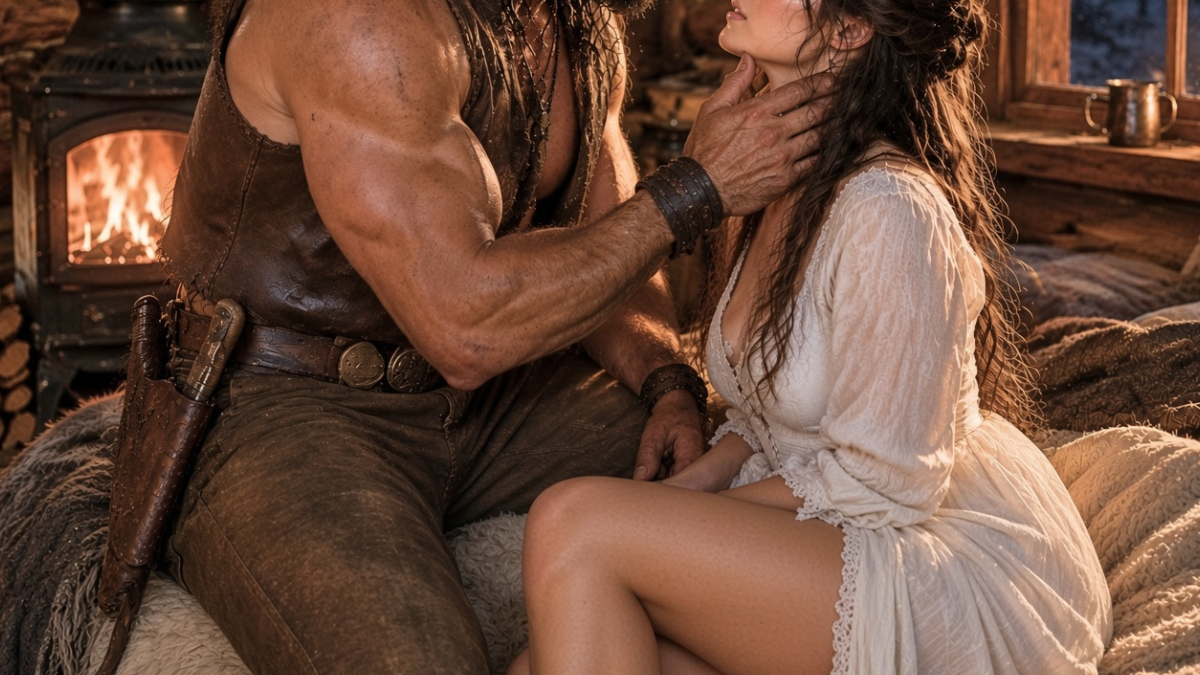
PART 3 — SHE THOUGHT HE HAD RUN FROM HER… BUT WHAT THE LONELY MOUNTAIN MAN SAID NEXT CHANGED BOTH THEIR LIVES
Silas returned at midday. Eleanor heard his horse before she saw him, but she refused to run to the window.
She sat at her table and continued writing as if her hand had not been trembling for the last hour.
Then came the knock. “Come in.” Silas entered covered in ridge dust. “You went to check the cattle,” Eleanor said.
“Yes.” “You checked them yesterday.” “I needed to check them again.” Eleanor put down her pen.
“Silas.” His defenses collapsed. “I don’t know how to do this.” She said nothing. “I know cattle.
Timber. Fences. I know how to ride eighteen miles on a bad ankle and sleep outside in winter if I have to.
But this?” He looked around her cabin. “I haven’t tried to know how to do this in ten years.”
Eleanor finally understood. He had not ridden away because he regretted caring for her. He had ridden away because caring frightened him.
“Tell me what you’re afraid of,” she said. Silas hesitated. Then the truth came. “I’m afraid you’ll stay because you need something.
Water. Help with the land. Another person nearby.” His voice dropped. “And I’m afraid I want you here badly enough that I’d let that be enough.”
That struck Eleanor harder than any declaration could have. Silas understood something her husband never had.
There was a difference between being needed and being chosen. Eleanor stood and crossed the room.
“I have forty acres,” she said. “I have a spring. I have right-of-way income. I have a cabin I built with my own hands.
I can manage accounts, mend fences, preserve food, negotiate against a Helena lawyer, and pull a stubborn mountain man out from under a collapsing timber chute.”
Silas almost smiled. She stepped closer. “I don’t need you, Silas Boone.” His expression fell.
Then she finished. “I want you.” Silas stopped breathing. “That is an entirely different thing.”
She told him she had realized it weeks earlier, waking in his cabin and discovering she had started listening for the sound of him making coffee.
“This ridge sounds different when you’re here,” she said. “Different how?” “Less quiet.” Something finally broke through the walls Silas had spent ten years building.
He lifted one rough hand and carefully tucked a strand of hair behind her ear.
“The spring stays yours.” “I know.” “The cabin stays yours.” “I know.” “The forty acres—”
“Silas.” He stopped. “Stop telling me what you’re not asking for. Tell me what you are asking for.”
Silas Boone—the man who had faced storms, thieves, collapsing timber, and lawsuits—looked almost terrified. “Come to supper tonight.”
Eleanor stared. “That’s it?” “That’s where I want to start.” She smiled. “What are you making?”
“Whatever is left in my pantry.” “Your pantry is only edible because I reorganized it.”
“I know.” “I’ll come at five-thirty and inspect it.” “Supper is at six.” “Then I’ll have thirty minutes.”
She laughed. And Silas looked at her as if that sound alone had made the previous ten years worth surviving.
What followed was not dramatic. That was exactly why it mattered. Eleanor lived in her cabin.
Silas lived in his. They drank coffee together in the mornings because his stove heated faster.
They worked separately through the day and somehow found themselves at the same supper table every evening.
On Tuesdays, Eleanor checked his supplies. On Thursdays, Silas checked her fence. On Saturdays, they rode into Copper Hollow together.
No promises. No declarations. Just repetition. Reliability. Choice. For two people who had both been betrayed, ordinary life became the most intimate thing imaginable.
Then September brought a letter. Eleanor recognized the handwriting instantly. Her husband. Technically, her legal husband.
He had abandoned her years earlier, but the marriage had never formally been dissolved. Now he was in Denver with a lawyer and suddenly wanted Eleanor’s cooperation.
She read the letter once. Then again. Silas entered while she was writing her response.
“My husband,” she said. Silas stopped. “Former husband. Almost.” She explained everything. Then waited for jealousy, anger, accusation—something.
Silas merely asked, “Are you all right?” That question almost hurt more than anger would have.
“Yes.” He read the letter. Then noticed one sentence she had skimmed over. Given the property matter in Montana Territory…
Silas looked up. “He knows.” Eleanor reread it. Her face hardened. The timing was not accidental.
Her husband had ignored a worthless deed, an abandoned cabin, and a woman struggling alone.
But now Eleanor owned valuable land and received quarterly payments from Pike’s cattle operation. “He wants money,” she said.
“As a marital asset,” Silas replied. The old Eleanor might have panicked. This Eleanor reached for her pen.
“I need a lawyer.” “Greer can recommend one.” “Tomorrow?” “Tomorrow.” Silas did not try to rescue her.
He simply sat with her while she prepared to rescue herself. And Eleanor understood why she trusted him.
Not because he solved every problem. Because he never needed her to become helpless before he could feel useful.
That evening, she looked across the table. “I’m not afraid of you.” Silas frowned slightly.
“I know.” “I need you to know that I know.” He waited. “The last time I trusted someone completely, I was wrong.
This time I’m not.” Her voice softened. “I trust you.” Silas went completely still. She immediately returned to her papers.
“You don’t have to say it back. Things that are true should simply be said.”
He stood. Walked toward the door. Stopped. “I trust you too, Nell.” Her pen froze.
Silas glanced back. “In case you wanted that said directly too.” Then he left. Days later, Eleanor’s legal problem was moving toward formal dissolution, and the right-of-way payments remained protected by the structure of her property agreement.
Life on the ridge settled again. Until one Tuesday morning. Silas walked to the fence separating their properties.
That fence had become symbolic without either of them admitting it. Eleanor’s land on one side.
His on the other. Surveyed. Measured. Legally established. Silas removed one rail. He leaned it against the post.
Eleanor came outside and stopped. “What are you doing?” “Fixing a mistake.” “The fence isn’t broken.”
He looked at her. “I wasn’t talking about the fence.” Eleanor’s heartbeat changed. “The spring stays mine.”
“I know.” “The cabin stays mine.” “Yes.” “The forty acres and the right-of-way income stay mine.”
“All of it.” “I’m not trading anything.” “I would never ask you to.” She approached the gap.
“Then what are you asking?” Silas looked down at the trail worn into the earth between their cabins.
Weeks of footsteps had created it. Coffee. Meals. Repairs. Conversations. Silences. A path created not by one dramatic decision, but hundreds of small ones.
“I want you to come to my place because you want to be there,” he said.
“Not because the fence is open. Not because you need anything.” “And if I don’t?”
“I put the rail back.” He paused. “Then I help you repair the south wall before supper.”
No punishment. No resentment. No debt. Only choice. Eleanor crossed the boundary. She walked through the opening and stopped in front of him.
“Don’t put the rail back.” That tiny movement appeared at the corner of Silas’s mouth.
The smile she had first seen hiding there weeks earlier. “But the spring stays mine.”
“I wouldn’t dare argue.” She offered her hand. Silas took it. The rail remained against the fence post.
Days became months. Months became years. The two cabins remained separate, but the path between them grew wider.
Eleanor managed her land and accounts. She negotiated every payment herself and once extracted another seven dollars per quarter from Pike’s operation because she had deliberately left room for adjustment in the contract.
Silas was deeply amused. Pike’s lawyer was not. Silas signed Eleanor’s water-use agreement granting his cattle access to the spring.
He noticed she had included a renegotiation clause after five years. “You left room to renegotiate.”
“I always leave room to renegotiate.” “I know.” Then he signed. Two copies existed. One went into Eleanor’s lockbox.
The other went onto Silas’s shelf beside the old land ledger. The ledger that had begun as proof that people could not be trusted now sat beside an agreement created because two people finally could.
The irony was not lost on either of them. Years earlier, Silas had come to Red Pine Ridge believing peace meant nobody could hurt him.
Eleanor had come believing independence meant nobody could leave her with nothing again. They were both partly right.
They were also missing something. Owning your life did not mean refusing to share it.
Strength did not require permanent solitude. And love did not have to mean surrendering land, money, identity, or choice.
Sometimes it was simply coffee already waiting on the stove. A repaired fence nobody had asked about.
A man walking two miles on an injured ankle beside a limping horse. A woman pulling that same man out from beneath collapsing timber.
A signature placed on an affidavit when telling the truth could cost everything. A walnut comb carved quietly because someone had noticed a crack nobody else noticed.
And a missing rail in a fence. The land remained Eleanor’s. The cattle remained Silas’s.
The spring remained documented exactly where the original survey had placed it. And between the two cabins ran a path no surveyor had ever measured.
Years later, people in Copper Hollow still told stories about the woman who rode into Montana Territory carrying a dead father’s deed and challenged the most stubborn man on Red Pine Ridge before she’d been there an hour.
Some versions said Silas fell in love with her because she refused to fear him.
Others said it happened when she saved his life. A few insisted it was the day he signed away his claim to the spring.
They were all wrong. There was no single moment. That was the secret. Trust accumulated.
One accurate measurement. One shared meal. One truthful document. One kept promise. One ordinary morning at a time.
Eleanor wore the walnut comb until the end of her life. The tiny pine branches carved into its back remained visible, and just as Silas had promised, the grain ran true.
It never cracked. Silas kept Eleanor’s account books beside his land ledger because, according to him, her handwriting was “good to look at.”
Nobody believed that was the entire reason. Nobody challenged him either. And the fence rail?
It remained leaning against the post. Year after year. The gap stayed open. Not because the boundary had disappeared.
Quite the opposite. They knew exactly where the boundary was. They simply chose to cross it.
Eleanor Whitaker and Silas Boone were both strong enough to live alone. They proved that long before they met.
But strength was never the question. The question was whether two people who had learned to survive without trusting anyone could become brave enough to trust again.
On Red Pine Ridge, they found their answer. Not in a courthouse. Not in a deed.
Not even in the spring that had nearly turned them into enemies. They found it in the worn trail between two cabins, where footsteps traveled in both directions.
Every morning. By choice. And perhaps that was the truest thing either of them ever built.
Disclaimer: This story is entirely fictional and was created solely for entertainment purposes. It does not represent any organization or individual, nor does it promote or encourage inappropriate behavior.
This content was created with the assistance of AI.








