HE SWORE HE’D NEVER GET INVOLVED—THEN A WOMAN FLED ACROSS HIS LAND WITH THREE RIDERS HUNTING HER
PART 3 — THE MAN WHO STOOD ALONE FINALLY CHOSE WHAT WAS WORTH STANDING FOR
The document examiner’s conclusion hit the room like a rifle shot. Several records supporting Holloway’s claims showed physical signs of alteration.
Dates had been added. Ink did not belong where Holloway claimed it belonged. Joseph Brooks had been right.
But Holloway was not finished. Emily’s challenge had to survive, the federal court still needed enough evidence to authorize a wider examination, and every minute gave Holloway’s lawyers another chance to bury the case beneath procedure.
Then Thomas Alderman arrived carrying Joseph Brooks’s final legal preparations. Joseph had known he might not live long enough to finish the fight.
So he had prepared for Emily to finish it. What Holloway had dismissed as the obsession of an aging farmer now became a map: file numbers, dates, survey discrepancies, questionable seals, debt patterns, altered claims, and names.
Joseph had not merely accused Holloway; he had built a path investigators could follow independently.
That distinction changed everything. The court did not need to trust Emily blindly. It could test Joseph’s work.
One record led to another. One alteration pointed toward another. One fraudulent claim connected to another family.
And suddenly Richard Holloway’s greatest protection—complexity—became the thing threatening to destroy him. The judge authorized the examination.
Federal authority expanded. The records Holloway had kept scattered behind offices, clerks, lawyers, and procedural barriers were no longer safely beyond reach.
A criminal fraud investigation was formally opened. Emily did not celebrate. She knew better. This was not victory; it was permission to begin the real war.
Holloway had money. He had lawyers. He had connections. He had spent years building a system in which frightened people depended on him for credit, employment, favors, and survival.
But now the federal government had something Holloway could not buy back once exposed. A trail.
When Emily and William stepped from the courthouse, Cheyenne continued as though nothing had happened.
Wagons rolled, horses stamped, people shouted across the street, and a dog slept beneath a hitching post while two of Holloway’s watchers stood half a block away looking suddenly uncertain.
Holloway knew. The hunt had changed direction. For three days, William and Emily had been running evidence toward Cheyenne.
Now investigators would begin following that evidence back toward Holloway. Yet when the danger finally loosened its grip, Emily faced a quieter problem.
Her father’s farm was trapped in legal proceedings. Her money was nearly gone. Her future had become a blank page.
She had nowhere to go. William gave her the simplest answer he could. His ranch had a spare room.
No conditions. No debt. No rescue. Just a place to stay while the case moved forward.
They rode north. The return journey felt nothing like the desperate ride south. They were still cautious, still watched the ridges, still understood Holloway remained dangerous, but for the first time Emily was no longer carrying her father’s entire fight alone.
Ten days after she had first crossed William’s meadow bleeding and hunted, she returned to the Carter Ranch beside him.
The cabin was unchanged. The fence William had been repairing still ran north across the grass.
His cattle still moved through the back pasture. The blue curtain still hung in the kitchen window.
Yet William looked at the place and realized solitude had changed its meaning. For eleven years, silence had meant safety.
Now it merely sounded empty. Emily moved into the spare room. Then she attacked William’s neglected garden with the same merciless efficiency she had used against Holloway’s documents.
Within days, she knew what he had overwatered, what he had planted badly, and what should never have been growing where he had put it.
William discovered there were apparently many ways to be criticized by a woman holding a garden hoe.
Strangely, he did not mind. They worked. They waited. They received messages from Harrian and Alderman as the investigation widened.
Records were seized and compared. Families Joseph had named were interviewed. Survey files were examined.
Former clerks were questioned. People who had remained silent began to understand that they might finally be safe enough to speak.
The wall around Holloway developed cracks. Then one crack became a door. A former employee named Cal Ritter came forward.
For four years, Ritter had worked inside Holloway’s land operation. He knew how the fraudulent documents had been created.
He knew who altered them. He knew how old claims were manipulated. He knew how Holloway selected vulnerable properties.
Worst of all for Holloway, Ritter knew about Joseph Brooks. The case that had begun with one dead farmer’s ledger was no longer merely documentary.
It had a witness from inside. Months passed. William and Emily built a life almost accidentally while waiting for the law to move.
Breakfast became two cups instead of one. Work became divided without discussion. Silence stopped being an absence and became something shared.
Emily visited the families affected by the investigation, helped organize records, and worked with lawyers to reconstruct claims.
William gathered every deed, receipt, tax record, and survey connected to his own land. Holloway had threatened his ranch.
William intended to make him regret choosing a man who kept eleven years of paperwork.
Yet the greatest change happened more quietly. William began to understand that he had not spent eleven years protecting his life.
He had spent eleven years preventing himself from having one. He had believed anything valuable could be taken, so he had carefully avoided collecting things he could not bear to lose.
Then Emily Brooks ran across his meadow. One afternoon, weeks after their return, William found her working in the garden.
He stood there too long. Emily noticed. Of course she noticed. William Carter could face armed riders without blinking, but suddenly telling one woman what he wanted seemed considerably more dangerous.
He finally admitted that the first time he saw her, before he knew about Joseph, Holloway, or the documents, something had already changed.
He had watched her fall. Then rise. Then fall again. Then rise again. That was what had pulled him across the fence.
Not helplessness. Defiance. For eleven years, he had kept everything behind walls. Emily had run straight through them.
“I’d like to court you,” he finally said. Emily stared at him. William prepared himself for every possible answer.
Then she told him she had been waiting approximately six weeks for him to say it.
For once, William Carter had absolutely nothing useful to say. Emily smiled. “Yes.” The following March, Richard Holloway finally went to trial.
Nineteen days. Nineteen brutal days in which lawyers attacked records, witnesses, motives, memories, and every weakness they could find.
William testified for three hours. He did exactly what he had done from the beginning: he told the truth without decoration.
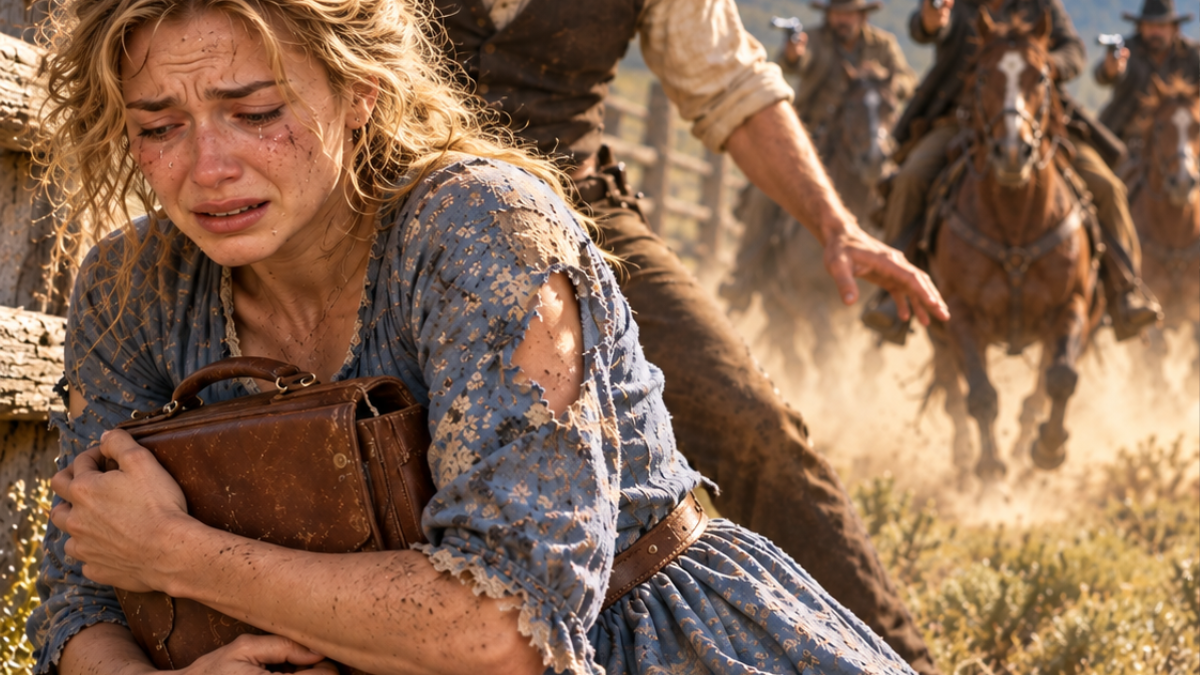
He described the woman crossing his meadow. The riders. The satchel. The documents on his kitchen table.
The journey. The custody of the evidence. His own threatened property. When Holloway’s lawyers suggested his financial interest made him unreliable, William did not deny that his land mattered.
He simply refused to let motive rewrite fact. Then Emily took the stand. For five hours across two days, Holloway’s lawyers tried to break her.
They questioned Joseph’s ledger. They questioned her judgment. They dressed the old competency attack in new language.
They tried to turn a grieving daughter into an unreliable witness pursuing revenge. Emily gave them nothing.
Dates. Names. File numbers. Seals. Survey references. Letters. Discrepancies. Every attack met documentation. Every insinuation met fact.
Every attempt to make her emotional ran into the same woman who had once crossed a Wyoming meadow with three horses behind her and refused to stop running.
Then came the seventeenth day. Cal Ritter entered the witness box. The courtroom went silent.
He described how Holloway’s operation worked. He named the forger. He explained how records were altered.
He described conversations about targeted farms. Then he spoke about Joseph Brooks. Emily sat motionless.
William sat beside her. Neither reached for the other’s hand. This moment belonged to Joseph.
The farmer Holloway had considered powerless had spent his final months creating the chain that now wrapped around the man who had taken his land.
On the nineteenth day, the jury left to deliberate. Four hours later, they returned. Richard Holloway was found guilty on every count.
The man who had once ridden to William’s fence believing money could rearrange the world around him was sentenced to eight years in federal prison.
Restitution was ordered for the families whose property had been fraudulently taken, and the process of restoring legitimate claims began.
It could not restore the lost years. It could not bring Joseph back. It could not erase the families who had been driven from homes they had built with their own hands.
But it could put their names back where Holloway had tried to erase them. One by one, properties returned.
Then, on a Tuesday in April, a telegram arrived at William’s cabin. Emily had just come in from the garden.
She opened it standing beside the kitchen table. William watched her eyes move across the message.
Her hands stopped. Her father’s farm had been restored to her. Twenty-two years of Joseph Brooks’s life.
Returned. The land Holloway had stolen with ink had been reclaimed with ink. For several seconds, Emily could not speak.
Then she looked at William. “It’s done.” William nodded. “It’s done.” She crossed the kitchen and went straight into his arms.
No speeches. No dramatic promises. No tears she needed anyone to wipe away. She simply held him.
William held her back while morning light moved through the old blue curtain, and for the first time he understood something he had spent half his life getting wrong.
A home was not land no one could take. It was the place where someone had reason to return.
By the following summer, the Brooks farm had good tenants who cared for it and paid fair rent.
Emily visited regularly, while the Carter Ranch prospered, the north fence held, and the garden became so productive that William privately suspected the vegetables feared her.
Hadley Creek changed too. Not perfectly. Not overnight. But people began keeping better records. Families learned to question suspicious claims.
Neighbors who once believed another person’s land dispute was none of their concern began showing up for one another.
Joseph Brooks’s fight became larger than Joseph Brooks. Emily was eventually asked to assist territorial officials in reviewing land claims and identifying irregularities before other families could be trapped by the same fraud.
The work would require travel. William told her to take it. She reminded him that he would sometimes be alone again.
He looked at the woman who had crossed his meadow and shattered eleven years of carefully maintained silence.
“The difference now,” he told her, “is that I know you’re coming back.” Emily accepted the position.
One evening, they stood together on the porch while Wyoming turned gold, rose, and purple around them.
Emily remembered something Joseph had written near the end of his ledger. For most of his life, her father had believed land was the most important thing a family could possess.
Near the end, he had changed his mind. Land could be replaced. People who stood for one another could not.
William looked across the two hundred acres he had once built deliberately small because he believed smaller things were easier to protect.
He thought of Kansas. His father. Joseph. The three riders. A torn blue dress. A leather satchel.
A frightened boy on a ridge. A federal courtroom. A garden that now belonged to two people.
Then he understood the strange mathematics of his life. The moment he broke the one rule designed to protect everything he owned was the moment he began gaining everything that mattered.
Eleven years earlier, William Carter had built a fence around his land. Without realizing it, he had built another around himself.
Emily Brooks had not asked him to tear it down. She had simply appeared on the other side of it, bleeding, exhausted, furious, and still refusing to surrender.
William had stepped across. That was all. One decision. Three seconds. A man who had sworn never to become involved walked into someone else’s trouble—and discovered that some trouble was worth sharing.
Emily slipped her hand into his. William closed his fingers around hers. Beyond the porch, the grass moved beneath the evening wind exactly as it had on the afternoon she first came running toward him.
Only now nobody was chasing her. Nobody was taking the land. Nobody was standing alone.
And William Carter finally understood the truth he had spent eleven years trying not to learn:
A man does not become stronger by having nothing to lose. He becomes stronger when he finally finds something worth standing in the open to protect.
Disclaimer: This story is entirely fictional and created for entertainment purposes only. It does not represent any organization or individual, nor does it encourage inappropriate behavior. The content was generated with AI assistance.








