THE MISTRESS TRADED HER OWN DAUGHTER FOR AN ENSLAVED WOMAN’S SON—20 YEARS LATER, A GOLD NECKLACE EXPOSED EVERYTHING
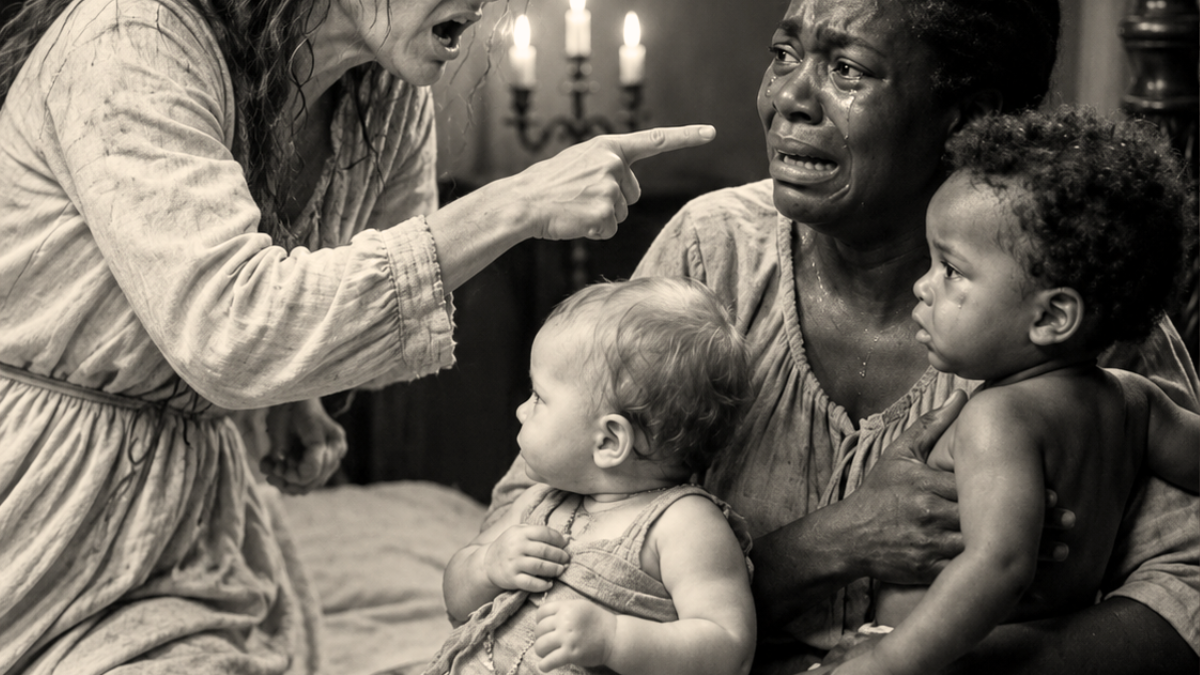
PART 3 — THE NIGHT THE FALSE HEIR LOST EVERYTHING
“Take her away!” Ricardo’s command shook the room. Silvério, the head overseer, appeared at the doorway, but Judge Arnaldo slammed his silver-topped cane against the floor.
“Touch that girl and you will answer to me.” Nobody moved. The judge placed the necklace carefully on the table and looked from Rosa to Leonor, then from Leonor to Ricardo.
The date matched Ricardo’s supposed birth, the family crest was unmistakable, and the name engraved on the gold was not Ricardo.
It was Rosa. Ricardo laughed. It was not amusement. It was panic. “She stole it!”
“From where?” Arnaldo demanded. Ricardo opened his mouth. Nothing came out. The judge turned toward Leonor.
“You told me this necklace disappeared twenty years ago.” Leonor’s lips trembled. Arnaldo remembered that night in 1860, the hurried baptism, the child hidden beneath blankets despite the heat, the Baron’s uneasiness in the years afterward.
Small details that had once meant nothing suddenly began locking together. “Bring me the baptismal register,” Arnaldo ordered.
“And nobody leaves this estate.” Leonor nearly collapsed. There was something worse than the parish register.
The Baron had kept private records in his library. Before his death, he had begun to suspect the truth.
Leonor knew that somewhere among his papers existed a sealed document she had never dared destroy.
Judge Arnaldo ordered one of his men to guard Rosa and announced that he would remain at Santa Cecília until the matter was resolved.
Rosa was taken upstairs, while Ricardo paced below like an animal discovering that the walls of its cage were closing.
Then he went after Benedita. He found her in the kitchen. “What did you tell Rosa?”
Benedita looked at him. For twenty years she had feared this moment. Now there was no fear left.
“I told her the truth.” Ricardo grabbed her. “What truth?” Benedita stared directly into the face of the child she had once held against her breast.
“That you are my son.” Ricardo went still. Benedita’s voice broke, but she continued. “You were born in the enslaved quarters.
Rosa was born upstairs. Leonor forced me to exchange you.” “No.” “You are my blood, Ricardo.”
“NO!” His scream tore through the kitchen. He struck Benedita and sent her crashing against the wall.
Silvério grabbed Ricardo before he could attack again. “Not here,” the overseer warned. “The judge is still in the house.”
Ricardo stood over Benedita, breathing hard. Everything he despised had suddenly become part of himself.
His name. His authority. His inheritance. All of it rested on the crime of the woman he called Mother and the suffering of the woman he had treated as property.
But Ricardo did not surrender. He decided to destroy the evidence instead. That night, Santa Cecília became a trap.
Judge Arnaldo placed Rosa in an upstairs guest room under guard, yet Ricardo knew every corridor, staircase, window, and hidden passage of the house.
Silvério would reach Rosa quietly, make her disappearance resemble an escape, and recover the necklace before dawn.
Except Rosa was awake. She heard metal scraping against the lock. Slowly, she rose from the bed and grabbed a heavy bronze candlestick.
The door opened. Silvério slipped inside holding a knife. Rosa waited until he passed. Then she swung.
The candlestick struck him and sent him collapsing to the floor. Rosa seized his knife and ran into the corridor.
“ROSA!” Ricardo’s voice thundered from the staircase. He was coming. And he had a pistol.
Rosa hid behind a heavy curtain as lamplight crawled along the corridor. Then another figure appeared.
Leonor. She was carrying an old wooden document box. “Stop, Ricardo.” “Move.” “No.” For the first time, Leonor stood against the monster her lie had created.
She opened the box. Inside lay a sealed envelope. Ricardo saw the handwriting and froze.
The inscription was addressed to Judge Arnaldo and instructed him to open it if the succession of Santa Cecília were ever questioned.
The Baron had suspected something. Perhaps he had never possessed enough proof to confront Leonor while he lived, or perhaps scandal and his attachment to the child he believed might not be his had kept him silent.
But he had left behind a final safeguard. Ricardo lunged for the envelope. Leonor pulled away.
They struggled. The paper tore. Several pages scattered across the floor. Rosa burst from behind the curtain and grabbed one.
She read only fragments, but one description was unmistakable: the Baron had recorded that his newborn daughter possessed a dark birthmark on her left shoulder shaped like a coffee leaf.
Rosa stopped breathing. She had carried that mark since birth. She tore the fabric from her shoulder.
There it was. Leonor closed her eyes. Ricardo stared. The necklace could be called stolen.
The register could be called forged. Benedita could be called a liar. But the mark described in the dead Baron’s own handwriting had been carried on Rosa’s body for twenty years.
Rosa raised the letter. “He knew.” Ricardo’s face changed. Something inside him snapped. He raised the pistol.
“If you disappear,” he whispered, “none of this matters.” Leonor screamed. Ricardo pulled the trigger.
The explosion shook the house. Rosa expected pain. Instead, Leonor crashed into her. Blood spread across the older woman’s silk dress.
At the final instant, the mother who had condemned her own daughter to twenty years of servitude had thrown herself between Rosa and the bullet.
“Mother!” The word escaped Rosa before she could stop it. Doors flew open. Judge Arnaldo rushed into the corridor with his guards.
Ricardo still held the smoking pistol. “Arrest him!” Ricardo tried to run. Two guards slammed him to the floor and tore the weapon from his hand.
He screamed that Santa Cecília belonged to him. Nobody listened. Rosa knelt beside Leonor. The woman who had stolen her childhood was dying in her arms.
“Why?” Rosa asked. “Why did you do this to me?” Leonor struggled for breath. “Power.”
Rosa’s eyes filled with tears. Leonor looked toward Ricardo being dragged away. “I was afraid of losing everything,” she whispered.
“So I traded you.” Her fingers tightened weakly around Rosa’s hand. “And I lost everything anyway.”
She begged Rosa’s forgiveness. Then her hand fell still. For several seconds Rosa remained beside her without speaking.
She could neither erase what Leonor had done nor pretend the final sacrifice repaired twenty years of cruelty.
Leonor had saved her life only after destroying the life she should have had. Judge Arnaldo collected the scattered papers.
The necklace, Benedita’s testimony, the Baron’s records, the birthmark, and Leonor’s final confession formed a chain that could no longer be hidden behind the walls of Santa Cecília.
But one final reckoning remained. Benedita. She regained consciousness as Ricardo was being taken through the courtyard in restraints.
When she saw him, she staggered forward. “My son.” Ricardo stopped. He looked at Benedita beneath the moonlight.
For the first time, he truly studied her face. The resemblance he had spent his life refusing to see was suddenly everywhere.
He had her eyes. Her jaw. Even the same crease appeared beside their mouths when anger tightened their faces.
Ricardo lowered his head. There was nothing left to say. Benedita had surrendered her child because she had been powerless to resist Leonor, then watched that child grow into a man who despised the people whose blood he shared.
Now the wealth meant to save him had destroyed him. The next morning, Santa Cecília awakened to a world that no longer made sense.
The workers gathered in the courtyard. Judge Arnaldo stood on the veranda with the documents.
Beside him stood Rosa. Only yesterday she had entered that house carrying coffee because she was commanded to serve.
Now every room, field, warehouse, horse, and coffee tree attached to the estate had become part of the inheritance being recognized as hers.
Arnaldo addressed the crowd. He declared Rosa Maria de Santa Cecília the Baron’s legitimate daughter and heir under the evidence and succession documents before him.
A murmur spread through the courtyard. People stared at Rosa. Rosa stared back. She saw scarred hands.
Bent backs. Terrified children. Women who had learned not to cry when families were separated.
She remembered Ricardo telling her she was merchandise. She remembered the buyer who was supposed to arrive for her.
Then Rosa looked at Benedita. The old woman was crying. Rosa stepped forward. She had spent twenty years being told where to stand, when to speak, when to eat, and whom to obey.
Now hundreds waited for her first command. She gave them something else. Freedom. Rosa announced that she would use her authority over Santa Cecília to end enslavement on the estate and arrange freedom for those held there.
Those who wished to remain would be treated as workers rather than property, and those who wished to leave would no longer be pursued as possessions.
For a heartbeat, nobody reacted. They had heard promises before. Then Benedita walked forward. Rosa descended from the veranda.
The two women embraced. Someone began crying. Then another. The courtyard erupted—not merely in cheers, but in the strange, overwhelming sound of people realizing that tomorrow might finally belong to them.
Rosa did not celebrate her inheritance as a victory of blood. Blood had caused enough suffering.
She treated Santa Cecília as a chance to destroy the system that had nearly destroyed her.
The plantation changed. The great house changed. And Rosa changed with it. She learned to read the books she had once only been permitted to dust.
She studied the accounts Ricardo had neglected, confronted creditors, sold luxuries the estate did not need, and rebuilt what his gambling had nearly ruined.
Benedita remained beside her. Not as a servant. Not as property. As family. Rosa never forgot the contradiction that had defined them: Benedita was the biological mother of the man who had tormented Rosa, yet she was also the woman who had protected Rosa when her own mother refused to do so.
Their bond had been created by cruelty, but it survived because both women chose something stronger than the lie.
Ricardo’s world collapsed just as quickly. Removed from Santa Cecília and forced to face the consequences of the violence surrounding the final confrontation, he no longer possessed the name that had shielded him.
The man who once decided whether other people could be bought and sold discovered how quickly power disappears when everyone stops pretending it belongs to you.
For years, he had believed nobility lived in his surname. Rosa proved otherwise without ever needing to say it.
She kept one object from the old world exactly as it was. The necklace. She did not wear it.
Instead, she placed it behind glass inside the dining room where she had once thrown it before Judge Arnaldo.
Visitors sometimes asked why the richest object in Santa Cecília was displayed instead of worn.
Rosa would look at the engraved name. Because that piece of gold had spent twenty years hidden inside a wall while human beings lived and died beneath a lie.
Gold had not saved her. Benedita’s courage had. The necklace had simply forced powerful people to look at a truth they had spent years refusing to see.
Years passed. Coffee still ripened across the red hills of the Paraíba Valley. The sun still struck the windows of the great house every morning.
But the sound coming from Santa Cecília was different. No overseer waited beside the fields with Ricardo’s authority behind him.
No terrified young woman lay awake wondering whether she would be sold before sunrise. And the room where Rosa had once cleaned floors became the room where she made decisions about the future.
Sometimes, at dusk, she stood before the portrait of the Baron. She could finally see why his face had always seemed familiar.
But she also understood something far more important. She was not worthy of Santa Cecília because she possessed his features.
She was worthy of deciding what to do with it because she remembered exactly what happened when power was allowed to exist without mercy.
One evening Benedita found Rosa standing before the necklace. “Do you ever wish that night twenty years ago had happened differently?”
Benedita asked. Rosa remained silent for a long moment. “Every day.” Then she took Benedita’s hand.
“But if I spend the rest of my life wishing for the childhood they stole from me, they will steal my future too.”
Outside, the final light of sunset stretched across the coffee fields. The necklace caught one ray of gold.
Twenty years earlier, Leonor had exchanged two babies because she believed power could defeat truth.
She had been wrong. The boy she placed in the great house became imprisoned by the lie that crowned him.
The daughter she cast into servitude survived long enough to walk back through the front door carrying the evidence of her own name.
And Benedita—the woman who had once been considered powerless—had preserved the one object capable of bringing the entire deception down.
The walls had protected Leonor’s secret for twenty years. The gold had waited. Rosa had survived.
And when the truth finally entered the great house, it did not knock. It shattered the door.
Disclaimer: This story is entirely fictional and created for entertainment purposes only. It does not represent any organization or individual, nor does it encourage inappropriate behavior. The content was generated with AI assistance.








