“TELL THEM I’M YOUR WIFE!” THE WIDOW BEGGED THE COWBOY HIDING HER—BUT WHEN HE DISCOVERED WHAT HER DEAD HUSBAND HAD LEFT BEHIND, HE RISKED EVERYTHING ❤️
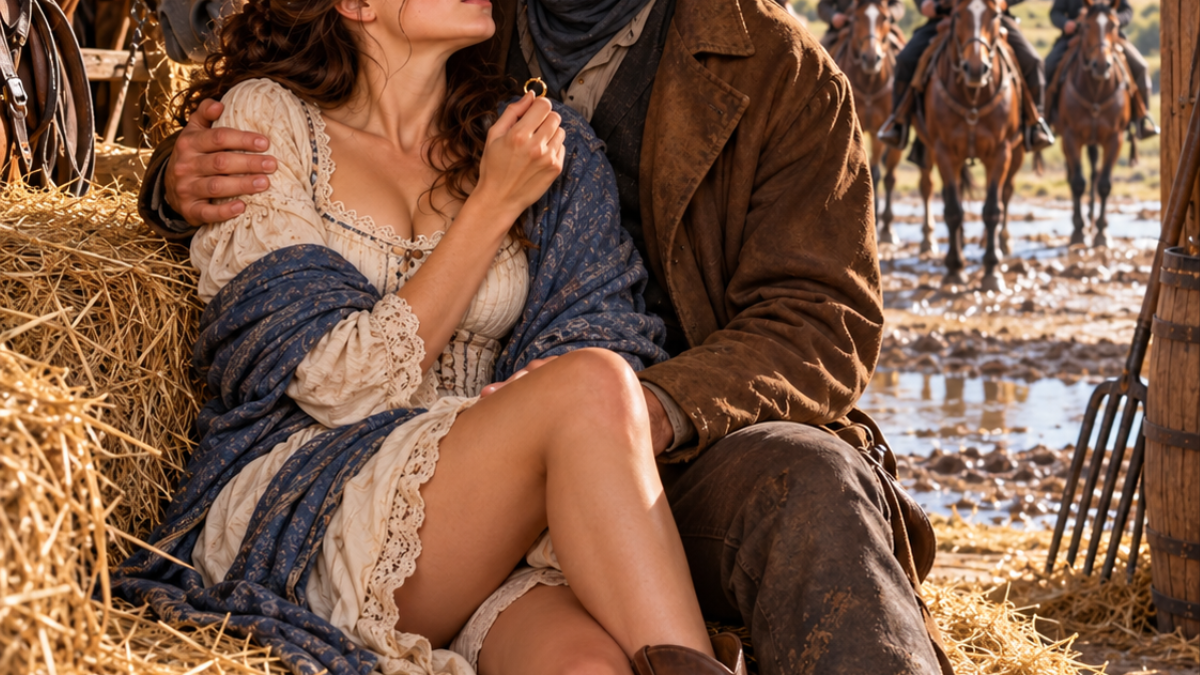
PART 3: THE WIDOW’S LAST GAMBLE—AND THE COWBOY WHO CHOSE HER WHEN HE HAD EVERYTHING TO LOSE
The night the truth almost died Marcus Drew stood in the entrance hall of Fen’s Rooms, holding a folded document bearing the county seal.
Rainwater dripped from his coat onto Harriet’s polished wooden floor. Behind him waited a young rider whose eyes kept moving toward the stairs.
Upstairs, Josephine held Thomas’s ring so tightly that its edges pressed into her palm. “mrs. Fen,” Marcus said pleasantly, “I have reason to believe you’re sheltering a woman who has removed confidential documents from Continental Freight and Land.
I’m authorized to recover those materials and bring her before the appropriate authorities.” Harriet took the paper and examined it beneath the hallway lamp.
“You’re authorized to recover company documents,” she said. “I don’t see anything here granting you the right to arrest one of my guests.”
Marcus’s smile disappeared. “Are you a lawyer now, Harriet?” “No. I can read.” Upstairs, Everett looked at Josephine.
The ledger lay open on the bed, surrounded by the notes Harriet had helped them prepare.
If Marcus searched the room, he would find everything Thomas had spent years collecting. Everett took the ledger, wrapped it in a clean shirt, and handed it to Josephine.
“The back stairs lead into the kitchen,” he whispered. “Harriet showed me when we arrived.
There’s a gate behind the washhouse.” “You’re coming with me.” “I’ll give you enough time to reach the livery.”
Josephine shook her head fiercely. “No. We agreed we were partners. You don’t get to decide that I escape while you stand here waiting to be arrested.”
Everett hesitated. Then, despite the danger, the corner of his mouth lifted. “Fair enough, mrs. Ward.”
He looked toward the door. “Then we leave together.” They slipped into the hallway as Harriet continued arguing with Marcus downstairs.
The younger rider had stepped inside, and Josephine could hear his boots moving across the entrance hall.
She and Everett reached the rear staircase just as a floorboard creaked beneath her foot.
“Who’s there?” Marcus called. Everett caught her hand. They ran. By the time Marcus reached the kitchen, the back door was swinging in the wind.
He rushed into the yard, but the narrow alley behind the boarding house was empty.
Josephine and Everett had already disappeared into the darkness. A young clerk with a terrible secret
They spent the remainder of the night in an unused storeroom behind a cooper’s workshop.
Harriet had given them the address before they escaped, explaining that its owner owed her a favor.
At dawn, she arrived carrying bread, coffee, and a message. Peter Quill had agreed to meet them.
The young county clerk was waiting behind the records office when Josephine and Everett approached.
He looked exhausted, with ink stains on his fingers and the frightened expression of a man who had spent the night reconsidering everything he believed about his employer.
“I shouldn’t be here,” he said. Josephine held out Thomas’s ring. “Neither should I. My husband should be alive, and I should be home running my inn.
Instead, I’m hiding from men who claim he owed money on an agreement he never signed.”
Peter examined the numbers. His expression changed. “Where did you get this reference?” “My husband scratched it into his wedding ring before he died.”
Peter looked toward the records office. “That number belongs to the old correspondence archive. mr. Mace told me those records were irrelevant to current property disputes.”
“Then why,” Everett asked, “would he be so determined to keep people from examining them?”
Peter had no answer. Josephine opened the ledger and showed him the list of fourteen properties.
She explained the forged debts, the authentic signatures copied from old receipts, and the freight corridor that Continental Freight intended to build.
Peter read the entries in silence. Finally, he whispered, “I’ve processed some of these claims.”
Josephine’s heart tightened. “Did you know they were fraudulent?” “No. mr. Mace told me they were routine corrections to old filings.
I believed him.” His voice shook. “I helped take people’s homes.” Josephine closed the ledger.
“Then help us give them back.” Peter looked at her for a long moment. Then he took a key from his pocket.
“Come with me.” The secondary archive occupied a narrow room at the rear of the county building.
Dust covered the shelves, and old correspondence boxes stood stacked beneath the windows. Peter found the box corresponding to Thomas’s four-digit reference.
Inside was a certified copy of an old purchase offer concerning the Bluebird Inn. Josephine unfolded it with trembling hands.
The original offer had been made years earlier, before Thomas and Josephine owned the property.
It had been formally rejected by Josephine’s father. The document contained the original date, the original terms, and the proper signatures.
It proved that Continental Freight’s later purchase agreement was fraudulent. But that was not all.
Peter retrieved the original freight receipt from which Thomas’s signature had been copied. When they placed it beside the alleged debt agreement, the handwriting matched exactly.
The signature was authentic. The agreement was not. Josephine stared at the papers. For eight months, she had wondered whether Thomas had died carrying a secret he had been too frightened to share.
Now she understood that he had left her the means to uncover it. “He knew,” she whispered.
“He knew where the proof was.” Everett stood beside her without speaking. Josephine pressed the ring against her lips.
“Thomas, you stubborn, impossible man. You should have told me.” A tear fell onto her sleeve.
Then she carefully folded the documents and placed them inside the ledger. There would be time to grieve later.
First, she had a valley to save. The evidence that could destroy a company Peter helped them examine the remaining county records.
By late afternoon, they had identified twenty-two suspicious property filings, including several belonging to families who had already lost their homes.
Harriet arrived carrying notes from her years at Continental Freight. She recognized archive references, altered dates, and signatures that had appeared on documents they were never intended to authenticate.
One of the records concerned the Whitmore family. Josephine remembered Margaret Durant’s account of the family losing their farm in March.
“They’ve already taken this property,” she said. Harriet nodded. “I processed the altered agreement before I left the company.
I knew something was wrong, but I was afraid of what Sloan would do if I spoke.”
Her hands trembled. “I’ve lived with that decision every day.” Josephine looked at the older woman.
“Then make a different decision now.” Harriet lifted her eyes. “What do you want me to do?”
“Come with us to the territorial examiner. Tell him everything you know.” Harriet looked toward the window.
“Sloan will destroy my reputation.” “He’ll try,” Josephine answered. “But this time, you won’t be standing alone.”
For a moment, Harriet seemed unable to speak. Then she nodded. “I’ll testify.” They were preparing to leave when Peter discovered that Marcus Drew had obtained another document from Aldis Mace.
It described Josephine’s evidence as stolen company property and authorized its recovery. Everett read it carefully.
“This could give Marcus an excuse to stop us before we reach the examiner.” “Then we go tonight,” Josephine said.
The territorial examiner’s office was in Mil Haven, beyond the mountain pass. They would have to travel through the night to arrive before Continental Freight could file its own petition.
Everett studied the route. “There’s a crossing through the northern hills. It’s rough, but we can make it.”
Josephine glanced at him. “And if Marcus is waiting?” Everett folded the map. “Then we’ll have to be more resourceful than Marcus.”
The cowboy’s confession They left Stonehaven after sunset. Harriet remained behind to prepare her testimony, while Peter promised to follow with the additional county records.
The mountain air was bitterly cold. Their wagon wheels struck loose stones, and the horses struggled along the narrow track.
Josephine sat beside Everett with the ledger beneath her coat and Thomas’s ring resting against her heart.
For several miles, neither spoke. Then Josephine asked a question that had been troubling her since their first night together.
“Why did you agree to help me?” Everett kept his eyes on the road. “My ranch is on the list.”
“That explains why you stayed involved after reading the ledger. It doesn’t explain why you put on a dead man’s wedding ring before you knew anything about the fraud.”
He was quiet for a long time. Finally, he said, “I knew what it was like to watch someone you care about lose everything.”
Josephine turned toward him. Everett told her about Clara, a woman he had once intended to marry.
Her family had become trapped in a property dispute, and Everett had tried to protect her by handling everything himself.
He had made decisions without consulting her, believing he was sparing her the worst of the trouble.
But Clara had wanted a partner, not a man who decided what she was allowed to know.
By the time Everett understood that, their relationship had ended. “I thought I was doing the right thing,” he said.
“I was so determined to protect her that I stopped listening to her.” Josephine looked down at Thomas’s ring.
“Thomas did that too.” “I know.” “He loved me. I never doubted that. But he kept the investigation secret because he thought it would frighten me.
Then he died, and I was left facing everything he had been trying to prevent.”
Her voice softened. “I would have been frightened if he’d told me. But I would have helped him.”
Everett reached across the wagon seat and rested his hand beside hers. He didn’t take her hand.
He simply left his own there, allowing her to decide whether to close the distance.
After a moment, Josephine placed her fingers over his. “I don’t need someone to carry me through my life,” she whispered.
“I know.” “But I think I would like someone to walk beside me.” Everett turned toward her.
In the pale moonlight, his expression was more vulnerable than she had ever seen it.
“I’d like that too.” For a few moments, the cold mountain road seemed less lonely.
Then Everett’s horse suddenly stumbled. A sharp metallic sound rang against the stones. Everett pulled the wagon to a stop and climbed down to inspect the animal.
One of Sunday’s shoes had come loose. Josephine looked back along the dark road. They were still miles from Mil Haven.
And somewhere behind them, Marcus Drew was searching for the documents that could destroy his employer.
The last ride through the mountains Everett examined the horse’s hoof by lantern light. “We can’t keep the wagon moving at this pace,” he said.
“Sunday will go lame.” Josephine looked at Pearl, her gray mare, following behind the wagon.
“Then I’ll ride ahead.” “Josephine—” “You can bring the wagon through slowly. I’ll take the evidence to the examiner.”
Everett glanced at the steep mountain trail. “You’ll be riding alone in the dark.” “I rode through a storm to reach your barn.
I can ride the remaining distance to Mil Haven.” He looked at her for a moment.
Then he nodded. “You’re right.” Josephine felt a sudden warmth in her chest. He hadn’t argued, ordered her to stay, or tried to make the decision for her.
He had listened. Together, they transferred the ledger, the certified correspondence, and Peter’s list of suspicious filings into Josephine’s travel bag.
Everett checked Pearl’s saddle and tightened the straps. When Josephine mounted, he stood beside her horse.
“There’s a narrow descent after the northern ridge,” he said. “Keep to the left. The right side looks easier, but the ground is loose.”
“I’ll remember.” “And Josephine?” She looked down. “Don’t wait for me at the examiner’s office.
Present the evidence as soon as you arrive.” She reached for his hand. “Then promise me you’ll get there.”
Everett squeezed her fingers. “I’ll do everything I can.” She rode into the darkness. For the next several hours, Josephine followed the mountain trail beneath a sky crowded with stars.
Her hands ached from holding the reins, and the cold wind cut through her coat.
More than once, she thought she heard riders behind her. Each time, she urged Pearl onward.
At dawn, the rooftops of Mil Haven appeared beyond the hills. Josephine nearly cried with relief.
She rode directly to the office of Amos Herd, a local attorney Everett had recommended.
Amos listened to her account, examined the documents, and immediately began preparing a petition for the territorial examiner.
By evening, the petition had been filed. But Continental Freight was not finished. Its attorney, a precise and experienced man named Whitfield, had already submitted a counterpetition challenging Josephine’s right to bring the case.
He claimed that she had unlawfully taken company documents and that her supposed marriage to Everett Boon was suspicious.
Josephine stared at the papers. The lie that had saved her life in Everett’s barn was now being used to undermine her credibility.
Amos studied the counterpetition. “Tomorrow morning, they’ll try to turn this into a dispute about your identity and how you obtained the evidence.”
“Will that work?” “I can’t promise what the examiner will decide.” Josephine looked at Thomas’s ring.
“Then we’ll make sure he sees the documents before anyone convinces him to look away.”
The morning everything changed At seven o’clock the following morning, Josephine entered the territorial examiner’s office.
Everett was waiting outside. He had arrived during the night after arranging a replacement shoe for Sunday.
When Josephine saw him, she stopped so suddenly that Amos nearly walked into her. Everett looked exhausted.
His coat was dusty, his eyes were red from lack of sleep, and there was a small cut across one knuckle.
But he was smiling. “You made it,” Josephine whispered. “So did you.” For one brief moment, she wanted to throw her arms around him.
Instead, she took his hand. Together, they walked inside. The territorial examiner, Thaddeus Wyn, was an older man with reading glasses hanging from a chain around his neck.
He listened patiently as Whitfield began arguing that Josephine had no legal standing to present the documents.
Then he raised one hand. “I’ll examine the evidence before hearing further procedural arguments.” Josephine opened her travel bag.
She placed Thomas’s ledger on the desk, followed by the fraudulent purchase agreement, the original freight receipt, and the certified county correspondence.
Finally, she placed Thomas’s wedding ring beside them. “My late husband scratched this archive number inside his ring,” she explained.
“It led us to the original document proving that Continental Freight’s claim against my inn was fabricated.”
Thaddeus examined the ring. Then he compared the documents. He looked at the dates, the signatures, and the county certification.
The room grew silent. Whitfield shifted in his chair. Thaddeus looked up. “mr. Whitfield, I’d like to hear about the other properties on this list.”
The attorney objected. The examiner allowed Josephine to continue. Over the next two hours, the office began to fill.
Amos had sent riders to several families whose properties appeared in Thomas’s ledger. Three families arrived carrying debt notices.
A fourth came in still wearing his work clothes. Each had a similar story. An unexpected debt.
A signature they could not explain. A demand to surrender land they had owned for years.
Then Harriet Fen arrived. She sat before the examiner, folded her trembling hands, and described the company’s fraudulent document system in careful detail.
She explained how authentic signatures had been copied from old receipts and attached to altered agreements.
She identified the archive references and the filing procedures used to conceal the fraud. She also named Aldis Mace, the senior county clerk who had processed the disputed records.
Whitfield attempted to challenge her credibility by referring to an old accounting dispute from her previous employment.
Harriet did not raise her voice. “My testimony is supported by the county’s own certified records,” she said.
“The original documents are here. The numbers match.” The examiner compared the papers again. Then the office door opened.
Peter Quill entered, carrying another bundle of records. He had ridden through the night. The young clerk explained that he had discovered additional suspicious property filings in a neighboring county, some submitted under another company name.
He also admitted that he had witnessed Marcus Drew obtain a county document that misrepresented the nature of the company’s evidence-recovery operation.
“I believed I was assisting a legitimate records inquiry,” Peter said. “I understand now that I was mistaken.”
He looked at Josephine. “I’m prepared to provide a full written account.” Thaddeus accepted the additional evidence.
Whitfield stood. “My client requests a continuance.” The examiner studied the documents before him. Then he spoke.
“I’m ordering an immediate suspension of the disputed debt claims and property recovery actions pending a full territorial review.”
Josephine stopped breathing. The examiner continued. “The evidence presented establishes sufficient grounds for an investigation into the company’s land transactions.
The affected property owners are to receive written notice of the suspension.” Whitfield gathered his papers.
For the first time since Josephine had encountered Continental Freight, its representatives had no immediate demand for her to obey.
The examiner turned toward her. “mrs. Ward, your petition has been received. The broader investigation will take time, but these claims cannot proceed while the review is underway.”
Josephine stared at him. “My inn?” “The disputed claim against your inn is suspended.” “Everett’s spring pasture?”
“That claim is included.” “And the families who’ve already lost their homes?” Thaddeus’s expression softened.
“If the review confirms the fraudulent transfers, those families will have grounds to seek restitution.”
Josephine looked at Everett. She had spent eight months living beneath the threat of losing everything Thomas had left behind.
Now, for the first time, she could imagine going home without looking over her shoulder.
The widow who refused to forget the others Outside the examiner’s office, the September morning was bright and warm.
People passed along the street, carrying groceries, opening shops, and discussing ordinary matters. They had no idea that a decision made upstairs had just changed the future of dozens of families.
Josephine stood on the steps, unable to move. Everett waited beside her. “Twenty-two properties,” she whispered.
“And the additional ones Peter found.” She looked at the papers in her hands. “We need to tell them.”
Everett nodded. “Amos has riders available. Margaret Durant can help us reach the families along the valley road.”
Josephine turned toward him. “You’re not going back to your ranch?” “I am. But first, there are people who need to know they aren’t losing their homes today.”
They spent the remainder of the day delivering written notices. At the first farm, a woman named Ella Hadley read the examiner’s order twice before covering her face with her hands.
“My husband died last winter,” she whispered. “I’ve been trying to keep this place for our children.
They told me I had until Friday.” Josephine sat beside her at the kitchen table.
“The claim has been suspended. Keep this notice, and if anyone from the company comes here, tell them to contact the examiner’s office.”
Ella began to cry. Josephine held her hand. At another property, an elderly rancher stared at the notice for so long that Josephine wondered whether he had understood it.
Finally, he looked toward the pasture beyond his window. “My father built that fence,” he said.
“I thought I was going to have to watch strangers tear it down.” Josephine could not find an answer.
She simply stood beside him until he was ready to speak again. By sunset, they had reached twelve families.
Margaret Durant agreed to contact the remaining property owners, while Amos continued coordinating the legal notices.
The investigation was far from over. But the valley was no longer facing Continental Freight alone.
The truth about Thomas That evening, Josephine and Everett met at a quiet road junction outside Mil Haven.
Pearl stood beside Ranger, the two horses resting after their long journey. Josephine took Thomas’s ring from her pocket.
For eight months, she had carried it everywhere. It had been a reminder of the man she loved, the life they had built, and the future that had disappeared when he died.
Now it held something else. A secret. A warning. And the evidence that had helped save their home.
“Thomas would have hated that he wasn’t here to see this,” she said. Everett looked toward the distant hills.
“Yes.” “He would have hated that I had to finish it without him.” Everett turned toward her.
“You didn’t do it without him. He left you the first pieces.” Josephine smiled sadly.
“He also left me an impossible puzzle.” “That sounds like something you would have complained about even if he were standing here.”
She laughed. Then, unexpectedly, she began to cry. Not the quiet tears she had allowed herself during the lonely months after Thomas’s funeral, but the kind that came when a person had spent too long being strong and suddenly no longer needed to hold everything together.
Everett stepped closer. “May I?” Josephine nodded. He wrapped his arms around her, and she rested her forehead against his shoulder.
For a long time, neither spoke. When she finally pulled away, she looked at the gold ring in her palm.
“I loved him,” she whispered. “I know.” “I still do.” Everett nodded. “I know that too.”
Josephine studied his face. “You don’t think that’s strange?” “No.” “Why?” “Because loving someone doesn’t stop being part of your life just because they aren’t here anymore.”
She looked down. “And what if there’s room in that life for someone else?” Everett’s voice softened.
“Then I suppose that person should be grateful for the room.” Josephine smiled through her tears.
For the first time, she understood that choosing a new future did not require her to erase the past.
The woman who came back to the barn The territorial ruling arrived in November. After reviewing the company’s records, the examiner’s office voided the fraudulent claims and ordered restitution for properties transferred under the scheme.
Continental Freight lost its planned corridor, and Garrick Sloan’s land operation faced further investigation. Aldis Mace resigned from his county position.
The Whitmore family filed to recover their farm the following spring. Harriet Fen began helping affected property owners understand their records, while Peter Quill provided his written account of the filing irregularities.
Josephine returned to the Bluebird Inn. She reopened the rooms, balanced the accounts, and repaired the fence that had been damaged during her absence.
Guests returned, the kitchen filled with the smell of fresh bread, and the familiar rhythm of the inn gradually settled around her.
Everett returned to his ranch. But he began visiting the Bluebird more often. Sometimes he came for supper.
Sometimes he brought supplies. And sometimes he arrived with no reason beyond wanting to see her.
Josephine noticed that he still took his coffee black and always left the last quarter inch in the cup.
Everett noticed that she still added exactly one spoonful of sugar to hers. They never spoke of marriage.
Not because they were afraid. But because neither wanted the decision to be made by danger, desperation, or the memory of a borrowed name.
Then, on a quiet Tuesday afternoon, Josephine saddled Pearl and rode to Everett’s ranch. There were no company riders behind her.
No ledger in her bag. No forged debt threatening her home. She found Everett in the same barn where they had first met, repairing a leather harness beneath the pale winter light.
He looked up when she entered. “mrs. Ward.” “mr. Boon.” He set down his tools.
“Is something wrong?” “No.” She walked toward him and held out Thomas’s gold wedding ring.
Everett’s expression changed. “Nobody needs mrs. Boon anymore,” Josephine said. He looked at the ring.
Then he looked at her. “Is that what you came to tell me?” “Partly.” Everett gently closed her fingers around the gold band.
“Then I have something to show you.” He walked to his workbench and opened a small wooden drawer.
Inside lay a brass button and a plain silver ring. Josephine stared at the button.
“That’s mine.” “It came off your dress the night you arrived. I found it in the barn after you left.”
“You kept it?” Everett looked almost embarrassed. “I liked remembering that night.” “The night I frightened your horses, hid behind your feed sacks, and asked you to pretend you were married to a complete stranger?”
“Yes.” Josephine laughed softly. “That’s a peculiar memory to treasure.” Everett picked up the silver band.
“It’s the night I met a woman who was frightened and exhausted and still refused to surrender what belonged to her.”
He paused. “And it’s the night I began to understand that helping someone doesn’t mean deciding her future for her.”
Josephine’s eyes filled. Everett held out the ring, but he did not place it on her finger.
“Today, you don’t need my name to protect you. You don’t need my ranch, my horses, or my help to save your home.”
He took a slow breath. “So I’m asking you something I couldn’t have asked that first night.”
Josephine looked at him. “Would you like to become my wife?” For a moment, the barn was perfectly still.
Outside, Pearl stamped her hoof, and the winter wind moved through the cottonwoods. Josephine looked at Thomas’s gold ring resting in one hand and Everett’s silver band waiting in the other.
She thought about the years she had shared with Thomas. She thought about the night she had entered this barn believing that her life might be over.
And she thought about the man standing before her, who had never asked her to become smaller so that he could feel stronger.
“Yes,” she whispered. Everett smiled. “But I have one condition,” she added. “Only one?” “For now.”
He laughed. Josephine stepped closer. “If danger belongs to both of us, then the truth belongs to both of us.
No secrets meant to protect me. No decisions about my life made without me.” Everett nodded.
“Agreed.” “And if I decide your tack room needs rearranging—” “I suspected that was coming.”
She laughed again. Then Everett gently slipped the silver band onto her finger. This time, the ring fit perfectly.
The name she finally chose ❤️ Josephine did not put Thomas’s ring away that day.
She carried it home to the Bluebird Inn and placed it in a small wooden box beside his ledger.
She kept the box in a place where she could open it whenever she wished, remembering the man who had loved her and the extraordinary secret he had left behind.
Months later, she and Everett were married in a small ceremony attended by Margaret Durant, Harriet Fen, Peter Quill, Amos Herd, and several families whose homes had been saved.
There was no grand celebration. Only a simple gathering, a warm meal, and the sound of laughter drifting through the open windows of the Bluebird Inn.
When someone asked how the bride and groom had first met, Josephine glanced at Everett.
“At a cattle auction,” she said. “At a church social,” he replied. The room erupted in laughter.
Josephine shook her head. “Apparently, my husband still can’t remember.” Everett leaned toward her. “I remember the important part.”
“And what was that?” He took her hand. “You asked me to tell a lie so you could survive.”
His eyes softened. “And somewhere along the way, I realized I wanted to spend the rest of my life making it true.”
Josephine kissed him. And for the first time in a very long while, she felt no need to look back at the road she had traveled or worry about the one ahead.
The Bluebird Inn remained hers, and Everett’s ranch remained his. Together, they built a life that allowed each of them to keep the work, independence, and memories that mattered.
Thomas’s ring remained safely in its wooden box. Everett’s silver band stayed on Josephine’s finger.
One ring represented a love that had helped shape her past. The other represented a future she had chosen freely.
And whenever Josephine thought about the stormy night when she had begged a stranger to call her his wife, she remembered the most important thing Everett had given her.
It wasn’t his name. It wasn’t his protection. It was the freedom to stand beside him as an equal—and the knowledge that she would never again have to face the hardest parts of life without someone willing to listen.
THE END.
Fictional story created for entertainment purposes only. It does not represent any real person or organization and does not encourage inappropriate behavior.
This content was created with the assistance of artificial intelligence.








