“The Man You Came to Marry Is Dead. So Marry One of Us.” — The Mountain Man Blocked Her Escape and Placed a Dead Man’s Letter in Her Hands
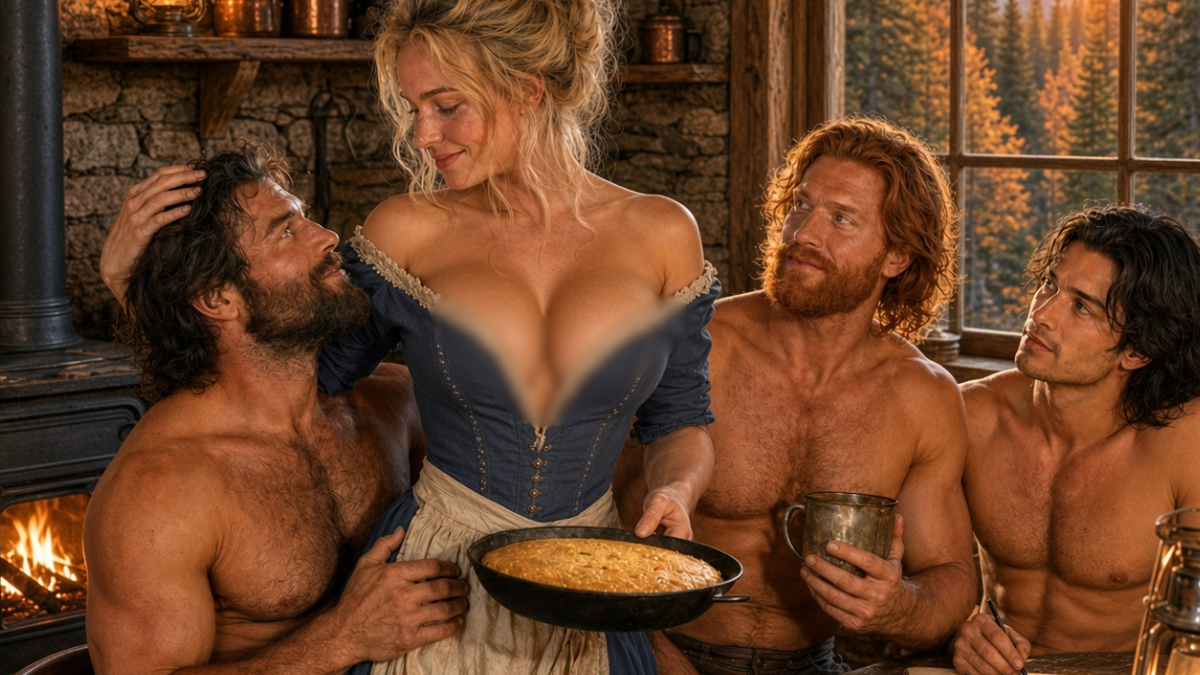
PART 3: THE WOMAN WHO REFUSED TO BECOME THE EIGHTH GRAVE
Marisol stared at the death notice while another bullet struck the cabin wall, sending splinters across the kitchen.
Bram snatched the paper from her hands, read the date, and immediately understood that Beckworth had never intended to negotiate.
The banker had prepared her death before she had even arrived in Texas, and the document he wanted her to sign was merely a convenient way to make the property transfer appear legitimate.
But Marisol had something Beckworth did not know about: the final pages of Wendell’s notebook, hidden beneath the lining of her traveling trunk.
Orin fired through the shattered window, forcing the attackers away from the porch, while Weisson pulled a loose floorboard from beneath the stove.
Underneath was a narrow passage leading toward a storage cellar behind the cabin, an escape route their adoptive father had built years earlier.
Bram ordered Marisol to take the notebook and follow Weisson through the passage while he and Orin held the front entrance.
She refused to leave until Bram seized her shoulders and told her that surviving was the only way Wendell’s death would ever mean anything.
The passage was barely wide enough to crawl through, and the earth trembled as the attackers forced their way into the cabin.
Weisson led Marisol into the cellar, where two saddled horses waited behind a concealed wooden gate.
Before mounting, he handed her a leather satchel containing copies of seven property deeds and explained that the original 1874 survey had recorded boundaries different from those appearing in Beckworth’s later documents.
If the original survey could be authenticated, the banker might lose his claim not only to Wendell’s ranch but to several properties he had acquired from the other dead men.
A tremendous crash came from the cabin, followed by two gunshots and a terrible silence.
Marisol tried to run back, but Weisson caught her arm and pointed toward the ridge, where flames had begun rising through the roof.
Bram and Orin emerged moments later, dragging the wounded postmaster between them while Beckworth’s men fled toward their horses.
The brothers had survived, but the cabin that had sheltered three orphaned boys for most of their lives was burning, and the evidence they had spent years collecting was now all that remained of their home.
They rode through the night and reached Wendell’s ranch before sunrise, where Bram immediately sent Orin to find Iona Threll, the editor of the Mill Haven Sentinel.
Weisson locked the surviving documents inside Marisol’s trunk, while the postmaster, whose shoulder had been grazed by a bullet, finally confessed that Beckworth had threatened to kill his wife and son unless he revealed the woman’s location.
He also admitted that the banker had instructed him to report Wendell’s death as fever before any independent investigation could begin.
Marisol listened without interrupting, then demanded that he repeat every word under oath before the county authorities.
By morning, Iona arrived carrying her notebook, a pencil, and the names of six families who had lost relatives after Beckworth called in their debts.
She had investigated the banker for two years, but every witness had either disappeared, withdrawn a statement, or died before testifying.
When Marisol showed her Wendell’s notebook, the newspaper editor immediately recognized the importance of the survey reference.
She promised to publish the seven deaths, the suspicious property transfers, and the postmaster’s account, but warned that they still needed physical evidence connecting Beckworth to the murders.
That evidence arrived sooner than anyone expected. While repairing the pump behind Wendell’s house, Weisson discovered a strange residue inside the well and collected a sealed sample.
He had studied chemical testing while working at a land office in Austin, and he used a known arsenic-detection method to examine the water.
The result was alarming: the sample indicated the presence of arsenic, a poison consistent with the symptoms Wendell had described during his final weeks.
Marisol suddenly remembered that she had been drinking from the same well since moving into the house, and Bram ordered every bucket emptied before anyone could take another sip.
That night, Marisol and Weisson investigated the stock pond above the ranch and found repeated bootprints leading to a concealed clay jar.
White residue coated the inside, and the surrounding mud showed that someone had visited the pond recently.
They collected the jar without disturbing the remaining footprints, then returned to the house with the first physical evidence of how the poison might have reached Wendell’s water supply.
Bram wanted to ride straight into town and confront Beckworth, but Marisol stopped him with a single question: “Would Wendell have died for this evidence just so they could bury you beside him?”
Bram lowered his rifle, and the four of them spent the following days preparing a case instead of seeking revenge.
Iona published the names of the seven dead men, the dates their debts had been called, and the suspicious transfers that followed.
The newspaper sold out before noon, and by evening, relatives of three victims had arrived at Marisol’s ranch asking to testify.
The sheriff, who had previously refused to investigate the deaths, announced that a formal inquest would be held on October eighteenth.
Beckworth responded by sending riders to destroy the ranch’s northern fence and drive the cattle into the open country.
Bram and Orin raced after the herd, leaving Marisol inside the house with a loaded rifle and instructions to admit no one until Weisson arrived.
Twelve minutes later, footsteps sounded on the porch, followed by a trembling voice asking to be let inside.
It belonged to Dr. Amberly, the physician who had signed all seven death certificates. Marisol kept the rifle trained on the door as the doctor confessed that he had knowingly recorded arsenic poisoning as fever.
Beckworth had threatened to expose a secret from his past, and the frightened physician had allowed seven men to die rather than face the consequences.
Now he had brought a journal containing the symptoms he had observed, the dates of each examination, and his private suspicions about the poison.
Marisol opened the door just far enough to take the journal, then admitted him and ordered him to remain at the kitchen table until Weisson arrived.
When Bram returned, he found the doctor sitting beneath the kitchen lamp, his hands shaking around a cup of coffee.
Marisol placed the journal beside Wendell’s notebook and told Bram that they finally had a witness who could explain how seven healthy landowners had died after drinking from their own wells.
For the first time since meeting her, Bram looked at Marisol without trying to conceal his fear.
He admitted that Beckworth would now do anything to silence her, and she answered that he had already tried everything except allowing her to speak.
The inquest began amid extraordinary tension, with armed deputies stationed outside the courthouse and dozens of townspeople gathering in the street.
Dr. Amberly testified about the seven deaths, Weisson presented the water-test findings, and the postmaster described Beckworth’s threats and his efforts to conceal the truth.
Iona submitted the documented property transfers, while the relatives of the dead men recounted the sudden illnesses that had devastated their families.
When Marisol took the witness stand, she carried Wendell’s notebook in both hands and refused to look away from the banker sitting across the room.
Beckworth’s attorney attacked her credibility, arguing that she had never married Wendell and therefore had no legitimate claim to his property.
He suggested that the Kolfax brothers had manipulated a frightened young woman into accusing a respected businessman because they wanted the ranch for themselves.
Marisol waited until the attorney finished, then explained that she had arrived in Texas expecting a husband and had found a grave, a fraudulent document, and seven families who had been denied the truth.
She placed Wendell’s final letter before the court and declared that the brothers had offered her shelter without demanding her money, her land, or her hand in marriage.
The courtroom fell silent when the attorney asked whether Bram intended to marry her after the proceedings.
Marisol turned toward the three brothers, who sat together in the front row, and answered that no man in that room had the right to decide whom she would marry.
She would not become someone’s wife to obtain protection, inherit property, or repay a debt of gratitude.
If she ever married again, it would be because she had chosen a man freely, and no banker, lawyer, or frightened town would make that decision for her.
Then the courthouse doors opened, and a woman in a black traveling coat stepped inside carrying a leather valise.
She introduced herself as Mercer Beckworth, Gideon’s estranged wife, and announced that she had brought records from his private office in Austin.
Inside her valise were a duplicate financial ledger, letters concerning the purchase of arsenic, and a small tin box containing seven rings.
Marisol opened the box and found a ring engraved with Wendell Doss’s initials, its silver surface marked by a tiny nick that matched the ring visible in his photograph.
Mercer testified that her husband had collected personal belongings from the men whose properties he acquired, keeping them hidden beneath the floorboards of his study.
The letters documented repeated purchases of arsenic from a supplier in Austin, while the duplicate ledger connected payments to the dates of the seven deaths.
She also revealed that Beckworth had been purchasing surrounding properties because the original survey identified valuable water access and grazing rights that his altered documents concealed.
Wendell had discovered the discrepancy and intended to challenge the fraudulent transfers, making him an obstacle the banker had decided to eliminate.
Beckworth rose from his chair and shouted that Mercer was lying, but the sheriff ordered him to sit down as the evidence was formally recorded.
The inquest’s findings led to criminal charges, and the case was transferred to Austin, where investigators examined the financial records, medical journal, survey documents, and physical evidence.
The surviving witnesses were placed under protection while the prosecution prepared for trial. Marisol returned to Wendell’s ranch with the brothers, knowing that the most dangerous man in Mill Haven could no longer reach her without facing the authorities.
But the relief did not last. A violent winter storm swept across Texas before the trial could begin, trapping Marisol and the three brothers inside the ranch house for five days.
Snow buried the roads, the wind tore at the barn roof, and the temperature fell so sharply that the animals had to be moved into shelter before nightfall.
Bram worked until his hands bled, securing the doors and hauling firewood, while Orin and Weisson struggled to keep the livestock alive.
When the storm finally forced everyone indoors, the four of them gathered around the kitchen stove, listening to the wind batter the walls of the house Wendell had died protecting.
Long after Orin and Weisson had fallen asleep, Bram remained awake beside the fire, watching Marisol mend a torn blanket.
He told her that Thurlo Kolfax had found him as a frightened orphan in a burned-out toll station and had given him a name, a home, and two brothers who had become his family.
Thurlo had taught them that kindness was never a debt to be collected and that helping someone did not give a man the right to control her future.
Bram had remembered those lessons every night he slept in the barn rather than under Marisol’s roof.
Marisol set down her sewing when Bram admitted that he had wanted to ask her to stay long before the investigation began.
He had kept silent because he never wanted her to believe that marrying him was the price of his protection.
Now, with the storm raging outside and the trial still ahead, he could no longer bear the possibility of leaving his feelings unspoken.
He asked whether, when everything was over, she might consider building a home with him, not because she owed him anything, but because he wanted to share whatever life they could make together.
Marisol crossed the room and rested her hand against his cheek. She told him that she had spent months wondering whether she would ever feel safe enough to choose a future for herself, and that somewhere between the first night at the mountain cabin and the long evenings on Wendell’s porch, she had begun to imagine Bram in that future.
She wanted the ranch, the open sky, the cattle, the books, and the two brothers who had become her family.
And she wanted Bram beside her, not as her protector or her rescuer, but as the man she loved.
Bram stared at her for a moment before admitting that he had prepared himself for her refusal and had no idea what to say now that she had accepted.
Marisol laughed, and the sound startled them both because she had almost forgotten what it felt like to laugh without fear.
From beneath his blanket, Weisson announced that he had heard every word and would be willing to help Bram write a proper marriage proposal.
Orin, who had apparently been awake as well, muttered that Bram would need all the help he could get, and the four of them laughed while the storm continued to rage outside.
The trial began in Austin in February 1887 and lasted eleven days. Dr. Amberly testified under oath, Mercer identified the financial records and correspondence, and the postmaster described the threats that had forced him to cooperate with Beckworth.
Weisson explained the survey discrepancies and the arsenic testing, while Iona presented the newspaper’s investigation and the documented history of the seven property transfers.
Marisol testified about Wendell’s letters, his notebook, the attempt to force her signature, and the night Beckworth had arrived at the mountain cabin to destroy the evidence.
The jury returned a guilty verdict on seven counts of murder, and Beckworth was sentenced to death.
The court proceedings also cleared the way for challenges to the fraudulent property transfers, allowing Wendell’s estate and the other affected families to pursue restoration of their land.
Dr. Amberly received a reduced sentence in recognition of his cooperation, though his testimony did not erase his responsibility for concealing the murders.
Mercer left Austin with her young son, determined to build a life in which the boy would never have to defend his father’s crimes.
Marisol did not attend Beckworth’s execution. She had no desire to watch the death of the man who had taken Wendell from her, because the life she had fought to protect was waiting hundreds of miles away.
By spring, the Doss ranch had been placed under her clear ownership, the poisoned well had been sealed, and a new well had been dug on the western side of the property.
Orin repaired the fences, Weisson helped correct the land records, and Bram rebuilt the mountain cabin so that Thurlo’s home would remain standing for another generation.
On May eleventh, 1887, Marisol stood in the front room of the ranch house wearing her finest navy-blue dress.
Bram waited beside the reverend in a gray coat, looking more nervous than he had on the night armed men surrounded the cabin.
Orin and Weisson stood as witnesses, while Iona held a small bouquet of wildflowers gathered from the hillside.
There were no wealthy guests, no elaborate decorations, and no promises of a life without hardship, only a room filled with people who had already proved that they would stand together when hardship came.
When the reverend asked whether Marisol freely chose Bram Kolfax as her husband, she answered without hesitation.
Bram took her hand and promised to love her without ever mistaking love for ownership, while Marisol promised to build a home with him that would always have room for the people who had nowhere else to go.
After the ceremony, they stepped onto the porch and looked toward the mountain ridge where three orphaned boys had once been taught to protect strangers in trouble.
Weisson wondered aloud whether Thurlo would have approved of the woman Bram had married, and Orin answered that the old hunter would probably have claimed her as his daughter before the wedding was even over.
That evening, Marisol placed Wendell’s photograph and silver watch on a small shelf beside her father’s Bible.
She kept the ring Mercer had returned in a wooden box, along with Wendell’s letters and the notebook that had helped expose his murderer.
She would never forget the man who had waited for her, or the sacrifice he had made trying to preserve a home for a woman he had never met.
But she no longer believed that honoring his memory required her to spend the rest of her life grieving a future they had never been given.
Years later, when Marisol’s aunt wrote from Charleston asking whether she intended to return, Marisol sent a short reply with a pressed Texas wildflower tucked inside the envelope.
She wrote that she had found a home, a family, and a husband who had never once asked her to surrender herself in exchange for being loved.
She told her aunt that the ranch was thriving, that the mountain cabin had been repaired, and that the three brothers still gathered around her kitchen table whenever the work was finished.
Then she signed the letter with the name she had chosen for herself: Marisol Kolfax.
On the anniversary of Wendell’s death, Marisol walked alone to his grave carrying a small bunch of wildflowers.
She thanked him for the letters that had brought her to Texas, for the home he had tried to give her, and for the final sentence that had led her to the brothers who changed her life.
Then she returned to the ranch, where Bram was waiting on the porch and Orin and Weisson were arguing over who had burned the evening biscuits.
She slipped her hand into her husband’s, stepped through the open door, and finally understood that the journey which had begun with a dead man’s promise had led her to a life she could never have imagined.
The man she had traveled two thousand miles to marry had died before she reached him.
But the home he had promised her was still standing, the men he had trusted had become her family, and the woman who had arrived in Texas with twelve dollars and nowhere to go had become the owner of her own future.
And when Bram asked whether she had ever regretted stepping off that stagecoach in Mill Haven, Marisol looked at the three brothers gathered around her table, the fire burning in the stove, and the wide Texas sky beyond the window.
“Not for a single day,” she answered. Then she closed the door against the evening wind, and the house was warm.
Disclaimer: This story is entirely fictional and created for entertainment purposes only. It does not represent any organization or individual, nor does it encourage inappropriate behavior. The content was generated with AI assistance.








